
Introduction
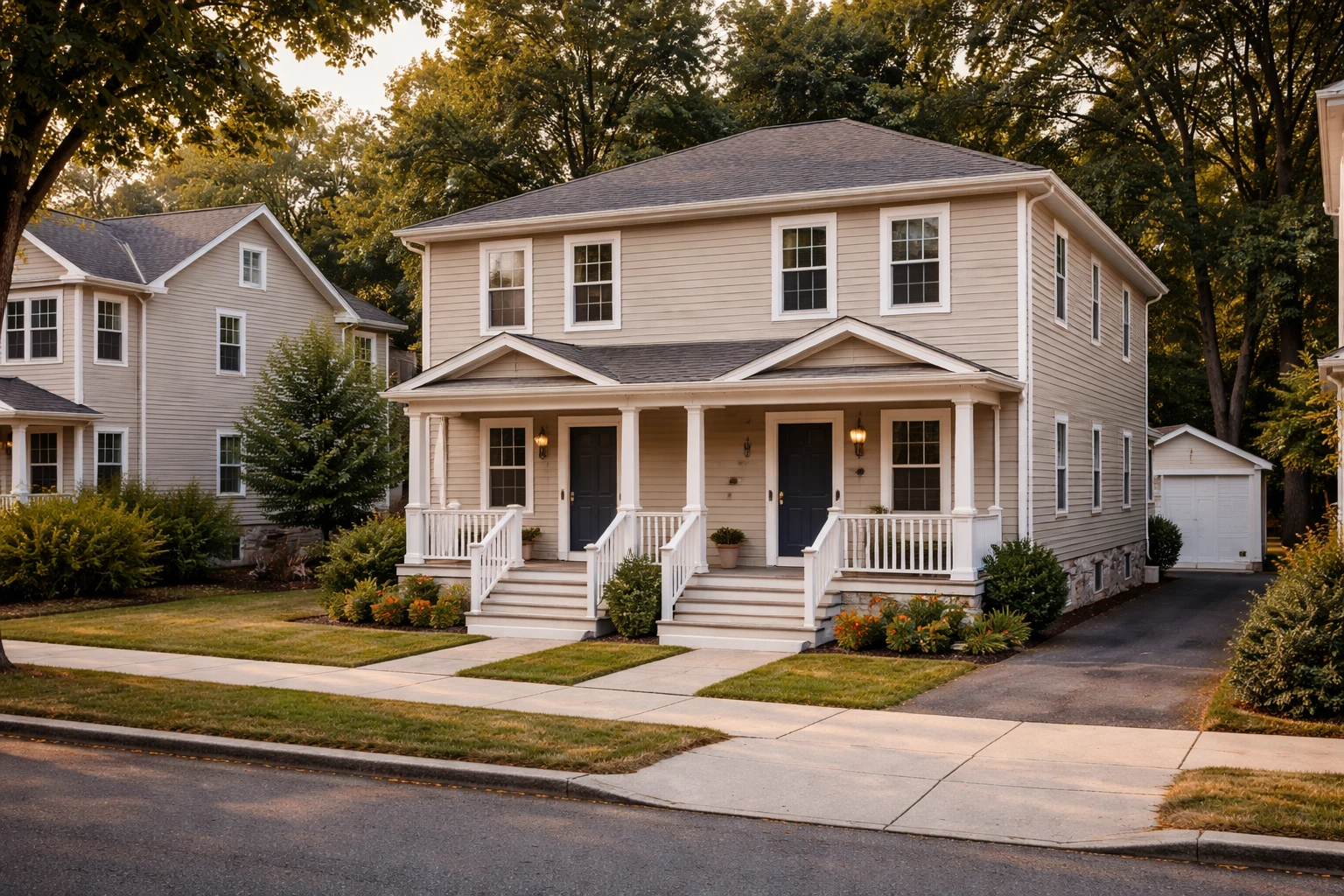
This page covers how to complete a cash out refinance on an investment property in Haverhill using rental income rather than personal tax returns. Haverhill, Massachusetts has spent the past decade quietly transforming from an overlooked Merrimack Valley city into one of northern Essex County’s most active investment property markets. Investors who positioned early — picking up two-families and three-deckers in Bradford, Washington Square, and the downtown Haverhill corridor — are now sitting on equity positions that a cash out refinance can put to work. Through DSCR investor loan programs, qualifying for a cash out refinance on a Haverhill investment property requires no W-2s, no personal tax returns, and no debt-to-income calculation. The property’s rental income is the only metric that matters.
Lendmire is a mortgage broker (NMLS# 2371349) that works with investors across 41 markets. Whether you’re holding a duplex on Main Street, a three-unit on Kenoza Avenue, or a single-family rental in the Bradford neighborhood, Lendmire can structure a cash out refinance that fits your investment timeline and equity position.
DSCR Cash-Out Calculator
Run the cash-out numbers in Massachusetts
Rate source: Freddie Mac 30-yr average via FRED® — Federal Reserve Bank of St. Louis · effective Jul 30, 2026
Prefilled with starting assumptions — enter your property’s value, balance, taxes, and insurance for a more accurate picture.
Program parameters update from Lendmire’s centralized guideline source. Taxes and insurance are editable estimates.
As of Jul 30, 2026 · General Freddie Mac market benchmark, not a Lendmire loan offer. Property value, balance, taxes, and insurance are editable estimates. Maximum loan-to-value varies by lender, program, property type, and seasoning. Not a Loan Estimate, approval, or commitment to lend. Program availability and eligibility are subject to lender guidelines, credit approval, property review, and underwriting.
What Is a DSCR Loan?
A DSCR loan evaluates a borrower’s eligibility based on the investment property’s income rather than the borrower’s personal finances. Get the complete picture of what is a DSCR loan and how DSCR underwriting compares to every other loan structure available to real estate investors.
The DSCR formula is: Monthly Gross Rents ÷ PITIA (Principal, Interest, Taxes, Insurance, and Association dues). A DSCR of 1.0 means the property’s monthly rental income exactly covers its debt obligations. Anything above 1.0 indicates positive cash flow. Haverhill’s multi-family properties — many of which generate $3,500 to $5,500 per month in combined gross rents — routinely qualify at DSCR ratios well above the 1.00 minimum.
A DSCR of 1.25 means the property earns 25% more per month than its debt obligations — a comfortable qualifying position with no personal income documentation required.
Why Haverhill Is a Strong Market for a Cash Out Refinance Investment Property Strategy
Haverhill is the second-largest city in Essex County, Massachusetts, and it sits at a crossroads that makes it one of the most strategically positioned investment markets in the Merrimack Valley. The city straddles the New Hampshire border — just minutes from Plaistow, Salem, and Hampstead — creating a cross-border employment and rental demand dynamic that benefits Haverhill landlords year-round. Renters who work in southern New Hampshire but prefer Massachusetts school systems and amenities frequently target Haverhill as their landing point.
The employer base anchoring Haverhill’s rental demand includes Pentucket Regional School District (a major local employer), Haverhill Bank, a cluster of manufacturing and distribution operations along Route 97 and the Industrial Park Drive corridor, and healthcare employment tied to Haverhill’s proximity to Lawrence General Hospital and Holy Family Hospital in Methuen. The commuter rail line running through Bradford Station to Boston’s North Station adds a further rental premium for properties within walking or driving distance of the station.
Property appreciation in Haverhill has been consistent over the past five years, driven by Boston-area housing cost pressure pushing investors and owner-occupants further north along the Route 495 and I-93 corridors. Two-family and three-family properties in Bradford, Washington Square, and the Hilldale Avenue corridor have appreciated meaningfully since 2019, creating equity positions that a cash out refinance can now unlock. The DSCR structure is ideal for Haverhill investors because the city’s multi-family housing stock generates strong gross rent totals that support qualifying DSCR ratios even after a refinance adjusts PITIA upward.
The city’s downtown revitalization along Washington Street and the Merrimack River waterfront has added a new layer of tenant demand from young professionals and service industry workers who want urban proximity without urban pricing. Haverhill’s rents are meaningfully lower than Lawrence to the south and significantly lower than Lowell and Boston — but the employment access is comparable. That value gap supports low vacancy and steady cash flow, the two fundamentals that DSCR lenders care most about.
Key Benefits of a Cash Out Refinance on a Haverhill Investment Property
- No personal income documentation required: Qualify on the Haverhill property’s gross rental income alone — no W-2s, no tax returns, no pay stubs, no personal DTI review.
- LLC and entity ownership supported: Close the refinance in an LLC or entity structure — subject to lender program eligibility. Haverhill investors who hold rental properties under LLCs can refinance without converting to individual ownership.
- Equity recycling into next acquisitions: Pull equity from a Bradford two-family or a downtown three-decker and redeploy those proceeds as a down payment on the next Merrimack Valley rental.
- Faster seasoning than conventional: DSCR cash out refinancing requires only a 6-month ownership period versus the 12-month conventional standard. Haverhill investors who purchased during the past year can access equity sooner.
- No cap on financed properties: DSCR programs have no limit on financed investment properties (program dependent), unlike conventional loans which cap borrowers at 10.
- Flexible loan structures: 30-year fixed, 40-year fixed, ARM options, and interest-only programs are all available to optimize post-refinance cash flow on Haverhill rental properties.
Thinking about a rental property in Haverhill? Lendmire’s specialists work with investors in 41 markets — no W-2s, no tax returns, just the property’s numbers. Call us at 828-256-2183 or apply online to see what you qualify for.
DSCR Loan Requirements for a Haverhill Cash Out Refinance
The following verified program parameters apply to DSCR cash out refinancing on Haverhill investment properties.
Credit Score Minimums
- 620 FICO minimum — DSCR ≥ 1.00, loans up to $3,000,000 (reduced leverage below 660)
- 660 FICO minimum — most refinance and cash-out transactions
- 700 FICO minimum — first-time investors
- 680 FICO minimum — interest-only loans (1–4 units)
- Sub-1.00 DSCR: 640 FICO minimum; options narrow significantly below 680
LTV / Loan-to-Value Guidelines
- DSCR ≥ 1.00: up to 80% LTV on purchases (620+ FICO, loans up to $3,000,000)
- DSCR < 1.00: up to 75% LTV on purchases (640+ FICO, loans up to $2,000,000)
- Cash-out refinance: up to 75% LTV (620+ FICO, DSCR ≥ 1.00, loans up to $3,000,000)
- 2–4 units and condos: max 75% LTV purchase / 70% LTV refinance
- Rural properties: max 75% LTV purchase / 70% LTV refinance
DSCR Ratio Requirements
- Standard minimum: DSCR ≥ 1.00
- Sub-1.00 DSCR available with restrictions (640+ FICO, reduced LTV)
- Formula: Monthly Gross Rents ÷ PITIA (or ITIA for interest-only loans)
- Short-term rental properties: gross rents reduced 20% before DSCR calculation
Loan Amounts
- 1–4 unit: $100,000 minimum / $3,000,000 maximum
- 2–4 unit mixed-use: $400,000 minimum / $2,000,000 maximum
- Condotel: $150,000 minimum / $1,500,000 maximum
Eligible Property Types
- SFR (attached/detached), PUDs, 2–4 unit residential, condos (warrantable and non-warrantable), condotels, modular/pre-fab
- Mixed-use: commercial space must not exceed 49.99% of building area
- Maximum lot size: 5 acres for 1–4 unit / 2 acres for mixed-use
Loan Terms Available
- 30-year fixed, 40-year fixed
- 5/6 ARM, 7/6 ARM, 10/6 ARM (30-day SOFR index)
- Interest-only available (10-year I/O period)
- 40-year term available combined with interest-only
Reserve Requirements
- At or below $1,500,000: none at 70% LTV or less, 6 months PITIA above 70% LTV on subject property
- Loans above $1,500,000: 9 months PITIA
- Cash-out proceeds may satisfy reserve requirements (1–4 unit only; not mixed-use)
DSCR vs. Conventional Investment Loans: What Haverhill Investors Need to Know
Haverhill investors evaluating their refinance options need to understand the structural differences between DSCR and conventional financing. A full comparison of DSCR vs conventional investment loans shows why DSCR is the preferred path for most Merrimack Valley portfolio investors.
- Income documentation: Conventional requires full income docs, W-2s, tax returns (Schedule E), pay stubs, and DTI underwriting. DSCR requires none of this — DTI does not apply.
- LLC ownership: Conventional loans require the borrower to be an individual — LLC closing is prohibited. DSCR fully supports LLC and entity closing (subject to lender program eligibility).
- Seasoning for cash-out: Conventional requires 12 months from note date to note date before cash-out is allowed. DSCR requires only a 6-month minimum ownership period.
- Financed property limit: Conventional caps borrowers at 10 financed investment properties. DSCR has no equivalent cap (program dependent).
- Cash-out LTV on 1-unit: Both conventional and DSCR cap 1-unit cash-out at 75% LTV — they are equal on this specific point.
- Reserve requirements: Conventional requires 6 months PITIA on every financed investment property. DSCR reserves follow leverage and loan size (none at or below $1,500,000 and 70% LTV; 6 months above 70% LTV; 9 months above $1,500,000).
For Haverhill investors who own multiple multi-family properties under LLCs, or whose income structure doesn’t present cleanly on tax returns, DSCR financing removes the barriers that conventional underwriting creates. DSCR reserves follow leverage and loan size rather than the count of financed properties — none at or below $1,500,000 and 70% LTV, 6 months of PITIA above 70% LTV, 9 months above $1,500,000, and 6 months on a cash-out, which the proceeds may satisfy — a reserve advantage for investors with large portfolios.
Haverhill Investment Submarkets: A Cash Out Refinance Deep Dive
Bradford: The Investor’s Anchor Neighborhood
Bradford is Haverhill’s most consistently investor-active neighborhood — a densely built residential area south of the Merrimack River anchored by Bradford Station on the Haverhill commuter rail line. Properties within a half-mile of the station command rental premiums from Boston commuters, and the neighborhood’s two-family and three-family housing stock generates some of the strongest gross rent figures in the city relative to property values.
A cash out refinance on a Bradford multi-family is often the catalyst for a Haverhill investor’s second acquisition. An investor who purchased a Bradford two-family in 2020 for $380,000 and has since seen the property appreciate to $490,000 is holding roughly $110,000 in equity above the original purchase price. After applying the 70% LTV cash-out ceiling on a 2-unit property, the available proceeds — before closing costs — are meaningful enough to fund a down payment on another Essex County rental.
Washington Square and Downtown Haverhill
The Washington Square corridor and the blocks surrounding downtown Haverhill on Washington Street, Merrimack Street, and Essex Street have benefited enormously from the city’s downtown revitalization push. New restaurants, arts venues, and riverfront development along the Merrimack have attracted younger professional tenants who want urban energy at rents that the Boston metro simply cannot offer. Properties within a few blocks of the Haverhill commuter rail station and the Merrimack riverfront are in particularly strong demand.
Investors in the Washington Square area face higher property prices than in some outer Haverhill neighborhoods, but the rent premiums are real. A well-maintained two-unit on Washington Street or Essex Street can command $1,800 to $2,400 per unit per month from professional tenants, producing gross rents that support qualifying DSCR ratios even after a cash out refinance increases the monthly PITIA obligation.
Hilldale Avenue and the Northern Residential Corridors
The Hilldale Avenue corridor and the residential streets north of downtown Haverhill — running toward the River Road neighborhoods — contain a dense concentration of two-family and three-family properties that have been trading actively among investors since 2018. These areas offer lower entry prices than Bradford and Washington Square, with tenant demand driven by manufacturing and distribution workers employed along the Route 125 and Route 97 corridors.
The higher gross rent-to-price ratios in these corridors make them attractive for DSCR cash out refinancing, especially for investors who purchased at pre-appreciation prices and are now sitting on equity that has grown faster than rents. A three-family in the Hilldale corridor generating $4,500 in monthly gross rents and valued at $470,000 presents a strong DSCR profile — the kind of property that lenders find straightforward to underwrite without any personal income documentation.
Ward Hill and the Route 125 Investment Corridor
Ward Hill is Haverhill’s industrial and commercial anchor in the northwest quadrant of the city, with employment tied to a mix of manufacturing, warehousing, and medical device operations. The residential neighborhoods surrounding Ward Hill — particularly along River Road, Groveland Street, and the streets near the Ward Hill commuter rail stop — attract workforce tenants employed in the area’s industrial base and benefit from the rare dual transit access of both the Ward Hill and Bradford commuter rail stops within the same city.
Single-family and two-family rentals in the Ward Hill area are particularly well-suited to DSCR financing because the tenant profile is stable and long-term. Low-turnover tenants produce consistent gross rents, which is exactly what DSCR underwriters want to see. Cash out refinancing in this submarket allows investors to pull equity and redeploy into higher-appreciation areas of the Merrimack Valley while keeping the Ward Hill property in the portfolio as a reliable cash flow anchor.
Kenoza Lake and the Eastern Haverhill Neighborhoods
The eastern Haverhill neighborhoods around Kenoza Lake, Kenoza Avenue, and the streets extending toward the Groveland border represent a more suburban character within Haverhill’s city limits. Single-family rentals in this area attract family tenants who value the lake access, lower density, and quieter residential environment — often at rents that reflect the neighborhood’s premium positioning within the Haverhill market.
For investors holding single-family rentals in the Kenoza corridor, the 75% LTV cash-out ceiling applies — versus the 70% ceiling on 2-4 unit properties. On a property valued at $460,000 with a $240,000 existing balance, that translates to a maximum loan of $345,000 and potential proceeds of roughly $105,000 before closing costs. That level of equity extraction, combined with the DSCR structure’s zero income documentation requirement, is the core engine behind portfolio scaling in Haverhill.
Bradford Common and the Cross-Border Rental Market
Bradford Common sits at the southern edge of Bradford near the Georgetown town line, and the neighborhoods along Groveland Street and South Broadway extending toward the border attract tenants drawn by Haverhill’s amenities and Massachusetts school access who would otherwise be priced into New Hampshire. This cross-border dynamic creates a consistent rental demand layer that pure in-city analysis sometimes misses.
Investors who hold properties in the Bradford Common and South Broadway corridors benefit from tenant retention that tends to run above the Haverhill average — renters who have made a deliberate choice to be in Massachusetts typically stay longer. That stability translates directly into DSCR performance: consistent gross rents with low vacancy months are exactly the income profile that supports a clean cash out refinance underwrite.
Short-Term Rental and Airbnb Applications in Haverhill
Haverhill is primarily a long-term workforce and commuter rental market rather than a vacation destination. However, some investors near the Merrimack waterfront and the Bradford commuter rail corridor have explored short-stay and corporate housing arrangements. Lendmire offers DSCR loans for Airbnb and short-term rentals with specific underwriting parameters for STR-classified properties.
- For STR-classified properties, gross rents are reduced by 20% before DSCR calculation — a standard program parameter applied universally regardless of actual occupancy performance.
- Haverhill investors pursuing STR strategies should verify local ordinance compliance before classifying any unit as a short-term rental, as Massachusetts municipalities vary in their permitting requirements.
- Corporate extended-stay arrangements tied to Ward Hill industrial employers or Haverhill’s healthcare sector may qualify as long-term rentals if lease terms are structured appropriately — consult your Lendmire loan officer on documentation requirements.
Example DSCR Scenario: Haverhill Duplex Cash Out Refinance
Here is a representative cash out refinance scenario for a Haverhill, Massachusetts investment property:
- Property type: 2-unit residential duplex
- Estimated current value: $490,000
- Existing mortgage balance: $270,000
- Cash-out refinance loan amount: $343,000 (70% LTV — 2-unit cash-out maximum)
- Cash out proceeds: approximately $73,000 after payoff
- Monthly gross rents: $3,600 ($1,800 per unit × 2)
- Estimated PITIA: $2,750
- DSCR calculation: $3,600 / $2,750 = 1.31 DSCR
This property qualifies well above the 1.00 DSCR minimum. No personal income documentation is required — the property’s rental income drives qualification entirely. LLC ownership is welcome — subject to lender program eligibility. The approximately $73,000 in proceeds could fund a down payment on a third Haverhill or Essex County rental property, continuing the portfolio compounding cycle.
This is exactly how many investors scale using DSCR loans in Haverhill.
Ready to run the numbers on your next Haverhill property? Lendmire closes DSCR loans on a timeline that varies by lender and file — no income docs, no W-2s, and LLC ownership is welcome (subject to lender program eligibility). Reach out today at 828-256-2183 and let’s get started.
DSCR Refinance Options for Haverhill Investment Properties
For Haverhill investors, refinancing is the lever that converts paper equity into active capital. Whether you want to extract equity for redeployment, restructure your loan terms, or move from a personal note to an LLC-held mortgage, the DSCR structure makes it possible without income documentation. Explore the full range of cash-out refinance options for investment properties and review the complete menu of investment property refinance options to identify the best approach for your Haverhill holdings.
The DSCR cash out refinance cycle in Haverhill typically works like this: an investor holds a Bradford or Washington Square multi-family for 6 months or more, the property appreciates alongside the broader Essex County market, and the investor executes a cash out refinance to pull 70–75% of the current appraised value — leaving the existing equity in place as a cushion while extracting working capital for the next deal.
The 6-month DSCR seasoning advantage over conventional lending’s 12-month requirement is particularly valuable in an active market like Haverhill. Investors who move quickly — buying, stabilizing, and refinancing within a single calendar year — can recycle equity into a second acquisition before conventional financing would even allow the first refinance.
Rate-and-term refinancing is another powerful option for Haverhill investors. Switching from an ARM to a fixed rate, extending to a 40-year term to reduce monthly PITIA and improve cash flow metrics, or restructuring from a personal note to an LLC-held mortgage can all be accomplished through a DSCR rate-and-term refinance without triggering personal income documentation requirements.
One often-overlooked benefit: on 1-4 unit Haverhill investment properties, cash-out proceeds from a DSCR refinance can be applied to satisfy the reserve requirements for the new loan. This means a single cash out transaction simultaneously produces working capital for the next acquisition and covers the 6-month PITIA reserve requirement on a cash-out (the proceeds may count) — a structural efficiency that conventional programs cannot replicate.
Why Haverhill Investors Choose Lendmire for Cash Out Refinancing
Lendmire works with investors across 41 markets and brings specialized expertise in DSCR and non-QM financing to every transaction. For Haverhill investors, that means a lender who understands Essex County’s multi-family market, the LLC structures common among Massachusetts portfolio investors, and the speed required to compete in the Merrimack Valley’s active deal environment.
- Speed: Lendmire closes DSCR loans on a timeline that varies by lender and file — not weeks or months.
- No income docs: Qualification based entirely on the property’s gross rental income.
- LLC-friendly: LLC and entity ownership supported — subject to lender program eligibility.
Lendmire is a great option for DSCR loans, offering flexible solutions for real estate investors in 41 markets.
Frequently Asked Questions
What is the minimum credit score for a DSCR loan?
The minimum is 620 FICO for DSCR-qualifying loans at 1.00 or above on purchase transactions (640–659 is purchase only). Most cash-out refinance transactions close at 660 FICO or higher; the program floor is 620, with reduced leverage below 660. First-time investors need 700 FICO minimum. Interest-only loans require 680 FICO minimum. Sub-1.00 DSCR loans require 640 FICO, with options narrowing significantly below 680.
Do DSCR loans require tax returns or W-2s?
No. DSCR loans require no personal tax returns, W-2s, pay stubs, employer verification, or personal income documentation of any kind. Qualification is based entirely on the subject property’s monthly gross rental income relative to its PITIA. Personal debt-to-income ratio is not part of DSCR underwriting.
Can I use an LLC to close a DSCR cash out refinance in Haverhill?
Yes. DSCR programs support LLC and entity ownership — subject to lender program eligibility. Haverhill investors who hold rental properties under LLCs for liability protection can complete a DSCR cash out refinance within the LLC structure. Not all programs unconditionally permit LLC closing, so confirming program availability with your Lendmire loan officer is the recommended first step.
Is Haverhill a good market for a cash out refinance on investment property?
Yes. Haverhill’s consistent property appreciation, strong multi-family housing stock, commuter rail access to Boston, and cross-border rental demand from southern New Hampshire workers create a durable investment environment. Investors who purchased between 2018 and 2022 are now holding meaningful equity positions that a DSCR cash out refinance can convert into active portfolio capital.
What is the maximum LTV for a cash out refinance on a Haverhill multi-family?
For 1-unit properties: up to 75% LTV (620+ FICO, DSCR ≥ 1.00, loans up to $3,000,000). For 2–4 unit properties: maximum 70% LTV on cash-out refinance. These are program ceilings — actual LTV is subject to appraisal, DSCR ratio, FICO score, and full program review.
How long must I own a Haverhill property before doing a cash out refinance?
DSCR programs require a minimum 6-month ownership period before a cash-out refinance can be completed — half the 12-month conventional seasoning requirement. Haverhill investors who purchased entirely in cash may also be eligible under a delayed financing exception. Speak with a Lendmire loan officer to confirm eligibility for that path.
About Lendmire
Lendmire is a non-QM mortgage brokerage (NMLS# 2371349) arranging DSCR investor loans in 41 markets, including Washington, D.C. DSCR eligibility is generally reviewed around property-level rental income rather than personal income, subject to lender and program guidelines, making it a fit for self-employed investors and LLC-owned portfolios. Scotsman Guide named Lendmire a Top Mortgage Workplace in both 2025 and 2026.
Get Started
Ready to find the right loan for you?
In about 30 seconds you can review financing options available for your investment property. No commitment required.
Informational only. Not a Loan Estimate, approval, or commitment to lend. Program availability and eligibility are subject to lender guidelines, credit approval, property review, and underwriting.
This article is part of Lendmire’s investment property cash-out refinance program — full qualification details, guidelines, and scenarios live on the program page.
Related reading: DSCR Cash Out Refinance Haverhill Massachusetts · DSCR Cash Out Refinance Methuen Massachusetts · Cash Out Refinance Investment Property Framingham Massachusetts
Guides: Investment Property Cash-Out Refinance in Haverhill, MA · Investment Property Cash-Out Refinance in Massachusetts
Brandon Miller
Founder & CEO, Mortgage Loan Originator, Lendmire LLC
- Mortgage Loan Originator · NMLS# 1129696 · Verify on NMLS Consumer Access
- North Carolina Real Estate Broker · License# 343312 · Verify on NCREC
- North Carolina Insurance Producer · License# 19053198 · Property, Casualty, Life, Health · Verify on NAIC SBS
- Lendmire LLC · Firm NMLS# 2371349 · Verify firm licensure
Disclosure information. Lendmire is a state-licensed mortgage brokerage under NMLS# 2371349. Lendmire is not a depository institution, direct lender, or financial advisor — all loans referenced are placed through wholesale lender partners and are subject to each lender's underwriting standards. This article is provided for general informational purposes and is not a commitment to lend, nor does it constitute financial, legal, or tax advice. Loan programs, terms, rates, and qualification standards change without notice and depend on borrower profile, property type, and the state in which the subject property is located. Equal Housing Opportunity provider. NMLS Consumer Access: nmlsconsumeraccess.org.