
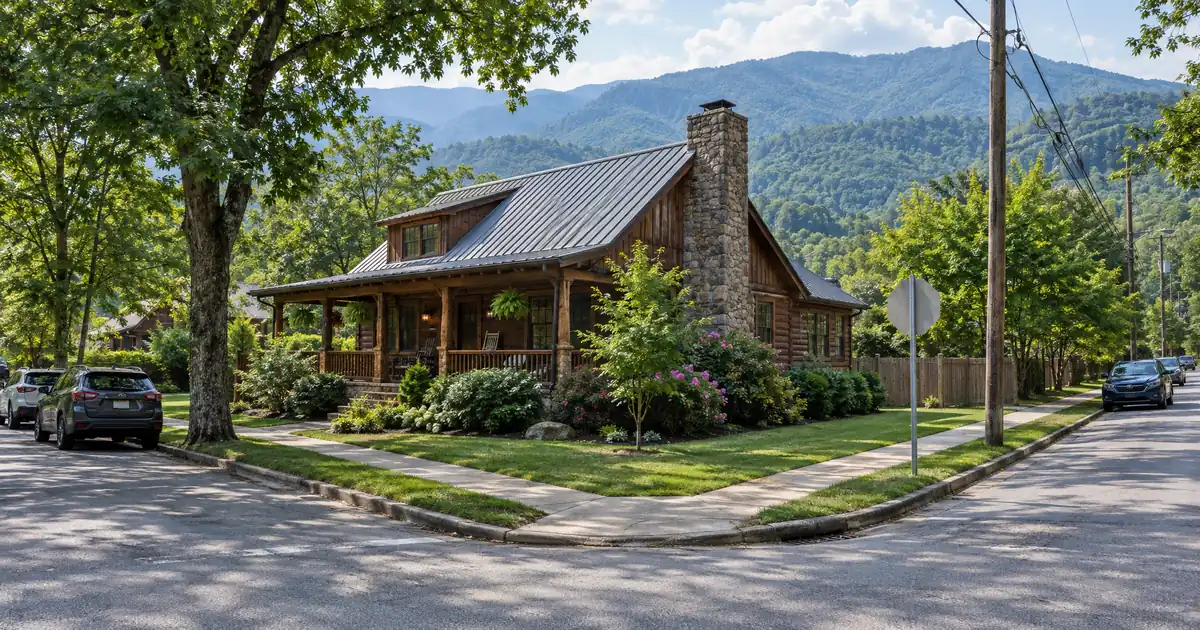
A rental in the Townsend core hits the DSCR math like this. Take a three-bedroom, 1,512-square-foot house listed at $2,200 a month on Zillow, in a town where the 12-month median sale price is $440,000 per Homes.com. Modeled at 75 percent LTV, with full taxes and insurance in the debt service, coverage lands around 0.8x. That is a modeled assumption, not a sourced market figure. It is also well short of the 1.00 benchmark most standard programs are built around.
So the owner holding equity in a Townsend house has a problem. The equity is real, but the rent doesn’t carry the refinance.
DSCR Cash-Out Calculator
Run the cash-out numbers in Townsend, TN
Rate source: Freddie Mac 30-yr average via FRED® — Federal Reserve Bank of St. Louis · effective Oct 1, 2026
Prefilled with starting assumptions — enter your property’s value, balance, taxes, and insurance for a more accurate picture.
Program parameters update from Lendmire’s centralized guideline source. Taxes and insurance are editable estimates.
As of Oct 1, 2026 · General Freddie Mac market benchmark, not a Lendmire loan offer. Property value, balance, taxes, and insurance are editable estimates. Maximum loan-to-value varies by lender, program, property type, and seasoning. Not a Loan Estimate, approval, or commitment to lend. Program availability and eligibility are subject to lender guidelines, credit approval, property review, and underwriting.
The Quick Read:
A cash-out refinance on a Townsend-area rental is underwritten primarily on the property’s rental income measured against its full monthly obligation, so it fits owners of workforce-rent multi-unit stock more than owners of tourism-priced cabins in Townsend, Tennessee.
- Townsend’s 12-month median sale price is $440,000 per Homes.com, against sample asking rents near $2,200.
- Cash-out caps at 75 percent LTV, with roughly six months of seasoning from title recording.
- Duplexes in Maryville and Alcoa put two rent streams against one loan.
- Cabin clusters are vacation assets. Log-construction homes fall outside these programs.
Lendmire’s team reads Townsend as a market where the property you own and the property that refinances well are often different properties. This article works through that gap: what the numbers say, what the 75 percent cap and seasoning rules do to your proceeds, and where the recycled capital should go.
The Townsend Math
Townsend single-family rentals run roughly 0.5 percent monthly rent-to-value, and that produces sub-1.00 coverage at standard leverage. A $440,000 median against $2,200 asking rent leaves almost no room once taxes and insurance join principal and interest. Cash-out proceeds on these properties are limited by the DSCR, not by the 75 percent LTV cap.
The rent-to-value figure is an illustration built from two sourced numbers, not a market statistic. Still, the listing data points the same direction. Zillow shows two-bedroom rentals around $1,800 and three-bedrooms between $1,800 and $2,200, with some listings sitting 114 to 424 days. Long listing times at those asking rents suggest thin demand at the top of the range. HotPads shows a median of $2,500 across three listings, which is too small a sample to lean on. (Three listings is an anecdote, not a market.)
Price data conflicts too. Homes.com’s $440,000 median is up 14 percent year over year, with an average of 70 days on market. Movoto shows a median sold price of $554,950, while Redfin shows a median near $263,000, down 29.1 percent. Swings that wide mean the sample is tiny. This article uses the $440,000 figure throughout and treats the other two as evidence of volatility, not as alternative truths.
Appraisals are the practical consequence. With so few sales, the appraiser’s comparable set can be thin, scattered, and seasonal, which makes any equity estimate soft until the order is back.
Why the Price Runs Ahead of the Rent
Townsend prices as a Smokies gateway town, not as a rental market. Tourism is the primary industry, per Blount County Industry, and the town sits at one of three entrances to Cades Cove. Blount County visitor spending reached nearly $611 million, up 6 percent and eighth in Tennessee, per WATE.
That money lifts values. It does not lift long-term rents in proportion.
The town itself is tiny. Census Reporter puts the population at 701, while other sources show 550 and 628, so “well under 1,000 residents” is the honest description. Median household income is $85,921, with a wide margin of error. Livability describes Townsend as a small bedroom community for people commuting elsewhere in Blount County or to Knoxville. That commuter tenant is real, but the pool is small. A listing broker page also suggests a large share of homes sit vacant or seasonal. It is undated, so treat it as color, not data.
Housing stock compounds the issue. NeighborhoodScout reports single-family detached homes at about 74.6 percent of units and duplexes or small converted buildings at roughly 1.6 percent. There is almost no conventional small multifamily to refinance inside city limits. If you want two-to-four-unit coverage math, you are going to look elsewhere in the county.
Seasoning, the 75 Percent Cap, and What “Equity” Means Here
Cash-out on an investment property tops out at 75 percent LTV, requires roughly six months of ownership measured from title recording, and still has to clear the coverage test. Three constraints apply at once, and the tightest one sets your number. In Townsend, the tightest one is usually coverage.
The standard framing: a 1.00 DSCR means rent used for lender review covers the full monthly obligation: principal, interest, taxes, insurance, and any HOA dues. Most standard programs are built around that benchmark. The calculation itself, which Lendmire explains in its guide to how DSCR coverage is calculated, is straightforward. Some lenders review lower ratios, but those files usually need lower leverage, stronger credit, deeper reserves, or different pricing. Typical credit tiers start at a 620 floor and step up through 660, 680, and 700, with the best terms at the top. Reserves generally run about six months of PITIA, and nine months on balances above $1,500,000. All of this is subject to lender guidelines and varies by borrower, property, and scenario.
Now apply it to the Townsend house. At full leverage the ratio sits near 0.8x. The owner has three practical options:
1. Lower the leverage. Pulling less out shrinks the debt service and lifts the ratio. The proceeds shrink with it.
2. Review a sub-1.00 structure. Select lenders in the network may look at sub-1.00 programs, or at interest-only structuring, with reduced leverage and stronger credit as compensating factors. These are options a lender would review, not outcomes anyone can promise.
3. Hold the Townsend asset and refinance a different one. This is often the cleaner answer.
Appreciation won’t rescue the math either. Zillow puts the average Blount County home value at $379,002, up only 0.6 percent over the past year. Redfin’s county snapshot showed a median sale price near $392,000, down 4.4 percent, with homes averaging 60 days on market versus 54 the year before. Prices are flat to slightly soft. A refinance should not count on appraisal gains to pull equity out. Proceeds depend on your purchase basis, how long you have held, and any value you added through renovation. Equity available is never a guaranteed cash figure. It comes out of rent used for lender review, PITIA, reserves, and the 75 percent ceiling working together. The Zillow Blount County data is the better county-level read than any single Townsend sale.
If you want the mechanics of the product itself, Lendmire’s DSCR cash-out refinance page covers it.
Maryville and Alcoa, Where the Coverage Lives
Maryville and Alcoa are the Townsend-area submarkets where cash-out math can actually clear 1.00. The reasons are price bands, unit counts, and employer-driven tenants. This is the strongest play in the county for a DSCR cash-out, and it sits about a commute away from Townsend.
Start with the demand base. Blount County government lists Clayton Homes, DENSO Manufacturing Tennessee, Blount Memorial Hospital, county government and schools, McGhee Tyson ANG Base, Arconic, and Vanderbilt Mortgage & Finance among the largest employers for county residents. The Blount Chamber adds ProNova Solutions, Amazon, Smith & Wesson, and Cirrus Aircraft, and counts more than 100 manufacturing plants in the county. McGhee Tyson airport sits in Alcoa. DENSO’s headcount is cited at roughly 4,000 to 4,500 depending on the source, and the higher number includes its Athens facility, so call it approximate.
The hospital matters for tenant mix. Blount Memorial is a 304-bed acute care hospital in Maryville, now branded Prisma Health Blount Memorial, per the hospital’s own site. Data-vendor estimates put its payroll at roughly 1,000 or more. Nurses, techs, and travel staff all need housing near the campus. That is long-term, lease-based demand, which is the tenant a cash-out refinance wants.
Now the price side. Homes.com shows Maryville multifamily listings from $390,000 to $1,650,000, with a median home price of $400,812. Apartments.com puts the Maryville rent range from about $962 to $1,683, averaging $1,225, with three-bedrooms averaging $1,683. These are asking rents, not duplex comps.
Run the numbers on a duplex priced near that $400,812 median, with two three-bedroom units. Assume gross rent of $3,000 to $3,400, which is arithmetic on listing averages, not a sourced duplex comp. At 75 percent LTV with full taxes and insurance in the debt service, coverage models around 1.25x to 1.4x. Compare that to the Townsend house at roughly 0.8x. The price is nearly the same, but two rent streams stand against one loan. Same dollars of value, different cash-flow structure.
Entry points run lower in some neighborhoods. A local brokerage guide says Maryville prices run from the low $200,000s in established areas such as Eagleton Village to $700,000 and up in premium areas such as Chilhowee Hills. Rents of roughly $1,200 to $1,700 against the lowest price bands give the best rent-to-value in the county, well ahead of Townsend. That guide is a brokerage blog, so verify the bands against current comps before underwriting anything.
One more data point, with a warning label. A listed three-unit property in the Maryville area advertises 100 percent occupancy and an 8.409 percent cap rate, per a local broker’s multifamily page. That is broker marketing, not a market cap rate. The useful signal is the income density. A rent roll and an expense history will tell you whether the number is real.
Seymour: The Apartment-Supply Comparison
Seymour matters mostly as a rent benchmark, not as a place to buy small multifamily. Redfin’s rental listings show a professionally managed Seymour community asking $1,538 for a two-bedroom and $1,954 for a three-bedroom. A Maryville community lists a one-bedroom at $1,195, a two-bedroom at $1,250, and a three-bedroom at $1,450.
Those are managed-community asking rents, so they overstate what a small landlord collects. They also show where tenant dollars sit relative to Townsend’s $2,200 cabin-style house. A tenant paying $1,450 for a three-bedroom in Maryville is a tenant who will not pay $2,200 for the same bedroom count in Townsend, which is part of why Townsend listings sit so long.
For a borrower who already owns a small property in Seymour or the Maryville edge, the refinance logic is the Maryville logic: workforce rents, modest price points, and a commuter economy. Rand Property Management describes Blount County rents as following a more balanced path than neighboring Knox County’s more volatile climb, with major corporate employers providing a steady baseline. It is a property manager’s marketing page, so read it as a directional view, not a forecast. The takeaway is that a refinance here should be underwritten on in-place rents, not on rent growth.
Skip the Cabin Clusters
Cabin clusters are a poor fit for a long-term-rental DSCR cash-out. A Blount County multifamily search surfaces a Townsend listing of four remodeled 1940s cabins plus an extra building, per Redfin’s county multifamily page. That is the “multi-unit” stock Townsend actually has. It is cabin-style, priced and underwritten as a vacation asset, and it will not behave like a conventional fourplex under long-term lease coverage.
A second problem is eligibility. Log homes, manufactured homes, and barndominiums fall outside the network’s DSCR programs. In a Smokies gateway town, plenty of cabins are log construction. A cabin cluster with log buildings is a non-starter regardless of the rent roll. Check construction type before you spend time on a scenario.
(Asking a lender to treat a vacation cabin as a workforce rental is a bit like asking a ski lodge to count as a duplex.)
Is the Townsend core ever worth holding for coverage? Honestly, it’s closer to a toss-up than a no. A well-located single-family house near the US-321 corridor, bought with substantial equity, can reach a refinance at reduced leverage. Owners with low basis and modest balances sometimes clear it. But buying new into Townsend with the cash-out in mind means paying a tourism premium for a rent that doesn’t cover it. Own it for the life, not the refinance.
What the Deal Desk Tends to See
On files from tourism-priced small markets, the common friction point is a mismatch between where the borrower’s equity sits and where the rent sits. The cleaner files from a documentation standpoint tend to be the ones with a seasoned lease, a clear rent roll, and an appraisal that doesn’t depend on a handful of out-of-pattern sales. The files that stall are the ones leaning on a single high asking rent or an aspirational number from a listing site. Owners who bring a trailing rent history and a plain description of the construction type tend to sort the question quickly, and the scenario that comes out the other side is usually a lower-leverage refinance or a different property entirely. Entity ownership, such as an LLC, is common on these files, subject to lender program eligibility.
Where the Proceeds Go
The point of pulling equity is to recycle it. In this market the recycling path is fairly clear.
A refinance on a seasoned Maryville or Alcoa duplex, held past the six-month mark, can produce proceeds that fund the down payment on the next small multifamily. That next purchase is a separate conversation, since it runs on different mechanics. The 75 percent cap is the ceiling, and reserves come out of the same capital you are trying to redeploy. Plan for that.
A Townsend owner with a coverage shortfall has a cleaner route. Sell the tourism-priced asset, or hold it unleveraged, and use the capital to buy workforce stock closer to the employers. That route trades Smokies-adjacent appreciation for rent-to-value, which is the whole thesis of this article.
Anyone weighing a rate-and-term versus cash-out structure on an existing note can review Lendmire’s investor refinance options. The DSCR loan options for Tennessee investors page covers the statewide picture. Verify current local rental rules, taxes, and insurance with qualified local professionals before committing to any property here, since those vary by county and municipality.
DSCR vs. conventional financing
There are two common ways to finance an investment property in Townsend, TN, and they qualify you differently — here’s how investors weigh them.
Why investors choose it
- Qualifies on the property’s rental income — no personal tax returns, W-2s, or pay stubs needed to document income.
- No personal debt-to-income ceiling to clear, so existing mortgages and obligations don’t cap your borrowing the same way.
- Can be closed in an LLC, keeping the property inside a business entity.
- Built for scaling — not held to the limit on number of financed properties that conventional financing applies.
- Underwriting centers on the deal: generally qualifies when the rent covers the payment, a 1.00x coverage ratio being a common baseline (confirmed in underwriting).
- Designed specifically for investment property, including long-term and, where the program allows, short-term rentals.
Where it’s strong
- Often the lowest ongoing financing cost for a buyer who fully qualifies on personal income — a fit for a first property or a cost-first purchase.
Trade-offs for investors
- Requires full personal income documentation and must fit within a debt-to-income limit — salary, existing debts, and other mortgages all count.
- Typically held in your personal name rather than a business entity.
- Caps how many financed properties you can carry, which can become a ceiling as a portfolio grows.
- Evaluates you as a borrower as much as the property, which usually means more paperwork.
How investors usually choose: a first or single property often optimizes for the lowest financing cost; portfolio builders often optimize for leverage, vesting in an LLC, and scaling past conventional caps. The right answer depends on your goals, the property, and current guidelines — both paths run through select lenders in Lendmire’s wholesale network, with eligibility and terms confirmed in underwriting.
To run a specific property, request a scenario review or call 828-256-2183. Program details are subject to change, and nothing here is a commitment to lend.
Frequently Asked Questions
How do you qualify for a DSCR cash-out refinance on a Townsend, Tennessee rental?
Qualification centers on the property’s rent measured against its full monthly obligation, with a 1.00 benchmark common on standard programs. Typical files also involve about six months of ownership from title recording, a 75 percent LTV ceiling on cash-out, credit tiers starting at a 620 floor, and roughly six months of reserves. In Townsend, the coverage test is usually the limiting factor, not the LTV cap. All of it is subject to lender guidelines and credit approval.
What are the requirements for an investment property loan in Townsend, Tennessee?
Expect a rental income documentation package, a property appraisal, entity paperwork if the property is held in an LLC, and proof of reserves. Eligible property types matter in a cabin town: manufactured homes, log homes, and barndominiums fall outside the network’s DSCR programs. Balances run up to $3,000,000 on standard programs, with smaller balances routed through select lenders in the network.
Why does a Townsend rental struggle to clear the DSCR test?
Price runs far ahead of rent. A $440,000 median sale price against sample asking rents near $2,200 works out to roughly 0.5 percent monthly rent-to-value, and that is before the long listing times visible on some rentals. Modeled with full taxes and insurance at 75 percent LTV, coverage lands around 0.8x. Maryville and Alcoa duplexes tend to model materially higher.
Does a Townsend cabin cluster qualify as small multifamily for a cash-out refinance?
Usually not in a way that helps. Cabin clusters are priced and underwritten as vacation assets, and their rents don’t behave like conventional long-term fourplex rents. Log-construction buildings also fall outside the network’s DSCR programs. A conventional duplex or fourplex in Maryville or Alcoa is a far better structural fit.
For current guidelines and terms, see Lendmire’s DSCR loan programs page.
Where the Asymmetry Sits
Townsend is priced for the Smokies, and rents are priced for a commuter town. The mispricing runs the other way a few miles down the road. Low-$200,000s Maryville neighborhoods like Eagleton Village, and duplexes near the Blount Memorial and DENSO payrolls, carry two-unit rent streams at price points that a single Townsend cabin-style house already exceeds. That is the underpriced asset against its rent and demand fundamentals: the small workforce multifamily in Maryville and Alcoa.
Documents to Gather Before You Request a Scenario
A clean file starts with proof of rent, proof of ownership, and proof of construction type. Gather these before the first call. They answer most of the early questions a lender will ask.
- A signed lease, or a trailing rent history if the unit is between tenants.
- The closing statement or deed showing your title recording date, so seasoning can be counted.
- Current tax and insurance figures for each property.
- Entity documents, if an LLC holds title.
- Recent statements showing reserves, typically measured in months of PITIA.
- A plain note on construction type, since log and manufactured homes fall outside these programs.
Bring the real rent, not the listing rent. A lease in hand carries more weight than an asking price on a website. Requirements vary by lender and scenario.
How to Compare Your Options Side by Side
Run the same property through three lenses before you commit to a plan. Look at full leverage, reduced leverage, and a different asset altogether. Then compare what each path leaves you.
Start with the Townsend house at full leverage. Note the coverage ratio and whether it reaches 1.00. Then lower the leverage and see how the ratio moves. Finally, model a Maryville or Alcoa duplex with in-place rents.
Keep these questions in view:
- Which path clears the coverage test without leaning on appreciation?
- How much cash remains after reserves?
- What does each option cost in pricing, subject to lender guidelines?
- Does the proceeds figure justify the added debt on a thin-rent asset?
Treat every output as a model, not a quote. Appraisals, credit, and lender overlays all shift the final answer.
Questions to Ask Before Moving Forward
The right questions up front save weeks of rework later. Ask them of yourself first, then of any lender you speak with.
- Have I held title long enough to meet seasoning?
- Is my rent documented, or only advertised?
- Does the property’s construction type fit program rules?
- Can I carry reserves after the cash-out closes?
- Would the capital earn more in a different property than it does in this one?
That last question matters most in Townsend. Sometimes the best refinance is the one you skip, in favor of a move into stock that covers its own debt.
Townsend rewards owners who value the town for what it is. A DSCR refinance rewards owners whose rent carries the loan. When those two facts point in different directions, the numbers should decide, and a scenario review is the quickest way to see them on paper.
About Lendmire
A non-QM mortgage broker (NMLS# 2371349), Lendmire arranges DSCR financing for real estate investors in 41 markets: 40 states plus Washington, D.C. Because deals are underwritten primarily on property cash flow rather than personal income documentation, the structure suits self-employed buyers and entity-owned portfolios. Lendmire places loans through wholesale investor lenders; it is not a direct lender. The firm was named a top-ranked workplace in 2026 and a 2025 Scotsman Guide Top Mortgage Workplace.
Get Started
Ready to find the right loan for you?
In about 30 seconds you can review financing options available for your investment property. No commitment required.
Informational only. Not a Loan Estimate, approval, or commitment to lend. Program availability and eligibility are subject to lender guidelines, credit approval, property review, and underwriting.
References
4. per WATE
5. Livability
10. blountmemorial.org — Resources Employment
11. Homes.com
12. Apartments.com
13. news.kingsofrealestate.com — Living in Maryville TN 2026 Guide
14. anniemaloney.com — Maryville Multi Family Homes
17. Redfin’s county multifamily page
18. Scotsman Guide — Top Workplaces 2026
19. a 2025 Scotsman Guide Top Mortgage Workplace
This article is part of Lendmire’s investment property cash-out refinance program — full qualification details, guidelines, and scenarios live on the program page.
Related reading: DSCR Cash Out Refinance in Townsend, Tennessee: The DSCR Guide to Refinancing a Townsend Rental in 2026 · Cash Out Refinance Investment Property in Maryville, Tennessee: The 2026 DSCR Guide to Broadway Avenue · DSCR Cash Out Refinance in Maryville, Tennessee: The 2026 DSCR Financing Guide to Broadway
Guides: Investment Property Cash-Out Refinance in Tennessee
Brandon Miller
Founder & CEO, Mortgage Loan Originator, Lendmire LLC
- Mortgage Loan Originator · NMLS# 1129696 · Verify on NMLS Consumer Access
- North Carolina Real Estate Broker · License# 343312 · Verify on NCREC
- North Carolina Insurance Producer · License# 19053198 · Property, Casualty, Life, Health · Verify on NAIC SBS
- Lendmire LLC · Firm NMLS# 2371349 · Verify firm licensure
Disclosure information. Lendmire is a state-licensed mortgage brokerage under NMLS# 2371349. Lendmire is not a depository institution, direct lender, or financial advisor — all loans referenced are placed through wholesale lender partners and are subject to each lender's underwriting standards. This article is provided for general informational purposes and is not a commitment to lend, nor does it constitute financial, legal, or tax advice. Loan programs, terms, rates, and qualification standards change without notice and depend on borrower profile, property type, and the state in which the subject property is located. Equal Housing Opportunity provider. NMLS Consumer Access: nmlsconsumeraccess.org.