
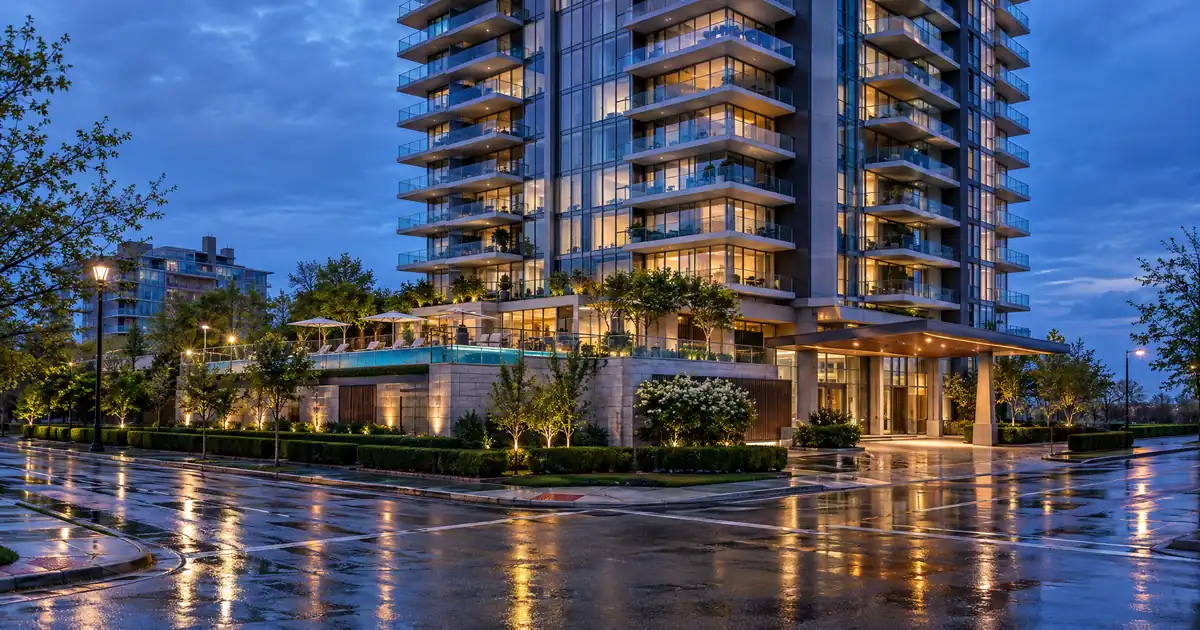
The Quick Read: A luxury tower unit is judged mostly on the building, while a workforce rental pool is judged mostly on blended rent across several properties. Both qualify primarily on property-level rental income covering the payment, subject to lender guidelines. The difference is where the risk sits and what the lender has to review.
- Tower unit: The condo project gets screened first, and association dues count in the payment your rent must cover.
- Workforce pool: One loan covers several modest rentals, and the lender divides total rent by total payment once.
- Leverage: Purchases typically run 75%–80% LTV (loan-to-value, the loan as a share of the property’s value) on most files in the network. Building problems or pool size can pull that lower.
- Cash flow: Clearing 1.00 coverage in either structure does not mean positive cash flow after vacancy, repairs, and management.
- Exit: A single unit sells on its own. A pooled property sells through whatever release terms the loan contains.
“Pool” means three different things online: a swimming pool amenity, a hotel-style rental pool, and a pool of loans. This article uses it for two collateral shapes. The first is one or more high-value units in a condo tower. The second is a single blanket loan over several middle-income rentals, qualified on pooled rent.
Here is the honest answer. A tower unit suits an investor buying one or a few high-value units who can document a healthy building and absorb high dues. A workforce pool suits an investor who already owns several modest rentals and wants one note instead of many. Neither is better on its face. The better one is whichever you can document cleanly and whose coverage holds in a slow month.
Key Terms Defined
DSCR (debt service coverage ratio): monthly rent divided by the full monthly obligation of principal, interest, taxes, insurance, and association dues.
PITIA: principal, interest, taxes, insurance, and association dues, the full payment the rent must cover.
Warrantable condo: a building that passes standard project review for owner-occupancy mix, finances, and legal health.
Non-warrantable condo: a building that fails that review. It is a label for the project, not a verdict on one unit’s rent.
Condotel: a condo operated like a hotel, often with a front desk and a rental program that pools owners’ income.
Blanket loan: one loan secured by several properties. The lender takes a lien on each, and Nav explains that a blanket lien lets multiple properties secure a single loan.
Release clause: a contract term that lets a property leave the pool after conditions are met.
Vesting: how title is held, such as personally or in an LLC.
For the full mechanics, see Lendmire’s complete DSCR loans guide.
Side-by-Side
This table reflects how the network’s programs treat a tower unit and common industry practice for pooled loans. Individual lenders vary, and every file is underwritten individually.
| Factor | Luxury Tower Unit | Workforce Rental Pool |
|---|---|---|
| Review basis | Unit rent vs. full PITIA | Total rent vs. total PITIA |
| Documentation weight | Heavy on the building (HOA records) | Heavy on each property (leases, appraisals) |
| Property types | Condo units; condotels treated separately | Single-family, condos, townhomes, 2–4 units |
| Entity vesting | LLC possible, subject to program terms | LLC possible; series LLCs raise questions |
| Dues effect | Dues sit in the payment and can sink coverage | Dues matter only on condo properties in the pool |
| Reserves | Commonly about 6 months PITIA | Varies; larger pools get case-by-case review |
| Timeline driver | Project questionnaire and HOA papers | Number of appraisals and title searches |
| Main risk | Building fails project review | Cross-collateralization and weak release terms |
How Coverage Works in Each Structure
Coverage is the same test with different inputs. On a tower unit, the lender takes the unit’s market rent and divides it by the full payment, including dues. On a pool, the lender adds all rents and all payments, then divides once. It is not an average of each property’s ratio, so properties with bigger payments carry more weight.
Neither calculation deducts vacancy, repairs, or management. That is why 1.00 is a payment test and not a profit test. Across the network, 1.00 is where select programs start. Stronger ratios tend to open better pricing and leverage. A separate select-lender path takes coverage below 1.00, with leverage and terms adjusted.
Appraisal forms differ too. A single condo unit is typically reported on the Individual Condominium Unit Appraisal Report (Form 1073) with a rent schedule (Form 1007). A pool with duplexes or fourplexes uses small-building reporting, since Form 1025 covers 2–4 unit properties, including units in condo projects. DSCR loans are not agency products. The forms are just the common reporting language.
When a Luxury Condo Tower Unit Is the Better Fit
A tower unit fits when you want one high-value asset in a building with strong finances, and when the rent still clears the payment after dues. Appraisal approach on a high-end unit has its own wrinkles. Lendmire’s piece Desk vs Field vs Second Appraisal on a Luxury Tower Condo DSCR covers that ground.
Here is what the tower path looks like in practice.
You want a simple exit. A single unit sells independently. No release mechanics, no lender consent to pull one property from a pool.
You are buying one or two assets. Pooling gains little for small holdings. A tower unit keeps the file focused on one building and one rent figure.
The building is clean. The lender sorts the project as warrantable, non-warrantable, or condotel, and that sorting sets leverage and reserve overlays. A healthy project keeps you in the 75%–80% LTV range typical on purchases. Select high-leverage programs reach 85% LTV on a purchase with roughly a 700+ score. Down payment mechanics are in Lendmire’s article How Much Down a Luxury Tower Condo Needs Under Non-QM vs a Bank. Final terms depend on the lender’s guidelines, the property type, and the borrower’s complete credit picture.
You can afford the dues drag. Amenity-heavy towers carry high association dues, and those dues land in the denominator. Picture a unit that clears roughly 1.15x on principal, interest, taxes, and insurance alone. Add a heavy dues line, and the same rent can drop toward 1.00x. This is a modeled illustration, not a market figure. It shows how a strong-rent tower unit can still run short on coverage.
Your credit and cash are strong. Network programs generally want around 660, with a 620 floor in parts of the network. A 700+ score unlocks the strongest leverage tiers. Reserves commonly run about 6 months of PITIA. Loans above $1,500,000 typically step up to about 9 months. Standard programs go up to $3,000,000, and above $2,500,000 the network generally holds to 30-year fixed structures.
When a Workforce Rental Pool Is the Better Fit
A workforce pool fits when you already own several modest rentals and want one note, one closing, and one payment stream. The term “workforce” describes the housing, not the loan. The Urban Land Institute defines workforce housing as housing for households earning 60–120% of area median income, as Shelterforce reports, and Shelterforce notes the term is contested. Lenders do not underwrite an affordability class. They compare rent to payment.
Here is where the pool earns its place.
You have three or more properties to consolidate. Pooling spreads the coverage test across the whole group. A strong property can carry a weak one, so a pool can clear 1.00 when one property alone would not. Small pools of two or three properties often gain little.
Your rents are steady and your buildings are plain. Single-family homes, townhomes, and small multifamily keep project-review questions off the table. A condo inside the pool still brings its own HOA and warrantability questions.
You value one set of loan terms. One lender relationship and one set of covenants beats juggling several. The trade is that every property now secures the whole loan.
You want to pay attention to release terms before you sign. Nav advises securing a release clause, which lets properties come out of the pool after conditions are met. Without one, selling a single property gets much harder. A release clause is a contract term, not a legal right.
Pool leverage is the part to ask about early. Larger pools generally step down on leverage and get case-by-case review. Purchase and refinance ceilings in the network, such as 75% LTV on a cash-out, are written for individual properties. How they translate to a blanket file depends on the lender and the pool. Ask before you assume.
Where Each Option Trips Up
Non-warrantable towers. Common triggers include pending litigation, financial distress, serious safety or code issues, thin reserves, heavy investor concentration, and commercial space. Treat them differently. Heavy investor concentration may not block a DSCR file the way it blocks agency financing, while active litigation often does. A non-warrantable label typically caps leverage and loan size, so a very large unit can run into the loan ceiling at normal leverage.
Condotels. A condotel with rental pooling is its own collateral class. Hotel-style operation can trigger separate treatment even if you rent the unit out yourself. If a tower has a mandatory rental program, confirm program eligibility with your broker before you write an offer.
Pools that hide a weak property. Blended coverage lets a strong rental mask a weak one. It also works in reverse: one vacancy hits blended coverage sooner than you expect. Some programs also run an individual-property check, which varies by lender.
Per-property diligence. A blanket structure changes how the debt is secured, not whether each property gets an appraisal, title work, and a condition review. Adding a property later usually means a modification, a refinance of the whole pool, or a separate loan.
LLC structures. Holding properties in an LLC is possible, subject to program terms. Cross-collateralizing across separate series LLCs may undercut the liability separation a series is meant to provide, so raise it with the lender up front. A personal guaranty typically stays in place after a property is released.
Equity does not erase rules. A bigger down payment lowers the payment and can lift coverage. It does not erase leverage caps, credit floors, reserve rules, or property eligibility. The strongest files clear both tests: enough equity and enough rental coverage.
A pattern worth noting from the network: tower files tend to stall on building paperwork, and pool files tend to stall on the weakest property. Ordering the condo questionnaire early on a tower, or pre-screening the weakest property on a pool, prevents most of the late surprises.
Verdict
Pick the tower unit if you want one clean asset, an independent exit, and you can document a healthy building with dues your rent can carry. Pick the workforce pool if you already own several modest rentals, want consolidation, and have negotiated a release clause you trust. Both depend on coverage, credit, reserves, and property review, and the strongest files in either shape clear the equity test and the rent test together.
If the building fails review, the tower path narrows. If the weakest property drags the pool, the pool path narrows. In both cases the rent has to cover the full monthly obligation first. Tax treatment varies; consult a qualified professional.
If you are buying or refinancing a rental property and want to see how the numbers work, Lendmire can help you compare DSCR loan options based on the property income, credit profile, leverage, and investor goals. Reach the team at 828-256-2183.
Frequently Asked Questions
Does a luxury tower condo qualify differently from a workforce rental?
The review basis is the same: property rent against the full payment. The difference is the collateral review. A tower unit gets a project screen and carries association dues in the payment. A workforce property is usually a house or small building with fewer building-level questions. Eligibility is subject to lender guidelines.
Is workforce rental pool a loan category?
No. Workforce describes who the housing serves, not how the loan is underwritten. Lenders look at rent, payment, credit, reserves, and property condition. Rents in a pool can sit anywhere the coverage test works.
How do lenders calculate DSCR on a pool?
They add all the rent, add all the payments, and divide once. It is not an average of each property’s ratio. Bigger payments carry more weight, and vacancy, repairs, and management are not deducted.
Can I sell one property out of a pool?
Only if the loan documents allow it. A release clause lets a property leave after conditions are met, and without one, a partial sale gets difficult. Negotiate release terms before you sign, not after.
Can I buy a tower unit through an LLC?
Often yes, subject to program terms. Vesting is how title is held, and some programs have their own LLC requirements. Confirm early, since entity paperwork can add review steps.
About Lendmire
As a DSCR and non-QM mortgage broker, Lendmire — NMLS# 2371349 — connects investors with wholesale lending channels across 41 markets, including Washington, D.C. The property’s rental income, not the borrower’s tax returns, is central to lender review, which works for self-employed operators and portfolios beyond four financed properties. Scotsman Guide named Lendmire a Top Mortgage Workplace in both 2025 and 2026.
Get Started
Ready to find the right loan for you?
In about 30 seconds you can review financing options available for your investment property. No commitment required.
Informational only. Not a Loan Estimate, approval, or commitment to lend. Program availability and eligibility are subject to lender guidelines, credit approval, property review, and underwriting.
References
1. Nav, Cross Collateralization
2. Fannie Mae Selling and Servicing Guide Forms
3. Form 1025 covers 2–4 unit properties
4. Shelterforce, Redefining Workforce Housing
This article is part of Lendmire’s DSCR loan program — full qualification details, guidelines, and scenarios live on the program page.
Related reading: How to Qualify a Pool With New Leases for a Portfolio DSCR Loan · Can Out-of-State Investors Pool Low-Value Rentals in One DSCR Loan? · Can You Sell One Rental Before Your DSCR Blanket Loan Matures?
Brandon Miller
Founder & CEO, Mortgage Loan Originator, Lendmire LLC
- Mortgage Loan Originator · NMLS# 1129696 · Verify on NMLS Consumer Access
- North Carolina Real Estate Broker · License# 343312 · Verify on NCREC
- North Carolina Insurance Producer · License# 19053198 · Property, Casualty, Life, Health · Verify on NAIC SBS
- Lendmire LLC · Firm NMLS# 2371349 · Verify firm licensure
Important disclosures. Lendmire (NMLS# 2371349) is a licensed mortgage brokerage. Lendmire is not a direct lender, depository institution, or financial advisor. All loan inquiries are subject to lender underwriting; this article does not constitute a commitment to lend. Rates, terms, and program guidelines are subject to change without notice and vary by borrower profile, property type, and state. Information in this article is general in nature and is not financial, legal, or tax advice. Equal Housing Opportunity. NMLS Consumer Access: nmlsconsumeraccess.org.