
The Quick Read: It depends on whether the specific DSCR program accepts room-by-room leasing as collateral, and even where it does, the lender usually sizes the loan on appraiser-supported market rent for each legal unit, not on the total of your individual room leases. Treat room income as upside, and make the market rent carry the payment alone.
- Many programs restrict or exclude properties leased bedroom by bedroom, so program acceptance comes before the appraisal.
- The unit count must be legal. A duplex needs two real dwelling units, and a certificate of occupancy is the usual proof.
- Rooms inside one unit stay one unit for appraisal purposes. Each unit gets one market-rent opinion.
- A lease above market rent earns no credit for the excess.
- Clearing the coverage test does not mean the property makes money.
What Does “Converted Duplex” Actually Mean Here?
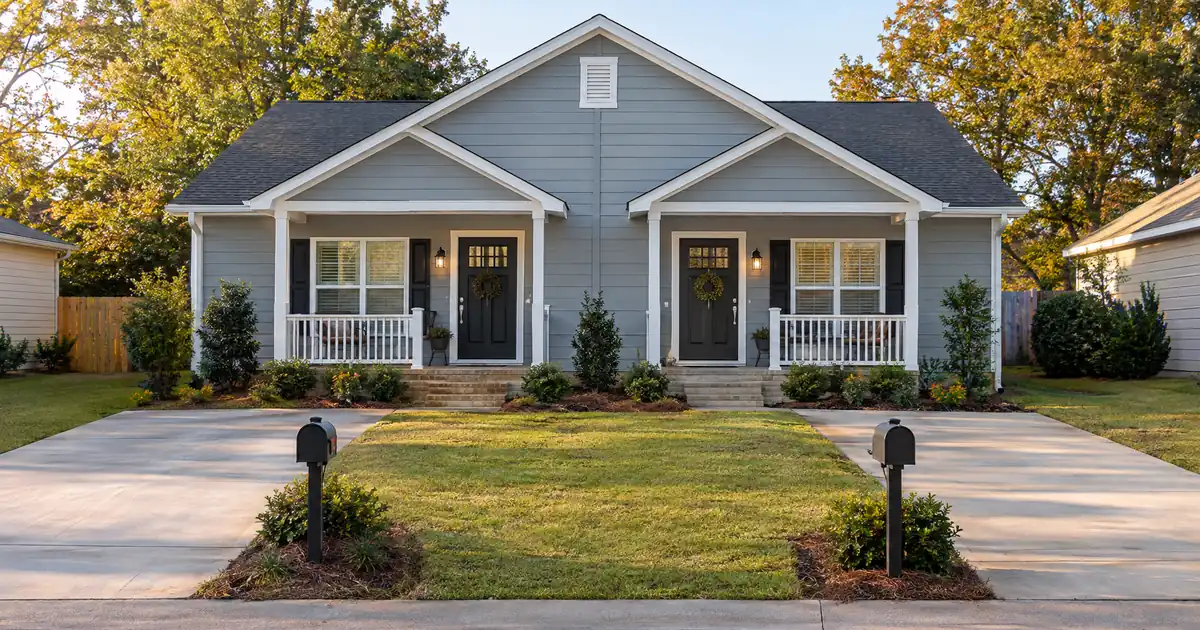
Two very different buildings get called converted duplexes, and lenders treat them differently. The first is a house legally converted into two units, with tenants then renting rooms inside each unit. The second is an existing duplex re-cut into extra bedrooms or small single-room units.
DSCR Calculator
Run the numbers in your market
Rate source: Freddie Mac 30-yr average via FRED® — Federal Reserve Bank of St. Louis · effective Oct 15, 2026
Prefilled with starting assumptions — enter your own rent or nightly figures, taxes, insurance, and HOA for a more accurate picture.
Program parameters update from Lendmire’s centralized guideline source. Taxes and insurance are editable estimates.
As of Oct 15, 2026 · General Freddie Mac market benchmark, not a Lendmire loan offer. Rent, nightly rate, occupancy, taxes, and insurance are editable estimates. Short-term rental figures are estimates only and vary significantly by season, property type, management approach, and local short-term-rental rules — confirm local regulations before relying on them. Qualifying income for short-term rentals varies by program — some use appraisal market rent, others use documented STR history or projections — and is confirmed in underwriting. Not a Loan Estimate, approval, or commitment to lend. Program availability and eligibility are subject to lender guidelines, credit approval, property review, and underwriting.
The first case is manageable. Eligibility rests on two questions: is the two-unit count legal, and does the program tolerate room leasing inside a unit? Plenty of files in that shape work when the leases are structured sensibly.
The second case is harder. It can look like a unit-count problem and a room-lease problem at the same time. A building permitted as two units but functionally operating as four or five rented spaces shows its real use in photos, listings, insurance applications, and the appraisal itself.
Before you go further, figure out which building you own or plan to buy. Everything else here branches from that answer.
How Do DSCR Lenders Count Rent on a Duplex?
On most files the lender counts the lower of the signed lease and the appraiser’s market rent. For a duplex, that comparison usually runs unit by unit, and the results are added together. The ratio is then monthly rent used for lender review divided by PITIA, which is principal, interest, taxes, insurance, and any association dues.
That structure explains why room leases rarely lift the number. A lease above market earns no extra credit. A lease below market pulls the figure down to the lease. Where a unit is vacant or month-to-month, the appraiser’s rent schedule alone often governs.
DSCR loans are designed for non-owner-occupied investment properties. Because they are business-purpose investor loans, they are reviewed differently from a standard owner-occupied mortgage. The loan is reviewed primarily on property-level rental income covering the payment, subject to lender guidelines, which is why the rent figure matters so much.
Rooms inside one unit remain one unit. If the left side of your duplex has four tenants on four room leases, the appraiser still gives that unit a single market-rent opinion. The sum of the four room rents is your pro forma, not the underwriting number.
Why Do Many Programs Restrict Room-by-Room Leases?
The usual reasoning is about resale. Modifying a house into rented rooms can create functional obsolescence: extra locks, lost common space, bathrooms shared awkwardly. If a loan defaults, the lender must sell the property, and the main buyer pool for houses is owner-occupants who often do not want that layout. The cost to cure and resell goes up.
Across the wholesale network Lendmire works with, programs split into a few camps. Many want one lease per unit or per property. A smaller group tolerates room leasing with documented history. The strictest treat separate room-by-room student leases as a restricted use. Eligibility also depends on credit profile, reserves, property review, and the lender’s own overlays.
No federal rule decides this. DSCR loans are non-agency investor products, so each program writes its own property-eligibility and rent rules. That is why you will read confident, contradictory claims about room rentals: one writer describes a lender that accepts them, another describes a lender that does not, and both are accurate about their own programs.
Lease Structure vs. Lender Reading
The structure of the leases inside each unit changes how a lender reads the file. This table shows the typical readings. Individual programs differ, so confirm in writing before you rely on any row.
| Lease structure | Typical lender reading | Next step |
|---|---|---|
| One lease per unit | Standard rental; cleanest file | Appraisal rent per unit |
| One joint lease, all roommates | Usually standard residential rental | Match lease to actual use |
| Separate room-by-room leases | Restricted by many programs | Confirm program first |
| Master lease to one operator | Read as a single lease | Show arm’s-length terms |
| Mix: one unit whole, one by room | Depends on program | Get per-unit guidance |
A joint lease is often the most workable middle path. It reads as a normal rental, which more programs accept. But the lease has to match how the house is actually run. Lenders also look at listing language and management agreements, so a joint lease on paper with four separate rent payments in practice invites trouble.
A master lease opens more doors but brings its own issues. The operator relationship has to look arm’s-length, and the underwritten rent can fall below what you hoped, because the operator needs margin.
A Worked Example in Ratios
Run the numbers this way, using modeled assumptions rather than market data. Say an investor buys a converted duplex and lists each unit with several room leases. Added up, the room leases make the pro forma look like roughly 1.5x coverage against the full monthly obligation.
The appraiser, though, documents market rent for each of the two units as whole units. Those two opinions support only about 0.9x coverage. The extra room income does not qualify the loan, because the lender’s number is the market rent per unit.
Now the investor has a decision. At 0.9x, standard programs that start at 1.00 are off the table. Coverage below 1.00 is a separate path, available through select lenders in the network, with leverage and terms adjusted. A lender reviews it subject to credit approval, property review, and its own guidelines, so none of this is a promise.
Small rent gaps also hit harder than they look. Taxes and insurance do not shrink when rent falls short, so a modest shortfall against the lease can shrink the maximum loan by more than the shortfall percentage. A seemingly minor appraisal miss can change the deal.
Underwrite the property so the appraiser’s market rent covers the payment by itself. If the room income arrives, it is cushion. If it does not, the loan still works.
Legal Unit Count: The Part Investors Skip
Lenders and appraisers weigh legal status heavily, and “duplex” is a legal classification before it is a physical one. LegalClarity describes a duplex as two separate dwelling units, each with its own kitchen, bathroom, and entrance, and notes that a certificate of occupancy is what confirms the status. A building missing those elements risks being classed as a single-family home with an accessory room.
Converting a single-family house into a duplex generally takes zoning approval, a change-of-occupancy permit, and a new certificate of occupancy, as DoINeedAPermit explains. Without that certificate, legal occupancy of the new unit is not established. LegalClarity’s conversion guide also warns that if you convert a house with an existing mortgage, the change to the collateral can matter. Some lenders may treat a material change as a trigger under a due-on-sale clause. Read your loan documents before you start.
Insurance follows the legal status. After a conversion, carriers usually want the property listed as a two-unit building, and liability exposure rises with two tenant households. Make sure the policy covers multi-tenant use as it is actually operated.
The appraisal format reflects the unit count too. Fannie Mae’s appraiser update describes Form 1007 as the rent schedule for one-unit investment properties. For two-to-four unit buildings, the Form 1025 report carries unit-level rent and an operating income statement. These are appraisal formats only. They do not set DSCR eligibility, which each program decides for itself.
Appraisers document market rent, but they do not decide how the lender uses it. McKissock notes that the lender, not the appraiser, makes the final income determination. So a strong appraisal helps, and the program still has the last word.
Does Living in One Room Change Anything?
Yes, and it usually ends the DSCR path. DSCR loans are for non-owner-occupied investment properties. If you plan to live in one room or one unit, you are looking at a different product, such as an owner-occupied loan that may count a share of projected rent from the other units.
Plenty of investors start there for exactly that reason. A house hack on an owner-occupied loan, followed by a move-out and a shift to a DSCR refinance once the property is a pure rental, is a common sequence. The refinance is reviewed as an investment property, with the rent supporting the payment.
Edge Cases Worth Knowing
Vacant or month-to-month units. With no signed lease to compare, the appraiser’s rent schedule alone often governs. That can work fine as long as the market rent supports the coverage you need.
Nightly rentals. Fannie Mae’s update says Form 1007 cannot be used to estimate a short-term nightly fee, so appraisal rent forms are built for monthly market rent. If you are moving a property out of nightly hosting into long-term leases, Lendmire’s piece How to Qualify for a Lower-Payment DSCR Refinance for a Converted Airbnb covers that path.
Brand-new leases. A rent roll built from leases signed just before the appraisal reads differently from one with a payment history. Lendmire’s article How to Qualify a Pool With New Leases for a Portfolio DSCR Loan walks through how fresh leases are treated.
Concealment. Some investors think they can buy as a standard rental and start renting by the room after closing. That is a bad plan. Lease documents, listings, and management agreements can reveal the real use, and a lender that finds a mismatch has legitimate concerns. Be transparent about your lease strategy before you close.
What Leverage, Credit, and Reserves Look Like When It Does Qualify
If you find a program that accepts your structure, the usual ranges apply, all subject to lender guidelines and individual file review. On an investment-property purchase, most files land at 75%–80% LTV, meaning 20%–25% down. On a cash-out refinance of a standard rental, the ceiling is around 75% LTV, and about six months of seasoning is the common expectation.
Credit works in tiers. A 620 floor exists in parts of the network, most programs want around 660, and 700 or higher opens the strongest leverage tiers. Reserves vary by lender, leverage, loan size, and transaction type. Commonly they run around six months of PITIA, and loans above $1,500,000 typically step up to about nine months. Standard programs go up to $3,000,000.
Among programs, 1.00 coverage is where many select programs start. A separate select-lender path accepts coverage below 1.00, with leverage and terms adjusted. A bigger down payment lowers the payment and can lift the ratio, but it never erases leverage caps, credit floors, reserve rules, or property eligibility. The strongest files have enough equity and enough rental coverage.
Remember what the ratio measures. DSCR compares rent to PITIA only. Repairs, vacancy, management, utilities, and capital expenses sit outside it. A room-based house often carries higher utility and turnover costs, so clearing 1.00 on paper can still leave thin real-world margins.
For the full picture of how these loans work, see the complete DSCR loans guide.
DSCR vs. conventional financing
There are two common ways to finance an investment property, and they qualify you differently — here’s how investors weigh them.
Why investors choose it
- Qualifies on the property’s rental income — no personal tax returns, W-2s, or pay stubs needed to document income.
- No personal debt-to-income ceiling to clear, so existing mortgages and obligations don’t cap your borrowing the same way.
- Can be closed in an LLC, keeping the property inside a business entity.
- Built for scaling — not held to the limit on number of financed properties that conventional financing applies.
- Underwriting centers on the deal: generally qualifies when the rent covers the payment, a 1.00x coverage ratio being a common baseline (confirmed in underwriting).
- Designed specifically for investment property, including long-term and, where the program allows, short-term rentals.
Where it’s strong
- Often the lowest ongoing financing cost for a buyer who fully qualifies on personal income — a fit for a first property or a cost-first purchase.
Trade-offs for investors
- Requires full personal income documentation and must fit within a debt-to-income limit — salary, existing debts, and other mortgages all count.
- Typically held in your personal name rather than a business entity.
- Caps how many financed properties you can carry, which can become a ceiling as a portfolio grows.
- Evaluates you as a borrower as much as the property, which usually means more paperwork.
How investors usually choose: a first or single property often optimizes for the lowest financing cost; portfolio builders often optimize for leverage, vesting in an LLC, and scaling past conventional caps. The right answer depends on your goals, the property, and current guidelines — both paths run through select lenders in Lendmire’s wholesale network, with eligibility and terms confirmed in underwriting.
Pre-Appraisal Checklist
Do these things before you pay for an appraisal. The order matters, because lenders differ on how they use the rent figure.
| Item | What to confirm |
|---|---|
| Program fit | Written yes or no on room leasing |
| Legal use | Unit count and certificate of occupancy |
| Rent roll | Current leases and proof of payment |
| Lease type | Per-room, joint, master, or per-unit |
| Insurance | Multi-tenant use is covered |
| Entity | Title and vesting match the loan |
| Purpose | Signed business-purpose statement |
Where the property is held in an LLC, that works subject to lender program eligibility, and the entity documents must match the title. A mismatch between the vesting and the application is an easy problem to prevent and an annoying one to fix late.
Can a Converted Duplex With Room Leases Still Work for DSCR?
Yes, if you choose the right structure. Here are the realistic options when your current setup does not fit a program.
- Switch to a joint lease per unit. This is often the simplest change. Each unit reads as a standard rental, and the appraiser’s market rent per unit carries the file.
- Lease each unit whole. One lease per unit is the cleanest structure and the easiest to underwrite.
- Use a master lease. Lease a unit to an operator at arm’s-length terms. More lenders consider it, but the underwritten rent can come in lower.
- Look at sub-1.00 coverage. If market rent falls short, a select-lender path takes coverage below 1.00 with leverage and terms adjusted.
- Consider other loan types. If room leasing is the core of your business plan, a different product may fit better than a program built around standard rentals.
Which option is realistic depends on your legal unit count, your credit, your reserves, and how much the property relies on room income to work. If the deal only pencils with room-by-room rents that no program will credit, that is a signal about the deal rather than the loan. Tax treatment varies; consult a qualified professional.
Key Terms Defined
DSCR (debt service coverage ratio): the property’s qualifying monthly rent divided by its monthly PITIA.
PITIA: principal, interest, taxes, insurance, and association dues, the full monthly housing obligation.
Market rent: what an appraiser concludes the unit would rent for, based on comparable properties.
Rent by room: leasing individual bedrooms to separate tenants, each on their own lease, instead of leasing the whole unit.
Master lease: one lease between the owner and a single operator, who then rents to the occupants.
Co-living or SRO: a building with private rooms and shared kitchens or baths, often with single-room occupancy.
Certificate of occupancy: the local building department’s document confirming a building is approved for its stated use and unit count.
Frequently Asked Questions
Can I use my room leases to qualify?
Usually the appraiser’s market rent governs, not the room-lease total. A lease above market earns no credit for the excess, and a lease below market pulls the figure down. Use room income as upside, and confirm the program accepts room leasing at all.
Does each room count as its own unit?
No. Rooms inside one unit stay one unit for appraisal purposes. Each legal unit gets one market-rent opinion, so a duplex gets two, no matter how many rooms are rented inside.
What if my duplex doesn’t have a certificate of occupancy?
Expect problems. The unit count has to be legal, and the certificate is the usual proof. A building that cannot show two compliant dwelling units risks being treated as a single-family home with an extra room, which changes the appraisal and the program fit.
Can I live in one room and still use a DSCR loan?
Not on a DSCR loan. These loans are for non-owner-occupied investment properties. Living in the property points you to an owner-occupied product instead, and you can move to a DSCR refinance once the property is a pure rental.
Does clearing 1.00 mean the property makes money?
No. The ratio compares rent to PITIA only. Repairs, vacancy, management, utilities, and capital expenses are outside it, and a room-based house often carries heavier operating costs. Run your own cash-flow numbers separately from the coverage test.
Next Step
If you are buying or refinancing a rental property and want to see how the numbers work, Lendmire can help you compare DSCR loan options based on the property income, credit profile, leverage, and investor goals. As a mortgage broker, Lendmire arranges financing through select lenders in its wholesale network, across 41 markets including Washington, D.C. Programs change, and every file is reviewed individually, subject to lender guidelines. This is not a commitment to lend.
About Lendmire
Lendmire (NMLS# 2371349), a non-QM mortgage broker serving investors in 41 markets including Washington, D.C., helps structure DSCR scenarios commonly evaluated around a property’s rental income rather than personal income paperwork, subject to lender guidelines. A Scotsman Guide Top Mortgage Workplace in 2025 and 2026, Lendmire places loans through wholesale investor lenders and is not a direct lender.
Get Started
Ready to find the right loan for you?
In about 30 seconds you can review financing options available for your investment property. No commitment required.
Informational only. Not a Loan Estimate, approval, or commitment to lend. Program availability and eligibility are subject to lender guidelines, credit approval, property review, and underwriting.
References
1. LegalClarity, Duplex Legal Definition and Property Classification
2. DoINeedAPermit, Change of Use
3. LegalClarity, How to Legally Turn a House Into a Duplex
4. Fannie Mae Appraiser Update (Form 1007 and one-unit investment properties)
5. Form 1025
6. McKissock Learning, Form 1007 and short-term rental appraisals
This article is part of Lendmire’s DSCR loan program — full qualification details, guidelines, and scenarios live on the program page.
Related reading: How to Document a Below-Market Lease for a DSCR Loan · Can a Travel Nurse Mid-Term Rental Qualify for a DSCR Loan? · Can a Cash Buyer Get a Second Appraisal Before a DSCR Cash-Out?
Brandon Miller
Founder & CEO, Mortgage Loan Originator, Lendmire LLC
- Mortgage Loan Originator · NMLS# 1129696 · Verify on NMLS Consumer Access
- North Carolina Real Estate Broker · License# 343312 · Verify on NCREC
- North Carolina Insurance Producer · License# 19053198 · Property, Casualty, Life, Health · Verify on NAIC SBS
- Lendmire LLC · Firm NMLS# 2371349 · Verify firm licensure
Required disclosures. Lendmire (NMLS# 2371349) operates as a licensed mortgage broker, not a direct lender or depository. The discussion in this article is general in nature and should not be relied upon as financial, legal, or tax advice — every investment scenario is unique and should be reviewed by a qualified professional. Any loan inquiry is subject to lender underwriting, and this article is not a commitment to lend or a guarantee of approval. Mortgage rates, loan terms, and program guidelines vary by borrower, property, and state, and may change without notice. Equal Housing Opportunity. Verify licensure at NMLS Consumer Access.