
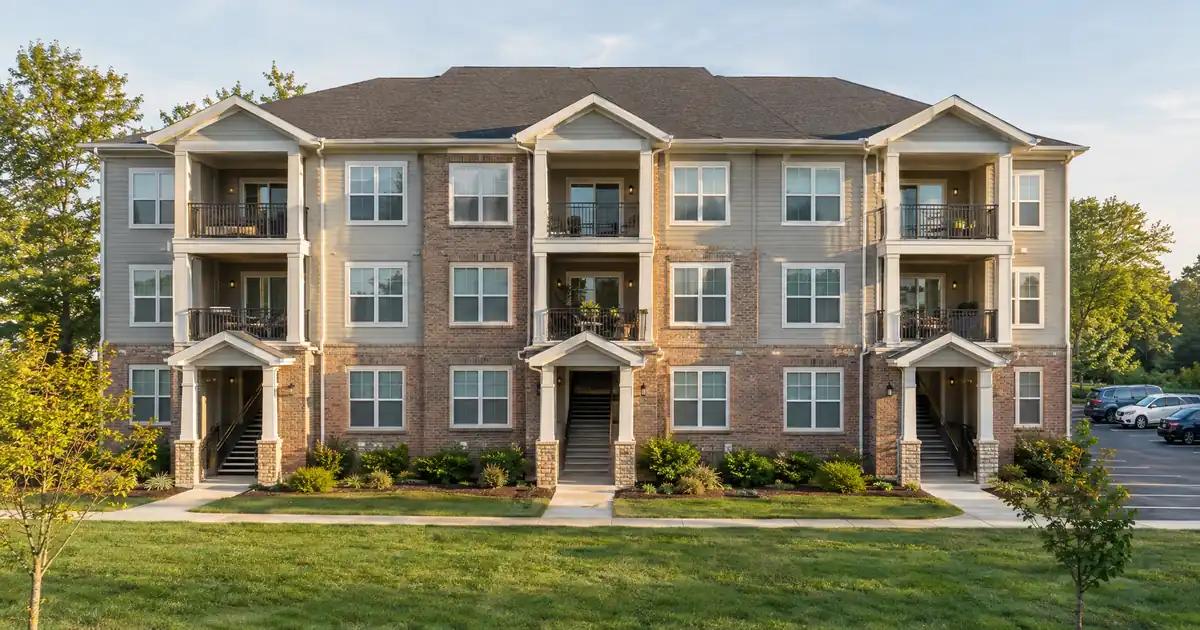
The Quick Read: A lender decides how to treat a building full of nightly rentals by asking two questions: how many units it has, and whether it runs like a rental or like a hotel, and a building that clears both stays in the residential DSCR lane, where property-level rental income covering the payment drives qualification, subject to lender guidelines. Hotel-style features, such as a front desk or a mandatory rental pool, can change that classification even below five units. Proof of legal short-term use and solid income evidence decide the rest.
- Four units or fewer generally stays in the residential lane. Five or more usually moves to commercial or portfolio structures.
- On an STR purchase, leverage reaches up to 75% LTV on the strongest files. On STR refinances and cash-outs it runs up to about 70%.
- Expect a 640+ credit score and about 12 months of landlord or host experience. The coverage floor is 1.00 on an STR purchase and 1.00 on an STR refinance.
- Clearing 1.00 does not mean the property cash flows. Repairs, vacancy, and management sit outside the ratio.
What Does “Past the Hotel Test” Actually Mean?
No federal rule or agency owns a hotel test for DSCR loans. It is shorthand investors use for a lender-side classification question: does this building count as a residential rental or as a lodging business?
Short-Term Rental Calculator
Run the STR numbers in your market
Rate source: Freddie Mac 30-yr average via FRED® — Federal Reserve Bank of St. Louis · effective Oct 15, 2026
Prefilled with starting assumptions — enter your nightly rate, occupancy, taxes, and insurance for a more accurate picture.
Short-term rental income is documented with a 12-month history or a market data report. Program parameters update from Lendmire’s centralized guideline source.
As of Oct 15, 2026 · General Freddie Mac market benchmark, not a Lendmire loan offer. Nightly rate, occupancy, taxes, and insurance are editable estimates. Qualifying income for short-term rentals varies by program — some use appraisal market rent, others use documented STR history or projections — and is confirmed in underwriting. Not a Loan Estimate, approval, or commitment to lend. Program availability and eligibility are subject to lender guidelines, credit approval, property review, and underwriting.
In practice that one phrase hides four separate questions:
1. A unit-count line. Four units versus five.
2. An operating-model line. A property run like a rental versus one run like a hotel.
3. A legal-use line. Zoning, permits, and association rules.
4. A tax-reporting line. How income is reported on a return.
Only the first three affect loan eligibility.
Most confusion comes from blending these. An investor with a fourplex zoned commercial assumes a commercial loan. Another rents all units nightly and assumes the lender will call it a hotel. Neither assumption is automatic. Each gate works differently, so take them one at a time.
Gate One: Four Units or Five?
Four units is the line that matters most. Lending treats one through four units as a single residential category, so a fourplex counts as residential even with four tenants. At five units, the property is classed as commercial multifamily.
The change at five is a change in who gets underwritten. LoopNet’s CRE Explained describes underwriting shifting at five units from the borrower to the property’s net operating income, with documents shifting toward rent rolls, income and expense statements, and occupancy history. Net operating income, or NOI, is rental income minus operating expenses, before debt payments.
Even the agency schedule follows the same cutoff. FHFA publishes conforming loan limits for one through four units only, with a one-unit baseline of $832,750 in most of the country. DSCR loans are not agency loans, so treat that as contrast, not as a rule for your file.
The line is a classification, not a building characteristic. A fourplex and a five-plex can look the same from the street. Lenders still sort them differently.
In the residential lane, DSCR means monthly rent divided by PITIA. PITIA is principal, interest, taxes, insurance, and any association dues. A 2-4 unit building with every unit rented nightly is the exact situation Lendmire’s piece How to Finance a 2-4 Unit Airbnb With a Short-Term Rental Loan covers in more detail.
Gate Two: Does the Building Read Like a Hotel?
Many programs treat a short-term rental that looks like a hotel or motel as a commercial property. Unit count is often the simple trigger, with five or more units being the common line. Count is not the only trigger, though.
Across the wholesale network, the features that push a building toward lodging treatment include:
- A staffed front desk or check-in lobby.
- A mandatory rental pool, where owners share revenue.
- Management by a hospitality company running the building as one operation.
- Condotel structures, which are condo units operated as hotel rooms.
Condotels and hotel-managed condo projects are a different collateral type, and many standard programs exclude them. A duplex or fourplex with keypad entry and a property manager is a different animal. It looks like houses and apartments, and lenders usually treat it that way.
Here is the twist. The hotel look is not always bad news. An operation that really is transient lodging may fit business financing built for lodging, which has its own eligibility tests and its own rules. That is a different product from DSCR, so it makes sense for owners running a staffed, hotel-style building. It rarely fits an investor holding a few apartments rented by the night.
Gate Three: Is Short-Term Use Legal Here?
Short-term rental rules can vary by city, county, HOA, and property type, so investors should confirm local rules before relying on projected rental income. That is the entire regulatory discussion this article will attempt. The loan-side point is simpler: a file needs proof that nightly rental is allowed.
Lenders usually look for permits or registrations, zoning verification, and association documents. If the proof is missing, the lender may count only long-term rent or stop the file.
Zoning and financing type are also different things. Zoning governs what the city allows. It does not by itself decide whether a lender underwrites the building as residential or commercial. A four-unit building zoned commercial is generally still a 2-4 unit residential file.
Associations add their own wrinkle. Courts have disagreed on whether renting by the night counts as commercial use under a community’s covenants. CondoLaw.net’s summary describes two state courts reaching opposite conclusions in the same month. It is an illustration of how local the question is, not lending law.
How Do Lenders Count Income Across Multiple Units?
Lenders count nightly income from one of two evidence sources, then trim it before computing the ratio. Documented platform history is common on refinances. A market-data projection from a rental-analytics report is common on purchases. Either way, the lender applies an expense factor to gross revenue. The PITIA in the denominator does not shrink.
Here is the process in order:
1. Classify by unit count. Two to four units stay residential. Five or more move to a different lane.
2. Confirm the operating model. Rental or hotel-like?
3. Verify legal use. Permits, zoning, association rules.
4. Establish the income number. History or projection, per unit and for the building.
5. Apply the haircut. The lender’s expense factor on gross revenue.
6. Order the appraisal. It sets value, which drives LTV.
7. Run the ratio and the leverage test. Income drives DSCR. Value drives LTV.
The appraisal step is where many multi-unit STR files get tangled. Appraisers use Form 1007 for a single-family rent schedule and Form 1025 for 2-4 unit properties. Both ask for monthly market rent, which is a long-term number. HousingWire argues that a rent-schedule form is a poor fit for nightly income and suggests a narrative addendum plus a seasonality stress test.
The practical lesson: do not assume the appraisal’s rent number is your STR income. A file that works on nightly revenue can look weak if the only income evidence is a long-term rent estimate. Bring documented history or a market report to the table.
DSCR files in STR-heavy buildings often come in tight on long-term rent and clear on trailing STR income. The stronger files show both scenarios on one page. Per-unit records beat a building-level lump sum, because the lender can see which units carry the coverage.
Which Path Fits Which Building?
The path depends on the building size, how many units are nightly, and how the income is documented. This table shows the general pattern. Specific eligibility depends on the program, the lender, and the file.
| Building | Underwriting method | STR income treatment | Likely path |
|---|---|---|---|
| 2-4 units, one STR unit | Residential DSCR | Often blended with long-term rent | Residential DSCR |
| 2-4 units, all STR | Residential DSCR | History or market projection, haircut applied | Residential DSCR, STR program |
| 2-4 units, mixed STR and long-term | Residential DSCR | Each unit counted by its use | Residential DSCR, overlays possible |
| 5+ units | Property NOI | Often excluded or limited | Portfolio or small-balance commercial |
| Hotel-style or condotel | Lodging or commercial | Business operating income | Commercial or business financing |
Mixed buildings deserve a note. Some portfolio structures test pooled coverage, so a strong long-term rental can offset a weaker STR. How a DSCR portfolio loan blends rent across a multi-unit short-term rental is a separate topic, and the details live there.
Above four units, the file typically leaves the residential DSCR lane. It moves to a rental portfolio or small-balance commercial structure, which can carry a balloon term, recourse, and a heavier document set. Whether a given building fits depends on the program and lender, so ask before you go under contract.
A Worked Example
Run the numbers on a fourplex where all four units rent by the night. These ratios are modeled assumptions, not market data.
- Gross STR revenue against full PITIA: about 1.45x.
- After the lender’s expense factor: about 1.10x.
- If the file falls back to a long-term rent estimate only: about 0.95x.
- Leverage on the purchase: 75% LTV, the top of the STR purchase range. Leverage, reserves, and pricing vary by lender and program; the final terms follow the full file review.
Same building, three different readings. At roughly 1.10x on documented or projected STR income, the property clears the 1.00 floor that select STR programs start from. On long-term rent alone, it dips under 1.00.
Under 1.00, there are paths a lender may review. One is a separate select-lender path that goes below 1.00, with leverage and terms adjusted. Another is interest-only restructuring, which can lift the ratio. Another is blending in income from a long-term unit. Eligibility stays subject to lender guidelines, credit review, and property review.
A bigger down payment lowers the payment and can lift the ratio. It does not erase credit floors, reserve rules, or property eligibility. The strongest files clear both tests: enough equity and enough rental coverage.
What Does the Network Typically Expect?
Across the wholesale network, STR files commonly look like this. Treat these as typical ranges from select lenders, not promises.
- Purchase leverage: up to 75% LTV on the strongest files.
- Refinance and cash-out: up to about 70% LTV on short-term-rental collateral. Standard long-term rentals reach up to about 75% on cash-out.
- Credit: about 640 and up for STR. Many standard programs want around 660, and 700+ unlocks the strongest tiers.
- Experience: about 12 months of landlord or host experience.
- Coverage: 1.00 on an STR purchase. On an STR refinance, the floor is also 1.00.
- Loan size: up to $3,000,000 on standard programs. Above $2,500,000, the network generally holds to 30-year fixed structures.
- Reserves: they vary by lender, leverage, loan size, and transaction type, commonly around 6 months of PITIA. Larger balances step up.
- Term structures: the spine is the 30-year fixed. Extended terms and interest-only periods are available through select lenders, and ARM structures exist.
Seasoning, the waiting period between a purchase and a cash-out refinance, is commonly around 6 months. One more edge: a few property types are simply not offered. Manufactured homes, log homes, and barndominiums fall outside these programs.
What About Living in One Unit?
Living in one unit changes the product entirely. DSCR loans are designed for non-owner-occupied investment properties. Because they are business-purpose investor loans, they are reviewed differently from a standard owner-occupied mortgage.
An owner who occupies one unit of a small building is looking at owner-occupied financing, which has its own occupancy rules and its own limits on nightly rentals. That route can make sense for a first building. Once the owner moves out and the building is a pure rental, the file generally moves to DSCR, where property income is central to lender review.
Clearing 1.00 Is Not Positive Cash Flow
DSCR compares rent to PITIA. That is all. Repairs, vacancy, management fees, utilities, cleaning turnovers, and capital expenses all sit outside the calculation.
Multi-unit STRs make this gap bigger. Nightly rentals bring heavy turnover, platform fees, and furnishing replacement. A building can sit at 1.15x and still lose money in a slow season. A lender’s expense factor on gross revenue gives a partial cushion for the ratio, not for your operating budget.
Build your own operating model separately, and stress it for a soft season. That is the number that tells you whether the building pays you.
Why Files Get Downgraded or Declined
The common failure modes are predictable. Most come back to the three gates and the income evidence.
- Income falls back to long-term rent. The nightly income cannot be documented, so the lender uses a rent-schedule number.
- Legal use is not proven. No permit, a zoning gap, or an association restriction.
- The building reads as hotel-like. A front desk, a rental pool, or a hospitality-company manager shifts the collateral class.
- Unit count surprises. The certificate of occupancy shows a different unit count than the listing.
- Coverage is thin after the haircut. A deal that looked strong on gross revenue slips below 1.00.
- Credit or experience misses the floor. Under 640, or without about 12 months of landlord or host experience, the file may need a different structure.
Pre-Application Checklist
Gather these before a lender sees the file:
- Permits or registrations for each unit, plus zoning and association documents.
- Unit-count verification, including the certificate of occupancy where available.
- Per-unit income evidence: platform history for a refinance, or a market report for a purchase.
- Insurance type confirmed for short-term use.
- Entity documents if the building will sit in an LLC, subject to lender program eligibility.
- Proof of reserves, plus your credit profile and landlord or host experience.
Key Terms Defined
DSCR (debt service coverage ratio): monthly rental income divided by the monthly PITIA, used to see whether the property’s income covers its payment.
PITIA: principal, interest, taxes, insurance, and association dues, the full monthly obligation.
LTV (loan-to-value): the loan amount as a percentage of the property’s value.
NOI (net operating income): rental income minus operating expenses, before debt payments, used on commercial and larger multifamily loans.
Expense factor (haircut): the percentage a lender subtracts from gross STR revenue before running the ratio.
Condotel: a condo project operated like a hotel, often with a front desk and a rental pool.
Form 1007 and Form 1025: appraisal forms for a single-family rent schedule and for a 2-4 unit income analysis.
Frequently Asked Questions
Can I finance a multi-unit short-term rental?
Yes, in many cases, when the building has four or fewer units, runs like a rental, and has documented legal use. Qualification rests primarily on property-level rental income covering the payment, subject to lender guidelines. Above four units, the file generally moves to portfolio or commercial structures.
Can all units be nightly rentals?
Yes, on a 2-4 unit building, though the underwriting is more detailed. The lender wants per-unit income evidence and proof that nightly use is legal. Expect the ratio to be tested on income after the expense factor.
What if only some units are short-term rentals?
Mixed buildings are common. Each unit is generally counted by its actual use, and some programs add overlays for mixed use. Portfolio-style structures can pool coverage, so a stronger long-term unit can help a weaker STR.
Do I need an operating history?
Usually the network expects about 12 months of landlord or host experience from the borrower. For the property itself, refinances commonly lean on documented platform history, while purchases often use a market-data projection. A new building with no history can still be reviewed on a projection.
Does the zoning decide whether I need a commercial loan?
No. Zoning governs what the city allows, while the lender’s unit count and operating model decide the loan class. A four-unit property zoned commercial is generally still reviewed as a 2-4 unit residential file.
Next Step
If you are buying or refinancing a rental property and want to see how the numbers work, Lendmire can help you compare DSCR loan options based on the property income, credit profile, leverage, and investor goals. As a broker, Lendmire arranges financing through select lenders in its wholesale network across 41 markets, including Washington, D.C., and lender guidelines decide eligibility. The complete DSCR loans guide covers the basics if you are still building your foundation.
The line between a four-unit rental and a five-unit hotel-like operation is thin on the street and thick on paper, so decide which side your building sits on before you write the offer.
About Lendmire
As a DSCR and non-QM mortgage broker, Lendmire — NMLS# 2371349 — connects investors with wholesale lending channels across 41 markets, including Washington, D.C. The property’s rental income, not the borrower’s tax returns, is central to lender review, which works for self-employed operators and portfolios beyond four financed properties. Scotsman Guide named Lendmire a Top Mortgage Workplace in both 2025 and 2026.
Get Started
Ready to find the right loan for you?
In about 30 seconds you can review financing options available for your investment property. No commitment required.
Informational only. Not a Loan Estimate, approval, or commitment to lend. Program availability and eligibility are subject to lender guidelines, credit approval, property review, and underwriting.
References
1. loopnet.com: Is Multifamily Commercial
2. FHFA – conforming loan limit values
3. CondoLaw.net – STR as commercial use
4. HousingWire – Short-term rentals are breaking the appraisal playbook
This article is part of Lendmire’s short-term rental loan program — full qualification details, guidelines, and scenarios live on the program page.
Related reading: How to Rebuild a DSCR Application Before Scaling Past Ten Properties · Can You Scale Past Ten Rentals With a DSCR Loan After a Short Sale? · Can Lake House Short-Term Rentals Share One Portfolio DSCR Loan?
Brandon Miller
Founder & CEO, Mortgage Loan Originator, Lendmire LLC
- Mortgage Loan Originator · NMLS# 1129696 · Verify on NMLS Consumer Access
- North Carolina Real Estate Broker · License# 343312 · Verify on NCREC
- North Carolina Insurance Producer · License# 19053198 · Property, Casualty, Life, Health · Verify on NAIC SBS
- Lendmire LLC · Firm NMLS# 2371349 · Verify firm licensure
Compliance and disclosures. Lendmire (NMLS# 2371349) is a licensed mortgage broker and is not a direct lender, depository institution, financial advisor, or tax professional. Content in this article is general market analysis and educational information — not financial, legal, or tax advice for any specific situation. Lendmire does not guarantee loan approval; every transaction is subject to underwriting by the funding lender. Mortgage pricing and loan program guidelines are subject to change at any time without notice and vary by borrower characteristics, property type, and state regulations. Lendmire complies with Equal Housing Opportunity. Licensure verification: NMLS Consumer Access.