
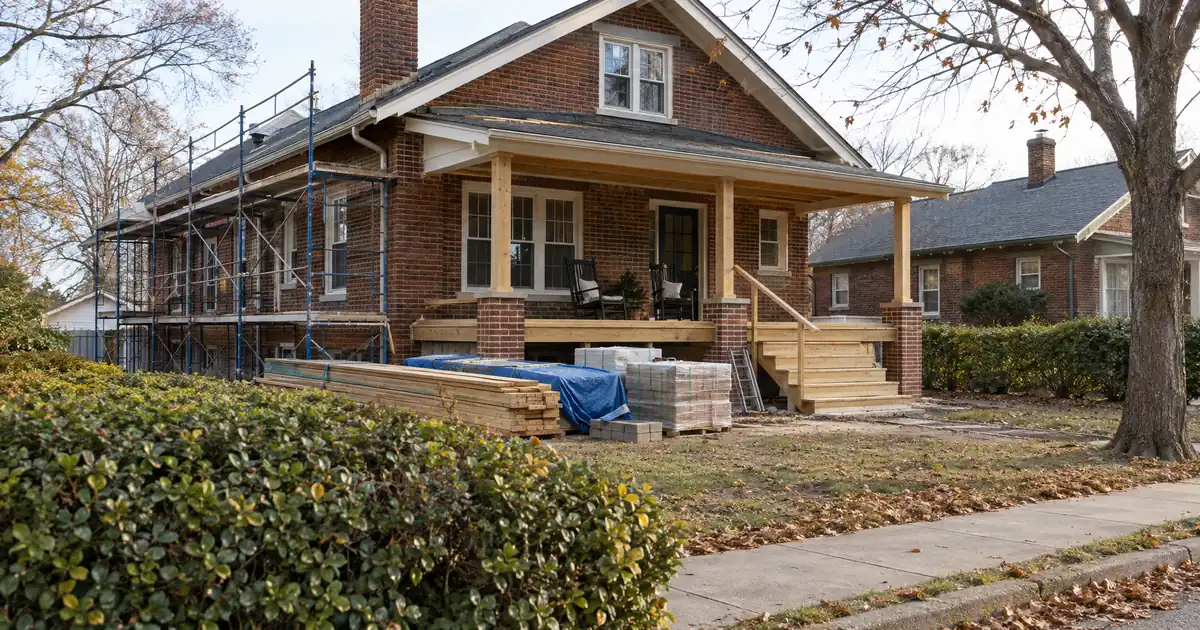
The Quick Read: A draw gap is the cash you carry between paying for rehab work and being reimbursed by the lender. You cover it by planning for three things up front: the first phase you must float, the lag from request to inspection to funding, and the shortfall when a draw is cut or held. The main levers are your own cash, contractor payment terms, how the budget is split into line items, and the draw schedule you negotiate before closing.
- Hard money rehab funds are usually reimbursements against verified work, not up-front advances. Terms vary by lender, property, and experience.
- Up to 100% of the rehab budget can fund in draws against completed work. That is a rehab-budget figure, not a purchase loan-to-value.
- On fix-and-flip files, leverage is typically 85% to 93% of project cost depending on completed projects, always capped at 75% of after-repair value.
- Missing lien waivers and over-claimed progress are the usual reasons draws stall.
- Size your cash buffer for the peak exposure point, then add a delay cushion.
Nothing here is a commitment to lend. Every file is underwritten individually by the lender.
What this loan actually costs to carry.
Hard money is sized against the project and priced by time. Enter the deal and see how much the program will lend, the cash required at closing, the carry while you hold it, and what is left at the exit.
Leverage tiers on the current program: 85% with fewer than 2, 90% with 2 or more, 93% with 5 or more completed projects — every tier capped at 75% of after-repair value. Loan amounts up to $5,000,000, larger by exception; terms of 6 to 18 months, interest-only, no prepayment penalty. The rehab portion funds in draws against completed work, not at closing.
Program parameters shown update from Lendmire’s centralized guideline source. Rate, points, and months are editable assumptions, not quoted terms.
Cost cap sets the loan · positive spread
Illustrative estimate only — not a quote, Loan Estimate, approval, or commitment to lend. Rate, points, and months are editable assumptions. Hard money is business-purpose financing for real estate investors, not a consumer mortgage. Leverage on the current program tops out at 93% of project cost for investors with a documented track record, capped at 75% of after-repair value, with rehab funding up to 100% of the documented budget released in draws; actual terms vary by lender, borrower experience, property, and exit. Lendmire is a mortgage broker, not a lender.
What Is a Draw Gap, and Why Does a Full Gut Make It Worse?
A draw gap is the out-of-pocket cash you carry while you wait for reimbursement. A full gut makes it worse because the early phases are expensive and the proof of completion is slow to assemble.
Many people read “100% rehab financing” and assume they put in nothing. Here is how the structure actually works. The lender holds the rehab money in a holdback and releases it as work is finished and verified. In practice you usually float the first draw.
The gap has three parts:
- The first-phase float. You pay for demo and early work before any reimbursement.
- The lag. Time passes between your request, the inspection, and the wire.
- The shortfall. A draw gets reduced or held, and you cover the difference.
A gut rehab stacks all three. Demo, framing, and rough mechanicals come first, and they are expensive. Meanwhile your cash also has to cover the down payment, closing costs, and reserves. The draw gap is a separate bucket on top of those.
One more point on leverage. Hard money pricing is built on cost, not a single purchase LTV. Fix-and-flip leverage typically runs 93% of project cost at five or more completed projects, 90% at two or more, and 85% below that, with every tier capped at 75% of after-repair value. Those tiers vary by lender, property, and experience. There is no true 100% purchase program. The “up to 100%” language applies only to the rehab budget, and it arrives in draws.
How Does the Reimbursement Loop Work, Step by Step?
The loop is: pay for the phase, submit proof, get inspected, clear title and lien checks, then receive funds. Then you repeat it for the next phase. Each pass has its own ways to stall.
1. Budget and schedule at closing. The scope of work is split into phases. On a gut these are usually demo, framing and structural, rough mechanicals, drywall, finishes, and a final punch list. Lenders differ on whether any money moves up front, so ask.
2. You pay for the phase. Many contractors bill on net-30 terms. That can shrink your float, but only if the contractor agrees to it in writing.
3. You submit the draw package. Expect invoices tied to budget lines, an updated schedule of values, approved change orders, and lien waivers. Procore notes that waivers are typically conditional because payment has not been made yet, and that a request is likely to be postponed until every waiver is in.
4. An inspector verifies the work. Innergy describes inspectors flagging line items where the request exceeds the observed completion, then recommending a supported disbursement amount. This is a progress check for the lender. It is not a code or permit sign-off.
5. Title and lien check. GoBuildYourHouse explains that lenders typically require a title update with each draw, plus conditional waivers for the current draw and unconditional waivers for the prior one.
6. Funding. The same page says to expect a typical draw cycle of 2 to 5 business days after the paperwork clears. Plan your cash flow around that lag, because individual lenders differ.
Notice what decides the outcome. It is whether the work is verifiably complete at the percentage you claimed, whether the waivers are complete, whether the spend matches the approved scope, and whether you have liquidity outside the loan.
Where Does Cash Exposure Peak in a Full Gut?
Exposure peaks early, usually across demo, structural work, and rough mechanicals. That is when you have spent the most and proven the least. The table below shows the pattern for a typical gut sequence.
| Phase | Typical work | Cash you front | Stall risk |
|---|---|---|---|
| Demo | Teardown, haul-off, dumpsters | First-phase float | Low |
| Structural | Framing, beams, sistering | Large, with long-lead materials | Medium |
| Rough mechanicals | Plumbing, electrical, HVAC rough | Large, work gets concealed | High |
| Drywall | Hang, tape, finish | Moderate | Medium |
| Finishes | Cabinets, flooring, fixtures | Moderate to large | Medium |
| Punch list | Final fixes, cleanup | Small | Low |
Rough mechanicals carry the highest stall risk because the work disappears behind walls. Concealed items are only provable with progress photos taken before cover-up, so photograph rough plumbing, electrical, and framing before drywall goes up. Some lenders also accept local building-department inspections as support. That varies.
Deposits are the other hidden spike. Windows, cabinets, and HVAC equipment often need money down before any milestone exists. No lender will reimburse work that has not started, so those deposits come from your own cash.
What Does the Cash Curve Look Like? A Worked Example
Run a modeled gut with six phases and draws after each one. These are labeled assumptions, not market data. The point is the shape of the curve, so the example uses unit-less percentages of the rehab budget.
Assume the rehab budget is 100 units. Each phase is paid by you first, then reimbursed after the inspection cycle. Assume the lender reimburses completed work at the claimed percentage.
| Phase | Spend (units) | Reimbursed after | Out of pocket at peak |
|---|---|---|---|
| Demo | 10 | Draw 1 | 10 |
| Structural | 20 | Draw 2 | 20 |
| Rough mechanicals | 25 | Draw 3 | 25 |
| Drywall | 15 | Draw 4 | 15 |
| Finishes | 25 | Draw 5 | 25 |
| Punch list | 5 | Draw 6 | 5 |
If each draw is reimbursed before you start the next phase, your peak exposure is the largest single phase, here 25 units, plus deposits. If a draw stalls, the next phase stacks on top of the unpaid one. A stalled rough-mechanicals draw followed by drywall puts you near 40 units out of pocket.
That is why the stress test matters. The first number to find is your largest single phase. The second is your largest two consecutive phases, which is what you carry if one draw stalls.
How Do You Size Your Cash Buffer?
Add four numbers: your largest single phase, the next-largest phase as a stall cushion, deposits for long-lead items, and contingency. That total is your draw-gap buffer, and it sits on top of down payment, closing costs, and lender reserves.
Here is the reusable formula:
1. Find the largest phase in your budget.
2. Add the next-largest consecutive phase as a delay cushion.
3. Add deposits for windows, cabinets, HVAC, and similar items.
4. Add contingency. A gut rehab hides surprises behind every wall, so how to budget a first flip so the DSCR cash-out still clears hard money points to funding contingency and the first draw from cash.
Do not skip step two. Inspectors can lag, waivers can go missing, and a contractor dispute can freeze a draw. If the next phase cannot start without paying for it, the stalled draw keeps compounding.
One investor heuristic floating around holds that cash needs run near 15% of after-repair value when purchase plus rehab is 70% of ARV. Treat that as one person’s rule of thumb, not a standard. Your own worksheet beats any heuristic.
Seven Ways to Cover the Gap, Ranked
Own cash is the cleanest source. Everything else adds cost, a counterparty, or risk. Here is how the options compare.
| Source | Cost to you | Key risk | Best for |
|---|---|---|---|
| Own cash | Opportunity cost | Leaves no cushion | Most files |
| Business line of credit | Interest on balance | Needs prior approval | Repeat investors |
| Supplier or materials account | Often none if paid on time | Credit limits | Material-heavy phases |
| Contractor net-30 terms | None if agreed | Contractor may refuse | Reliable crews |
| Partner capital | Profit share | Shared control | Larger projects |
| Negotiated first-draw advance | Possibly a fee | Lender may decline | Experienced borrowers |
| Credit cards | High carrying cost | Debt stays if the project slips | Small gaps only |
Pick the source based on how long the gap will last. Net-30 terms and supplier accounts fit short lags. Partner capital fits a long, uncertain gap. Credit cards belong at the bottom of the list. If the project slips, you carry that balance with no lender reimbursing it.
Some investors also tap home-equity loans or retirement-account loans. Those carry their own costs and risks, and they are outside the scope of this article.
How Do You Structure the Draw Budget to Shrink the Gap?
Break the budget into specific line items, and think hard about how many draws you want. Both choices change how much you carry.
Lenders typically pay only the percentage of a line item that is actually complete. Half a fence earns about half that budget line. A single giant line item such as “plumbing” is harder to verify than separate lines for rough, trim, and fixtures. Smaller lines let you claim progress sooner.
Then there is the draw count. Fewer, larger draws mean fewer inspection and admin fees but a bigger float each time. More frequent draws shrink the float but cost more in fees and paperwork. One investor reports using about three draws per deal to limit per-draw fees. Fee structures vary by lender.
Ask about interest on undrawn funds. Some lenders charge interest on the full loan balance from closing, while others charge only on funds disbursed. That choice changes your carry cost. Hard money terms typically run 6 to 18 months, interest-only, with no prepayment penalty, so a slow draw cycle eats into a short term.
One more watch item: scope creep. If you upgrade the flooring midway, the added cost is yours unless the lender approves a budget revision first. Get it approved before you buy it.
What Stalls Draws, and How Do You Fix Each One?
Most stalls come from paperwork and over-claimed progress, not from the lender changing its mind. The fix is usually something you can do before you request the draw.
| Problem | Cause | Fix |
|---|---|---|
| Held draw | Missing or mistimed lien waivers | Collect waivers before you submit |
| Reduced draw | Claim exceeds observed completion | Claim only what is verifiably done |
| Failed inspection | Concealed work, no photos | Photograph before cover-up |
| Frozen draw | Contractor dispute | Resolve payment before the next request |
| Out-of-pocket overage | Change order not approved | Get budget revision in writing first |
The contractor issue deserves a second look. If a general contractor takes a draw and does not pay the subs, the subs gain lien rights against the property, as Innergy points out. Paying the GC does not guarantee you are safe. A recorded lien preserves the claimant’s rights, and enforcing it takes a separate foreclosure suit, according to GoBuildYourHouse. It is serious, but it is not a lawsuit tomorrow.
Here is one practical observation from brokering these files: across wholesale-network hard money lenders, draw practices differ more than almost any other term. Some advance a slice up front, some inspect on every request, and some reimburse only a percentage of cost. The strongest files go in knowing which kind of lender they have.
What Should You Ask Your Lender Before Closing?
Ask these before you sign. The answers change your cash buffer more than almost anything else.
- Does any rehab money advance at closing, or do I float the first draw?
- Can I choose the draw schedule and the number of draws?
- Who pays inspection fees, and are there wire fees per draw?
- How long does the cycle run from request to funding?
- Do you pay partial credit on a line item that is partly done?
- Is interest charged on the full balance or only on funds disbursed?
- What happens if a draw is reduced, and how do I appeal it?
- Will you approve budget revisions in advance?
Get the answers in writing. Draw terms are set by contract with each lender. No regulator or trade body sets them for you.
Should You Self-Fund the Whole Rehab Instead?
Sometimes, yes. If your liquidity is deep and your contractor wants a deposit that the draw schedule cannot match, paying cash and requesting one reimbursement at the end can reduce friction. You skip inspection fees and the stop-start rhythm.
The tradeoff is capital. Your money sits in the project until the end, which may stop you from starting a second deal. It also leaves no cushion if a hidden condition appears. A middle path often works better: pay early, high-risk phases from cash, then use draws for the phases where inspection is straightforward.
This is a genuine toss-up for experienced investors. Newer borrowers with limited liquidity usually fare better with a staged schedule and a firm buffer.
Many investors eventually refinance out of the hard money loan into long-term DSCR financing once the property is renovated and rented. Lendmire brokers that path through its wholesale network, and the complete DSCR loans guide explains how it works. Keep in mind that DSCR compares rent to the full monthly obligation only. Clearing 1.00 is not the same as positive cash flow, because repairs, vacancy, and management sit outside the ratio. A slow draw cycle also lengthens the runway to that refinance. For a deeper look at fitting the numbers together, see Lendmire’s piece How to Keep a Full Gut Hard Money Rehab Within DSCR Cash-Out Limits.
Key Terms Defined
Draw: A release of rehab funds after the lender confirms a phase of work is complete.
Holdback: The portion of the loan the lender keeps until work is verified.
Draw gap: The cash you carry between paying for work and being reimbursed.
Lien waiver: A signed document in which a contractor or supplier gives up lien rights for amounts paid.
Loan-to-cost: The loan as a percentage of project cost, meaning purchase plus rehab.
After-repair value (ARV): The estimated value of the property once the work is done.
Frequently Asked Questions
Do I need cash on hand even when 100% of the rehab is funded in draws?
Yes. Up to 100% of the rehab budget can fund in draws, but those draws reimburse completed work. You typically float the first phase, plus your down payment, closing costs, and lender reserves.
Can a lender front the first draw?
Some will advance a portion of the rehab budget at closing, and others will not. It is a negotiating point, and experienced borrowers have more room to ask. Raise it before you sign, because it is hard to add later.
Does interest accrue on undrawn funds?
It depends on the lender. Some charge interest on the full loan from closing, while others charge only on funds disbursed. Ask which applies, since it changes your real carry cost on a 6 to 18 month interest-only term.
What if my contractor wants a deposit?
The deposit comes from your own cash, since no lender reimburses work that has not started. Try to negotiate a smaller deposit tied to a material order, or use a supplier account. Then document the deposit so it can be credited in the draw schedule.
What if my rehab goes over budget?
Overages typically come out of your pocket unless savings elsewhere in the budget offset them. Contingency is the first buffer. For new scope, get the lender to approve a budget revision before you spend.
For current guidelines and terms, see Lendmire’s DSCR loan programs page.
About Lendmire
Lendmire is a DSCR-focused mortgage brokerage, NMLS# 2371349, placing investor loans across 41 markets, including Washington, D.C. DSCR eligibility is generally reviewed by the lender around a property’s rental income rather than personal income documentation, which fits LLC-held rentals, self-employed investors, and portfolios scaling past conventional financed-property limits. Scotsman Guide named Lendmire a Top Mortgage Workplace in both 2025 and 2026.
Get Started
Ready to find the right loan for you?
In about 30 seconds you can review financing options available for your investment property. No commitment required.
Informational only. Not a Loan Estimate, approval, or commitment to lend. Program availability and eligibility are subject to lender guidelines, credit approval, property review, and underwriting.
References
1. Procore – Draw request process
2. Innergy – What is a draw inspection
3. GoBuildYourHouse – Mechanics liens, lien waivers and draws
This article is part of Lendmire’s hard money loan program — full qualification details, guidelines, and scenarios live on the program page.
Related reading: Full Appraisal vs Automated Value on a Rural DSCR Loan With No Comps · Can a DSCR Loan Hit the Closing Date in a Purchase Contract? · How Long Each Step of a DSCR Refinance Takes to Pay Off Hard Money
Brandon Miller
Founder & CEO, Mortgage Loan Originator, Lendmire LLC
- Mortgage Loan Originator · NMLS# 1129696 · Verify on NMLS Consumer Access
- North Carolina Real Estate Broker · License# 343312 · Verify on NCREC
- North Carolina Insurance Producer · License# 19053198 · Property, Casualty, Life, Health · Verify on NAIC SBS
- Lendmire LLC · Firm NMLS# 2371349 · Verify firm licensure
Disclosures. The information presented in this article is general market commentary, not financial, legal, or tax advice. Lendmire is a mortgage brokerage (NMLS# 2371349) — not a direct lender or depository institution — and loan placement is subject to lender underwriting. Nothing in this content represents a commitment to lend. Loan terms, pricing, and program availability vary based on borrower qualifications, property characteristics, and state of subject property, and are subject to change at any time. Lendmire complies with Equal Housing Opportunity requirements. Consumer access: nmlsconsumeraccess.org.