
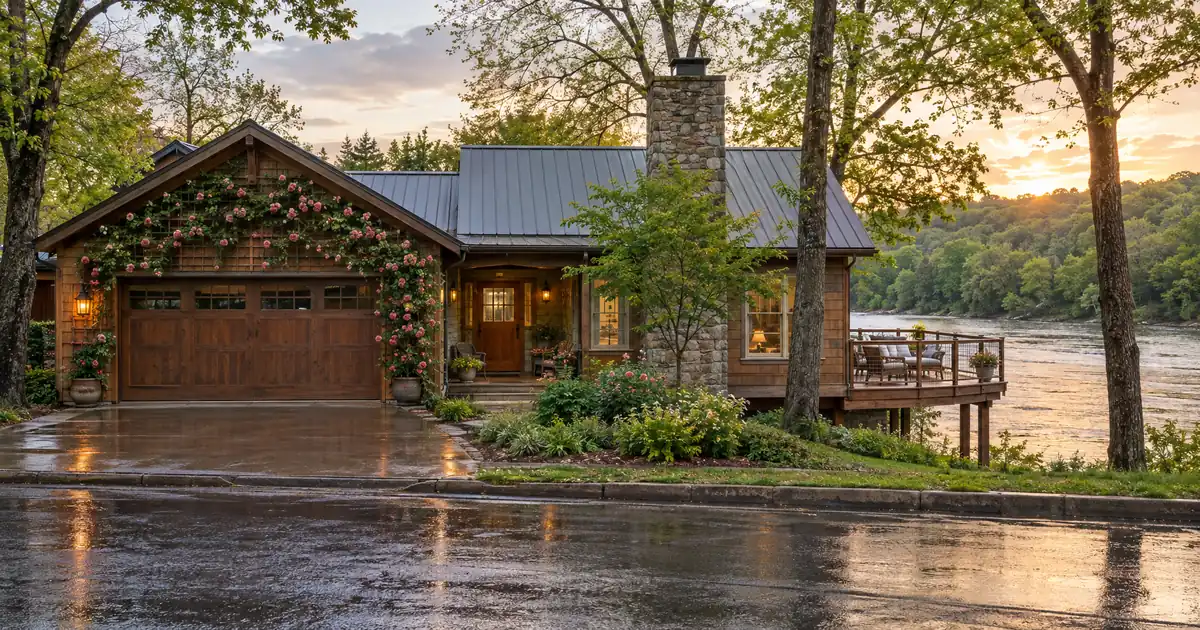
The Quick Read: It depends on the loan size, your credit score, and whether the house is a second home or a rental. Through select wholesale programs, subject to full underwriting, a second-home lake purchase typically needs about 15% down at smaller loan sizes, and the cash required rises as the loan grows.
- The down payment is whatever remains after the program’s maximum loan-to-value cap is applied to the price.
- Second homes run lower in leverage than a primary residence, and investment properties run lower still in some bands.
- Appraisal gaps, reserves, and flood coverage sit on top of the percentage.
- Above $4,000,000, every file is reviewed case by case before submission.
Why There Is No Single Number
The down payment is the price minus the largest loan the program allows. That cap moves with three things: your credit score, the loan amount, and how the house is classified.
Nobody publishes one standard figure. Bank statement loans are non-QM, meaning they sit outside the standard rules for mainstream mortgages. Each program sets its own leverage grid. Across the wholesale network Lendmire works with, those grids differ by lender, and the strictest overlays sit at the top of the size range.
Loan-to-value (LTV) is the loan divided by the property value. An 85% LTV ceiling means you put down at least 15%. The ceiling is a maximum, so a weak file or a thin appraisal can push the real number higher. Terms depend on the lender’s guidelines, the property type, the leverage, and a full review of the credit profile. Lendmire’s complete DSCR loans guide covers the investor-loan side if your lake house may end up as a rental.
How the Loan Reads Your Income
Bank statement loans qualify you on deposits instead of traditional personal-income documentation. HousingWire’s non-QM guide describes the core idea: the lender reviews 12 to 24 months of actual deposits and applies an expense factor to business accounts.
The mechanics matter here because income sets how much loan you can carry. Across the programs Lendmire places files with, the process runs like this:
- You provide 12 or 24 consecutive months of personal or business statements. Transaction histories do not substitute.
- Business statements require at least 25% ownership of the business.
- Qualifying income is eligible deposits divided by the statement months, after an expense ratio.
- Fixed expense ratios are tiered by business type and headcount. A service business with no employees gets the lowest ratio, and ratios step up for businesses with employees and for any product business. An accountant-provided ratio is another route.
- A profit-and-loss method exists too, capped at 80%.
- Transfers from your own business into your personal account count in full.
Debt-to-income can run to 50%. The credit floor is typically 660 on the portfolio non-QM program, which carries files to $6,000,000, and 700 above the super-jumbo line.
Founders, physicians, attorneys, and entertainers fit this path because their traditional personal-income documentation often understates cash flow. A bigger down payment shrinks the loan and lowers the income needed to carry it. That is a useful lever when the deposits are strong but lumpy.
Second Home or Rental? That Decides the Grid
Occupancy is the first question, not the last. A lake house you will use yourself is a second home. A lake house you plan to rent out is an investment property. Each has its own leverage ladder.
Here is the ladder for purchases through select wholesale programs, subject to underwriting. Every figure is a ceiling, and the bands are by loan amount.
| Loan size | Second home purchase | Investment purchase | Credit for this leverage (second home) |
|---|---|---|---|
| $300K–$1M | 85% | 85% | 700+ |
| $1M–$1.5M | 80% | 80% | 680+ |
| $1.5M–$2M | 80% | 80% | 700+ |
| $2M–$2.5M | 80% | 80% | 720+ |
| $2.5M–$3M | 75% | 75% | 720+ |
| $3M–$4M | 65% | 60% | 760+ |
| $4M–$5M | 65%, on review | 65%, on review | 760+ |
Read the second-home column as a down payment. An 85% ceiling means at least 15% down. An 80% ceiling means at least 20%. At 65%, you are putting down at least 35%, and above $4,000,000 that figure is reviewed case by case before submission. The exact numbers vary by lender and program and follow a full review of property, leverage, and credit.
Two things jump out. Leverage steps down as loans get larger, and the top-leverage cell in each band asks for a stronger score. That score is what the best cell needs, not a program floor. A lower score takes a lower leverage cell inside the same band. Most lake cabins and mid-range lake homes sit in the first four rows. Trophy lakefront sits in the last three.
Past $3,000,000 on a second home or investment property, the program adds overlays. The credit floor is 700, and the top-leverage cells in the table ask for more (720 to 760). The overlays also include a clean 0x30x24 housing history and 48 months of seasoning after any credit event. They require U.S. citizens or permanent residents, no rural property, and ten acres maximum.
Please don’t pick the classification that gives the nicer percentage. Occupancy cannot be misstated on an application. A house rented most of the year and declared a second home is a problem, not a shortcut.
Lake-Specific Factors That Raise the Cash You Need
The percentage is the starting point. Lake properties add friction that conventional suburban purchases rarely face.
Appraisals. Waterfront comparable sales are often thin. A Texas lake-market realtor notes that waterfront comps are limited, and value turns on frontage, water depth, boathouse condition, and shoreline improvements. If the appraisal lands under your contract price, the lender lends against the lower number. You cover the difference in cash. In an offer situation, plan extra down payment or appraisal-gap language.
Access, water, and septic. A Western New York law firm’s lake-house guide says lenders may ask about flood risk, property condition, access, appraisal value, and whether the home is seasonal or year-round. Private roads, shared wells, and septic systems can mean extra paperwork and a slower file. Our experience matches this pattern: files stall less over the loan terms than over road-maintenance agreements and well or septic proof that nobody collected up front.
Rural classification. Programs in the network allow rural property up to 80% on ten acres or less, and never above $3,000,000. Many lake properties sit in rural or semi-rural areas, so confirm this early.
Flood insurance. If the building sits in an FEMA flood hazard area, the lender requires coverage before funding. That changes your budget more than your leverage cap.
Property type. Second homes are one unit only. A main house with a guest unit, or a duplex on the water, generally does not fit the second-home category.
Condos and condotels. A lakeside warrantable condo can reach 85%, and a non-warrantable condo 80%, through select programs. Condotels are limited to 75% on a purchase. Check the HOA rules too, because dock and shoreline policies can restrict rentals.
Worked Examples (in Percentages)
Run the numbers on three lake purchases through a program like this one. These are modeled scenarios, not quotes.
A modest cabin, priced under $1,000,000, 720 credit. The loan lands in the first band. The second-home ceiling on a purchase is 85%, so the minimum down payment is 15%. Reserves run three months on a loan up to $500,000 and six months above that, so a cabin at 85% leverage often lands in the six-month tier. Strong deposits and the reserve months for that loan size clear the file on paper.
A mid-range lake home, with a loan between $1.5M and $2M, 700 credit. The second-home ceiling on a purchase is 80%, so you put down at least 20%. Reserves rise to nine months at this size.
A large estate, with a loan between $3M and $4M, 760 credit. The second-home ceiling on a purchase is 65%, so the down payment is at least 35%. Reserves move to nine months, and the super-jumbo overlays apply.
Now the same house as an investment property. In the $3M–$4M band the ceiling on an investment purchase is 60%, so the second-home classification gives you five points back. That gap is the reason occupancy has to be honest from the start.
Here is a toss-up worth thinking through. If you plan to use the house six weekends a year and rent it the rest, the better route might be the investment grid with a DSCR loan. That loan is reviewed primarily on property-level rental income covering the payment, subject to lender guidelines. But if you want the house as your own retreat, the second-home bank statement route is cleaner. Think about the use first, then the loan.
Reserves and Cash to Close
The down payment is one pot. Closing costs, reserves, and prepaid items are separate ones. Typical program reserves run 3 months of the housing payment for loans up to $500,000, 6 months up to $1,500,000, and 9 months above. Each additional financed property adds 2 months, to a 12-month maximum.
Cash-out proceeds cannot satisfy reserves above the super-jumbo line. Retirement accounts count toward reserves at 70% of their value, or 80% for borrowers 59½ and older. Business funds, gifts, and cryptocurrency do not count.
Add the lake-house extras on top, since lake-living guides list stricter loan requirements, flood coverage, and dock maintenance as costs beyond the mortgage. Docks, boat lifts, shoreline work, and well and septic upkeep all draw on the same cash. Budget for them before you set your down payment.
Where the Down Payment Can Come From
Your own liquid funds work best. The down payment has to be documented, and large unexplained deposits draw questions. Funds should be in your account long enough to look like yours.
Business funds are the sticking point for self-employed buyers. Moving money from your business to your personal account for income purposes counts at 100%. Business funds never count as liquid assets on the asset-based paths, and they do not count toward reserves. Keep those ideas apart, and plan on personal funds for the cash to close.
The practical rule: start moving funds to where they will sit well before you apply, and ask the lender how they will treat any business-account money before you transfer it.
Other Paths: Assets and the Longer Documentation Menu
Some buyers have high net worth but thin deposits. Two asset-based paths exist in the network for primary and second homes:
- Asset allowance. The lender divides liquid assets by 36, 60, or 84 months to produce qualifying income. The 84-month version stands alone and applies to any loan above $3,500,000.
- Assets-only. There is no debt-to-income test when U.S. liquid assets equal the loan amount plus closing costs plus any net loss on other residential property.
Both are subject to full underwriting, and neither is a shortcut around the leverage ladder.
Bank Statement or DSCR for a Lake House?
The two products answer different questions. A bank statement loan asks whether you can carry the house. A DSCR loan asks whether the house can carry itself.
| Factor | Bank statement | DSCR |
|---|---|---|
| Reviewed on | Your deposits or assets | Property rental income |
| Best for | Personal-use second home | True rental |
| Personal stays | Fits | Limited |
| Leverage grid | Second home or investment | Investment |
DSCR loans are designed for non-owner-occupied investment properties. Because they are business-purpose investor loans, they are reviewed differently from a standard owner-occupied mortgage. If you want to use the lake house yourself, DSCR is rarely the right fit. Short-term rental rules can vary by city, county, HOA, and property type, so investors should confirm local rules before relying on projected rental income.
Tax treatment can depend on how the funds are used and how the property is held; investors should keep clear records and speak with a qualified tax professional before relying on any deduction.
What If You Are Short on Down Payment?
You have options. None of them involves bending the paperwork.
1. Lower the price. A smaller loan can land in a higher-leverage band.
2. Wait and build. Extra months of deposits can raise income and also the liquid funds on file.
3. Strengthen credit. The ladder is tiered by score, and a higher score can improve leverage at several sizes.
4. Try the asset path. If your liquid assets are strong but deposits are lumpy, the allowance may replace the income calculation.
5. Switch the structure. Some buyers move to a larger down payment on a smaller house and finance a boat or dock separately.
This is also where a broker earns the fee. Lenders in the wholesale network differ on credit tiers, asset treatment, and property types, so a file that fails one grid may fit another.
Preparing Your Statements 12 to 24 Months Out
Clean paper matters more than clever structure.
- Keep business and personal accounts separate, with clear transfer history.
- Avoid large, unexplained deposits that you cannot tie to a source.
- Decide whether 12 or 24 months of statements shows your income best. A volatile year can argue for 24 months.
- Know your expense ratio method before you apply.
- Gather the lake-specific documents: road agreements, septic and well proof, flood determination.
The rule of thumb: if you could explain every deposit to a stranger, you are ready.
Key Terms Defined
Non-QM: A mortgage that falls outside the standard qualified-mortgage box and is underwritten to its own program rules. The consumer-protection baseline still applies; the CFPB’s assessment report describes the requirement that lenders make a reasonable, good-faith determination, based on verified documentation, that you can repay.
LTV (loan-to-value): The loan amount divided by the property value, expressed as a percentage.
Expense ratio: The share of business deposits the lender removes before counting income.
Reserves: Liquid funds left after closing that cover months of housing payments.
Seasoning: The time funds or credit events must sit on record before a lender counts them.
Appraisal gap: The difference between your contract price and a lower appraised value, paid in cash.
Frequently Asked Questions
Can I put less than 15% down on a lake house with a bank statement loan?
Usually not on a second home at the sizes most lake houses carry. Through select wholesale programs, the best second-home purchase ceiling is 85%, which means 15% down, and that applies to loans from $300,000 to $1,000,000 at a 700 credit score. Primary-residence programs reach 90% in that band, but a lake house rarely qualifies as a primary. Every file is underwritten individually.
Does renting the lake house change the down payment?
Yes, and it can raise it. In the $3M–$4M band the investment ceiling on a purchase is 60% versus 65% for a second home. In several lower bands the two ladders match. Occupancy must match how you actually use the house.
Do I need reserves on top of the down payment?
Yes. Programs typically ask for 3 months of housing payments up to $500,000, 6 months up to $1,500,000, and 9 months above, with extra months for each additional financed property. Lake houses often add flood insurance, docks, and upkeep to the cash picture.
Can I use business funds for the down payment?
Not directly, as a rule. Business-account money is not counted as your personal liquid assets, and it does not count toward reserves either. The safe plan is to move the money into your personal account well ahead of the purchase and document where it came from. Whether a given program accepts a particular transfer as your cash to close depends on the lender and your paperwork, so ask before you move anything. Separately, transfers from your business into your personal account count in full as income on a bank statement file.
Does a seasonal cabin qualify as a second home?
It can, but classification and access matter. Lenders ask whether the home is seasonal or year-round, and county records sometimes label winterized homes as cabins. Confirm the classification and road access before you make an offer.
Next Step
If you are financing a high-balance property on business or personal bank statements and want to see how the numbers work, Lendmire can help you compare super jumbo bank statement loan options based on your deposits, the property, credit profile, leverage, and your goals. Lendmire is a broker, not the lender, and nothing here is a commitment to lend. Consumer mortgage lending is licensed in 16 states: AL, CA, CO, FL, GA, IN, MI, MT, NM, NC, OH, PA, TN, TX, VA, and WA. Programs change and every file is underwritten individually.
Lake buyers who plan the percentage, the appraisal gap, and the reserve cushion together tend to arrive at the closing table with cash left over.
About Lendmire
Lendmire — NMLS# 2371349 — is a mortgage brokerage specializing in DSCR investor loans, helping arrange financing across 41 markets, including Washington, D.C., through wholesale and investor-lending channels. The model centers on property-level rental income reviewed by the lender rather than W-2 documentation, subject to lender guidelines, suiting entity-owned and multi-property investors. Lendmire holds Scotsman Guide Top Mortgage Workplace recognition for 2025 and 2026.
Get Started
Ready to find the right loan for you?
In about 30 seconds you can review financing options available for your home or investment property. No commitment required.
Informational only. Not a Loan Estimate, approval, or commitment to lend. Program availability and eligibility are subject to lender guidelines, credit approval, property review, and underwriting.
References
2. Debbie French, second home financing for Cedar Creek Lake buyers
3. Cole Sorrentino, buying a lake house: legal steps before closing
4. Rosó Homes, the smart buyer’s guide to the perfect lake house
5. CFPB: CFPB Ability to Repay Qualified Mortgage Assessment Report
This article is part of Lendmire’s super jumbo bank statement loan program — full qualification details, guidelines, and scenarios live on the program page.
Related reading: How Much Down Payment Does a P&L Only Jumbo Loan Need? · How Much Can You Borrow With a 40-Year Super Jumbo Bank Statement Loan? · How Much a Super Jumbo Bank Statement Loan Lends a Founder After a Sale
Brandon Miller
Founder & CEO, Mortgage Loan Originator, Lendmire LLC
- Mortgage Loan Originator · NMLS# 1129696 · Verify on NMLS Consumer Access
- North Carolina Real Estate Broker · License# 343312 · Verify on NCREC
- North Carolina Insurance Producer · License# 19053198 · Property, Casualty, Life, Health · Verify on NAIC SBS
- Lendmire LLC · Firm NMLS# 2371349 · Verify firm licensure
Required disclosures. Lendmire (NMLS# 2371349) operates as a licensed mortgage broker, not a direct lender or depository. The discussion in this article is general in nature and should not be relied upon as financial, legal, or tax advice — every investment scenario is unique and should be reviewed by a qualified professional. Any loan inquiry is subject to lender underwriting, and this article is not a commitment to lend or a guarantee of approval. Mortgage rates, loan terms, and program guidelines vary by borrower, property, and state, and may change without notice. Equal Housing Opportunity. Verify licensure at NMLS Consumer Access.