
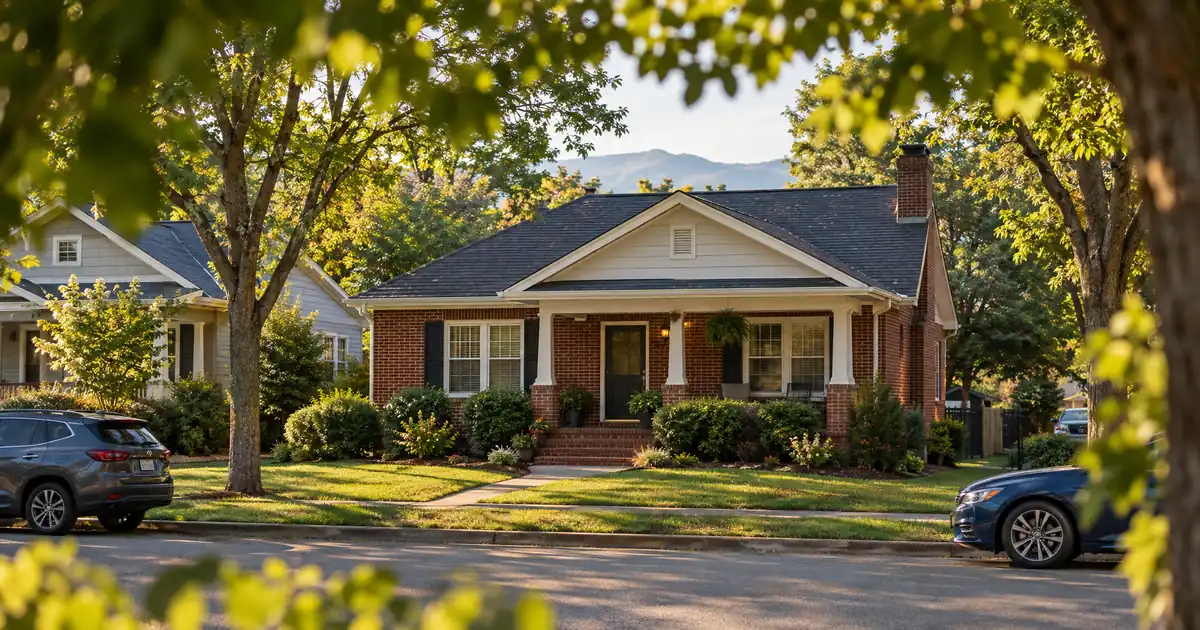
Own a paid-down rental in Asheboro and thinking about pulling cash out? Here’s what most brokers skip: at the 75 percent ceiling, a typical Asheboro house may not cover its own debt service. The equity is real, but the rent has to carry the new loan, and in a market with a price-to-rent ratio of 19.2 per Homes.com, that takes planning.
DSCR Cash-Out Calculator
Run the cash-out numbers in Asheboro, NC
Rate source: Freddie Mac 30-yr average via FRED® — Federal Reserve Bank of St. Louis · effective Sep 24, 2026
Prefilled with starting assumptions — enter your property’s value, balance, taxes, and insurance for a more accurate picture.
Program parameters update from Lendmire’s centralized guideline source. Taxes and insurance are editable estimates.
As of Sep 24, 2026 · General Freddie Mac market benchmark, not a Lendmire loan offer. Property value, balance, taxes, and insurance are editable estimates. Maximum loan-to-value varies by lender, program, property type, and seasoning. Not a Loan Estimate, approval, or commitment to lend. Program availability and eligibility are subject to lender guidelines, credit approval, property review, and underwriting.
The Short Version:
A DSCR cash-out refinance on an Asheboro investment property is underwritten primarily on the property’s rental income measured against its full monthly obligation, with the loan sized to a capped percentage of appraised value rather than to the owner’s personal income.
- Cash-out tops out at 75 percent LTV, and that’s a ceiling, not a target.
- Asheboro single-family rents run around $1,300, so leverage choice drives coverage.
- Ownership seasoning of about six months from title recording applies before cash-out.
- Toyota’s Liberty plant is the forward demand story. Rent data doesn’t show a surge yet.
- Older one-bedroom stock is where oversupply and subsidized-unit competition show up first.
Asheboro Market Snapshot
A quick read on the Asheboro investor landscape — figures come from the cited sources below. Confirm current property-level numbers before underwriting.
| Metric | Detail |
|---|---|
| Home prices | $295K median (Homes.com Asheboro multi-family) |
| Employment | 5,100+ jobs (NC Governor) |
The Ceiling Isn’t the Number
Max leverage is where Asheboro cash-outs get tight. At 75 percent LTV, most single-family rentals here pencil below 1.00 coverage, which is the standard benchmark for most DSCR programs. Dial leverage back and the same house clears comfortably. The real question is how much equity you extract before the rent stops carrying it.
Run the numbers on a modeled house. Assume an appraised value of $245,000, close to the $244,404 Zillow home value index, and assume $1,300 rent, the single-family median on Homes.com. Coverage below is rent divided by full PITIA on a standard 30-year structure, including taxes and insurance at North Carolina averages. These are modeled inputs, not sourced deal data.
| Cash-out LTV | Modeled coverage |
|---|---|
| 75 percent | High-0.8s |
| 65 percent | About 1.0 |
| 60 percent | Low-1.0s |
That table is the whole article in miniature. Extracting equity at 75 percent on a $1,300 rental leaves you under the benchmark. Stopping near 60 to 65 percent gets you to a file that lenders can review on standard terms. Sub-1.00 files may be reviewed by select lenders, but that usually means reduced leverage, stronger credit, more reserves or different pricing. An interest-only structure can also reshape the coverage number. Qualification stays subject to lender guidelines, credit approval and property review.
Working DSCR brokers see a recurring pattern in low-price, moderate-rent markets like this one: the borrower anchors on the 75 percent maximum, then discovers the rent only supports about 60 to 65 percent. The stronger files start with the coverage math, work backward to a loan size, and treat whatever cash comes out as the output rather than the goal. Lower-basis properties, whether bought cheaply or held a long time, tend to clear at higher leverage than recently purchased ones.
For the mechanics behind this, see the guide “The Refi Options” and the broader refinance details.
What Will the Appraisal Say?
Asheboro’s price data is scattered, and that spread is your appraisal risk. Zillow’s index is the steadiest read at $244,404. Resideline shows a median closing price of $235,000 across 177 closings, with the middle half between $187,500 and $290,000. Redfin posted a median sale price of $265,000, up 18.8 percent year over year, but on only 19 sales, which makes it noise more than trend. Days on market on that snapshot rose to 63 from 28.
Read that as a wide band, not a point. Underwrite at the conservative end. An investor who models cash-out at $295,000 because one portal said so may watch the appraisal land closer to $240,000, and the proceeds shrink accordingly. Slow-to-moderate days on market point to steady demand, not an overheated market that will hand you a generous valuation. Don’t count on appreciation to bail out the math.
Seasoning matters here too. The six-month clock runs from title recording, so an investor who bought recently and renovated should map the calendar before ordering anything. Reserves of about six months of PITIA also apply, so budget for cash left in the account after the deal, not just cash coming out.
Sunset Avenue and the Older Stock
Downtown and midtown, along the Sunset Avenue corridor, are the city’s most actively revitalizing residential zone: historic brick storefronts, loft apartments and local eateries near the Sunset Theatre. Renter interest is there and the story is improving. But no source gives reliable rent or price figures for the corridor, so this is a hold-and-watch submarket for cash-out purposes, not a proven equity machine. A property here that has been renovated could appraise well. One that hasn’t gets treated like the older stock around it.
South and East Asheboro are the affordability tier. Per the Homes.com local guide, much of the city’s housing is two- and three-bedroom ranches and bungalows priced roughly $150,000 to $325,000, and the low end sits in these older neighborhoods. For rent-to-value, this is where Asheboro’s best coverage ratios likely live, since a low basis against workforce rents helps. That is inference, though, and no sourced submarket rent data confirms it. Older stock also means capital needs, which appraisers notice.
Newer-build rental clusters on the west side, around Whirlwind Lane and Oak Bend Drive in ZIP 27203, show three-bedroom, 2.5-bath listings asking roughly $1,545 to $1,975. Those are point-in-time asking rents, not medians. Still, a newer three-bedroom holding rent near the top of that range covers its obligations with much more cushion than an older unit at the median. If you own one, you’re the investor most likely to clear a higher LTV.
Skip Greystone for this purpose. The historic homes there are mostly owner-occupied character properties, which means thin rental comps and low yield. Nice neighborhood. Wrong tool.
The Toyota Clock (What to Watch Over the Next Two Years)
Toyota is the reason to think about Asheboro’s equity trajectory at all. The Governor’s press release puts the battery plant investment in Liberty at $13.9 billion, creating more than 5,100 jobs in Randolph County. The plant is in Liberty, not Asheboro. Asheboro is the county seat, roughly 25,000 people, and the services and housing hub. A local broker guide puts Asheboro at a 25-minute commute, with the plant employing more than 3,000 people and ramping toward 5,100. Treat that as a broker-blog claim.
Health-care spending points the same way. Cone Health opened a $72 million, 51,500-square-foot MedCenter Asheboro and tied the investment to expected job growth, Toyota included. Local manufacturing is the base underneath: the Randolph County Economic Development Corporation says manufacturing makes up 28 percent of county employment, and the city lists Randolph Hospital, Energizer, Klaussner Furniture and Post Consumer Brands among major employers.
Here’s the honest part. Nothing sourced shows Toyota has moved Asheboro rents or prices yet. RentCafe’s average of $1,142 is up only 1.45 percent, and other platforms show anything from declines to double-digit gains. This is forward-looking demand, not proven appreciation. Underwrite today’s appraisal on today’s comps.
Indicators worth tracking over the next 6 to 24 months:
- Rent movement on three-bedrooms, not one-bedrooms. That’s where a workforce influx shows up first.
- Sale volume, since a market with 19 sales in a month can swing on a handful of deals.
- Housing coming online near the plant. Regional officials say new housing is on the way, and it competes for the same tenants.
- Hospital and MedCenter hiring, a steadier signal than announcements.
A timing thought: an owner who seasons and refinances now locks in a conservative valuation. One who waits for Toyota-driven appreciation bets that appraisals catch up before rents do. Genuine toss-up. The conservative route captures less equity but doesn’t require the forecast to be right.
Multi-Unit Is Thin and Priced Oddly
Two-to-four-unit stock is scarce in Asheboro. Homes.com showed four multi-family listings priced from $750,000 to $1.9 million, while Redfin showed three at a median list price of $275,000. The platforms disagree, so pull the MLS directly. For a cash-out, scarcity has a specific cost: few comps, which makes the appraiser’s job harder and the value less predictable.
One data point shows how the income side works. A fully occupied 10-unit building of one-bedrooms listed on Homes.com brings in $7,739 a month, or about $774 per unit, in line with the older one-bedroom rents in South and East Asheboro. Multi-unit income here is built from roughly $775 units, so coverage depends almost entirely on what you paid and what it appraises for. Get the value and expense figures before modeling anything.
Where the Cash-Out Case Gets Shaky
Vacancy and oversupply at the bottom of the market are the risk to size. No vacancy rate was sourced, so this is a flag, not a measurement. One directory counts 1,025 subsidized affordable units in Asheboro, and new housing is coming near the Toyota site. Both compete for lower-end tenants, which is exactly where the older one-bedroom stock sits. Newer three-bedroom product likely holds rent better.
The offsetting point comes from the Randolph Hub, which reported that the area lacked enough housing to meet demand even before expected job growth. That reporting appears to be from late 2022, and several announced projects it names may have changed, so weigh it as context, not current fact. Renters make up 55 percent of Asheboro households per RentCafe, which supports the demand side either way.
DSCR vs. conventional financing
Two common ways to finance an investment property in Asheboro, NC. They qualify you differently — here’s how investors weigh them.
Why investors choose it
- Qualifies on the property’s rental income — no personal tax returns, W-2s, or pay stubs needed to document income.
- No personal debt-to-income ceiling to clear, so existing mortgages and obligations don’t cap your borrowing the same way.
- Can be closed in an LLC, keeping the property inside a business entity.
- Built for scaling — not held to the limit on number of financed properties that conventional financing applies.
- Underwriting centers on the deal: generally qualifies when the rent covers the payment, a 1.00x coverage ratio being a common baseline (confirmed in underwriting).
- Designed specifically for investment property, including long-term and, where the program allows, short-term rentals.
Where it’s strong
- Often the lowest ongoing financing cost for a buyer who fully qualifies on personal income — a fit for a first property or a cost-first purchase.
Trade-offs for investors
- Requires full personal income documentation and must fit within a debt-to-income limit — salary, existing debts, and other mortgages all count.
- Typically held in your personal name rather than a business entity.
- Caps how many financed properties you can carry, which can become a ceiling as a portfolio grows.
- Evaluates you as a borrower as much as the property, which usually means more paperwork.
How investors usually choose: a first or single property often optimizes for the lowest financing cost; portfolio builders often optimize for leverage, vesting in an LLC, and scaling past conventional caps. The right answer depends on your goals, the property, and current guidelines — both paths run through select lenders in Lendmire’s wholesale network, with eligibility and terms confirmed in underwriting.
Investors should verify current local rental rules, taxes and insurance with qualified local professionals before sizing any refinance.
Where the Proceeds Go
Extracted equity works best as the down payment on the next deal, not as a lifestyle line item. In Asheboro’s price range, a smaller cash-out can seed a purchase without pushing the original rental under the coverage benchmark, because both files will be judged on their own rent. That’s why sizing the first loan conservatively often beats maximizing it. Reserves of about six months PITIA also carry across a growing portfolio. Read the guide “What Is a DSCR Loan” if the ratio mechanics are new, or Lendmire’s DSCR-versus-conventional breakdown for why property-income underwriting suits investors scaling past conventional limits. The DSCR loan options for North Carolina investors page covers the state-level picture. To test your own property, see how the math pencils or call 828-256-2183.
Frequently Asked Questions
How do you qualify for a DSCR cash-out refinance in Asheboro?
Qualification centers on the property’s rent versus its full monthly obligation, with 1.00 the common benchmark. Typical guidance includes a credit floor of 620, about six months of ownership seasoning and reserves near six months of PITIA. Cash-out LTV is capped at 75 percent. Exact eligibility depends on lender guidelines, credit, reserves and property review.
What are the requirements for an investment property loan refinance in Asheboro, North Carolina?
Expect a rental-income appraisal, a rent schedule or lease, proof of reserves and an eligible property type. Manufactured homes, log homes and barndominiums fall outside these programs. Standard programs go up to $3,000,000, with smaller balances routed through select lenders in the network. Terms vary by lender and borrower.
Will Toyota’s plant push my Asheboro appraisal higher?
Not on a schedule anyone can promise. The plant is in Liberty, and sourced rent and price data for Asheboro show mixed movement, not a surge. Appraisers work from closed comps, so demand has to appear in sales first. Underwrite conservatively and treat any Toyota lift as upside.
Can a LLC-owned Asheboro rental be reviewed for DSCR financing?
Why does 75 percent LTV often fail on an Asheboro rental?
Because rents are modest against values. With single-family rent near $1,300 and values in the mid-$200,000s, full leverage tends to land under 1.00 once taxes and insurance are counted. Lower leverage, a newer higher-rent property or an interest-only structure may change the picture.
One Thing to Take Away
If you only take one thing from this piece, it’s this: in Asheboro, the rent decides how much equity you can pull out, so size the cash-out to the coverage math and treat Toyota’s ramp as upside rather than the plan.
For current guidelines and terms, see Lendmire’s DSCR loan programs page.
About Lendmire
Lendmire is a DSCR-focused mortgage brokerage, NMLS# 2371349, placing investor loans across 41 markets, including Washington, D.C. DSCR eligibility is generally reviewed by the lender on a property’s rental income rather than personal income documentation, which fits LLC-held rentals, self-employed investors, and portfolios scaling past conventional financed-property limits. The brokerage was recognized by Scotsman Guide as a 2026 Top Workplace.
Get Started
Ready to find the right loan for you?
In about 30 seconds you can review financing options available for your investment property. No commitment required.
Informational only. Not a Loan Estimate, approval, or commitment to lend. Program availability and eligibility are subject to lender guidelines, credit approval, property review, and underwriting.
References
1. Homes.com
2. Homes.com Asheboro multi-family
3. NC Governor’s Office: Toyota battery plant opening
4. Zillow: Asheboro home values
5. Resideline
6. Redfin
7. Homes.com
8. Randolph County Economic Development Corporation
9. Randolph Hub
11. recognized by Scotsman Guide as a 2026 Top Workplace
This article is part of Lendmire’s investment property cash-out refinance program — full qualification details, guidelines, and scenarios live on the program page.
Related reading: DSCR Cash Out Refinance Kannapolis North Carolina · DSCR Cash Out Refinance Sanford North Carolina · DSCR Cash Out Refinance Highlands North Carolina
Guides: Investment Property Cash-Out Refinance in North Carolina
Brandon Miller
Founder & CEO, Mortgage Loan Originator, Lendmire LLC
- Mortgage Loan Originator · NMLS# 1129696 · Verify on NMLS Consumer Access
- North Carolina Real Estate Broker · License# 343312 · Verify on NCREC
- North Carolina Insurance Producer · License# 19053198 · Property, Casualty, Life, Health · Verify on NAIC SBS
- Lendmire LLC · Firm NMLS# 2371349 · Verify firm licensure
Disclosures. The information presented in this article is general market commentary, not financial, legal, or tax advice. Lendmire is a mortgage brokerage (NMLS# 2371349) — not a direct lender or depository institution — and loan placement is subject to lender underwriting. Nothing in this content represents a commitment to lend. Loan terms, pricing, and program availability vary based on borrower qualifications, property characteristics, and state of subject property, and are subject to change at any time. Lendmire complies with Equal Housing Opportunity requirements. Consumer access: nmlsconsumeraccess.org.