
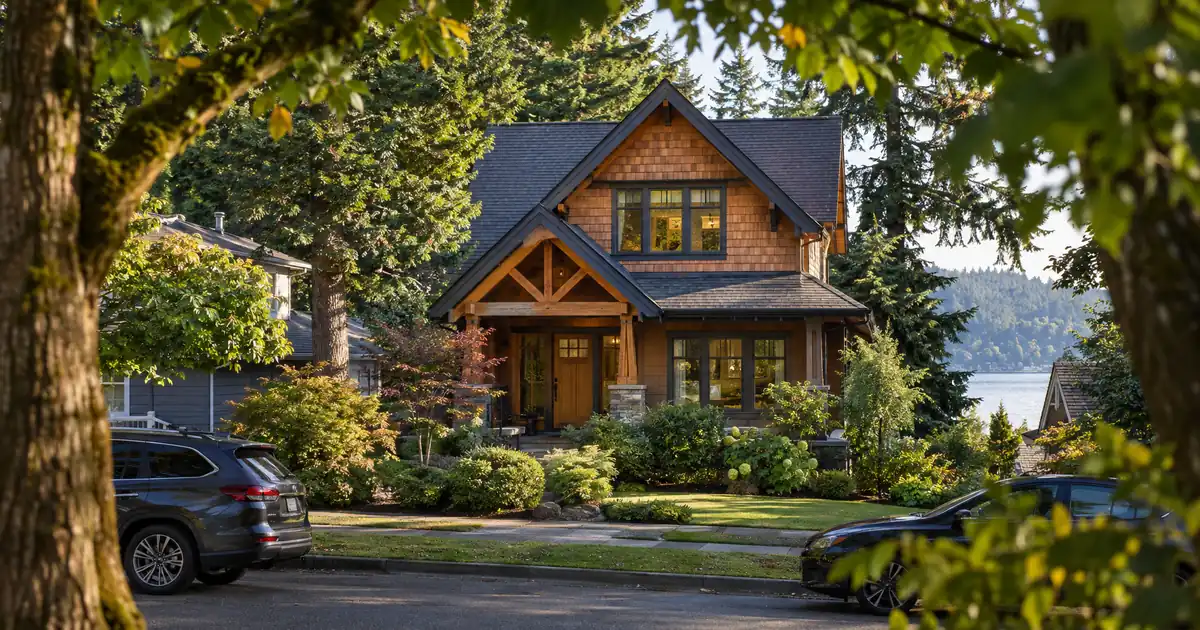
Redfin reports a Mercer Island median sale price near $2.5M, up just 0.03% year over year, at roughly $785 per square foot. RentCafe puts the 3-bedroom average rent at $3,100. Divide one by the other and annual rent comes to about 1.5% of value. That ratio defines the DSCR cash-out problem on this island, and it explains why the best refinance candidates here are not the houses people picture when they think of Mercer Island.
At a Glance: A DSCR cash-out refinance in Mercer Island, Washington State is underwritten primarily on the property’s rental income measured against its full monthly obligation, so the file works only where documented rent can carry that obligation after the lender caps leverage at 75% LTV on the new loan. Final terms depend on lender guidelines, property type, leverage, and the borrower’s complete credit picture.
DSCR Cash-Out Calculator
Run the cash-out numbers in Mercer Island, WA
Rate source: Freddie Mac 30-yr average via FRED® — Federal Reserve Bank of St. Louis · effective Sep 24, 2026
Prefilled with starting assumptions — enter your property’s value, balance, taxes, and insurance for a more accurate picture.
Program parameters update from Lendmire’s centralized guideline source. Taxes and insurance are editable estimates.
As of Sep 24, 2026 · General Freddie Mac market benchmark, not a Lendmire loan offer. Property value, balance, taxes, and insurance are editable estimates. Maximum loan-to-value varies by lender, program, property type, and seasoning. Not a Loan Estimate, approval, or commitment to lend. Program availability and eligibility are subject to lender guidelines, credit approval, property review, and underwriting.
- Median-priced single-family rentals produce coverage far below 1.00x on modeled math, with taxes and insurance included.
- Town Center multi-unit and older condo buildings are the likeliest cash-out candidates.
- Price and rent are both nearly flat, so proceeds depend on equity already built.
- The light rail station and a thin supply pipeline support in-place rents.
This article skips purchase mechanics. It assumes the investor already owns a Mercer Island property, has held it past seasoning, and wants to know whether the rent supports pulling equity out, and where the proceeds go next.
Mercer Island Market Snapshot
A quick read on the Mercer Island investor landscape — figures come from the cited sources below. Confirm current property-level numbers before underwriting.
| Metric | Detail |
|---|---|
| Home prices | 69 sales (Redfin Mercer Island Housing) |
| University enrollment | ~4,000 students (Mercer Island School District) |
| Employment | 500 staff (Mercer Island School District) |
Why Does Cash-Out Math Break on Island Single-Family Homes?
Because rent does not scale with land value. A $3,100 rent against a $2.5M asset covers roughly 0.2x of the full obligation once principal, interest, taxes, and insurance are all counted. That figure is a modeled estimate using a 30-year term, Washington-average tax and insurance loads, and a conservative financing assumption. It is not a sourced finding. Even at generous leverage assumptions, a median-priced detached rental stays well below the 1.00x benchmark that most standard programs are built around.
Some lenders may review sub-1.00x files, but those usually require stronger compensating factors, lower leverage, different pricing, or more cash in the deal. They are options a lender would weigh, not outcomes anyone should assume. Where a program permits it, interest-only structures or a sub-1.00 program can narrow the gap, though on a 0.2x file the gap is too wide for structure alone to close.
NeighborhoodScout puts the median home value at $2,629,440, with detached single-family homes making up 66.7% of housing units. Two-thirds of the island’s stock sits in the category where coverage is weakest. A lender reads that as a value story, not a yield story.
The 75% LTV ceiling on cash-out matters here too. Equity available depends on rent used for lender review, the full monthly obligation, reserves, and that ceiling. On a high-basis island, the ceiling often binds before the rent does, or the reverse, depending on the asset. Lender guidelines vary on every one of those inputs.
Where the Coverage Math Can Work
Stacked-income properties are the answer. Four 2-bedroom units at the asking rents Redfin lists for older Town Center product, $2,250 to $3,000, would gross about $9,000 to $12,000 a month, or $108,000 to $144,000 a year. A single 3-bedroom house at $3,100 grosses about $37,200 a year. That is a derived comparison from Redfin asking rents and the RentCafe average, not a sourced comp.
Run it as a modeled break-even. Using the same financing assumptions as above, at 75% LTV and with taxes and insurance included, a property needs gross rent of roughly 7% of its value per year to reach 1.00x. On that basis, the four-unit gross lines up with a value ceiling somewhere around $1.5M to $2.0M. The single house lines up with a value ceiling near $520K, which is nowhere close to island pricing. Those are modeled assumptions, not market facts, and no sourced purchase prices exist for small multi-unit buildings here. Underwrite with real comps. These specifics are subject to lender guidelines and a full review of property, leverage, and credit.
| Property type | Rent logic | DSCR fit |
|---|---|---|
| Detached SFR, median value | About 1.5% of value per year | Weak |
| Older Town Center condo/apartment | Lower basis, in-place leases | Best |
| Small multifamily (4+ units) | Stacked rent on one basis | Strong if basis is low |
| SFR with ADU | Added income, no sourced comps | Case by case |
Town Center: The Submarket That Pencils
Town Center is the strongest cash-out market on the island, and it is not close. The city’s Housing Element says most multifamily housing sits in and around Town Center, including two large complexes that straddle I-90. City-data lists a median value of $677,929 for structures with five or more units. Treat that as a secondary estimate, but it sits far below the single-family median, and that gap is the whole thesis.
Asking rents here spread widely by vintage. Apartments.com shows The Mercer Apartment Homes at $2,420 to $3,870 a month across studios to two-bedrooms. Redfin shows studios from roughly $1,805 to $2,160 depending on the building, with a $500-off concession at The Hadley. Older condo and apartment units list lower: 2-bedrooms at $2,250 to $2,500 and 1-bedrooms at $2,150 to $2,200. These are asking rents, not appraiser market-rent schedules.
The practical read: older, smaller units rent about $300 to $1,000 a month below new construction. Underwrite the specific unit’s rent, not the island average. RentCafe’s $2,622 average covers only buildings with 50 or more units, so it skews toward newer product and overstates what a mid-century building will collect.
Those mid-century buildings, including The Clarice, Mercer Tower, and Mercer View Terrace, sit just west of Town Center. According to My Mercer Island, smaller buildings turn units over less often than larger ones. Low turnover means stable in-place leases, and in-place leases are what a lender wants to see when the alternative is an appraiser’s market-rent estimate. Cleaner documentation, cleaner file.
Picture an investor who bought a small Town Center building well before current values, with an existing balance sitting around 40% of today’s appraised value. A refinance to the 75% LTV cap would return the difference between the new loan and the payoff, subject to the file clearing 1.00x on documented rent. The proceeds are the point. They fund the next acquisition, and the next acquisition probably does not sit on Mercer Island. Terms vary by lender guidelines, property type, leverage, credit profile, and full file review.
Light Rail Changed the Tenant Story
Rail access is now a documented demand driver for Town Center rentals. Sound Transit lists the Mercer Island to Downtown Bellevue trip at 10 minutes, and the 2 Line began full service across Lake Washington in late March. The station’s west entrance is a short walk from the island’s retail core. The city’s older, pre-opening light rail page cites Sound Transit ride times of 10 minutes to the International District and 21 minutes to the UW campus.
For a refinance file, this matters in a specific way. It gives the appraiser and lender a concrete location story behind the rent schedule: commuters and downsizers who can reach Seattle, Bellevue, and Redmond job centers without a car. It is not a rent forecast. Neither RentCafe nor any other source in the research shows rents moving on the strength of it yet.
A Thin Pipeline, With One Exception
Supply risk on the island is low. The Urbanist reports just 549 multifamily homes added near light rail since 2010, with one building under construction adding 146 homes. It contrasts that with roughly 14,000 homes in the pipeline or recently added in Bellevue and 8,000 in Overlake. (Read that as advocacy reporting; the outlet pushes for more housing.) The sourced data shows no oversupply on the island.
The exception is that 146-unit building. Seattle Transit Blog says Lunara was set to open in summer. A lease-up of that size can pressure Town Center rents and concessions for a period, and the effect lands hardest on competing newer buildings. An older building with long-tenured leases is better insulated. Still, a refinance appraised during a lease-up should be checked against whatever concessions the new building is offering.
The city has also adopted interim rules permitting duplex, triplex, fourplex, and similar middle-housing types on most residential lots, per Let’s Talk Mercer Island. No rent comps for that new product surfaced in the research. It is a supply story, and investors should verify current local rental rules, taxes, and insurance with qualified local professionals before assuming any stacked-unit plan.
The Rest of the Island: Where Cash-Out Gets Harder
Shorewood is the island’s most accessible rental entry point. Whittley Properties describes a large apartment community there, and supply is scarce. For a DSCR owner of a small asset in that pocket, the lower basis helps coverage. No per-neighborhood price or rent data was found, so any cash-out math there starts from the investor’s own leases.
Central island areas such as Mercerdale and Parkwood are dominated by larger single-family rentals, per SJA Property Management. Those carry the same weak rent-to-value problem as the median house. Detached homes with an ADU are plausible, since the Housing Element notes accessory units can add owner income, but no ADU rent data exists to size it.
The waterfront (East Mercer Way, Island Point, Groveland) is luxury single-family territory. Skip it for DSCR cash-out. Rents there, even at the high end, run against values that make 1.00x unreachable at meaningful leverage.
What the Seasoning and Flat Market Mean for Proceeds
Equity extraction here depends on equity already built. Redfin shows the median price essentially flat, homes selling in about 9 days versus 5 a year earlier, and 69 sales in June versus 77 the prior year. RentCafe shows rents up 0.46%, from $2,610 to $2,622. Neither side is moving fast.
Don’t underwrite a refinance that assumes appreciation. Seasoning is typically about 6 months of ownership measured from title recording, so a recent purchase can qualify on the clock, but a recent purchase at today’s flat prices has little equity to extract at a 75% LTV cap. The strongest candidates are holdings bought years ago at lower basis, or properties where renovation created value.
Reserves matter on this island more than most. Programs typically ask for about 6 months of PITIA in reserves, and about 9 months once the loan balance climbs past $1,500,000. Standard programs generally run up to $3,000,000. Large balances are normal here, so the 9-month tier will come up often. Credit tiers typically start at a 620 floor, with pricing improving at 660, 680, and 700. All of these are guideline ranges, subject to lender review.
What the Deal Desk Tends to See
In supply-constrained, high-basis markets like this one, the cleaner files tend to be the ones with signed leases, rent rolls that match deposits, and a small building with several units rather than a single house. The common friction point is the appraiser’s market-rent schedule coming in under the owner’s asking rents, which can reduce coverage below what the investor modeled. Investors who run the numbers on documented in-place rent, and treat the appraisal rent as the controlling figure, avoid most surprises.
Population, Tenure, and Tenant Base
The City of Mercer Island reports a population of 25,748 in the most recent census count, up 14.1% from the prior decade, with 10,199 occupied housing units and an average household size of 2.50. Recent estimates suggest the population is essentially flat since. RentCafe shows 34% of households, 3,364, renting, against 66% owner-occupied.
The island is a high-income bedroom community. According to City-data, 44.9% of workers both live and work on the island, and daytime population drops 9.1% from commuting. The Mercer Island School District is the one verifiable large local employer, with a staff of 500 per an undated AWSP profile. Most other tenant demand comes from Seattle and Bellevue jobs, which is why the rail link matters. No hospital or college sits on the island.
Frequently Asked Questions
How do you qualify for a DSCR cash-out refinance in Mercer Island?
The property’s documented rent has to cover its full monthly obligation (principal, interest, taxes, insurance, and any HOA dues), typically at a 1.00x minimum. The investor also needs about 6 months of seasoning, a credit score above the typical 620 floor, and reserves of about 6 months PITIA. Loans are capped at 75% LTV on cash-out, subject to lender guidelines and property review. The DSCR qualification mechanics are laid out on a separate page.
DSCR vs. conventional financing
There are two common ways to finance an investment property in Mercer Island, WA, and they qualify you differently — here’s how investors weigh them.
Why investors choose it
- Qualifies on the property’s rental income — no personal tax returns, W-2s, or pay stubs needed to document income.
- No personal debt-to-income ceiling to clear, so existing mortgages and obligations don’t cap your borrowing the same way.
- Can be closed in an LLC, keeping the property inside a business entity.
- Built for scaling — not held to the limit on number of financed properties that conventional financing applies.
- Underwriting centers on the deal: generally qualifies when the rent covers the payment, a 1.00x coverage ratio being a common baseline (confirmed in underwriting).
- Designed specifically for investment property, including long-term and, where the program allows, short-term rentals.
Where it’s strong
- Often the lowest ongoing financing cost for a buyer who fully qualifies on personal income — a fit for a first property or a cost-first purchase.
Trade-offs for investors
- Requires full personal income documentation and must fit within a debt-to-income limit — salary, existing debts, and other mortgages all count.
- Typically held in your personal name rather than a business entity.
- Caps how many financed properties you can carry, which can become a ceiling as a portfolio grows.
- Evaluates you as a borrower as much as the property, which usually means more paperwork.
How investors usually choose: a first or single property often optimizes for the lowest financing cost; portfolio builders often optimize for leverage, vesting in an LLC, and scaling past conventional caps. The right answer depends on your goals, the property, and current guidelines — both paths run through select lenders in Lendmire’s wholesale network, with eligibility and terms confirmed in underwriting.
What are the requirements for an investment property loan in Mercer Island, Washington State?
Beyond the DSCR ratio, lenders review credit, reserves, property type, and loan size. Standard programs run up to $3,000,000, and balances above $1,500,000 typically need about 9 months of reserves. LLC-titled holdings can be eligible, subject to lender program eligibility. Manufactured homes, log homes, and barndominiums fall outside these programs.
Will a median-priced Mercer Island house qualify for cash-out on rent alone?
Almost certainly not on long-term rent alone. Rent near $3,100 against a value near $2.5M models far below 1.00x with taxes and insurance included. Lenders may review sub-1.00 programs or interest-only structures, with stronger compensating factors, but those are options for a lender to weigh, not expected outcomes. DSCR versus conventional is worth comparing if traditional employment income can carry the file instead.
Does light rail raise the cash-out value of a Town Center rental?
It strengthens the tenant-demand story an appraiser can cite, but nothing sourced shows rents rising yet. RentCafe’s trailing change is 0.46%. Treat rail as support for documented rent, not as a reason to project higher proceeds.
One Practical Next Step
Investors who want the equity math on a specific building can talk through the numbers with the brokerage, and the pages on pulling equity out and rate-and-term and cash-out refi details cover program structure.
For current guidelines and terms, see Lendmire’s DSCR loan programs page.
About Lendmire
Lendmire, NMLS# 2371349, is a non-QM mortgage broker serving real estate investors in 41 markets, including Washington, D.C., through DSCR investor loan programs. Qualification is generally reviewed around the subject property’s rental income rather than the borrower’s W-2 history, a practical fit for LLC-titled portfolios and self-employed investors. All scenarios remain subject to lender review and program guidelines. The firm has been recognized as a 2025 Scotsman Guide Top Mortgage Workplace and a 2026 Scotsman Guide Top Mortgage Workplace.
The biggest blind spot for DSCR investors on Mercer Island is underwriting off the island-wide average rent. That figure comes from large, newer buildings, while the appraiser’s rent schedule on a mid-century Town Center building, in the shadow of a 146-unit lease-up, can land materially lower, and on a market with flat values there is no appreciation to rescue a file that misses 1.00x.
For broader investor-financing rules and property-type coverage across the state, see Washington State DSCR loans.
Get Started
Ready to find the right loan for you?
In about 30 seconds you can review financing options available for your investment property. No commitment required.
Informational only. Not a Loan Estimate, approval, or commitment to lend. Program availability and eligibility are subject to lender guidelines, credit approval, property review, and underwriting.
References
1. Redfin
2. RentCafe
3. Mercer Island School District
5. Redfin
7. City-data
9. Redfin
10. My Mercer Island
11. Sound Transit
12. mercerisland.gov — Light Rail East Link
13. The Urbanist
18. a 2025 Scotsman Guide Top Mortgage Workplace
19. a 2026 Scotsman Guide Top Mortgage Workplace
This article is part of Lendmire’s investment property cash-out refinance program — full qualification details, guidelines, and scenarios live on the program page.
Related reading: Luxury Rental DSCR Loans In New Jersey · Jersey Shore Vacation Rental Loans: DSCR Financing In Ocean City, Cape May And Long Beach Island · DSCR Cash-out Refinance In New Jersey: Pulling Equity From A Rental
Guides: Investment Property Cash-Out Refinance in Washington
Brandon Miller
Founder & CEO, Mortgage Loan Originator, Lendmire LLC
- Mortgage Loan Originator · NMLS# 1129696 · Verify on NMLS Consumer Access
- North Carolina Real Estate Broker · License# 343312 · Verify on NCREC
- North Carolina Insurance Producer · License# 19053198 · Property, Casualty, Life, Health · Verify on NAIC SBS
- Lendmire LLC · Firm NMLS# 2371349 · Verify firm licensure
Disclosures. The information presented in this article is general market commentary, not financial, legal, or tax advice. Lendmire is a mortgage brokerage (NMLS# 2371349) — not a direct lender or depository institution — and loan placement is subject to lender underwriting. Nothing in this content represents a commitment to lend. Loan terms, pricing, and program availability vary based on borrower qualifications, property characteristics, and state of subject property, and are subject to change at any time. Lendmire complies with Equal Housing Opportunity requirements. Consumer access: nmlsconsumeraccess.org.