
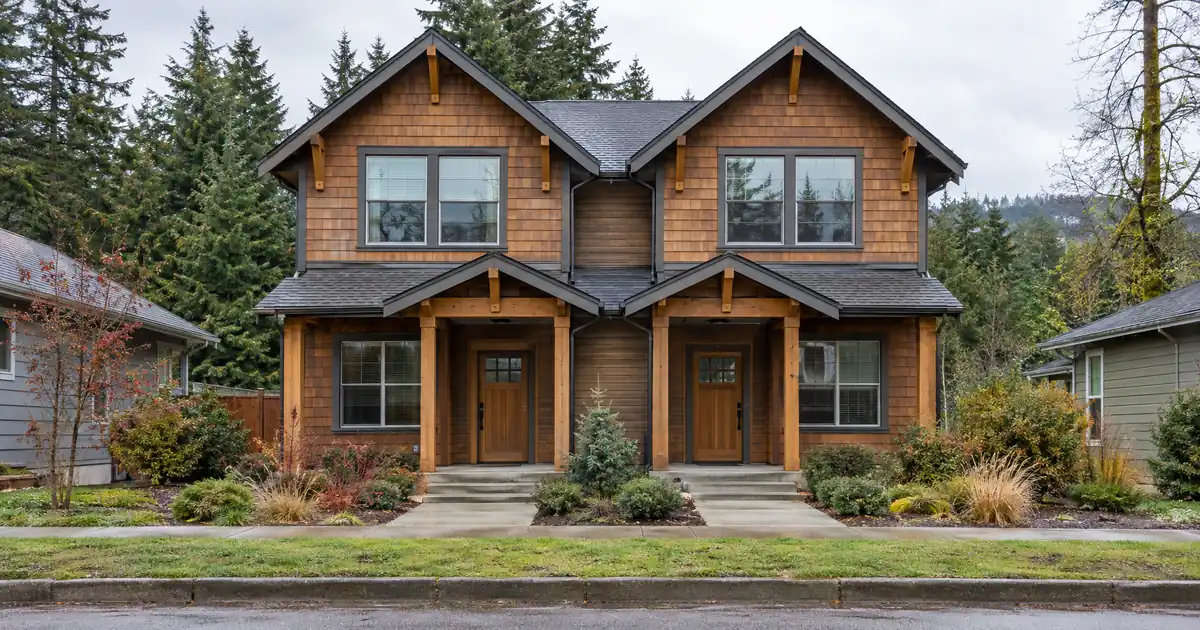
Two numbers are pulling against each other in Pullman right now. WSU’s Pullman campus slipped from 16,449 to 16,248 students in the latest fall count, per WSU News. Meanwhile, RentCafe shows average asking rent up 3.57 percent, while Zumper’s listing data shows a sharp drop. Over the next 6 to 18 months, whether enrollment stabilizes or keeps sliding will decide how appraisers and lenders read the equity in any Pullman rental. An investor planning a DSCR cash-out refinance here should plan around that tension, not around the headline rent.
At a Glance: A DSCR cash-out refinance in Pullman, Washington is underwritten primarily on the property’s rental income measured against its full monthly obligation, so stacked rents under one loan balance matter far more than the house’s price tag or the owner’s personal income.
DSCR Cash-Out Calculator
Run the cash-out numbers in Pullman, WA
Rate source: Freddie Mac 30-yr average via FRED® — Federal Reserve Bank of St. Louis · effective Sep 24, 2026
Prefilled with starting assumptions — enter your property’s value, balance, taxes, and insurance for a more accurate picture.
Program parameters update from Lendmire’s centralized guideline source. Taxes and insurance are editable estimates.
As of Sep 24, 2026 · General Freddie Mac market benchmark, not a Lendmire loan offer. Property value, balance, taxes, and insurance are editable estimates. Maximum loan-to-value varies by lender, program, property type, and seasoning. Not a Loan Estimate, approval, or commitment to lend. Program availability and eligibility are subject to lender guidelines, credit approval, property review, and underwriting.
- Duplexes and small multifamily near College Hill carry a refinance balance better than single-family homes. – NeighborhoodScout reports 74.43 percent of Pullman dwellings are rentals, with 15.35 percent small multifamily.
- Cash-out leverage typically caps at 75 percent, with about 6 months of ownership seasoning.
- Thin multi-unit sales comps can limit appraised value, and that limits cash out.
Pullman Market Snapshot
A quick read on the Pullman investor landscape — figures come from the cited sources below. Confirm current property-level numbers before underwriting.
| Metric | Detail |
|---|---|
| Home prices | $469,000 median (Movoto, Pullman) |
| Employment | Pullman regional hospital 650+ employees (WSU Pullman jobs page) |
College Hill: Where Stacked Rents Meet the Academic Calendar
College Hill is the strongest candidate for a DSCR cash-out in Pullman, and it is also the most calendar-dependent. Visit Pullman describes it as fully equipped with student-oriented housing, from apartments to rental homes, sitting beside campus and Martin Stadium. For equity extraction, the useful part is the housing form. Duplexes, triplexes, fourplexes, and converted older homes put several rent streams under one balance, and that is the structure DSCR underwriting rewards.
Pullman’s stock supports this. Per NeighborhoodScout, duplexes, converted homes, and small apartment buildings make up 15.35 percent of units, while large complexes are 49.94 percent and detached single-family homes are 27.12 percent. That small-multifamily slice is the core cash-out inventory, and it is a narrow one. Larger complexes sit outside what a small-balance investor can realistically refinance.
The College Hill Historic District adds a wrinkle. It holds 81 contributing properties, and historic status may limit alterations. An investor counting on a renovation to lift rents before refinancing should confirm what is permitted first.
The skeptical view: College Hill rents to students, and student income follows the semester. MoveGenie’s local guide notes the city quiets significantly when students leave in May. A refinance that qualifies only on nine months of strong occupancy is a refinance with a summer problem. Lenders reviewing the file may ask for lease terms that cover the full year, and a property with 12-month leases on bedroom-by-bedroom units reads very differently from one that turns over every August.
Military Hill and Sunnyside: Skip the Single-Family Math Unless the Equity Is Huge
Single-family workforce rentals on Military Hill and Sunnyside Hill are the weakest cash-out candidates in town, and the numbers show why. Zillow puts the typical Pullman home value at $429,145, up 3.0 percent year over year. RentCafe’s average 3BR asking rent is $1,722. That works out to roughly 0.4 percent of value per month, thin for a single-family rental at high leverage. (RentCafe only covers buildings with 50 or more units, so treat it as a ceiling-ish reference, not a read on small rentals.)
MoveGenie calls Military Hill an owner-occupant neighborhood where many SEL engineers and mid-career faculty settle. That makes it a long-term-tenant market, which is a real strength for lease stability. It does not fix the ratio. Sunnyside Hill and Pioneer Hill are described as quieter, more single-family streets, which is attractive to tenants and unhelpful to coverage.
Here is where the single-family case flips. An investor who bought well below market years ago, or who holds a property with a large equity cushion and a modest remaining balance, may still clear a cash-out at a lower loan-to-value than the program maximum. Pulling a smaller amount against a house can work even when pulling the maximum can’t. An investor expecting to extract the full 75 percent from a single-family rental here should stress-test that first.
Running the Coverage Numbers
The numbers below are modeled assumptions, not market data. They use full PITIA (principal, interest, taxes, and insurance) at a standard 30-year structure and 75 percent LTV, with Washington-average tax and insurance loads. Rounded down on purpose.
The only duplex rent data in the research is a single listing, not a market average. Homes.com shows a Military Hill duplex with a 4BR/2BA upper unit at $1,525 and a 3BR/1BA lower unit at $1,225, totaling $2,750 a month under one balance.
Run the numbers on two modeled values:
| Modeled scenario | Combined rent | Coverage (incl. Taxes and insurance) |
|---|---|---|
| Duplex valued near $430K | $2,750 | Roughly 1.05 |
| Duplex valued near $550K | $2,750 | Around 0.8 |
| Single-family at $429K, 3BR rent | $1,722 | Roughly 0.65 |
Same rent, different price, completely different outcome. A duplex valued near the citywide median clears the standard 1.00 baseline with little room. A duplex priced higher does not, and a single-family rental at the city median sits well below it.
When a modeled file lands under 1.00 on long-term rent, the paths a lender might review include a sub-1.00 program (typically at reduced leverage and with stronger credit), an interest-only structure, or a smaller cash-out amount. Qualification remains subject to lender guidelines, credit review, and property appraisal. The more useful question is whether the investor should reach for sub-1.00 at all. If the property’s value depends on a student-housing premium that enrollment trends could erode, a lower-leverage refinance is the more defensible structure.
DSCR files in markets like this one typically look like a small stack of units where the appraisal and the rent schedule tell different stories. The stronger files arrive with signed leases, a lender-ready rent schedule, and a clear answer on how much income comes from the academic calendar versus year-round tenants. Weak files lean on a single strong month of rent. Investors who pull their own rent comps before ordering the appraisal tend to see fewer surprises on value.
For the underlying mechanics, the guide “What Is a DSCR Loan” walks through the rent-to-obligation ratio in detail.
The 75 Percent Cap, Seasoning, and the Thin-Comp Problem
Cash-out leverage on these programs typically caps at 75 percent LTV, with about 6 months of ownership seasoning measured from title recording, a 1.00 minimum coverage baseline on standard programs, and credit tiers that generally run from 620 up through 700. Reserves around 6 months of PITIA are typical. Exact eligibility depends on lender guidelines, credit profile, reserves, and property review.
Equity available is not a fixed number. It depends on rent used for lender review, the full monthly obligation, reserves, and that 75 percent ceiling, so a property with strong equity on paper can still produce a small check if coverage is tight. Investors weighing the broader choice between refinancing paths can compare the investment property refinance options and pulling equity with a DSCR cash-out.
Appreciation is a modest lever in Pullman. Zillow’s 3.0 percent annual gain is not the kind of market growth that manufactures equity. Movoto reports a $469,000 median sale price and 58 days on market, and the sources spread from roughly $430,000 to $470,000 depending on methodology. Equity here more often comes from a below-market purchase, a renovation, or years of principal paydown than from price growth alone.
The bigger structural issue is comp depth. Redfin’s page reported 13 homes sold in Pullman in the past month, with 15 multi-family units for sale, per Redfin. That is a thin sales base. With few sold multi-unit comps, appraisers may lean on income approaches or reach to distant comps, and that can cap the appraised value used for cash-out. An investor expecting a certain equity figure should ask the lender how it handles thin comps before counting on it.
If the property is held in an LLC, entity ownership is supported on many programs, subject to lender program eligibility.
Who Pays the Rent When May Arrives?
The answer determines whether a Pullman file is stable or seasonal. Pullman has three demand layers, and only some are tied to the semester.
The university layer. WSU’s facts sheet puts Pullman campus enrollment at 16,248, including 14,178 undergraduates, 1,543 graduate and MBA students, and 527 professional students. The Washington Employment Security Department says WSU accounts for 30 percent of Whitman County employment. That concentration is a strength and a single-point exposure at once. The Washington State Standard reports enrollment down nearly 20 percent over six years across all WSU campuses, while describing the decline as slowing and stabilizing. The word “stabilizing” is doing a lot of work, and it is worth watching each fall.
The year-round layer. Schweitzer Engineering Laboratories is employee-owned, headquartered in Pullman, and employs roughly 2,300 people locally, per Wikipedia’s SEL entry. That source is secondary, so treat the figure as approximate. SEL households don’t follow the academic calendar, which is why a Military Hill rental to an SEL tenant reads differently on a file than a College Hill unit. Pullman Regional Hospital adds more than 650 employees, per WSU’s jobs page.
The twin-market layer. Moscow, Idaho sits about 8 miles away, per ForRent. The Pullman–Moscow combined statistical area counted 87,490 people in the 2020 census and an estimated 90,354 more recently, according to Wikipedia’s summary of Census figures. That widens the renter pool beyond city limits.
On renters, RentCafe shows 8,623 renter-occupied households, 68 percent of the total, and 44 percent of rentals fall in the $1,001 to $1,500 band. That band is a realistic per-unit underwriting target. Premium rents are not.
On vacancy, signals conflict, and the honest read is uncertainty. Zumper reports rents down 20.34 percent year over year, per Zumper, while RentCafe shows an increase. Their samples differ: Zumper’s listing mix and RentCafe’s 50-plus-unit buildings both differ from small-building reality. A 2021 UW Washington Center for Real Estate Research report called Whitman County the outlier with vacancy above 5 percent when other counties outside Puget Sound ran lower. It is dated, so use it qualitatively. The practical move: underwrite with a vacancy factor above a typical 5 percent and haircut rents to leases actually signed.
Five Units and Up: Where Standard Programs Stop
Pullman’s multi-unit inventory is campus-adjacent and irregular. Homes.com lists 18 multi-family homes for sale, including a Greek Row duplex, a six-unit property next to Reaney Park and the WSU campus, and a quadplex in the College Hill area, per Homes.com. The six-unit example mixes four leased 1-bedroom units with a 3BR/1BA and a 2BR/1BA home that can function as a single-family residence or a duplex.
That mix matters for financing. Five or more units usually fall outside standard 1-to-4 unit DSCR programs, so confirm unit count and program eligibility early. Mixed configurations tend to get appraised case by case. An investor who owns a quadplex or smaller has the cleaner path.
(Honestly, the six-unit property is the kind of deal where the equity looks best on paper and the financing is hardest to line up.)
Where the Proceeds Go Next
Equity extraction is only as good as the next deployment. Pulling cash out of a College Hill duplex to buy another small multifamily in the same submarket keeps the thesis consistent, since coverage ratios there can clear on stacked rents. Pulling cash out to fund a single-family purchase on Sunnyside Hill is a different decision: the new property’s coverage will be weaker than the one funding it.
An investor holding more than four financed properties is likely past what conventional lending handles, and DSCR becomes the practical lane. An investor with one rental and strong traditional employment income may find the conventional-vs-DSCR tradeoffs favor conventional on cost. The flip point tends to arrive when personal income documentation stops being the cleaner basis for the file.
Lendmire structures DSCR scenarios for investors targeting Pullman, Washington and places them with wholesale lenders across 41 markets, including D.C. Investors can see how the state fits together through Lendmire’s Washington DSCR platform or request a scenario quote, and a loan scenario call is available at 828-256-2183.
DSCR vs. conventional financing
There are two common ways to finance an investment property in Pullman, WA, and they qualify you differently — here’s how investors weigh them.
Why investors choose it
- Qualifies on the property’s rental income — no personal tax returns, W-2s, or pay stubs needed to document income.
- No personal debt-to-income ceiling to clear, so existing mortgages and obligations don’t cap your borrowing the same way.
- Can be closed in an LLC, keeping the property inside a business entity.
- Built for scaling — not held to the limit on number of financed properties that conventional financing applies.
- Underwriting centers on the deal: generally qualifies when the rent covers the payment, a 1.00x coverage ratio being a common baseline (confirmed in underwriting).
- Designed specifically for investment property, including long-term and, where the program allows, short-term rentals.
Where it’s strong
- Often the lowest ongoing financing cost for a buyer who fully qualifies on personal income — a fit for a first property or a cost-first purchase.
Trade-offs for investors
- Requires full personal income documentation and must fit within a debt-to-income limit — salary, existing debts, and other mortgages all count.
- Typically held in your personal name rather than a business entity.
- Caps how many financed properties you can carry, which can become a ceiling as a portfolio grows.
- Evaluates you as a borrower as much as the property, which usually means more paperwork.
How investors usually choose: a first or single property often optimizes for the lowest financing cost; portfolio builders often optimize for leverage, vesting in an LLC, and scaling past conventional caps. The right answer depends on your goals, the property, and current guidelines — both paths run through select lenders in Lendmire’s wholesale network, with eligibility and terms confirmed in underwriting.
Review details are subject to lender overlays, and program terms can change. For anything involving local rental rules, taxes, insurance, or ADU and zoning questions, verify current requirements with qualified local professionals.
Frequently Asked Questions
Can a single-family rental in Pullman support a cash-out refinance?
Sometimes, but at a lower loan-to-value than the program maximum. At roughly 0.4 percent monthly rent-to-value, a house at the city median produces modeled coverage well under 1.00 at 75 percent LTV. A property with a large equity cushion and a small remaining balance has a better chance, since a smaller cash-out brings the ratio up.
Does the WSU enrollment decline hurt cash-out appraisals?
It can, mostly through lender caution rather than a formula. Pullman campus enrollment slipped from 16,449 to 16,248, and system-wide enrollment is down nearly 20 percent over six years, though described as stabilizing. A lender reviewing a College Hill file may probe lease terms and occupancy more closely than it would in a market with a diversified tenant base.
How long must I own a Pullman property before pulling equity?
About 6 months, measured from title recording, is typical on these programs. A recently purchased duplex bought below market may hit seasoning before the rents have been verified on signed leases, so the paperwork often matters more than the calendar.
Do College Hill duplexes qualify under the same program as a six-unit building?
Not necessarily. Five or more units usually fall outside standard 1-to-4 unit DSCR programs. A duplex, triplex, or fourplex is the cleaner fit, while mixed configurations like a six-unit building next to campus are typically reviewed case by case.
Which rent figure should I use for Pullman underwriting?
Use the rents on signed leases, then cross-check them against comps. Published averages range from RentCafe’s $1,446 to Zillow’s $1,500 to lower figures from other sources, and none of them is a direct read on small buildings. A lender’s rent schedule will generally control.
The Blind Spot
The biggest risk for a DSCR-financed Pullman investor is concentration: one university drives the demand, student rents run on a nine-month calendar, and the small-multifamily comps that support appraised value are scarce. A refinance sized to the maximum 75 percent on rents that only hold during the school year leaves almost no room if enrollment slides again or summer vacancy runs longer than modeled. Sizing the cash-out to the year-round income, not the peak-semester income, is the discipline this market rewards.
For current guidelines and terms, see Lendmire’s DSCR loan programs page.
About Lendmire
A non-QM mortgage broker (NMLS# 2371349), Lendmire arranges DSCR financing for real estate investors in 41 markets, spanning 40 states plus Washington, D.C. Because deals are underwritten primarily on property cash flow rather than personal income documentation, the structure suits self-employed buyers and entity-owned portfolios. Lendmire places loans through wholesale investor lenders and is not a direct lender. It is recognized as a 2026 Scotsman Guide Top Workplace and a 2025 Scotsman Guide Top Workplace.
Get Started
Ready to find the right loan for you?
In about 30 seconds you can review financing options available for your investment property. No commitment required.
Informational only. Not a Loan Estimate, approval, or commitment to lend. Program availability and eligibility are subject to lender guidelines, credit approval, property review, and underwriting.
References
2. RentCafe: Pullman rent trends
3. NeighborhoodScout: Pullman real estate
4. Movoto
7. Zillow Home Value Index: Pullman
8. Homes.com
9. Redfin
11. Washington Employment Security Department: Whitman County profile
12. Washington State Standard: WSU enrollment
14. ForRent
15. Wikipedia’s summary of Census figures
16. Zumper
17. UW Washington Center for Real Estate Research report
18. Homes.com: Pullman multi-family
19. a 2026 Scotsman Guide Top Workplace
20. a 2025 Scotsman Guide Top Workplace
This article is part of Lendmire’s investment property cash-out refinance program — full qualification details, guidelines, and scenarios live on the program page.
Related reading: Cash Out Refinance Investment Property in Pullman, Washington State · DSCR Cash Out Refinance in College Station, Texas: Can Northgate Rents Cover the New Payment? · DSCR Cash Out Refinance in Dahlonega, Georgia: How the Rent Math Clears at 75% LTV Here
Guides: Investment Property Cash-Out Refinance in Washington
Brandon Miller
Founder & CEO, Mortgage Loan Originator, Lendmire LLC
- Mortgage Loan Originator · NMLS# 1129696 · Verify on NMLS Consumer Access
- North Carolina Real Estate Broker · License# 343312 · Verify on NCREC
- North Carolina Insurance Producer · License# 19053198 · Property, Casualty, Life, Health · Verify on NAIC SBS
- Lendmire LLC · Firm NMLS# 2371349 · Verify firm licensure
Compliance and disclosures. Lendmire (NMLS# 2371349) is a licensed mortgage broker and is not a direct lender, depository institution, financial advisor, or tax professional. Content in this article is general market analysis and educational information — not financial, legal, or tax advice for any specific situation. Lendmire does not guarantee loan approval; every transaction is subject to underwriting by the funding lender. Mortgage pricing and loan program guidelines are subject to change at any time without notice and vary by borrower characteristics, property type, and state regulations. Lendmire complies with Equal Housing Opportunity. Licensure verification: NMLS Consumer Access.