
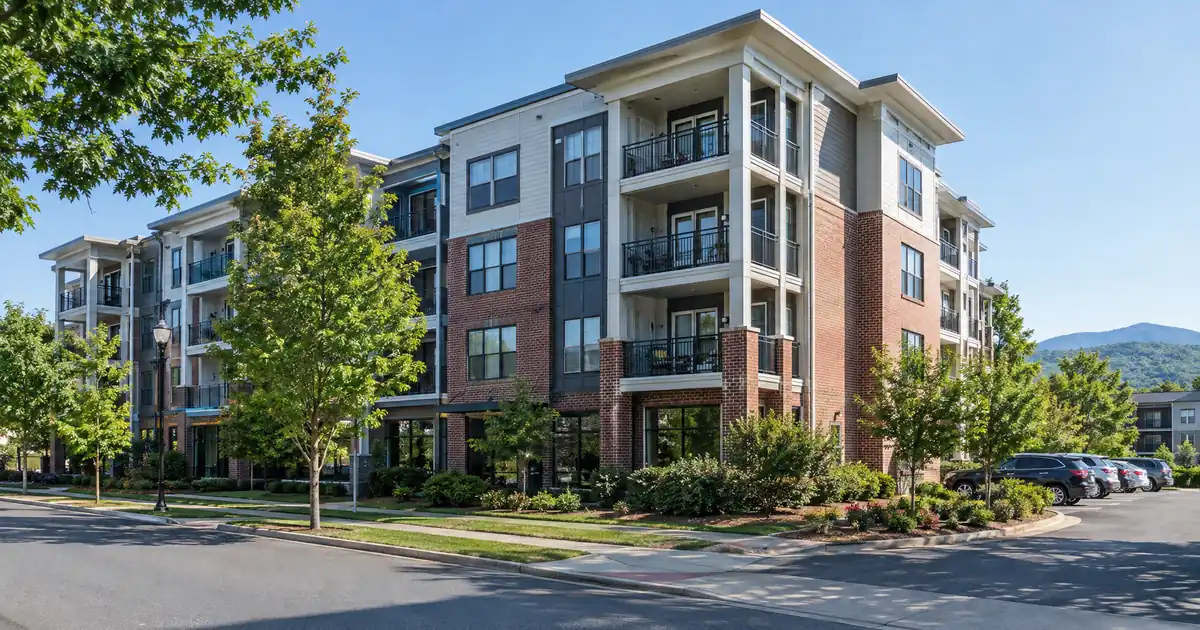
A rental in Downtown Statesville hits the DSCR math like this: an older house near the courthouse and Main Street, owned well past six months, appraising near the $277,000 median sale price Redfin reports for the neighborhood, a figure up 21.0 percent year over year. Model the rent at $1,750, the top of the three-bedroom range Zumper shows, and run a DSCR cash out refinance in Statesville at the 75 percent ceiling. Coverage, with taxes and insurance counted, lands just above 1.0x, which leaves very little cushion. Drop the loan-to-value to 65 percent and it climbs toward 1.15x. That tradeoff, how much equity to pull against how much cushion to keep, is the whole decision. (Every input in this scenario is a modeled assumption, not a quoted deal.)
The Quick Read: A DSCR cash out refinance on an investment property in Statesville, North Carolina is underwritten primarily on the property’s rental income measured against its full monthly obligation, letting an owner convert seasoned equity into capital up to a 75 percent loan-to-value ceiling, subject to lender guidelines, appraisal and reserves.
DSCR Cash-Out Calculator
Run the cash-out numbers in Statesville, NC
Rate source: Freddie Mac 30-yr average via FRED® — Federal Reserve Bank of St. Louis · effective Oct 1, 2026
Prefilled with starting assumptions — enter your property’s value, balance, taxes, and insurance for a more accurate picture.
Program parameters update from Lendmire’s centralized guideline source. Taxes and insurance are editable estimates.
As of Oct 1, 2026 · General Freddie Mac market benchmark, not a Lendmire loan offer. Property value, balance, taxes, and insurance are editable estimates. Maximum loan-to-value varies by lender, program, property type, and seasoning. Not a Loan Estimate, approval, or commitment to lend. Program availability and eligibility are subject to lender guidelines, credit approval, property review, and underwriting.
- Downtown’s median sale price sits near $277,000, up 21.0 percent, per Redfin.
- Citywide values are flat-to-modest: Zillow shows $288,953, up 2.2 percent.
- Three-bedroom rents span $1,388 to $1,750 across RentCafe and Zumper.
- Cash-out typically needs about 6 months of seasoning and caps at 75 percent loan-to-value.
- Multi-unit comps are thin, so duplex appraisals carry more risk than single-family.
Lendmire, a DSCR-focused mortgage broker, arranges these loans through wholesale and investor-lending channels. Real estate investors buying in Statesville, North Carolina can work with Lendmire to access DSCR programs across a 41-market footprint that includes D.C. This piece is about the other side of ownership: the property is already yours, and the question is what the equity can do next.
Statesville Market Snapshot
A quick read on the Statesville investor landscape — figures come from the cited sources below. Confirm current property-level numbers before underwriting.
| Metric | Detail |
|---|---|
| Recent appreciation | +2.2% yoy (Zillow Home Values) |
| University enrollment | 5,000+ students (Iredell EDC Post-Secondary) |
| Employment | 2,300+ employees (Iredell Health (City directory)) |
Downtown Statesville: Where the Equity Showed Up
Downtown Statesville is the likeliest place in the city to find real equity worth pulling. Redfin shows a $277,000 median sale price, up 21.0 percent year over year, in a historic core of older houses and small multifamily near the courthouse. Coverage there is workable, not generous.
The character matters for the lender and for the tenant. Older stock near Main Street sits close to Mitchell Community College’s Broad Street campus, and it tends to rent to working households rather than students (more on that below). A small-sample warning applies: a neighborhood median built on a handful of sales can swing hard in either direction, and a 21.0 percent jump can reverse as easily as it arrived. Treat it as a signal that downtown is moving, not as a permanent step up in value.
Further out, the affordable entry streets (Oakdale, College Park and the southeast side) are where basis tends to be lowest. No source publishes reliable rent data at that level, so the coverage claim stays qualitative: lower purchase prices against the same citywide rents mean better rent-to-value, and an owner who bought there years ago may hold more equity than the headline appreciation numbers suggest.
Which is the better refinance candidate, downtown or the affordable southeast? Honestly a toss-up. Downtown offers more recent appreciation to point an appraiser toward. The southeast offers a lower basis and, usually, a longer-held property. An owner with a long hold and a low balance has the most room under the 75 percent cap regardless of address.
West Iredell Is the Coverage Play (With a Catch)
West Iredell is where the rent-to-value arithmetic works best. Redfin’s snapshot of new homes there shows a $225,000 median, and against three-bedroom rents of $1,388 to $1,750 that implies modeled coverage of roughly 1.0x to 1.3x at 75 percent loan-to-value, taxes and insurance included.
In ratio terms, that is about 0.62 to 0.78 percent of value per month in rent (derived and illustrative, not a published figure). Compare the citywide picture: at Zillow’s $288,953 average value the same rents work out to roughly 0.48 to 0.61 percent, and modeled coverage drops to about 0.8x at the low end of the rent range and just around 1.0x at the high end.
Now the catch. A newer West Iredell house bought from a builder usually appraises close to what was paid, so a refinance after six months may free very little equity. The coverage is strong; the cash-out is small. The city-wide new-construction picture adds pressure: Redfin lists 92 new homes at a $325,000 median, and Livabl counts six low-rise new-home communities with D.R. Horton the most active developer. Builder inventory competes with resale stock and can cap appreciation on older homes, which limits refinance equity. No absorption or vacancy data exists to size that risk, so it is a watch item, not a number.
If the modeled number lands below 1.00 on long-term rent alone, a lender may review other structures: a sub-1.00 program, an interest-only period, or a lower loan-to-value that improves the ratio. Whether any of those apply depends on lender guidelines, credit approval and property review. The first question worth asking, though, is whether the property or the submarket is the problem.
The Mechanism, Step by Step
A DSCR cash-out runs five checks in sequence: seasoning, value, coverage, reserves and credit. Each can limit the proceeds independently, so the binding constraint is whichever one bites first, and in Statesville that is usually coverage or appraisal, not credit.
1. Seasoning. Programs typically look for about six months of ownership, measured from title recording.
2. Value. An appraisal sets the number. The loan can reach 75 percent of it, never above, and the existing payoff comes out first. An investor whose balance sits at 55 percent of appraised value has a 20-point gap before costs and reserves.
3. Coverage. Monthly rent divided by full monthly obligation (principal, interest, taxes, insurance and any HOA dues). The standard benchmark is 1.00x, and the guide “What Is a DSCR Loan” goes deeper. Lenders may review lower-ratio files with compensating factors, but those typically mean reduced leverage or different pricing.
4. Reserves. Roughly six months of the monthly obligation held after closing.
5. Credit. A 620 floor, with tiers at 660, 680 and 700 that typically improve terms.
Here is the part most owners miss: coverage is measured on the NEW loan, not the old one. Pulling the maximum raises the obligation and lowers the ratio. Using the downtown scenario at a modeled $1,750 rent, taxes and insurance included:
| Loan-to-value | Modeled coverage | Read |
|---|---|---|
| 75 percent | about 1.05x | Clears, barely |
| 70 percent | about 1.1x | Modest cushion |
| 65 percent | about 1.15x | Comfortable |
At the low end of the rent range the picture changes, which is why modeling both ends matters. Smaller balances, common in a market where property values sit well below those of the metro’s pricier submarkets, route through select lenders in the network. Holding the property in an LLC is common, subject to lender program eligibility. For the mechanics of the refinance types, the differences between rate-and-term and cash-out refinancing are worth understanding, and pulling equity with a DSCR cash-out covers the equity side.
On the conventional comparison: if you hold one or two financed properties and strong traditional employment income, a conventional vs DSCR on investor loans comparison is worth running, since conventional may price lower. DSCR becomes the practical lane when the portfolio is entity-held, the traditional personal-income documentation understates rental income, or the financed-property count has outgrown conventional limits. Unlike some larger non-QM lenders that treat investor loans as a side product, Lendmire is a brokerage built around DSCR files, which shapes how it packages a Statesville cash-out for lender review.
In markets like this one, the cleaner files tend to share a pattern. The lease and rent comps are lined up before the application, the insurance quote is current rather than carried over from the original purchase, and the borrower has chosen a target loan amount from the coverage math rather than from the maximum the 75 percent cap allows. The common friction point is a refinance sized to the cap that then lands under the coverage benchmark once the new obligation is counted.
Is 2.2 Percent Appreciation Enough to Refinance Into?
Statesville is a flat-to-modest market, not a boom, and equity here comes mostly from purchase basis, not market lift. Zillow shows an average value of $288,953, up 2.2 percent over the past year. For a cash-out thesis, that changes who benefits.
The owner who bought below market, improved the property or held through earlier price gains has equity. The owner who bought near current value has mostly paid down a little principal. Run the percentages honestly: if the original loan was at 75 to 80 percent of the purchase price and values have risen 2.2 percent, the cash-out cap leaves almost nothing after payoff and costs.
Sale-price data adds noise. Redfin’s citywide median sale price was $272,000 in one monthly reading, down 13.7 percent year over year, while its price per square foot rose 5.7 percent. Those monthly medians come from small samples and say more about which houses sold than about what houses are worth. Movoto’s list price sits near $359,000, but list prices skew toward new construction. An appraiser works from comparable closed sales, so the sale-side figures are what matter at refinance.
The practical test: pull three recent comparable sales within a mile or two of the property and see what the appraiser will see before committing to a target. (Do it before the application, not after.)
Duplexes and the Thin-Comp Problem
Multi-unit properties pencil better on income stacking but appraise worse here. Homes.com showed six multi-family listings priced from $270,000 to $5,000,000, and Redfin’s investment-property page shows 7 multi-family units for sale against 39 homes sold in a recent month. Single-family comps are deep. Duplex comps are not.
For a cash-out, that gap is the story. A $270,000 duplex entry price sits near the single-family median, so the income advantage depends entirely on whether the unit rents are at market. Underwrite each rent roll rather than the listing’s pro forma.
One West Statesville listing illustrates the risk: a three-house package producing $1,500 a month gross on a long rental history, roughly $500 per house against a three-bedroom market range of $1,388 to $1,750. Long-tenured legacy rents like that mean in-place income understates what a lender may use. A lender may qualify on market rent, but the owner needs a realistic plan to reach it. That is one listing, not a trend. The lesson is general: if your rents trail the market, coverage and cash-out proceeds both shrink until they catch up.
Small newly built townhome packages marketed near downtown offer another route to several rentable units at once. A lender may treat such a group as a portfolio or blanket deal, so per-unit rents and financing structure need confirming. Skip a duplex or fourplex cash-out if the comp check turns up fewer than a handful of similar sales; a single-family refinance is the cleaner path.
Who Is Actually Renting Here
Statesville’s tenant base is industrial and interstate-driven, not student or commuter-suburb. Census Bureau QuickFacts lists 43,885 people in the Statesville urban area with a median household income of $57,570, and RentCafe puts renter-occupied households at 48 percent, or 5,944 households. The official city profile is on Census QuickFacts.
I-40 and I-77 intersect in the northeastern part of the city, about 42 miles north of Charlotte on I-77, according to Salary.com’s summary of the geography. That crossroads feeds manufacturing and distribution employment, the sectors the Iredell EDC highlights alongside high-tech and agribusiness. Per BusinessWire, a $70 million expansion made Bobcat’s Statesville plant the company’s largest North American manufacturing facility, with up to 250 jobs to be added over five years. An older Iredell EDC employer list put county-level anchors at Lowe’s with 4,000 employees, Iredell-Statesville Schools at 2,900 and county government at 1,330, though those counts are dated.
Healthcare adds a steady layer. Iredell Health System took over the Davis Regional campus on Statesville’s east side, with acute care possibly returning later. Headcount figures vary by source and date, from about 1,448 in the older EDC list to more than 2,300 in the city’s directory. These are non-cyclical tenant sources.
Mitchell Community College reported a record fall enrollment above 5,000 students per the Iredell EDC, but that counts continuing education too, and no four-year university sits in the city. This is not a student-rental market. The demand story is workforce housing, and the deepest rental pool is the three-bedroom single-family home.
DSCR vs. conventional financing
There are two common ways to finance an investment property in Statesville, NC, and they qualify you differently — here’s how investors weigh them.
Why investors choose it
- Qualifies on the property’s rental income — no personal tax returns, W-2s, or pay stubs needed to document income.
- No personal debt-to-income ceiling to clear, so existing mortgages and obligations don’t cap your borrowing the same way.
- Can be closed in an LLC, keeping the property inside a business entity.
- Built for scaling — not held to the limit on number of financed properties that conventional financing applies.
- Underwriting centers on the deal: generally qualifies when the rent covers the payment, a 1.00x coverage ratio being a common baseline (confirmed in underwriting).
- Designed specifically for investment property, including long-term and, where the program allows, short-term rentals.
Where it’s strong
- Often the lowest ongoing financing cost for a buyer who fully qualifies on personal income — a fit for a first property or a cost-first purchase.
Trade-offs for investors
- Requires full personal income documentation and must fit within a debt-to-income limit — salary, existing debts, and other mortgages all count.
- Typically held in your personal name rather than a business entity.
- Caps how many financed properties you can carry, which can become a ceiling as a portfolio grows.
- Evaluates you as a borrower as much as the property, which usually means more paperwork.
How investors usually choose: a first or single property often optimizes for the lowest financing cost; portfolio builders often optimize for leverage, vesting in an LLC, and scaling past conventional caps. The right answer depends on your goals, the property, and current guidelines — both paths run through select lenders in Lendmire’s wholesale network, with eligibility and terms confirmed in underwriting.
Where the Proceeds Go
The cash-out thesis holds up when the proceeds buy another unit in a band where coverage works, and weakens when they fund a purchase where it doesn’t. Consider an owner of a seasoned downtown property redeploying into the West Iredell price band: the equity from the older asset funds a property with stronger rent-to-value. That is the cleanest version of the strategy here.
The weaker version is pulling the maximum from a thinly covered property to buy another thinly covered property. Two files at borderline coverage double the exposure to a single rent softening. If the plan involves stacking cash-outs, size each loan so the property clears comfortably on its own.
For a modeled scenario on a specific property, see how the math pencils, or reach Lendmire at 828-256-2183. Investors weighing multiple Statesville and Piedmont holdings can also review the North Carolina DSCR investor loans hub for the statewide picture.
Frequently Asked Questions
How do you qualify for a DSCR cash-out refinance in Statesville?
Qualification centers on the property’s rent against its full monthly obligation, typically measured against a 1.00x benchmark, plus appraised value within the 75 percent loan-to-value ceiling. Lenders also review credit (a 620 floor, with tiers at 660, 680 and 700), reserves of about six months and roughly six months of ownership. Exact eligibility depends on lender guidelines, credit approval and property review.
What are the requirements for an investment property loan in Statesville, North Carolina?
For a cash-out on a rental you already own: seasoning of about six months, coverage at or above the program benchmark, reserves near six months of the monthly obligation and a credit profile at or above 620. Manufactured homes, log homes and barndominiums fall outside these DSCR programs, which matters in a Piedmont market where some rural-edge properties fit those categories. Balances here are typically modest, and smaller loans route through select lenders in the network.
Does a duplex refinance differently than a single-family rental in Statesville?
The coverage math is the same, but the appraisal is harder. Multi-unit comps are thin: Redfin shows only 7 multi-family units for sale against 39 homes sold in a recent month, so an appraiser has fewer sales to anchor value. Order a comp check before choosing a target loan-to-value, and underwrite each unit at market rent rather than a legacy rent.
What documents matter most for a Statesville DSCR cash-out review?
The lease or market-rent support, the current insurance declaration and the title and payoff details for seasoning and existing balance carry the most weight. Lendmire (NMLS# 2371349) arranges DSCR programs, and those programs evaluate property cash flow rather than personal income, subject to lender guidelines.
Will new-build inventory hurt my appraisal in Statesville?
It can, indirectly. Builder communities, including six low-rise new-home communities listed on Livabl, compete with resale stock and may cap appreciation on older homes. No absorption or vacancy data was found, so treat it as a watch item. Recent comparable sales near your property are the better guide to how an appraiser will see value.
The Blind Spot: Appraisal, Not Coverage
The biggest risk for DSCR-financed investors in Statesville is not the coverage ratio; it is the appraisal. Coverage can be modeled in advance from rent and price, but value is set by closed comps, and this is a market with small samples, volatile monthly medians, a flat appreciation read and thin multi-unit sales. An owner who plans a cash-out around last year’s neighborhood headline can land well short of the proceeds they expected. Verify current local rental rules, taxes and insurance with qualified local professionals, then pressure-test the equity before the application, because in Statesville the number that most often surprises an owner is the appraised value, not the debt coverage.
For current guidelines and terms, see Lendmire’s DSCR loan programs page.
About Lendmire
Lendmire (NMLS# 2371349) is a mortgage brokerage focused on DSCR investor financing, helping arrange programs through wholesale and investor-lending channels in 41 markets, including Washington, D.C. DSCR loans are evaluated by the lender on property cash flow rather than personal income, subject to lender guidelines, supporting LLC closings and accommodating investors with four or more financed properties. Scotsman Guide named Lendmire a Top Mortgage Workplace in both 2025 and 2026.
Get Started
Ready to find the right loan for you?
In about 30 seconds you can review financing options available for your investment property. No commitment required.
Informational only. Not a Loan Estimate, approval, or commitment to lend. Program availability and eligibility are subject to lender guidelines, credit approval, property review, and underwriting.
References
1. Redfin: Downtown Statesville housing market
2. Zumper: Statesville rent research
3. Zillow: Statesville home values
4. RentCafe: Statesville average rent
5. Iredell EDC: post-secondary education
6. Iredell Health (City directory)
7. Redfin — West Iredell New Homes
8. Redfin lists 92 new homes at a $325,000 median
9. Livabl counts six low-rise new-home communities
10. Redfin’s citywide median sale price
12. Homes.com showed six multi-family listings
13. Redfin’s investment-property page
15. Iredell Health System: growth
16. Mitchell Community College
17. 2025
18. 2026
This article is part of Lendmire’s investment property cash-out refinance program — full qualification details, guidelines, and scenarios live on the program page.
Related reading: Cash Out Refinance Investment Property in Statesville, North Carolina: Will My Rent Cover the New Loan? · DSCR Cash Out Refinance in Durham, North Carolina: Will My Rent Cover a Cash-Out Loan? · DSCR Cash Out Refinance in Apex, North Carolina: The 2026 DSCR Financing Guide to Downtown Apex
Guides: Investment Property Cash-Out Refinance in North Carolina
Brandon Miller
Founder & CEO, Mortgage Loan Originator, Lendmire LLC
- Mortgage Loan Originator · NMLS# 1129696 · Verify on NMLS Consumer Access
- North Carolina Real Estate Broker · License# 343312 · Verify on NCREC
- North Carolina Insurance Producer · License# 19053198 · Property, Casualty, Life, Health · Verify on NAIC SBS
- Lendmire LLC · Firm NMLS# 2371349 · Verify firm licensure
Required disclosures. Lendmire (NMLS# 2371349) operates as a licensed mortgage broker, not a direct lender or depository. The discussion in this article is general in nature and should not be relied upon as financial, legal, or tax advice — every investment scenario is unique and should be reviewed by a qualified professional. Any loan inquiry is subject to lender underwriting, and this article is not a commitment to lend or a guarantee of approval. Mortgage rates, loan terms, and program guidelines vary by borrower, property, and state, and may change without notice. Equal Housing Opportunity. Verify licensure at NMLS Consumer Access.