
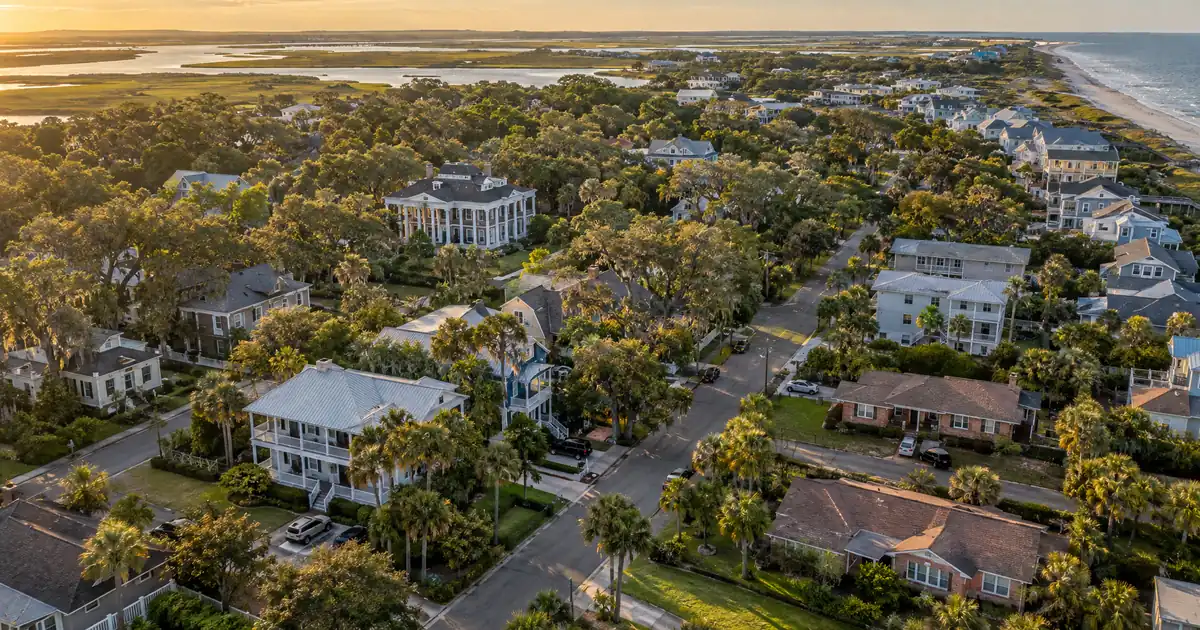
How much cash can a Sullivans Island rental actually release? Far less than the home value suggests. Zillow puts the average home value at $4,537,108, while HotPads shows a median house rent of $8,200. A cash-out refinance on an investment property here is a rent-to-value problem before it is an equity problem, and rent sets the ceiling on the proceeds.
Lendmire (NMLS# 2371349) is a DSCR-focused mortgage broker. For real estate investors in Sullivans Island, South Carolina, Lendmire helps structure and place DSCR financing through wholesale lenders operating in 41 markets, including D.C. The broker’s view of this island is narrow and practical: the equity is real, but the rent has to carry the balance.
DSCR Cash-Out Calculator
Run the cash-out numbers in Sullivans Island, SC
Rate source: Freddie Mac 30-yr average via FRED® — Federal Reserve Bank of St. Louis · effective Sep 24, 2026
Prefilled with starting assumptions — enter your property’s value, balance, taxes, and insurance for a more accurate picture.
Program parameters update from Lendmire’s centralized guideline source. Taxes and insurance are editable estimates.
As of Sep 24, 2026 · General Freddie Mac market benchmark, not a Lendmire loan offer. Property value, balance, taxes, and insurance are editable estimates. Maximum loan-to-value varies by lender, program, property type, and seasoning. Not a Loan Estimate, approval, or commitment to lend. Program availability and eligibility are subject to lender guidelines, credit approval, property review, and underwriting.
At a Glance: A DSCR cash-out refinance in Sullivans Island, South Carolina is underwritten primarily on the property’s rental income measured against its full monthly obligation, so the deal works from ownership seasoning and recorded title, through a rent schedule and appraisal, to a leverage cap set by coverage, reserves, and loan-size limits.
- Cash-out LTV tops out at 75 percent, with about 6 months of seasoning from title recording.
- Listed house rent runs near $8,200 against multi-million-dollar values, which thins the coverage number.
- Standard programs run up to $3,000,000, and island values often sit above that.
- Interior homes and condos should pencil better than oceanfront.
Sullivans Island Market Snapshot
A quick read on the Sullivans Island investor landscape — figures come from the cited sources below. Confirm current property-level numbers before underwriting.
| Metric | Detail |
|---|---|
| Home prices | $4.2M median (Southern Bell Living) |
| Typical rents | $2,571 median gross rent 2024 (City-Data Sullivan’s Island) |
What the Rent-to-Value Gap Does to the Number
The island’s rents are high in dollars and low against value. A DSCR cash-out refinance divides rent used for lender review by the full monthly obligation (principal, interest, taxes, insurance, and any HOA dues). When the value is $4 million or more, that obligation is large, and a rent near $8,200 does not cover it at high leverage.
Run the numbers on it as a modeled example. Assume a $4.5 million home renting at $8,200, financed at the 75 percent cash-out ceiling, with the full obligation including taxes and insurance. Coverage lands well under 0.50. That is nowhere near the 1.00 benchmark most standard programs are built around.
The same math applies at the top of the rent range. A local property manager, Palmetto Street, puts island single-family rent at roughly $8,500 to $12,000 or more per month. Even at the high end, the ratio stays far below 1.00 at full leverage.
Files like this have a few paths, and a lender would review each one on the borrower’s credit, reserves, and the property:
- A sub-1.00 program, where the network has one for the scenario.
- Interest-only structuring.
- A much lower leverage point. To reach 1.00 on a $4.5 million value, the balance would have to fall to a small fraction of value.
Where 1.00 is the baseline, some lenders review lower ratios with stronger compensating factors, lower leverage, or more cash in. Eligibility depends on lender guidelines, credit approval, and property review.
Then there is the loan-size guide. Standard programs run up to $3,000,000, and 75 percent of most island values lands above that. So the cap on the balance often comes from loan size, not from LTV.
Oceanfront, Interior, and Condos: Where Coverage Holds Best
Coverage holds best in the lower-priced parts of the island. Rent does not scale in proportion to price, so the cheaper the property relative to its likely rent, the better the ratio.
Katherine Cox Homes, a local agent, puts interior homes at roughly $2.5 million to $3.5 million and oceanfront at $5 million to $15 million or more. Oceanfront is the appreciation play. It is also the weakest DSCR candidate on the island, because a rent that might run 40 percent higher than an interior home’s sits on a price that runs more than double.
Interior homes are the middle ground. They still carry a low ratio at 75 percent leverage, but they sit closer to the loan-size guide and give an appraiser more comparable sales to work with.
Condos are the most workable DSCR fit. Listings start near $899,000 per Homes.com, which puts them in a different rent-to-value range from the houses. The research does not include a documented condo rent series, so pull a rent schedule on the specific unit rather than assuming a number. Condo files also bring HOA questionnaire completeness and condo certification into the file, and an incomplete questionnaire is a common reason these files stall.
Small multifamily is a different story, and it barely exists here. The research found no documented duplex, triplex, or fourplex inventory on the island. Skip the unit-stacking playbook. This is a single-family and condo market.
The Central commercial district near Middle Street is worth a look for walkable condos and homes. Zillow’s rental listings show single examples, such as a 3-bedroom near $7,500 and a 4-bedroom near $9,800. Those are single listings, not medians. They are useful for a rent schedule, not for underwriting a whole submarket.
Appraisal Range Is the Real Variable
Comps on this island are thin, and the appraisal can land anywhere in a wide band. Sources disagree on where the market sits. Southern Bell Living, citing Charleston Trident Association of Realtors data, shows a year-end median sale price of $4.2 million, down 15.7 percent from the year before. Redfin shows an average house price of $4.76 million, up 15.5 percent, with about 112 days on market. Homes.com shows a 12-month median of $5.25 million, up 30 percent.
Those figures cannot all be right at once. What they show is a small sample where one or two oceanfront sales move the median. (Small-sample medians swing hard, and this island is the textbook case.) Homes.com counts 25 active listings and about 119 days on market. Fewer than 30 listings is a thin comp pool.
For a cash-out file, that means three things:
1. Expect a conservative valuation and plan for an LTV below the 75 percent ceiling. 2. Ask early whether an appraisal reconsideration is likely to be needed. A packet with recent in-neighborhood sales and condition adjustments is the standard recovery tool when a value comes in light. 3. Do not pencil the deal on the highest data point. Zillow’s index value sits well below the Homes.com median. Use the lower read when sizing proceeds.
Zillow’s 6.3 percent year-over-year gain supports the appreciation story. It does not settle what an appraiser will do with one specific house.
What Seasoning and Reserves Look Like on This File
Seasoning is mechanical. Programs typically look for about 6 months of ownership, measured from title recording, before cash-out is available on a recent purchase. Files that assume the seasoning away get kicked back. The settlement statement is the documentation.
Reserves matter more here than on a typical file. Programs generally ask for about 6 months of full monthly obligation in reserves, and about 9 months above $1,500,000. A luxury island balance runs well past that threshold, so the reserve requirement is large in dollar terms. Reserves documentation (statements showing the assets, seasoned and sourced) is where files on high-value properties most often need a second pass.
Credit tiers in the network start at a 620 floor, with pricing and leverage improving across the 660, 680, and 700 tiers. At this loan size, expect the higher tiers to matter. Review details are subject to lender overlays, and a thin, high-value market can draw conservative treatment on appraisal and rent schedule.
The rest of the file is documentation:
- Lease evidence. A signed long-term lease on each unit, plus a rent schedule from the appraiser. Underwriting rests on long-term lease income.
- Entity documents. Articles, operating agreement, and EIN if the property sits in an LLC, subject to lender program eligibility.
- Insurance. A complete quote in the file before it goes to the lender. Investors should verify insurance, taxes, and current local rental rules with qualified local professionals and the Town of Sullivan’s Island.
For the general mechanics, the guide “What Is a DSCR Loan” covers the ratio in full, and the cash-out qualification details walk through seasoning and LTV. Owners who want to compare a rate-and-term move can also consider their refinance options for investment properties.
Working DSCR brokers see a recurring pattern in thin, high-value markets: the appraisal is not the surprise, the coverage number is. Borrowers assume equity translates to proceeds, then the rent-to-obligation ratio caps the loan well below the LTV ceiling. Running the ratio before ordering the appraisal saves a wasted valuation.
Who Rents Here, and Why It Matters
Demand is real but narrow. Census Reporter shows 2,087 residents and a median household income of $192,813, with a mean commute of 17.6 minutes. Areavibes reports renter-occupied households well below the national average. Income supports high rents. The small renter pool means a vacancy could take longer to fill, which is a re-leasing risk for a lender to weigh against the rent.
Jobs are off the island, across the Ben Sawyer Bridge. The Charleston Regional Development Alliance lists Boeing South Carolina at more than 9,000 employees, MUSC at about 17,000, and Joint Base Charleston at nearly 25,000 military and civilian jobs. Palmetto Street names relocating professionals, military families, and healthcare workers as the typical high-end tenant, and describes them as creditworthy households who could buy but choose to rent.
That tenant base is stable. It is also small. A cash-out that assumes rent growth is a mistake, and the comparison markets show why. RentHop shows two- and three-bedroom rents in Mount Pleasant down 14 percent and 10 percent year over year. Underwrite with current in-place rent.
Where the Proceeds Go: Mount Pleasant and Charleston
Here’s the honest read. The stronger play for many island owners is not a maximum cash-out on the island. It is a moderate cash-out that funds a purchase where rent-to-value is better. Terms vary by lender guidelines, property type, leverage, credit profile, and full file review.
DSCR vs. conventional financing
Two common ways to finance an investment property in Sullivans Island, SC. They qualify you differently — here’s how investors weigh them.
Why investors choose it
- Qualifies on the property’s rental income — no personal tax returns, W-2s, or pay stubs needed to document income.
- No personal debt-to-income ceiling to clear, so existing mortgages and obligations don’t cap your borrowing the same way.
- Can be closed in an LLC, keeping the property inside a business entity.
- Built for scaling — not held to the limit on number of financed properties that conventional financing applies.
- Underwriting centers on the deal: generally qualifies when the rent covers the payment, a 1.00x coverage ratio being a common baseline (confirmed in underwriting).
- Designed specifically for investment property, including long-term and, where the program allows, short-term rentals.
Where it’s strong
- Often the lowest ongoing financing cost for a buyer who fully qualifies on personal income — a fit for a first property or a cost-first purchase.
Trade-offs for investors
- Requires full personal income documentation and must fit within a debt-to-income limit — salary, existing debts, and other mortgages all count.
- Typically held in your personal name rather than a business entity.
- Caps how many financed properties you can carry, which can become a ceiling as a portfolio grows.
- Evaluates you as a borrower as much as the property, which usually means more paperwork.
How investors usually choose: a first or single property often optimizes for the lowest financing cost; portfolio builders often optimize for leverage, vesting in an LLC, and scaling past conventional caps. The right answer depends on your goals, the property, and current guidelines — both paths run through select lenders in Lendmire’s wholesale network, with eligibility and terms confirmed in underwriting.
Palmetto Street puts Mount Pleasant single-family rent at about $3,300 a month, with three-bedrooms near $4,025, and downtown Charleston near $4,395. Zillow’s area page shows average values of about $875,306 in Mount Pleasant and $590,308 in Charleston. Rents run at a fraction of the island’s, but prices run at a far smaller fraction. Rent-to-value is likely stronger in both, and small multifamily is a realistic strategy there, which it is not on the island.
Consider an owner with an island house held for more than 6 months, seasoned, with a documented lease. They can request a cash-out at a conservative LTV, then deploy the proceeds into a Mount Pleasant rental that covers its own obligation comfortably. Whether that beats holding the island property outright is a genuine toss-up. Appreciation-minded owners could argue for keeping leverage low and waiting. Cash-flow-minded owners will see the rent gap and redeploy.
Investors who want to price a scenario can start your quote or call 828-256-2183.
Where This Fits in South Carolina
Most South Carolina DSCR content leans on Charleston, Greenville, and Myrtle Beach. Sullivans Island is a different animal, and it needs its own file discipline. The investor-loan hub for South Carolina DSCR financing covers the statewide program picture. This island sits at the far end of it, where value is high, rent is thin against it, and the file is built around conservative leverage.
Reserves, loan size, and the appraisal range are the three things that decide how much comes out. Coverage decides whether anything does.
Owners who seasoned their property, documented the lease, and sized the request to the rent will come out ahead.
Frequently Asked Questions
How do you qualify for a DSCR cash-out refinance in Sullivans Island, South Carolina?
Qualification centers on the property’s rent against its full monthly obligation, with a 1.00 ratio as the typical baseline. The file also needs about 6 months of seasoning from title recording, a credit score of at least 620 at the floor tier, and reserves of about 6 months (about 9 months above $1,500,000). Lender guidelines, credit approval, and property review all apply.
What are the requirements for an investment property loan in Sullivans Island, South Carolina?
Expect a signed long-term lease, a rent schedule from the appraiser, entity documents if the property is in an LLC, a complete insurance quote, and reserves documentation. Standard programs run up to $3,000,000, so many island values push against the loan-size guide. Investors should verify local rental rules and taxes with qualified local professionals and the Town.
How much equity can a Sullivans Island rental actually release?
It depends on rent used for lender review, the full monthly obligation, reserves, and the 75 percent LTV ceiling, and it is not a guaranteed figure. On a multi-million-dollar home renting near $8,200, coverage at full leverage sits far below 1.00, so proceeds are usually capped by lower leverage or a different program structure. Condos and interior homes generally give the rent more to work with than oceanfront.
Is a Mount Pleasant rental a better cash-out candidate than a Sullivans Island home?
Usually, on rent-to-value. Palmetto Street shows Mount Pleasant single-family rents near $3,300 against average values near $875,306 on Zillow, a much tighter ratio than the island’s. Rents there have softened, though, so underwrite on in-place leases.
Can an LLC-owned Sullivans Island rental be reviewed for DSCR financing?
Yes, subject to lender program eligibility. Lendmire arranges DSCR investor loans and qualification is generally reviewed around the property’s rental income rather than the borrower’s W-2 history. Articles of organization, the operating agreement, and the EIN go in the file.
About Lendmire
Lendmire, NMLS# 2371349, is a non-QM mortgage broker working with real estate investors in 41 markets, including Washington, D.C., through DSCR investor loan programs. Review generally centers on the subject property’s rental income instead of the borrower’s W-2 history, which suits LLC-titled portfolios and self-employed investors. Every scenario stays subject to lender review and program guidelines. The firm has earned a 2026 Scotsman Guide Top Workplace recognition and a 2025 Scotsman Guide Top Workplace recognition as a Top Mortgage Workplace.
Get Started
Ready to find the right loan for you?
See your offer in seconds. No credit pull, no obligation.
Informational only. Not a Loan Estimate, approval, or commitment to lend. Program availability and eligibility are subject to lender guidelines, credit approval, property review, and underwriting.
References
1. Zillow Home Values, Sullivans Island
2. HotPads, Sullivans Island houses for rent
4. City-Data Sullivan’s Island
5. Palmetto Street, Charleston rental market trends
7. Homes.com
8. Redfin, Sullivan’s Island housing market
10. Census Reporter — Sullivans Island SC
11. Charleston Regional Development Alliance, major employers
12. MUSC
13. Zillow — Sullivans Island SC
14. a 2026 Scotsman Guide Top Workplace
15. a 2025 Scotsman Guide Top Workplace
This article is part of Lendmire’s investment property cash-out refinance program — full qualification details, guidelines, and scenarios live on the program page.
Related reading: Cash Out Refinance Investment Property in Sullivans Island, South Carolina: How Rent Math Clears at 75% LTV · DSCR Cash Out Refinance in Pawleys Island, South Carolina: Equity Beyond the Luxury Comps · Cash Out Refinance Investment Property in Kiawah Island, South Carolina: Equity Over Cash Flow
Guides: Investment Property Cash-Out Refinance in South Carolina
Brandon Miller
Founder & CEO, Mortgage Loan Originator, Lendmire LLC
- Mortgage Loan Originator · NMLS# 1129696 · Verify on NMLS Consumer Access
- North Carolina Real Estate Broker · License# 343312 · Verify on NCREC
- North Carolina Insurance Producer · License# 19053198 · Property, Casualty, Life, Health · Verify on NAIC SBS
- Lendmire LLC · Firm NMLS# 2371349 · Verify firm licensure
Disclosures. The information presented in this article is general market commentary, not financial, legal, or tax advice. Lendmire is a mortgage brokerage (NMLS# 2371349) — not a direct lender or depository institution — and loan placement is subject to lender underwriting. Nothing in this content represents a commitment to lend. Loan terms, pricing, and program availability vary based on borrower qualifications, property characteristics, and state of subject property, and are subject to change at any time. Lendmire complies with Equal Housing Opportunity requirements. Consumer access: nmlsconsumeraccess.org.