
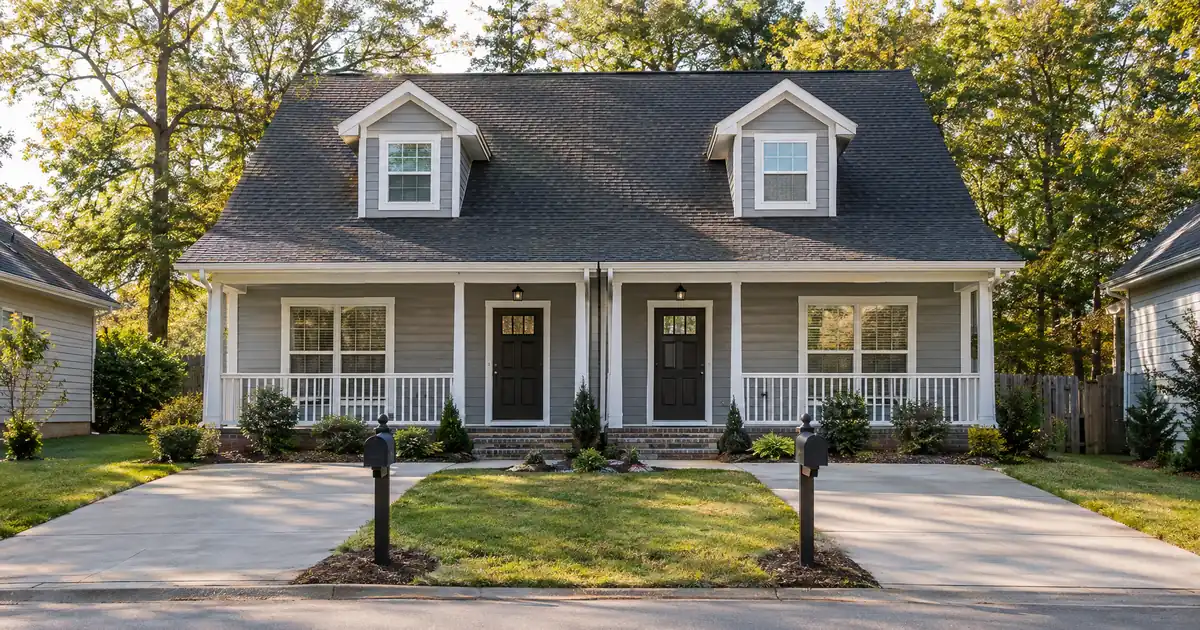
The Quick Read: A DSCR lender underwrites finished duplexes on rent supported by an appraiser’s market-rent opinion, so ten new buildings can be reviewed before any tenant signs a lease, as long as each one is complete and rentable. What changes with a batch is the sequencing, the paperwork, and whether one note or ten secures the group.
- A DSCR loan is a permanent, rent-based loan. It takes out construction. It does not pay for it.
- Each duplex needs a certificate of occupancy and working systems before its rent counts.
- Vacant units use the appraiser’s market rent. Leased units typically use the lower of the lease or market rent.
- Ten duplexes can sit under one pooled note or ten separate loans, and the choice shapes your risk more than it shapes your price.
What Does the Lender Actually Test on a Finished Duplex?
The lender tests whether the property’s monthly rent covers its full monthly obligation. The ratio is rent divided by PITIA: principal, interest, taxes, insurance, and any HOA dues. A result of 1.00 means rent equals the obligation. Anything higher means rent exceeds it.
Wikipedia’s overview of the debt service coverage ratio notes that a ratio above 1.0 means income covers debt service. It also records that traditional banks have historically wanted about 1.20 on investment property. Across the wholesale network Lendmire works with, the picture is different. 1.00 is where select programs start, and stronger ratios open better pricing and higher leverage. A separate path takes coverage below 1.00 through select lenders in the network, with leverage and terms adjusted. Those are two different paths, not one program with a moving floor.
For a new duplex, the test runs on the property, not on you. The loan is reviewed primarily on property-level rental income covering the payment, subject to lender guidelines. Credit, reserves, and property eligibility still matter. They sit beside the ratio, not behind it.
Why Can Unleased Units Still Qualify, and Where Does That Stop?
Unleased units can qualify because the income comes from an appraisal, not a lease. On a purchase of a finished, rent-ready property, most programs in the network will underwrite vacant units on market rent. The test is simple: could a tenant move in today? It is not whether anyone has.
For new builds, “rent-ready” has a concrete meaning. The building has a certificate of occupancy, utilities are on, and the systems work. A duplex that still needs punch-list work to be habitable does not pass. A finished one with no tenant usually does.
The appraiser supplies the rent figure. For two- to four-unit buildings, the report is Form 1025, the small residential income property appraisal, which Fannie Mae’s Selling Guide lists for traditional appraisals of that property size. DSCR loans are not agency loans. They borrow the form. An appraiser’s practitioner guide describes how it records rent per unit and rolls it into an operating income statement with gross rent, vacancy and expense allowances, and net income. That per-unit rent is what the DSCR lender reads.
Three limits apply:
- No ground-up construction. A DSCR loan needs an income-producing, rentable property as collateral. A building under construction is not collateral it can use.
- No borrower estimates. Projected rent comes from the appraisal, not from your pro forma.
- Refinances differ. Vacant purchases are the designed-for case. On a refinance, some programs want a lease or operating history, and seasoning is a separate test from vacancy. Cash-out refinances top out around 75% LTV on standard rentals, with about six months of seasoning as the common expectation. Terms depend on the lender’s guidelines, the property type, the leverage, and a full review of the credit profile.
Where Does the Construction Loan End and the DSCR Loan Begin?
The construction or bridge loan ends when the duplex is finished. The DSCR loan is the permanent takeout that replaces it. The builder or investor completes each building on construction money, then refinances (or sells to a buyer who finances) once the certificate of occupancy is in hand and the unit is rent-ready.
The main risk is requalification at takeout. The DSCR loan has its own appraisal, its own reserve review, and its own credit check. If the appraiser’s rent comes in lower than your pro forma, coverage drops and leverage may follow. A construction maturity date does not move because the appraisal disappointed you. Check rent comps before the buildings finish, not after.
One contrast helps here. Agency single-family-rental programs for build-to-rent communities are a different world. Skylatus, an advisory firm, describes them as requiring a minimum community size of roughly 25 to 50 or more homes, stabilized occupancy of about 90% or higher, and single-entity ownership. Ten duplexes would typically fall below those community-size thresholds. A DSCR takeout can proceed on appraiser-supported rent instead, so you do not have to wait for the occupancy number that those agency programs expect.
One Pool or Ten Files?
You can finance ten duplexes under one note or ten separate loans. The right answer depends mostly on whether the buildings finish and lease at the same time.
A portfolio DSCR loan puts several rentals under one note. People also call it a blanket loan or a cross-collateralized loan. Those are three names for the same thing: one loan secured by several properties. (A bank’s “portfolio loan,” meaning a loan the bank keeps on its own books, is a different use of the term.)
Here is how the three common structures compare:
| Factor | One pooled note | Ten separate loans | Staged takeouts |
|---|---|---|---|
| Coverage test | Pooled rent vs pooled debt | Each duplex alone | Each batch alone |
| Closings | One | Ten | Several |
| Weak property | Offset by strong ones | Stands alone | Stands alone |
| Risk | One problem weighs on all | Isolated | Isolated by batch |
| Best fit | Finished, leased group | Uneven finish dates | Phased deliveries |
Two portfolio structures exist in the network, and they differ. The 30-year portfolio DSCR loan covers 2 to 20 properties under one note, with loan sizes typically from $300,000 to $5,000,000, leverage up to 80% of value on a purchase or rate-and-term refinance, and a 1.00 coverage floor measured on the pool. It offers fixed or adjustable options, a 30-year term, an interest-only period, and eligibility for single-family, two-to-four-unit, condo, and townhome properties. Ten duplexes sit comfortably inside that range. The rental portfolio term loan is a different product built for five or more properties or units, with loan sizes from $500,000 and leverage up to 75% of value. It offers fixed 3-, 5-, 7-, and 10-year terms with a balloon at maturity. It is also the only portfolio structure that accepts small multifamily of five or more units. Both are program ceilings and floors, not quotes, and all of it is subject to lender guidelines.
The pooled test has a real advantage. Stronger duplexes can offset weaker ones, and a single duplex under 1.00 can sit in the pool when underwriting tests the pooled coverage, the leverage, and the terms. The credit floor on these portfolio programs is typically 640, with some structures asking for 680 or 720. Some structures also require a special-purpose entity, usually an LLC, subject to lender program eligibility.
The pool has costs as well. Every property still needs its own appraisal and rent evidence. Selling one duplex later follows the loan documents and the lender’s release terms, and the remaining portfolio must still cover its debt service. Ask for release terms in writing before you sign.
Where the flip point sits. If all ten duplexes finish at once and you intend to hold them together, one pooled note can be tidy. If the buildings deliver in waves, individual loans usually fit better, because a finished duplex can close on its own appraisal while an unfinished one cannot close at all. On individual loans, most purchase files in the network land at 75% to 80% LTV on an investment-property purchase, subject to lender guidelines.
How Is Rent Chosen When Leases and Projections Mix?
The lender picks one rent number per unit, and it is the lower of the signed lease and the appraiser’s market rent. A lease above market does not raise your ratio. A below-market lease can pull it down. Each unit gets its own number, and the unit results are added up for the duplex.
| Unit status | Rent counted | What to document |
|---|---|---|
| Vacant, rent-ready | Appraiser’s market rent | Appraisal only |
| Leased at market | Lease or market rent | Lease plus appraisal |
| Leased below market | The lower lease figure | Lease plus appraisal |
| Leased above market | Market rent | Lease plus appraisal |
| Duplex half-leased | Each unit on its own basis | Lease for one, appraisal for both |
Partially vacant buildings are the place where programs differ most. Many use market rent for the vacant unit, but treatment varies by lender. One practical consequence follows. A discounted lease signed just to fill a unit can cost you coverage on the loan, even though it helps your occupancy. Weigh any concession against the number the lender will actually use.
What Does a Lease-Up Timeline Look Like From Completion to Takeout?
Lease-up on a DSCR file runs in phases, and each phase has a gate. Here is the sequence:
1. Completion. Each duplex receives its certificate of occupancy and the systems are working.
2. Rent-comp check. Review comps for each unit before the appraisal is ordered, so no number surprises you.
3. Appraisals. Each duplex gets its own Form 1025 report. Ten properties mean ten appraisals, which is a real cost and scheduling line. Batching helps with coordination, but each report stands alone.
4. First leases. Signed leases begin to arrive. Each one is compared against the appraiser’s market rent.
5. Application and structure choice. You decide between one pooled note, ten separate loans, or staged takeouts, based on which buildings are done and leased.
6. Takeout. Each loan or the pool replaces the construction financing.
7. After takeout. Leasing continues on any units still vacant, and your reserves carry the gap.
What Does a Worked Example Look Like in Ratios Only?
Take ten duplexes, labeled here as modeled assumptions rather than market data. Say the payments on each building are roughly equal. Eight duplexes are leased at or near market and each produces coverage around 1.20x. Two duplexes are still vacant, and the appraiser’s rent for them yields coverage around 0.95x.
- As ten separate loans: eight files clear a 1.00 floor on their own. The two at 0.95x do not. They would need a path through select lenders in the network that accepts coverage below 1.00, with leverage and terms adjusted, or they wait for leasing to lift the number.
- As one pooled note: pooled coverage lands near 1.15x, because the stronger eight lift the weaker two. That clears a 1.00 pooled floor with room to spare, though lender review still applies.
- After the vacant two lease at market: every building sits near 1.20x, and either structure works cleanly.
The pooled version looks easier on paper. The tradeoff is cross-collateralization. If one building develops a problem, it weighs on the whole pool. Whether that tradeoff is worth taking depends on how well you know each building’s lease-up trajectory.
What Should You Hand the Lender, and When?
Paperwork follows the status of each unit, and it arrives in layers. Personal income documents are not the center of the file.
- Before the appraisal: proof the building is finished (certificate of occupancy), plus entity documents if the loan will be titled to an LLC.
- With the appraisal: Form 1025 for each duplex, ordered through the lender’s process.
- As leases arrive: signed leases, and a rent roll once more than a few units are occupied.
- For funds: statements showing where your down payment and reserves came from. Large deposits generally must be sourced and seasoned before they count.
- For reserves: commonly around six months of PITIA. Some conservative rate-and-term files at modest leverage under $1,500,000 see reserves waived, and loans above that size typically step up to about nine months. Reserves vary by lender, leverage, loan size, and transaction type.
What If Leasing Runs Slower Than the Appraiser Expected?
When leasing lags, you have four options, and each one fixes a different problem.
| Option | What it fixes | What it costs |
|---|---|---|
| Stage the takeouts | Closes the leased buildings first | More closings |
| Hold on construction financing | Buys time to lease | Extension terms vary |
| Seek a second appraisal | Challenges a thin rent opinion | Needs comp-level evidence |
| Use a sub-1.00 path | Accepts lower coverage | Lower leverage, adjusted terms |
Decide before a maturity date forces your hand. A staged plan made with time to spare nearly always beats a rushed single closing. If market rent comes in thin, the routes are narrow: a formal reconsideration with comp-level evidence, or a second appraisal. Neither is certain, and both depend on the lender’s process.
What Doesn’t the Ratio Cover?
Clearing the coverage number is not the same as positive cash flow. The calculation compares rent to PITIA and nothing else. Repairs, vacancy between tenants, management, utilities, and capital expenditures all sit outside it. With twenty units leasing at once, plan a separate budget for vacancy and concessions. A building can pass underwriting and still lose money in its first months.
Short-term rental strategy changes the picture. Nightly-rate income was not what the standard rent schedule was built to measure, and short-term programs typically want about 12 months of hosting history. Short-term rental rules can vary by city, county, HOA, and property type, so investors should confirm local rules before relying on projected rental income. For how those files treat a lease against projected rent, see Lendmire’s article How a Short-Term Rental DSCR Lender Weighs a Lease Against Projected Rent.
Tax treatment varies; consult a qualified professional.
A few property types never enter this conversation. Manufactured homes, log homes, and barndominiums are not offered in the network’s DSCR programs.
Lendmire’s complete DSCR loans guide covers the broader program landscape if you want the background before structuring a batch.
Key Terms Defined
DSCR (debt service coverage ratio): The property’s monthly rent divided by its monthly PITIA.
PITIA: Principal, interest, taxes, insurance, and any HOA dues, which together form the full monthly obligation.
Takeout: The permanent loan that replaces construction or bridge financing.
Lease-up: The stretch between completion and a full rent roll, when units are still filling.
Stabilization: The point when a property is leased and producing steady rent, often defined by an occupancy target.
Form 1025: The appraisal report for two- to four-unit properties that records rent for each unit.
Seasoning: The length of time you have owned a property or held funds, which some programs require before a refinance or deposit counts.
Cross-collateralization: One loan secured by several properties, so each property backs the whole note.
Frequently Asked Questions
Do I need a signed lease on every duplex to get a DSCR loan?
No. On a purchase of a finished, rent-ready property, most programs in the network use the appraiser’s market rent for vacant units, so no lease is required. If a lease exists, the lender typically uses the lower of the lease and market rent. Refinances can be stricter, and some programs want a lease or operating history.
Can a DSCR loan pay for building the duplexes?
Not directly. A DSCR loan needs an income-producing, rentable property as collateral, so it generally cannot fund ground-up construction. Builders usually finish on a construction or bridge loan and use the DSCR loan as the permanent takeout once each duplex has a certificate of occupancy.
Does the lender test all ten duplexes together or one at a time?
It depends on the structure. Separate loans test each duplex on its own rent and payment. A pooled portfolio DSCR loan tests the combined rent against the combined payment, so stronger buildings can offset weaker ones. Underwriting still reviews each property’s appraisal and rent evidence in either case.
What if the appraiser’s rent comes in lower than I expected?
Lower rent means lower coverage, and leverage may tighten. Your routes are a second appraisal or a formal reconsideration backed by comp-level evidence. A select-lender path that accepts coverage below 1.00 may also be available, with leverage and terms adjusted. Everything is subject to lender guidelines.
Does 90% occupancy have to be reached before a DSCR takeout?
No. A stabilized-occupancy target of about 90% is a build-to-rent and agency-takeout convention, not a rule for residential DSCR loans. Programs differ, but a finished duplex can generally proceed on appraiser-supported rent.
Talk Through the Structure Before the Buildings Finish
If you are buying or refinancing a rental property and want to see how the numbers work, Lendmire can help you compare DSCR loan options based on the property income, credit profile, leverage, and investor goals. A DSCR-focused mortgage broker with DSCR investor loans across 40 states plus Washington, D.C., Lendmire arranges these loans through select lenders in its wholesale network. It is not a commitment to lend, and every file is underwritten individually.
About Lendmire
Lendmire is a non-QM mortgage brokerage (NMLS# 2371349) arranging DSCR investor loans in 41 markets, including Washington, D.C. DSCR eligibility is generally reviewed around property-level rental income rather than personal income, subject to lender and program guidelines, a fit for self-employed investors and LLC-owned portfolios. Lendmire was recognized as a Scotsman Guide Top Mortgage Workplace in 2025 and 2026.
Get Started
Ready to find the right loan for you?
In about 30 seconds you can review financing options available for your investment property. No commitment required.
Informational only. Not a Loan Estimate, approval, or commitment to lend. Program availability and eligibility are subject to lender guidelines, credit approval, property review, and underwriting.
References
1. Wikipedia: Debt service coverage ratio
3. NJ Real Estate Appraisal blog: Form 1025 appraisal
4. Skylatus: Build-to-rent financing
This article is part of Lendmire’s DSCR loan program — full qualification details, guidelines, and scenarios live on the program page.
Related reading: How a Portfolio DSCR Lender Underwrites a Small Partnership · Can a Mix of Houses and Duplexes Share One DSCR Loan? · How a DSCR Lender Handles a Release on a Maturing Loan
Brandon Miller
Founder & CEO, Mortgage Loan Originator, Lendmire LLC
- Mortgage Loan Originator · NMLS# 1129696 · Verify on NMLS Consumer Access
- North Carolina Real Estate Broker · License# 343312 · Verify on NCREC
- North Carolina Insurance Producer · License# 19053198 · Property, Casualty, Life, Health · Verify on NAIC SBS
- Lendmire LLC · Firm NMLS# 2371349 · Verify firm licensure
Compliance and disclosures. Lendmire (NMLS# 2371349) is a licensed mortgage broker and is not a direct lender, depository institution, financial advisor, or tax professional. Content in this article is general market analysis and educational information — not financial, legal, or tax advice for any specific situation. Lendmire does not guarantee loan approval; every transaction is subject to underwriting by the funding lender. Mortgage pricing and loan program guidelines are subject to change at any time without notice and vary by borrower characteristics, property type, and state regulations. Lendmire complies with Equal Housing Opportunity. Licensure verification: NMLS Consumer Access.