
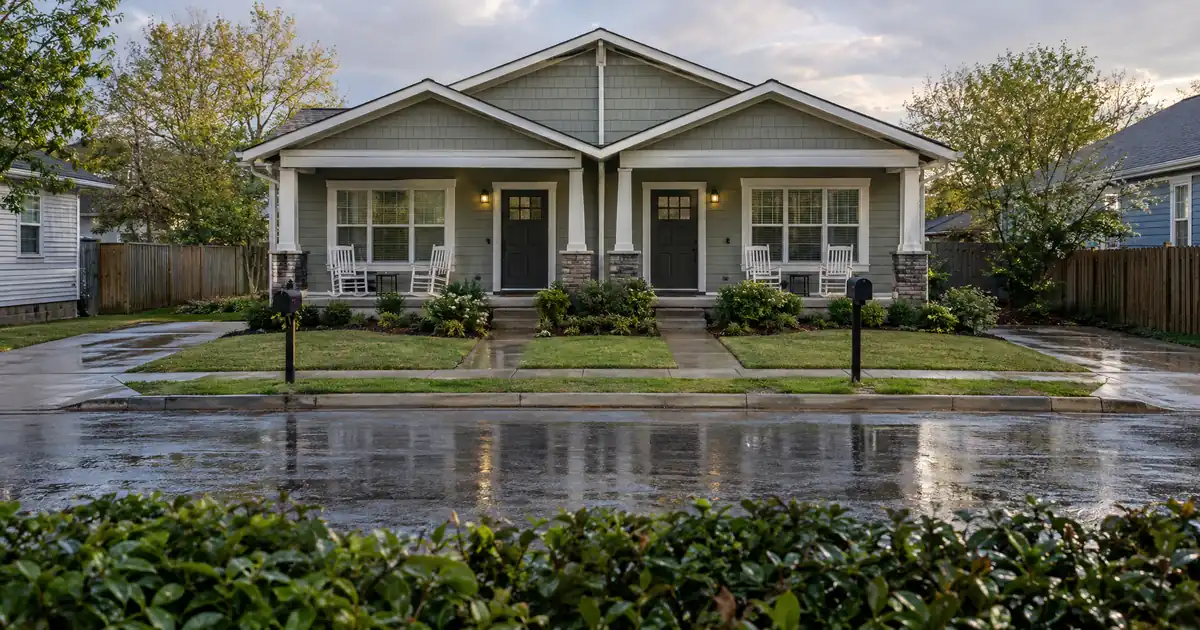
The Quick Read: To meet the occupancy requirement, no unit in a 2-4 unit building can be occupied by the borrower, the borrower’s entity members, or family, and every unit needs rent support that matches the paperwork. Programs across the wholesale network treat this as a hard yes-or-no test, separate from how many units are leased.
- The borrower must not live in any unit, in a duplex, triplex, or fourplex alike.
- Putting the building in an LLC does not change who actually lives there.
- Each unit needs either a lease or an appraiser’s market rent.
- The affidavit, leases, insurance, and mailing address must tell one consistent story.
- If you live in the building now, the DSCR refinance only works after you move out and document it.
Most of the mechanics below come from how files actually move through the network: the occupancy question gets answered first, and everything else on the file depends on that answer.
DSCR Cash-Out Calculator
Run the cash-out numbers in your market
Rate source: Freddie Mac 30-yr average via FRED® — Federal Reserve Bank of St. Louis · effective Oct 15, 2026
Prefilled with starting assumptions — enter your property’s value, balance, taxes, and insurance for a more accurate picture.
Program parameters update from Lendmire’s centralized guideline source. Taxes and insurance are editable estimates.
As of Oct 15, 2026 · General Freddie Mac market benchmark, not a Lendmire loan offer. Property value, balance, taxes, and insurance are editable estimates. Maximum loan-to-value varies by lender, program, property type, and seasoning. Not a Loan Estimate, approval, or commitment to lend. Program availability and eligibility are subject to lender guidelines, credit approval, property review, and underwriting.
What Does “Occupancy” Mean on a DSCR Refinance?
Occupancy means two different questions, and files go wrong when they get blended. The first is who lives in the building. That is a hard yes or no. The second is whether the units are leased. That is graded, and it varies by lender, unit count, and the condition of the property.
Question one decides whether the file is a DSCR file at all. If the borrower, a member of the borrower’s LLC, or a relative lives in any unit, the loan belongs on an owner-occupied track. Question two only matters once question one is answered correctly. It affects how rent is counted and sometimes how much leverage a lender will offer.
DSCR loans are designed for non-owner-occupied investment properties. Because they are business-purpose investor loans, they are reviewed differently from a standard owner-occupied mortgage. That difference is the reason the occupancy rule exists, and it is why programs hold to it so firmly.
Key Terms Defined
Non-owner-occupied: The borrower does not live in the property and does not plan to live there while the loan is outstanding.
Business-purpose loan: A loan where the money is used to buy, improve, or carry a rental property as an investment.
Occupancy affidavit: A signed statement, given before funding, that the borrower and family will not occupy the property.
Market rent: The rent an appraiser supports for a unit, based on comparable rentals, shown on the appraisal’s rent schedule.
Rent roll: A unit-by-unit list of tenants, lease terms, and monthly rent.
Form 1025: The appraisal report form used for small residential income properties of two to four units.
Can You Live in One Unit and Still Use a DSCR Refinance?
No. A DSCR refinance on a 2-4 unit property requires zero owner occupancy, and the rule has no unit-count exception. Living in one unit of a fourplex while renting the other three makes it an owner-occupied file, however much of the income comes from tenants.
This catches investors who read “2-4 units” and assume the unit count unlocks some flexibility. It does not. The usual home for a live-in owner is owner-occupied financing, which allows house hacking by design.
The rule reaches past the borrower. Most programs also bar occupancy by members of the borrower’s LLC and by family members. Closing in an entity does not convert an owner-occupied home into an eligible one. Subject to program terms, a DSCR loan to an LLC still requires that no member lives there.
Part-time use is a trap too. Some investors assume a few weeks of personal stay is fine. Programs generally allow no personal occupancy at all. The 14-day figure that circulates comes from other places, and it does not carry over:
- The IRS counts personal-use days to decide whether a rental unit is also treated as a residence for deductions. IRS Topic 415 describes that test. It is a tax test, not a loan rule.
- A separate 14-day expectation appears in the federal business-purpose commentary. The original Federal Reserve Board wording, reproduced by a state consumer agency, says a property the owner expects to occupy more than 14 days is not treated as non-owner-occupied. It uses a beach house as its example.
Neither one is a safe harbor for a DSCR file. Tax treatment varies; consult a qualified professional about how personal use affects deductions.
The Federal Angle (and Why It Does Not Help You)
One trap deserves a short note. Federal consumer-credit rules exempt loans made primarily for business purposes. That exemption flows through to the mortgage-servicing and settlement rules as well; 12 CFR 1024.5 ties its business-purpose exemption to the same definition.
Under the federal commentary, an owner-occupied rental with more than two units can be treated as business-purpose for acquisition credit. So a three- or four-unit building where the owner lives may qualify as business-purpose under federal law.
That is a classification point, not program permission. DSCR programs apply their own non-occupancy rule on top of it. A building can pass the federal test and still fail the program test. Do not read the federal point as a green light to live in a unit.
How Underwriting Treats Occupancy, Step by Step
This is the path a 2-4 unit refinance takes through the network, with the occupancy checks in the order they come up.
1. Classify the loan. The file confirms the property is non-owner-occupied, held for rent, and that any cash-out proceeds go to business or investment use.
2. Collect the occupancy affidavit. The borrower signs a business-purpose and occupancy affidavit before funding. Typical language says the borrower and family do not intend to occupy the property at any time while the loan is outstanding, that it will not be claimed as a primary or secondary residence, and that the borrower lives elsewhere. If a unit is vacant, the borrower commits to making reasonable efforts to find a tenant. Misstatement is an event of default that can lead to acceleration.
3. Make the paper trail agree. Leases, the borrower’s mailing address, the landlord insurance policy, the application, and the affidavit all need to point the same direction. Mismatches are what flag a file, not any single document.
4. Order the 2-4 unit appraisal. Form 1025 supplies the value and a market rent for each unit. Form 1007 is the single-family equivalent and does not apply here.
5. Document rent unit by unit. Occupied units need a lease, and the rent roll should show proof of payment. Vacant units use the appraiser’s market rent. Many programs use the lower of the lease or the market rent. A month-to-month or expired lease often falls back to market rent.
6. Calculate the coverage ratio. Qualifying monthly rent is divided by the full monthly housing obligation: principal, interest, taxes, insurance, and any HOA dues. Clearing 1.00 is where select programs start. Many files need stronger coverage for better pricing and leverage. A separate select-lender path takes coverage below 1.00, with leverage and terms adjusted.
7. Keep the certification alive after funding. The covenants in the affidavit continue after funding. Moving in later is a breach, not a paperwork detail.
Three things decide the outcome: whether anyone connected to the borrower occupies a unit, whether the documents tell one story, and whether every unit has rent support.
Scenario Table: Where Common Situations Land
| Your situation | DSCR-eligible? | What to do instead |
|---|---|---|
| Owner lives in one unit | No | Owner-occupied multi-unit loan |
| Relative lives in a unit rent-free | No | Move them out or use another track |
| Relative pays market rent under a real lease | Program-specific | Ask the broker before applying |
| One unit vacant between tenants | Often yes | Appraiser’s market rent counts that unit |
| One unit under renovation | Varies by lender | Finish and lease first, then refinance |
| Owner plans to move in next year | Wrong track | Refinance owner-occupied before moving in |
| LLC member lives in a unit | No | Entity label does not fix occupancy |
| Former home moved out of | Possible | Document the move first (see below) |
The relative-with-a-lease row is the gray one. Some programs will consider a related-party tenant who pays market rent under a real lease, with the relationship disclosed. Others bar it outright. The network does not treat it uniformly, so ask before the file is built around it.
How Vacant or Partly Leased Units Change the Refinance
Vacancy and owner occupancy are not the same thing. A vacant unit does not turn a building into an owner-occupied one. Vacancy is a rent-support question, and the answer differs by lender.
Here is the framework that holds across most programs:
- Leased units are counted at the lower of the lease or market rent. A lease above market does not raise the number.
- Vacant units are usually counted at the appraiser’s market rent for that unit.
- Fully vacant buildings are often workable on appraisal market rent, but some lenders trim leverage, discount the rent, or want a lease in place on a refinance.
- Units under renovation are the weakest case. Many lenders want the unit rent-ready.
Market commentary on vacant refinances contradicts itself. Some say a lease is required, others say it is not. Both can be right, because the answer depends on the program, the unit count, and whether the vacancy is turnover or a long-term condition. The practical move is to ask which version of the rule applies before ordering the appraisal.
Consider a fourplex with three leased units and one empty after a tenant left. The three leases are counted at the lower of lease or market rent. The fourth unit is counted at the appraiser’s market rent. If the blended total covers the full monthly obligation by a comfortable margin, the file reads cleanly. If one lease is far below market, the lower-of rule drags the total down, and the ratio can land lower than the investor expected.
Mixed-use buildings are a separate question. Commercial space raises its own eligibility limits, and those are program-specific.
DSCR vs. conventional financing
There are two common ways to finance an investment property, and they qualify you differently — here’s how investors weigh them.
Why investors choose it
- Qualifies on the property’s rental income — no personal tax returns, W-2s, or pay stubs needed to document income.
- No personal debt-to-income ceiling to clear, so existing mortgages and obligations don’t cap your borrowing the same way.
- Can be closed in an LLC, keeping the property inside a business entity.
- Built for scaling — not held to the limit on number of financed properties that conventional financing applies.
- Underwriting centers on the deal: generally qualifies when the rent covers the payment, a 1.00x coverage ratio being a common baseline (confirmed in underwriting).
- Designed specifically for investment property, including long-term and, where the program allows, short-term rentals.
Where it’s strong
- Often the lowest ongoing financing cost for a buyer who fully qualifies on personal income — a fit for a first property or a cost-first purchase.
Trade-offs for investors
- Requires full personal income documentation and must fit within a debt-to-income limit — salary, existing debts, and other mortgages all count.
- Typically held in your personal name rather than a business entity.
- Caps how many financed properties you can carry, which can become a ceiling as a portfolio grows.
- Evaluates you as a borrower as much as the property, which usually means more paperwork.
How investors usually choose: a first or single property often optimizes for the lowest financing cost; portfolio builders often optimize for leverage, vesting in an LLC, and scaling past conventional caps. The right answer depends on your goals, the property, and current guidelines — both paths run through select lenders in Lendmire’s wholesale network, with eligibility and terms confirmed in underwriting.
Moving Out of the Building to Qualify
If you live in the building now, a DSCR refinance is possible only after you stop living there and can show it. Moving out on paper is not enough.
1. Move out for real. Your belongings, your daily life, and your address leave the building.
2. Establish the new residence. A lease or purchase contract, utility bills, and a driver’s license or voter registration at the new address all help.
3. Update the mailing address on credit, bank, and insurance records so nothing points back to the subject.
4. Lease the vacated unit to an unrelated tenant at market rent, with a signed lease and proof of the first payment.
5. Switch the insurance to a landlord or rental policy that matches the new use.
6. Keep the dates consistent. The affidavit, the application, and the leases should all describe the same move.
Rent-free living by a relative is the common stumbling block. If the borrower moves out and a family member moves in without paying, the file treats that unit as occupied by family. Real tenants under real leases are what the file needs.
Planning to move back in later is a different problem. If there is a real chance you will occupy a unit within the next year, start on the owner-occupied track. Converting later means a new refinance, and moving into a DSCR-financed property can breach the loan agreement.
What Documents Prove Occupancy Status?
Clean documents give a lender fewer preventable gaps to review. A pre-application set for a 2-4 unit usually looks like this:
- Signed leases for every occupied unit
- A current rent roll, unit by unit
- Proof of recent rent payments
- The landlord or rental insurance policy
- Entity documents, if the building is held in an LLC, subject to lender program eligibility
- The borrower’s current primary residence address, with a lease or mortgage statement
- The business-purpose and occupancy affidavit, signed before funding
- The 2-4 unit appraisal with the per-unit rent schedule
Most delays on these files come from inconsistency rather than missing paper. A lease that names a family member, an insurance policy written as a homeowner policy, or a credit report address that matches the subject all invite questions.
How Lenders Verify Occupancy (and What Goes Wrong When It Is Misstated)
Lenders cross-check. The appraiser sees the property in person and notes who appears to occupy each unit. Leases and rent payments should match the rent schedule. Mailing addresses and insurance should line up with the affidavit.
The federal consumer-credit regulator makes a related point about business-purpose loans generally: a checked box alone may not be enough evidence, and the facts about how the loan is used matter. The CFPB’s TILA examination procedures say a statement of purpose from the borrower helps the lender decide. It is the same logic in the file room. The facts have to support the label.
Misstating occupancy to get investor terms carries real consequences. The affidavit makes it an event of default, which can lead to acceleration of the loan. Beyond the contract, it can draw fraud allegations. Business-purpose status also does not mean every consumer rule falls away; Fortra Law notes that other consumer laws can still apply to business-purpose loans. State rules can differ as well.
Where to Go if DSCR Is Not the Right Fit
| If this is true | Better track |
|---|---|
| You will live in one unit | Owner-occupied multi-unit financing |
| A unit is not rent-ready | Finish work and lease up, then refinance |
| Rent does not cover the payment | Sub-1.00 path through select lenders, with adjusted leverage and terms |
| Family occupancy cannot change | Owner-occupied or another non-QM product |
The same fourplex can be financed either way. Owner-occupied financing qualifies the borrower on personal income and carries consumer protections. A DSCR loan is reviewed primarily on property-level rental income covering the payment, subject to lender guidelines. The right track depends on who lives there, not on which one looks cheaper on paper.
What the Numbers Look Like Once Occupancy Is Clean
Once the occupancy question is settled, the rest of the file runs on standard program terms. Across most of the wholesale network, a 2-4 unit rental on a purchase typically lands at 75%-80% LTV. On a cash-out refinance, the ceiling is generally 75% LTV, and a rate-and-term refinance can go higher on select programs, up to about 85% LTV. Credit expectations typically start around a 620 floor in parts of the network, with most programs wanting around 660 and 700 or higher opening the strongest leverage tiers. Reserves commonly run about 6 months of PITIA, stepping up to about 9 months above $1,500,000. Loan sizes reach up to $3,000,000 on standard programs. All of it is subject to lender guidelines and credit approval.
One caution on interpreting the ratio. DSCR compares rent to the full housing payment only. Clearing 1.00 is not the same as positive cash flow, because repairs, vacancy, management, utilities, and capital expenses sit outside the calculation.
A larger down payment can lift the ratio by lowering the payment. It does not erase leverage caps, credit floors, reserve rules, or property eligibility. The strongest files clear both tests: enough equity and enough rental coverage. For the full program picture, see Lendmire’s complete DSCR loans guide. Investors weighing a cash-out against a conventional refinance can also read Lendmire’s piece DSCR Cash-Out vs Conventional Refinance on a 2 to 4 Unit Property.
Pre-Application Checklist
- Confirm no one connected to you lives in any unit.
- Confirm your own primary residence is elsewhere and documented.
- Gather leases and proof of payment for each occupied unit.
- Decide how vacant units will be supported, by market rent or a signed lease.
- Align insurance, mailing address, and entity documents with rental use.
- Ask which version of the vacancy and related-party rules the program applies.
- Review leverage, credit, and reserves against typical network ranges.
If you are buying or refinancing a rental property and want to see how the numbers work, Lendmire can help you compare DSCR loan options based on the property income, credit profile, leverage, and investor goals. Reach the team at 828-256-2183 or request a quote.
Frequently Asked Questions
Can I rent out rooms in my own home and use a DSCR refinance?
No. If you live in the property, it is an owner-occupied file, and renting rooms does not change that. The loan belongs on an owner-occupied track, where rental income from other units or rooms may help qualify under that program’s rules.
Does an LLC let a member live in one unit?
No. Closing in an entity does not change who actually occupies the building, and most programs also bar LLC members and family. The entity can hold title to a true rental, subject to program terms, but it cannot make a live-in unit eligible.
What if a unit is vacant at the refinance?
It is often workable. The appraiser’s market rent is commonly used for the empty unit, and a vacant unit does not make the building owner-occupied. Some lenders trim leverage or want a lease on a refinance, so the answer depends on the program and the unit count.
Can I move into the building after the loan funds?
No. The affidavit covenants continue after funding, and moving in can breach the loan and risk acceleration. If a move-in is possible within the next year, start on an owner-occupied loan instead.
Is a lease above market rent counted at the full lease amount?
Usually not. Many programs use the lower of the lease or the appraiser’s market rent. A lease above market does not raise the coverage ratio, while one far below market can pull it down.
About Lendmire
Lendmire, NMLS# 2371349, is a mortgage brokerage focused on investor financing, arranging DSCR loans in 40 states plus Washington, D.C. — 41 markets total. Qualification is based on the property’s income rather than personal income documentation, subject to lender guidelines, making it a fit for LLC-held rentals and scaling portfolios. Scotsman Guide named Lendmire a Top Mortgage Workplace in both 2025 and 2026.
Get Started
Ready to find the right loan for you?
In about 30 seconds you can review financing options available for your investment property. No commitment required.
Informational only. Not a Loan Estimate, approval, or commitment to lend. Program availability and eligibility are subject to lender guidelines, credit approval, property review, and underwriting.
References
2. SC Consumer Affairs interpretation quoting the Federal Reserve Board
4. Fortra Law, consumer laws that apply to business-purpose loans
This article is part of Lendmire’s DSCR loan program — full qualification details, guidelines, and scenarios live on the program page.
Related reading: How a Short-Term Rental Loan Works on a 2-4 Unit Property · For a First Rental 40-Year DSCR Loan vs Rate-and-Term Investment Refinance · Can You Refinance a Rental Into a 15-Year DSCR Loan?
Brandon Miller
Founder & CEO, Mortgage Loan Originator, Lendmire LLC
- Mortgage Loan Originator · NMLS# 1129696 · Verify on NMLS Consumer Access
- North Carolina Real Estate Broker · License# 343312 · Verify on NCREC
- North Carolina Insurance Producer · License# 19053198 · Property, Casualty, Life, Health · Verify on NAIC SBS
- Lendmire LLC · Firm NMLS# 2371349 · Verify firm licensure
Disclosures. The information presented in this article is general market commentary, not financial, legal, or tax advice. Lendmire is a mortgage brokerage (NMLS# 2371349) — not a direct lender or depository institution — and loan placement is subject to lender underwriting. Nothing in this content represents a commitment to lend. Loan terms, pricing, and program availability vary based on borrower qualifications, property characteristics, and state of subject property, and are subject to change at any time. Lendmire complies with Equal Housing Opportunity requirements. Consumer access: nmlsconsumeraccess.org.