
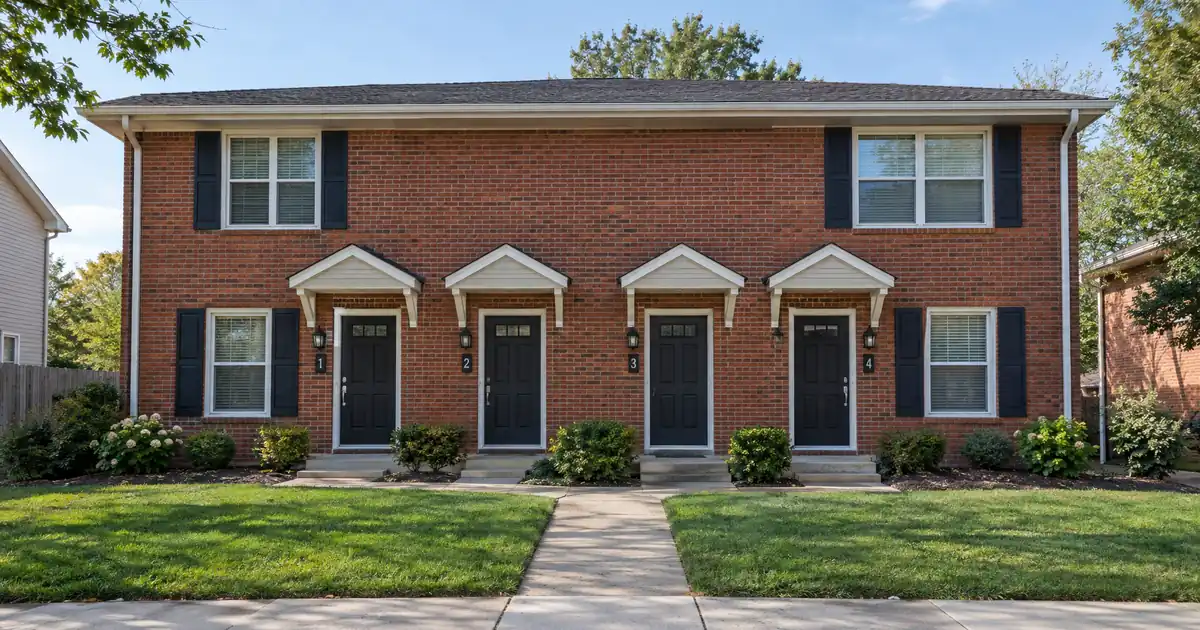
Family Trust Finances A Fourplex With A Super Jumbo DSCR Loan — The Quick Read: Yes, a family trust can hold title on a fourplex financed with a super jumbo DSCR loan, because these are business-purpose, non-agency loans that qualify on the property’s rent instead of the borrower’s traditional personal-income documentation. The lender underwrites the trust instrument and the trustee’s authority, not the settlor’s income. Loan sizes on this program run to $10,000,000, with leverage stepping down as the balance climbs. Trust vesting is standard practice across most of the wholesale network, subject to program eligibility.
That’s the short version. Here’s how it actually gets built, file by file.
DSCR Calculator
Run the numbers in your market
Rate source: Freddie Mac 30-yr average via FRED® — Federal Reserve Bank of St. Louis · effective Sep 17, 2026
Prefilled with local estimates — enter your own rent or nightly figures, taxes, insurance, and HOA for a more accurate picture.
Program parameters update from Lendmire’s centralized guideline source. Taxes and insurance are editable estimates.
As of Sep 17, 2026 · General Freddie Mac market benchmark, not a Lendmire loan offer. Rent, nightly rate, occupancy, taxes, and insurance are editable estimates. Short-term rental figures are estimates only and vary significantly by season, property type, management approach, and local short-term-rental rules — confirm local regulations before relying on them. Qualifying income for short-term rentals varies by program — some use appraisal market rent, others use documented STR history or projections — and is confirmed in underwriting. Not a Loan Estimate, approval, or commitment to lend. Program availability and eligibility are subject to lender guidelines, credit approval, property review, and underwriting.
Why Does Non-QM Status Make This Possible?
Rate assumptions belong in the calculator, and the article should discuss coverage qualitatively. That single fact is why non-warrantable condos and trust-held vesting both clear underwriting here when they’d get rejected on a conventional file.
A DSCR loan (debt-service coverage ratio loan) qualifies a property based on whether its rent covers the monthly payment. It does not rely on the borrower’s traditional personal-income documents. Because it’s written for investment property rather than a primary home, it’s classified as business-purpose financing. That means a different underwriting lane with different rules. Lendmire’s complete DSCR loans guide covers the baseline mechanics if this is new territory for you.
DSCR loans are designed for non-owner-occupied investment properties. Because they are business-purpose investor loans, they are reviewed differently from a standard owner-occupied mortgage.
That’s really the whole story of why a trust works here. Nobody’s checking the settlor’s DTI. Somebody’s checking whether the trustee can legally sign for this specific building.
What Does Underwriting Actually Look At In The Trust?
Underwriting reviews the trust’s structure and the trustee’s authority to borrow. It does not look at the beneficiaries’ income or credit. Files typically move faster with a certification of trust rather than the full trust document. This short form states the essential terms without exposing private family details.
The lender wants to know: is this trust revocable or irrevocable, who holds signing authority, and can the trustee pledge this exact unit as collateral. A certification of trust answers those questions cleanly. Full trust instruments run long and contain distribution language the lender doesn’t need to see.
When the trustee is also the person whose credit and reserves qualify the loan, most files require dual-capacity signatures. The person signs once individually and once as trustee. This mirrors the naming convention used in Fannie Mae’s inter vivos revocable trust signature framework, referenced here only as a format comparison since DSCR loans never sell to the agencies. The lender wants the trust’s property pledged as collateral while holding a real person accountable for repayment.
Vesting decisions belong before the application, not after. If a trust, an LLC, or an individual name is the plan, settle it with an attorney or advisor before the file opens — closing directly into the trust avoids a re-titling event down the road, and re-titling after the fact is exactly the kind of transfer that can trip a due-on-sale clause.
Key Terms Defined
DSCR (debt-service coverage ratio): the rent divided by the full monthly payment — anything above 1.00 means the rent covers the payment with room to spare.
Certification of trust: a short document a trustee signs that states the trust’s essential terms and borrowing authority without disclosing the full private instrument.
Due-on-sale clause: a mortgage provision letting a lender demand full repayment if the property transfers ownership without consent.
Super jumbo: an industry label — not a government category — for DSCR loans that climb well past standard non-QM size tiers, often into seven figures.
Interest-only period: a stretch of the loan term where payments cover only interest, not principal, which lowers the monthly obligation and can help coverage math.
How Does A Trust Avoid A Due-On-Sale Problem?
Because DSCR loans are business-purpose and non-agency, a trust can hold title from the day the loan records — there’s no need to close in an individual’s name and transfer into the trust afterward. That timing matters because federal law treats trust transfers differently than it treats other ownership changes.
Under 12 U.S.C. §1701j-3, the Garn-St. Germain Act, a due-on-sale clause is enforceable when a property transfers without the lender’s consent — with a specific carve-out for transfers into an inter vivos trust where the borrower remains a beneficiary and the transfer doesn’t touch occupancy rights. In plain terms: moving a property into a revocable living trust, where the grantor stays a beneficiary, generally doesn’t trigger the clause.
Irrevocable trusts are a different story. If the grantor isn’t also a beneficiary — common in irrevocable structures built for estate planning — the statutory protection doesn’t apply. A lender then retains the right to enforce a due-on-sale clause on that transfer. This distinction, along with the unit-count threshold that limits the Act’s broader protections, is laid out across several practitioner sources, including Gem McDowell Law Firm’s coverage of the Garn-St. Germain Act. That’s why closing directly into the intended trust at origination — rather than transferring in later — removes a risk window entirely on a DSCR file.
LLCs get none of this statutory cover. Moving mortgaged real property into an LLC can trigger a due-on-sale clause outright, which is one more reason vesting decisions need to happen before the loan records, not after.
How Big Can This Loan Actually Get?
Across the wholesale network Lendmire places files with, this program runs from $150,000 to $10,000,000 — well past the $3,000,000 ceiling on the standard DSCR product. Short-term-rental and no-ratio files stop earlier, at $2,000,000.
Leverage steps down as the balance grows, and it does so in stages rather than a single flat number. On files with coverage at 1.00 or better, purchase and rate-and-term leverage typically run 80% up to $1,000,000, stepping to 75% through $3,000,000, then down to 65% for the $3,000,000-$4,000,000 band, and 60% from $4,000,000 to $10,000,000 — that top tier reviewed case by case before submission, purchase or rate-and-term only, with no cash-out available. Credit expectations tighten too: a 660 floor on smaller balances, rising to 700 once the loan crosses $3,000,000.
Cash-out follows its own, tighter ladder. It’s generally available up to 75% on standard rental collateral (a lower 70% ceiling applies specifically to short-term-rental collateral) at the smallest balances, stepping down through the tiers, and it stops entirely above $3,000,000 on this program. Two independent appraisals are required above $2,000,000 — a fourplex at that size isn’t getting a single opinion of value.
Where Does The Rent Number On A Fourplex Actually Come From?
The DSCR math runs on the property’s income, and for a 2-4 unit building that income comes from a form built specifically for small multifamily — not the single-family rent schedule. Every unit needs its own supportable rent conclusion; the appraiser can’t lean on the strongest unit and assume the rest match.
A single-family rental pulls its rent used for lender review from Fannie Mae’s Form 1007. A fourplex uses Form 1025 instead, which requires the appraiser to weigh multiple comparable rent indications and land on a market-rent opinion for each individual unit in the building. That unit-by-unit requirement is exactly why fourplex deals get made or broken at the appraisal stage more often than the paperwork stage — one weak or vacant unit drags down the blended number for the whole building, even if the other three units perform well.
Underwriting then applies a lower-of rule: whichever figure is smaller, the signed lease or the appraiser’s market-rent conclusion, is what counts toward the DSCR calculation. A lease priced above market rent doesn’t lift the ratio past what the appraisal supports. And if a unit sits vacant at closing, the appraiser’s market-rent opinion becomes the only basis for that unit’s contribution, since there’s no lease to compare it against.
Coverage of 1.00 or higher earns full leverage on this ladder. Coverage between 0.75 and 0.99 is a real path through select programs in the network, capped at $2,000,000, with leverage and terms adjusting to reflect the thinner coverage — subject to underwriting. On files where the rent doesn’t quite reach that range at all, interest-only structuring, sized to a 120-month interest-only period on 30- and 40-year terms up to 75% LTV, can bring the payment down enough to change the math, and no-ratio paths exist through a handful of lenders in the network up to $2,000,000 for investors with a clean seven-year housing history, subject to underwriting. Every figure here varies by lender and program — guidelines, property type, leverage, and credit profile all apply.
What Trips Up Trust-Held Fourplex Files In Practice?
Files with entity or trust vesting move cleanly through most of the wholesale network Lendmire works with, provided the structure stays simple — a single trust or a single LLC holding title directly. Layered structures, an LLC owned by a trust owned by another LLC, generally aren’t something a single lender’s file can absorb.
DSCR vs. conventional financing
Two common ways to finance an investment property in this market. They qualify you differently — here’s how investors weigh them.
Why investors choose it
- Qualifies on the property’s rental income — no personal tax returns, W-2s, or pay stubs needed to document income.
- No personal debt-to-income ceiling to clear, so existing mortgages and obligations don’t cap your borrowing the same way.
- Can be closed in an LLC, keeping the property inside a business entity.
- Built for scaling — not held to the limit on number of financed properties that conventional financing applies.
- Underwriting centers on the deal: generally qualifies when the rent covers the payment, a 1.00x coverage ratio being a common baseline (confirmed in underwriting).
- Designed specifically for investment property, including long-term and, where the program allows, short-term rentals.
Where it’s strong
- Often the lowest ongoing financing cost for a buyer who fully qualifies on personal income — a fit for a first property or a cost-first purchase.
Trade-offs for investors
- Requires full personal income documentation and must fit within a debt-to-income limit — salary, existing debts, and other mortgages all count.
- Typically held in your personal name rather than a business entity.
- Caps how many financed properties you can carry, which can become a ceiling as a portfolio grows.
- Evaluates you as a borrower as much as the property, which usually means more paperwork.
How investors usually choose: a first or single property often optimizes for the lowest financing cost; portfolio builders often optimize for leverage, vesting in an LLC, and scaling past conventional caps. The right answer depends on your goals, the property, and current guidelines — both paths run through select lenders in Lendmire’s wholesale network, with eligibility and terms confirmed in underwriting.
The other recurring friction point is PITIA (principal, interest, taxes, insurance, and any association dues). The seller’s current tax bill and insurance premium rarely survive the transfer intact. Taxes often reassess after a sale. Insurance pricing is specific to the new owner and the property’s condition. So underwriting rebuilds the payment fresh rather than copying it from the listing sheet.
On the appraisal side, a fourplex stays firmly in residential territory — the 1025 form and a sales-comparison approach — right up until a property crosses into five units, at which point the appraisal shifts to a full commercial narrative built on the income approach instead. That line is drawn strictly by unit count, not by price or by the investor’s experience. Related reading on the appraisal mechanics of large-balance files, including when two independent appraisals come into play, is covered in two appraisals on a super jumbo DSCR loan.
In our wholesale network, the strongest fourplex files pair two things: a clean certification of trust and an appraisal that already prices each unit conservatively. Lenders rarely let a strong unit cover for a weak one. That trick rarely survives a second appraiser’s review.
Why Are Investors Choosing This Structure At All?
Investor purchase activity has held above pre-pandemic levels, claiming roughly three in ten home sales through the first half of 2025, according to Scotsman Guide. More than 85% of home investors own fewer than five properties. This is a market built on individual and family holdings, not just institutional funds. That backdrop is part of why trust- and entity-vested DSCR lending has become standard practice rather than an exception request.
For a family using a trust for estate-planning reasons, the practical payoff is straightforward: the trust doesn’t need to be unwound to get the property financed, and on a DSCR loan specifically, it doesn’t need to be transferred in after closing the way some other loan types require. That removes the due-on-sale risk window discussed above entirely, rather than just managing it.
Tax treatment can depend on how the funds are used and how the property is held; investors should keep clear records and speak with a qualified tax professional before relying on any deduction.
Common Misconceptions Worth Clearing Up
A newly formed trust isn’t automatically a weaker file. Qualification runs mainly on two things: the property’s rental income and the guarantor’s personal credit. How long the trust has existed doesn’t matter much. A properly drafted certification of trust with clear borrowing authority typically qualifies the same way an older trust would.
“Super jumbo” also isn’t an official size category. No regulator defines it; it’s shorthand lenders apply once a DSCR loan climbs well past standard non-QM tiers. And the lender never needs the full trust document — a certification of trust, confirming the trustee’s authority to mortgage the specific property, is what title companies and lenders actually ask for.
If you’re weighing a trust-held condo instead of a fourplex, the vesting logic is similar but the property review differs — see how a trust-held condo qualifies for a super jumbo DSCR loan for that side of the comparison.
This article is not legal or tax advice. Trust structuring, due-on-sale exposure, and tax treatment are fact-specific — investors should consult a qualified attorney or CPA about their own situation before vesting title in a trust.
Frequently Asked Questions
Can an irrevocable trust hold title on a DSCR-financed fourplex? Generally yes, subject to lender guidelines and underwriting review of the trust instrument and trustee authority. The complication isn’t underwriting eligibility — it’s due-on-sale exposure, since the Garn-St. Germain beneficiary protection typically doesn’t extend to irrevocable trusts where the grantor isn’t also a beneficiary.
Does the trustee need to personally guarantee the loan? In most cases, yes, when the trustee’s personal credit and reserves are what qualify the file — the trustee typically signs both individually and as trustee. This dual-capacity signature lets the trust’s property serve as collateral while a real person remains accountable for repayment.
What credit score does a trust need for a super jumbo DSCR loan? The credit profile evaluated belongs to the trustee or guarantor, not the trust itself. Across the wholesale network, expect a 660 floor on smaller balances, rising to 700 once the loan crosses $3,000,000, subject to underwriting.
Can a family trust cash out equity from a fourplex it already owns? Cash-out is available through select programs, generally up to 75% LTV on standard rental collateral, with proceeds capped and unavailable above $3,000,000 on this program. Terms adjust by balance and coverage, subject to lender guidelines.
Does every lender in the network accept layered entity structures? No — a single trust or a single LLC holding title directly is the standard accepted structure across most of the network. Layered vesting, such as an LLC owned by a trust owned by another entity, generally isn’t supported on a single file.
If you are buying or refinancing a rental property and want to see how the numbers work, Lendmire can help you compare DSCR loan options based on the property income, credit profile, leverage, and investor goals. Reach Lendmire at 828-256-2183 or request a quote directly to walk through a specific trust-held file.
For current guidelines and terms, see Lendmire’s super jumbo DSCR loan programs page.
Self-employed borrowers can compare both super jumbo programs on Lendmire’s self-employed mortgages page.
About Lendmire
Lendmire is a non-QM mortgage brokerage (NMLS# 2371349) arranging DSCR investor loans in 40 markets, including Washington, D.C. DSCR eligibility is generally reviewed around property-level rental income rather than personal income, subject to lender and program guidelines, a fit for self-employed investors and LLC-owned portfolios. Lendmire was recognized as a Scotsman Guide Top Mortgage Workplace in 2025 and 2026.
Lendmire’s Top Mortgage Workplace recognition is documented by Scotsman Guide 2026 Top Mortgage Workplace.
Lendmire’s Top Mortgage Workplace recognition is documented by Scotsman Guide 2025 Top Mortgage Workplace.
Get Started
Ready to find the right loan for you?
In about 30 seconds you can review financing options available for your home or investment property. No commitment required.
Informational only. Not a Loan Estimate, approval, or commitment to lend. Program availability and eligibility are subject to lender guidelines, credit approval, property review, and underwriting.
References
1. Fannie Mae Selling Guide B8-5-02
2. Cornell Legal Information Institute, 12 U.S.C. §1701j-3
3. Gem McDowell Law Firm, Garn-St. Germain Act Archives
4. Scotsman Guide, Investors Anchor Housing Market As Non-QM Loans Surge
5. Scotsman Guide 2026 Top Mortgage Workplace
6. Scotsman Guide 2025 Top Mortgage Workplace
Brandon Miller
Founder & CEO, Mortgage Loan Originator, Lendmire LLC
- Mortgage Loan Originator · NMLS# 1129696 · Verify on NMLS Consumer Access
- North Carolina Real Estate Broker · License# 343312 · Verify on NCREC
- North Carolina Insurance Producer · License# 19053198 · Property, Casualty, Life, Health · Verify on NAIC SBS
- Lendmire LLC · Firm NMLS# 2371349 · Verify firm licensure
Required disclosures. Lendmire (NMLS# 2371349) operates as a licensed mortgage broker, not a direct lender or depository. The discussion in this article is general in nature and should not be relied upon as financial, legal, or tax advice — every investment scenario is unique and should be reviewed by a qualified professional. Any loan inquiry is subject to lender underwriting, and this article is not a commitment to lend or a guarantee of approval. Mortgage rates, loan terms, and program guidelines vary by borrower, property, and state, and may change without notice. Equal Housing Opportunity. Verify licensure at NMLS Consumer Access.


