
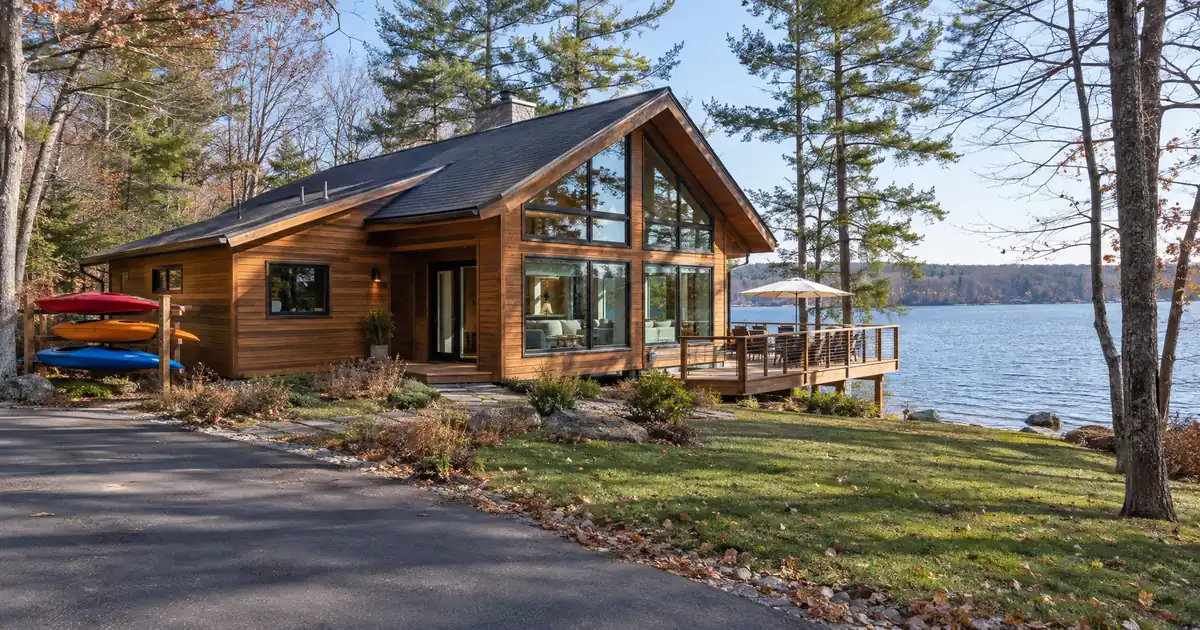
The Quick Read: A waterfront rental is financed the way any rental is: the lender compares the property’s rent to its full monthly payment. Waterfront adds flood and wind insurance, a harder appraisal, and dock or seawall questions that all change that comparison before a lender approves anything.
- The loan is reviewed primarily on property-level rental income covering the payment, subject to lender guidelines. Your traditional personal-income documentation is not the center of the file.
- Insurance is the swing factor. Wind and flood premiums sit inside the payment and can pull coverage down fast.
- The appraisal is where waterfront files get stuck: thin comps, dock and bulkhead condition, and water-access rights.
- Large balances are common on the water. Leverage steps down as the loan grows, subject to underwriting.
- Short-term rental income counts only with documented history or an appraisal analysis, and local permission must be documented for the specific property.
DSCR loans are designed for non-owner-occupied investment properties. Because they are business-purpose investor loans, they are reviewed differently from a standard owner-occupied mortgage.
DSCR Calculator
Run the numbers in your market
Rate source: Freddie Mac 30-yr average via FRED® — Federal Reserve Bank of St. Louis · effective Oct 15, 2026
Prefilled with starting assumptions — enter your own rent or nightly figures, taxes, insurance, and HOA for a more accurate picture.
Program parameters update from Lendmire’s centralized guideline source. Taxes and insurance are editable estimates.
As of Oct 15, 2026 · General Freddie Mac market benchmark, not a Lendmire loan offer. Rent, nightly rate, occupancy, taxes, and insurance are editable estimates. Short-term rental figures are estimates only and vary significantly by season, property type, management approach, and local short-term-rental rules — confirm local regulations before relying on them. Qualifying income for short-term rentals varies by program — some use appraisal market rent, others use documented STR history or projections — and is confirmed in underwriting. Not a Loan Estimate, approval, or commitment to lend. Program availability and eligibility are subject to lender guidelines, credit approval, property review, and underwriting.
What a DSCR Loan Does With a Waterfront Property
DSCR stands for debt service coverage ratio. You take the monthly rent and divide it by the full monthly payment: principal, interest, taxes, insurance, and any association dues. A result of 1.00 means rent exactly covers the payment. The lender wants cushion above that.
Nothing about the formula changes on the water. What changes is what lands in the bottom half. A lakefront house may rent for noticeably more than an inland twin. It may also carry wind coverage, flood coverage, and higher dues, and those costs can grow faster than the rent premium.
That is the central tension of every waterfront file. The view raises the rent. The water raises the cost. Underwriting measures the gap.
Key Terms Defined
PITIA: Principal, interest, taxes, insurance, and association dues, the full monthly obligation that rent must cover.
Special flood hazard area: A mapped zone with a 1%-or-greater annual chance of flooding. Zone letters starting with A or V fall in it.
Bulkhead or seawall: A wall along the shoreline that holds back water and soil. Appraisers and lenders care about its condition.
Cost to cure: The estimated price of a needed repair, which an appraiser may subtract from value.
Interest-only period: A stretch where the payment covers interest only, which lifts coverage because the payment is smaller.
Entity vesting: Holding title in an LLC or similar entity, subject to program terms.
How Underwriting Treats a Waterfront Rental, Step by Step
1. The rent is established. For a long-term rental, the lender uses a signed lease or the appraiser’s market-rent schedule. For a short-term rental, it uses documented operating history or the appraisal’s short-term rent analysis. More on that below.
2. The payment is built, with insurance inside it. Hazard, wind, and any required flood premium all count in the payment. Get a real, bindable quote before you go under contract. An estimate is a guess, and guesses sink coverage ratios.
3. A flood determination is run. The lender checks whether the property sits in a mapped flood zone. If it does, expect to bind a flood policy before closing.
4. The appraisal values the water. This is the hard step, covered in its own section.
5. Coverage is measured against the program. Across the wholesale network, a 1.00 coverage ratio earns full leverage on the ladder below. A select group of lenders will also look at coverage from 0.75 to 0.99 on loans up to $2,000,000, but LTV and terms adjust, subject to underwriting.
6. Credit, reserves, and entity are checked. The program floor is typically 660 on loans up to $3,000,000 and 700 above that. The higher scores in the ladder below are what the top leverage in each band needs, not the floor. Six months of reserves on the subject property is typical, and 12 for first-time investors. Cash-out proceeds cannot satisfy reserves on the larger loans.
Flood Insurance: Practice Versus Law
Flood coverage is the item that surprises people. Federal law requires flood insurance in identified high-risk zones when a federally regulated or insured lender is involved, as FEMA’s mandatory purchase glossary explains. DSCR loans are privately funded investor products, so that mandate is not the direct driver.
In practice it makes little difference. Lenders in the network protect their collateral the same way. If the property sits in a mapped high-risk zone, you should plan on a flood policy as a condition of the loan.
Three gaps matter on the water.
First, the federal flood program has limits. FloodSmart lists up to $250,000 of building coverage on a homeowner-type policy and up to $500,000 on a commercial one. A waterfront house can cost far more than that to rebuild. Many investors add private excess flood coverage.
Second, a standard federal policy generally leaves out items outside the insured building, such as seawalls and docks. It also does not pay for lost rent. A flood condition satisfied for the lender does not protect your income.
Third, a mapped low-risk zone is not a safe zone. Flood losses happen outside high-risk areas too. Do not let a favorable map letter talk you out of coverage.
| Coverage layer | What it typically covers | Common gap |
|---|---|---|
| Hazard | Fire, theft, general damage | Often excludes flood and wind |
| Wind or named storm | Storm damage to the structure | Higher deductibles |
| Federal flood policy | Building and contents, within caps | Seawalls, docks, lost rent |
| Private excess flood | Value above federal caps | Terms vary by policy |
| Liability | Guest injury claims | Dock, pool, and watercraft exposure |
Landlord policies often stop at the property line. If guests swim off your dock, confirm the liability policy actually reaches it.
Why the Appraisal Is Where Waterfront Files Get Stuck
Appraisers value a waterfront property against comparable sales that match its frontage type, shoreline, dock status, and water access, as Homes.com’s waterfront buying guide describes. Those matches are rare. Waterfront appraisal often means searching a much wider area and time window for comps, a point covered in a Maryland appraiser association course description.
When comps are thin, value can land below the contract price. Value drives the loan amount, since leverage is a percentage of value, so a light appraisal shrinks your loan and raises the cash you bring.
Expect these adjustments. A permitted dock or sound bulkhead tends to help. An unpermitted or failing structure tends to hurt. Documented repairs may be deducted as a cost to cure. Shared access, or no deeded water access, can reduce value.
Above $2,000,000, the network requires two appraisals. Plan for that on a high-end waterfront purchase.
Documents that smooth the file:
- A boundary and dock survey.
- Permits for the dock, lift, seawall, or any dredging.
- A condition report if the seawall or dock shows wear.
- The flood determination and a bindable insurance quote.
- Your short-term rental permit, where one applies.
- The entity vesting package, if you borrow through an LLC, subject to program terms.
Modeling It: Inland Versus Waterfront
Run the numbers on one house in three versions. These are modeled assumptions, not market data.
| Scenario | Rent source | Insurance in payment | Coverage read |
|---|---|---|---|
| Inland, long-term | Lease or rent schedule | Hazard only | Comfortable, near 1.25x |
| Waterfront, long-term | Lease or rent schedule | Hazard, wind, flood | Thinner, near 1.05x |
| Waterfront, short-term | History or appraisal analysis | Same, plus liability | Depends on documented income |
The waterfront version rents for more, yet coverage lands lower. Insurance grew faster than rent. That is the pattern to test for before you make an offer.
A property that misses the floor still has options. Lower leverage shrinks the payment. A 120-month interest-only period on 30- and 40-year terms is typically available up to 75% LTV with coverage of 0.75 or better, qualified on interest, taxes, and insurance only. Select lenders will also review coverage from 0.75 to 0.99 at reduced leverage. All of it is subject to underwriting.
Short-Term Rental Income on the Water
Waterfront and short-term rentals go together, so this matters. On a purchase, the network typically counts the short-term rent analysis from the appraisal. On a refinance, it counts twelve months of operating history. Either way, income is typically counted at 80% of gross.
Short-term rental files typically need coverage of 1.00 or higher, loans up to $2,000,000, and an investor with twelve months of owning income property in the last thirty-six. They sit outside the reduced-coverage paths.
Seasonality is the quiet risk. A summer-heavy lake market can look great on a trailing twelve months, but winter months drag the average. Underwriting looks at the whole year.
Short-term rental rules can vary by city, county, HOA, and property type, so investors should confirm local rules before relying on projected rental income. Lendmire’s piece How a Waterfront Rental DSCR Loan Works covers the property-level side in more depth.
DSCR vs. conventional financing
There are two common ways to finance an investment property, and they qualify you differently — here’s how investors weigh them.
Why investors choose it
- Qualifies on the property’s rental income — no personal tax returns, W-2s, or pay stubs needed to document income.
- No personal debt-to-income ceiling to clear, so existing mortgages and obligations don’t cap your borrowing the same way.
- Can be closed in an LLC, keeping the property inside a business entity.
- Built for scaling — not held to the limit on number of financed properties that conventional financing applies.
- Underwriting centers on the deal: generally qualifies when the rent covers the payment, a 1.00x coverage ratio being a common baseline (confirmed in underwriting).
- Designed specifically for investment property, including long-term and, where the program allows, short-term rentals.
Where it’s strong
- Often the lowest ongoing financing cost for a buyer who fully qualifies on personal income — a fit for a first property or a cost-first purchase.
Trade-offs for investors
- Requires full personal income documentation and must fit within a debt-to-income limit — salary, existing debts, and other mortgages all count.
- Typically held in your personal name rather than a business entity.
- Caps how many financed properties you can carry, which can become a ceiling as a portfolio grows.
- Evaluates you as a borrower as much as the property, which usually means more paperwork.
How investors usually choose: a first or single property often optimizes for the lowest financing cost; portfolio builders often optimize for leverage, vesting in an LLC, and scaling past conventional caps. The right answer depends on your goals, the property, and current guidelines — both paths run through select lenders in Lendmire’s wholesale network, with eligibility and terms confirmed in underwriting.
The Size Ladder: Leverage Steps Down as the Loan Grows
Waterfront prices push many files above standard loan limits. Lendmire arranges DSCR loans from $150,000 to $10,000,000 through select wholesale programs, while its standard program stops at $3,000,000. The figures below are ceilings at 1.00 coverage or better, subject to underwriting. The bands are loan amounts, not purchase prices.
| Loan size | Purchase | Cash-out |
|---|---|---|
| $150K–$1M | 80% | 75% |
| $1M–$1.5M | 75% | 70% |
| $1.5M–$2M | 75% | 60% |
| $2M–$3M | 75% | 60% |
| $3M–$4M | 65% | — |
| $4M–$6M | 60% on review | — |
| $6M–$10M | 60% on review | — |
Rate-and-term refinances follow the purchase figures in each band. The top cell in each band needs a score of 660 or higher up to $1,000,000, 700 or higher from $1,000,000 to $1,500,000, and 720 or higher from $1,500,000 to $3,000,000. A lower score takes a lower leverage cell in the same band.
Above $4,000,000, every request is reviewed case by case before submission, and cash-out is not available. Above $3,000,000, expect 0x30x24 housing history, 48-month seasoning after a credit event, and citizen or permanent-resident status.
Cash-out has its own rules: unlimited proceeds at or below 60% LTV, and a $1,500,000 cap above that. If you refinance a waterfront rental to pull equity for the next purchase, Lendmire’s overview of the DSCR cash-out refinance explains how those caps interact. These specifics are subject to lender guidelines and a full review of property, leverage, and credit.
Where the General Rule Breaks
Condos and condotels. Warrantable and non-warrantable condos both exist in the network. Non-warrantable condos run to 75% and $1,500,000. Condotels run to 75% on a purchase and 65% on a refinance, up to $1,500,000, with $250,000 cash in hand. Master policy costs and dues flow into the payment.
Rural lake property. Rural property on five acres or less can reach 75%, on loans at or below $3,000,000. Above $3,000,000, there is no rural property, and no more than ten acres on a non-rural one.
Remapping. A property can be remapped into a high-risk zone, which creates a new flood requirement for you as owner.
Failing structures. A deteriorating seawall is an uninsured capital expense. Seawall replacement can run to tens of thousands of dollars, per the Homes.com guide above. Budget for it in cash-on-cash even though it never touches the coverage ratio.
Entities. Holding title in an LLC is welcome, subject to program terms. Layered entities are not.
Honestly, this is a toss-up for many buyers: a pricier property with a stronger rent story, or a plainer one that clears the ratio with room to spare. The second usually makes the loan cleaner. The first usually makes the better vacation.
What the Investor Decision Looks Like in Practice
Most waterfront buyers who do this well follow the same order. Across files like these, the ones that go smoothly price insurance before the offer, not after. A bindable wind and flood quote on day one tells you whether the deal clears the floor. Everything else is secondary.
1. Check flood zone and water access before you fall in love.
2. Get insurance quotes, including wind and excess flood.
3. Confirm local rental rules and any HOA restrictions.
4. Model the coverage ratio with real numbers, long-term and short-term.
5. Inspect the dock and seawall, and gather permits.
6. Choose leverage and structure based on the ladder above.
DSCR loans qualify primarily on property-level rental income covering the payment, subject to lender guidelines, which suits investors with complex returns. They are a poor fit when the property cannot clear the floor under any structure. The complete DSCR loans guide covers the underlying mechanics.
Tax treatment can depend on how the funds are used and how the property is held; investors should keep clear records and speak with a qualified tax professional before relying on any deduction.
If you are buying or refinancing a high-balance rental property and want to see how the numbers work, Lendmire can help you compare super jumbo DSCR loan options based on the property income, the loan balance, credit profile, leverage, and investor goals. Reach the team at 828-256-2183. Programs change, every file is underwritten individually, and nothing here is a commitment to lend.
Frequently Asked Questions
Do I need flood insurance on a waterfront rental?
If the property sits in a mapped high-risk flood zone, plan on it. DSCR loans are not covered by the federal mandate directly, but lenders in the network protect collateral the same way and typically require a bound policy before closing. Even outside high-risk zones, flood coverage is worth pricing.
Will a DSCR lender count my short-term rental income?
It can, but not on every program. A purchase typically uses the appraisal’s short-term rent analysis, and a refinance uses twelve months of operating history, at 80% of gross. Coverage of 1.00 or better is typical, and the loan stops at $2,000,000, subject to underwriting.
What if the appraisal comes in below the contract price?
Your loan amount drops, because leverage is a percentage of appraised value. You bring more cash, renegotiate, or walk. Waterfront comps are thin, so this risk is real. Above $2,000,000, two appraisals are required.
Can I buy a waterfront condo with a DSCR loan?
Often yes. Warrantable and non-warrantable condos both exist in the network, with non-warrantable condos running to 75% and $1,500,000. Condotels have tighter limits, and association dues enter the payment.
Does a low coverage ratio end the deal?
Not always. Select lenders in the network will review coverage from 0.75 to 0.99, with LTV and terms adjusted, subject to underwriting. Lower leverage or an interest-only period can also lift coverage.
Lendmire’s self-employed mortgages page presents both super jumbo programs, bank statement and DSCR, side by side.
About Lendmire
Lendmire is a non-QM mortgage brokerage (NMLS# 2371349) arranging DSCR investor loans in 41 markets, including Washington, D.C., through wholesale and investor-lending channels. DSCR loans are evaluated by the lender on rental income rather than personal income, subject to lender guidelines. They suit LLC-owned portfolios, self-employed investors, and operators scaling beyond conventional loan caps. Recognized as a Scotsman Guide Top Mortgage Workplace in 2025 and 2026.
Get Started
Ready to find the right loan for you?
In about 30 seconds you can review financing options available for your investment property. No commitment required.
Informational only. Not a Loan Estimate, approval, or commitment to lend. Program availability and eligibility are subject to lender guidelines, credit approval, property review, and underwriting.
References
1. FEMA – Mandatory Purchase glossary
2. FEMA FloodSmart – Buy a Policy
3. Homes.com Learn – What to Know Before Buying Waterfront Property
4. Maryland appraiser association – waterfront appraisal course
This article is part of Lendmire’s super jumbo DSCR loan program — full qualification details, guidelines, and scenarios live on the program page.
Related reading: How Big Can a Large-Balance DSCR Loan Be? · How a Luxury Rental DSCR Loan Works in Savannah · How a Palm Beach Luxury Rental DSCR Loan Works
Brandon Miller
Founder & CEO, Mortgage Loan Originator, Lendmire LLC
- Mortgage Loan Originator · NMLS# 1129696 · Verify on NMLS Consumer Access
- North Carolina Real Estate Broker · License# 343312 · Verify on NCREC
- North Carolina Insurance Producer · License# 19053198 · Property, Casualty, Life, Health · Verify on NAIC SBS
- Lendmire LLC · Firm NMLS# 2371349 · Verify firm licensure
Required disclosures. Lendmire (NMLS# 2371349) operates as a licensed mortgage broker, not a direct lender or depository. The discussion in this article is general in nature and should not be relied upon as financial, legal, or tax advice — every investment scenario is unique and should be reviewed by a qualified professional. Any loan inquiry is subject to lender underwriting, and this article is not a commitment to lend or a guarantee of approval. Mortgage rates, loan terms, and program guidelines vary by borrower, property, and state, and may change without notice. Equal Housing Opportunity. Verify licensure at NMLS Consumer Access.