
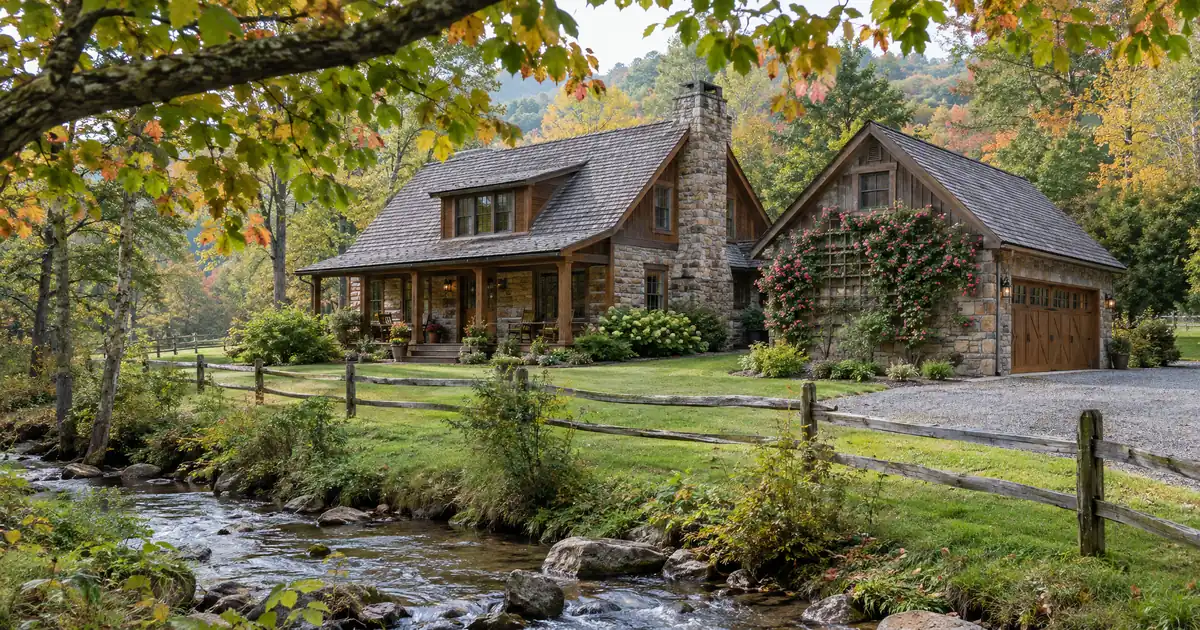
The Quick Read: You can finance a rural cabin on a DSCR loan when the property type is eligible and the rental income covers the payment, but short-term rental income only counts if the use is legal at that exact parcel, so the rule check comes first. Everything below is subject to lender guidelines and individual file review.
- Short-term rental (STR) legality is set locally and in layers: jurisdiction, zoning district, private covenants, and whether the right passes to a new owner.
- A permit or grandfathered status often does not pass to a buyer, so the seller’s booking history may not describe what you can legally do.
- On select STR programs in Lendmire’s network, purchases typically reach 75% LTV on the strongest files, with a 640 minimum score, about 12 months of hosting history, and a 1.00 coverage floor.
- Log homes and barndominiums are not offered, so confirm the cabin is conventionally built.
- Run the coverage math twice: once on STR income and once on long-term rent.
Key Terms Defined
Short-term rental rules can vary by city, county, HOA, and property type, so confirm local rules before relying on projected rental income. These terms come up in every rule check.
- DSCR (debt service coverage ratio): monthly rent divided by the full monthly housing obligation. A result of 1.00 means rent equals the obligation.
- PITIA: principal, interest, taxes, insurance, and any association dues. It is the payment the ratio is measured against.
- LTV (loan-to-value): the loan amount as a percentage of the property’s value.
- Zoning district: the land-use category a parcel sits in, which decides whether nightly rentals are allowed.
- Conditional use permit: a special approval for a use that the zone does not allow outright.
- CC&Rs: recorded covenants, conditions, and restrictions that bind a property and can be stricter than local law.
- Grandfathering (nonconforming use): permission to keep a use that was legal before the rules changed.
- Unincorporated land: land outside any city or town, governed by the county and sometimes a township.
- Form 1007: an appraisal form that reports a one-unit home’s long-term market rent.
Short-Term Rental Calculator
Run the STR numbers in your market
Rate source: Freddie Mac 30-yr average via FRED® — Federal Reserve Bank of St. Louis · effective Oct 15, 2026
Prefilled with starting assumptions — enter your nightly rate, occupancy, taxes, and insurance for a more accurate picture.
Short-term rental income is documented with a 12-month history or a market data report. Program parameters update from Lendmire’s centralized guideline source.
As of Oct 15, 2026 · General Freddie Mac market benchmark, not a Lendmire loan offer. Nightly rate, occupancy, taxes, and insurance are editable estimates. Qualifying income for short-term rentals varies by program — some use appraisal market rent, others use documented STR history or projections — and is confirmed in underwriting. Not a Loan Estimate, approval, or commitment to lend. Program availability and eligibility are subject to lender guidelines, credit approval, property review, and underwriting.
Why Do Local Rules Decide the Numbers?
Local rules decide which income the lender may count. If nightly rentals are lawful at the address, STR income can support the file. If they are not, the file usually falls back to long-term rent, and the coverage ratio can look very different.
DSCR loans qualify primarily on property-level rental income covering the payment, subject to lender guidelines. That is why legality matters so much. A ratio built on income you cannot legally earn is not a ratio a lender should trust.
Here is a second point that trips up new investors. A DSCR above 1.00 is not the same as positive cash flow. The ratio compares rent to PITIA only. Repairs, vacancy, management, utilities, and capital costs sit outside it. A rural cabin with a long, snowy off-season can clear the ratio and still lose money.
Lendmire’s complete DSCR loans guide covers the basic mechanics. This article covers the rural cabin check that comes before them.
How Do You Check the Rules, Step by Step?
Work through the rule layers in order and treat any unresolved item as a pause. One address-check framework, RentalIncomeHQ’s seven-gate method, puts jurisdiction, zoning, and permit first. It puts HOA or lease terms second, lender documents third, insurance fourth, taxes fifth, platform sixth, and economics last. Its rule is that an open row means pause, not probably fine.
Step 1: Pin down the true jurisdiction. Mailing addresses mislead in rural areas. A cabin can carry a town’s name on its mail and still sit on unincorporated county land. Use the county’s online parcel map to see which government actually covers the parcel. Then find out whether a township, fire district, or other body adds its own layer. A county may issue no STR permit at all while the city, village, or township does.
Step 2: Read the zoning district, not just the STR ordinance. An area can have no STR law and still bar the use through zoning. One Michigan township states on its own site that short-term rentals are not allowed in any zoning district except C-2 Resort Commercial. Farm and forest zones in many places treat nightly rental as something that needs a conditional use permit, not an outright right. Rural agricultural-residential zones are often friendlier, but that varies by county.
Step 3: Read the code, not just the phone call. BiggerPockets says licensing rules usually live in the planning and zoning section of the city website, and that calling the zoning department is a good second step. It also lists the limits investors run into: caps on days operated (it has seen a 240-day maximum and some cities as low as 30 days), zoning requirements, and primary-residence requirements. The article is a few years old, so use it for the method, not the numbers. A verbal answer from a clerk is not evidence. Read the ordinance text, often posted on a municipal code site, and ask for a written confirmation.
Step 4: Look for pending changes. Counties and townships sometimes circulate draft ordinances for months. Underwrite to the law as it stands today, and note any draft that could change it. Check meeting agendas and minutes, and ask staff whether a moratorium or cap is under discussion.
Step 5: Read the private restrictions. Pull the recorded covenants and any association rules. They can be stricter than local law. Grandfathering protects a use against a local ordinance, not against an association’s covenants.
Step 6: Check the rural physical items. Septic systems are often permitted for a set number of bedrooms. That count can limit how many guests you can sleep and how you can market the cabin. Also confirm water source (well or public), who maintains the road, winter access, whether insurance is available, and any local lodging registration.
Step 7: Collect the paper. A lender may ask for a business license or permit, an HOA approval letter where one applies, and confirmation that local rules allow STR. A file that rests on written, document-level evidence is stronger than one that rests on a listing’s claim.
| Who to ask | What to ask | Get in writing |
|---|---|---|
| County or city planning | Is nightly rental allowed in this zone? | Zoning verification letter |
| Township or town office | Does a local layer add rules? | Email confirming status |
| HOA or road association | Do covenants bar short stays? | Approval or no-restriction letter |
| County health or septic office | What bedroom count is permitted? | Septic permit copy |
| Local tax or lodging office | Is registration required? | Registration confirmation |
| Insurance agent | Will they cover nightly rental? | Written quote or binder terms |
What Do the Possible Outcomes Mean for Financing?
Each outcome points to a different underwriting path. These are general patterns, and every file is reviewed individually by the lender.
| Rule outcome | Likely underwriting effect | Next move |
|---|---|---|
| Allowed outright | STR income may be usable | Document it and proceed |
| Allowed with permit | Depends on permit status | Confirm the permit can transfer |
| Capped or waitlisted | New permit may be unavailable | Price for long-term rent |
| Grandfathered only | Status may end on sale | Get written transfer terms |
| Banned | STR income generally unusable | Underwrite on long-term rent |
A ban does not always end the deal. It changes the income basis. If the cabin still works as a long-term rental, the file may still be reviewed on that basis. If it only works as a nightly rental, you have your answer before you pay for an appraisal.
Where Does the General Rule Break?
The general rule is that legal use supports STR income. Several edge cases make that harder to read in rural areas.
Permits often do not run with the land. One California county’s planning page says its STR certificates are non-transferable because they do not run with the land. The same page notes that newer ordinances eliminated the renewal grace period. Other local ordinances end nonconforming status on a sale, after major damage, or after a stretch of non-operation. The practical effect is blunt: the seller’s revenue history may describe a right you cannot buy.
Entity ownership can matter. Some jurisdictions issue permits only to a natural person or to the owner of record. If you plan to hold the cabin in an LLC, which is generally workable on DSCR loans subject to lender program eligibility, confirm whether the entity can hold the permit. Set up the entity before the permit application, not after.
Caps and per-owner limits exist. Some counties allow one STR license per owner. Some use cap zones, where new permits stop once a set share of nearby homes are already rentals. A cabin in a capped zone may have no path to a permit even if the last owner had one.
Minimal regulation is not no regulation. Some mountain regions are described as lightly regulated. Light rules can still include zoning, septic, safety, and registration requirements, and they can change.
State law can protect existing uses. Some states protect lawful nonconforming uses, which can mean a prior use continues without a new permit. That is state-specific and fact-specific, so it is a question for a local attorney, not an assumption.
Property type can end the search. The network does not offer DSCR loans on manufactured homes (single- or double-wide), log homes, or barndominiums. A cabin built as a log home therefore falls outside these programs. A conventionally framed cabin with log-style siding is a different question, and the lender confirms the construction type in review.
1007 does not capture STR income. Form 1007 is a rent schedule for one-unit properties, and it reports long-term market rent. An appraisal management company explains that Form 1007 cannot carry STR income, so appraisers use a narrative short-term-rental projected income addendum instead. Form 1025 is used for two- to four-unit properties. Either way, the long-term rent figure is the fallback if STR use cannot be supported.
When Should You Do the Check?
Do the check before you waive contingencies. Rural parcels can sit under county, township, HOA, and state rules all at once. Build the rule review into your due-diligence period, ahead of the appraisal and the coverage calculation.
| Stage | What to check |
|---|---|
| Before the offer | Jurisdiction, zoning district, covenants |
| Contract period | Written confirmations, permit transfer, septic |
| Underwriting | Permit and rule documents, income evidence |
| After closing | Pending ordinances, renewals, registration |
Rule risk keeps running after you own the cabin. Ordinances change, renewals lapse, and non-compliance can bring fines. A lender approval is not a local compliance certificate. Financing eligibility and legal permission to operate are two separate questions.
How Does Income Get Proven on a Rural Cabin?
Once the use is lawful, the file needs income evidence. Depending on the program, STR income is typically supported by an appraiser’s short-term-rental analysis, a market-data projection, or the property’s own booking and deposit history. Ask early which method the program uses, because it shapes what documents you gather.
STR programs on select lenders in the network typically expect about 12 months of hosting history. That experience requirement is about you as an operator, not just the cabin. A first-time host can ask about alternatives, since eligibility depends on the lender and the file.
Rural cabins add two difficulties. Comparable sales and rental data can be thin, which makes projections less reliable. Seasonality also swings hard. A cabin that books solid in peak months can sit empty in the shoulder season. Lenders look at the full picture, and you should too.
Consider a modeled example, using illustrative assumptions and not market data. Say a cabin shows coverage near 1.25x on projected STR income and about 0.85x on long-term rent. If the township allows STR and the permit transfers, the first number is the one that matters. If the township bars STR, the second one governs.
Coverage below 1.00 is available through select lenders in the network, with leverage and terms adjusted. That is a different path from the standard 1.00 programs, not a lower floor on the same one. A no-ratio structure is available only through select lenders, generally for borrowers who already own a primary residence. Both come with trade-offs in leverage and terms.
Operators in rural resort-style markets often run both scenarios before they make an offer. The stronger files tend to show the legal basis and the income basis side by side. They also show the seasonal low points, not just the summer peak. A thin file with one rosy projection is the one that stalls in review.
DSCR vs. conventional financing
There are two common ways to finance an investment property, and they qualify you differently — here’s how investors weigh them.
Why investors choose it
- Qualifies on the property’s rental income — no personal tax returns, W-2s, or pay stubs needed to document income.
- No personal debt-to-income ceiling to clear, so existing mortgages and obligations don’t cap your borrowing the same way.
- Can be closed in an LLC, keeping the property inside a business entity.
- Built for scaling — not held to the limit on number of financed properties that conventional financing applies.
- Underwriting centers on the deal: generally qualifies when the rent covers the payment, a 1.00x coverage ratio being a common baseline (confirmed in underwriting).
- Designed specifically for investment property, including long-term and, where the program allows, short-term rentals.
Where it’s strong
- Often the lowest ongoing financing cost for a buyer who fully qualifies on personal income — a fit for a first property or a cost-first purchase.
Trade-offs for investors
- Requires full personal income documentation and must fit within a debt-to-income limit — salary, existing debts, and other mortgages all count.
- Typically held in your personal name rather than a business entity.
- Caps how many financed properties you can carry, which can become a ceiling as a portfolio grows.
- Evaluates you as a borrower as much as the property, which usually means more paperwork.
How investors usually choose: a first or single property often optimizes for the lowest financing cost; portfolio builders often optimize for leverage, vesting in an LLC, and scaling past conventional caps. The right answer depends on your goals, the property, and current guidelines — both paths run through select lenders in Lendmire’s wholesale network, with eligibility and terms confirmed in underwriting.
What Financing Terms Fit a Rural STR Cabin?
On select STR programs in the network, purchases typically go up to 75% LTV on the strongest files. Refinances typically sit around 70% LTV. Cash-out on STR collateral tops out at 70%, while standard long-term rentals can reach 75% on cash-out. The usual credit minimum is 640, with stronger scores opening better terms.
The coverage floor is 1.00 on STR purchases. On STR refinances, it is also 1.00. Stronger coverage generally opens better pricing and leverage. Standard loan sizes run up to $3,000,000, and a rural cabin will usually sit well inside that range.
Reserves vary by lender, leverage, loan size, and transaction type. About six months of PITIA is common. A larger down payment lowers the payment and can lift the coverage ratio. It never erases leverage caps, credit floors, reserve rules, or property eligibility. The strongest files clear both tests: enough equity and enough rental coverage.
Tax treatment can depend on how the funds are used and how the property is held; investors should keep clear records and speak with a qualified tax professional before relying on any deduction.
Which Myths Cost Investors Money?
- The listing proves it is legal. It does not. A platform listing can exist without legal eligibility.
- The county has no STR law, so it is allowed. Zoning may still bar the use, and the answer may sit at the city or township level.
- The mailing address tells me the jurisdiction. In rural areas it often does not.
- The permit comes with the cabin. Often it does not.
- Grandfathering beats the HOA. It does not. It protects against ordinances, not covenants.
- The 1007 captures STR income. It does not. It reports long-term market rent.
- A phone call is enough. A verbal answer is not evidence. Get it in writing.
Pre-Offer Checklist
1. Confirm the true jurisdiction from the county parcel map.
2. Identify the zoning district and whether nightly rental is allowed outright, by permit, or not at all.
3. Read the ordinance text and save a copy.
4. Check for pending or draft changes.
5. Pull recorded covenants and association rules.
6. Confirm whether any permit transfers on sale, in writing.
7. Check the septic bedroom count, water source, road access, and insurance availability.
8. Confirm the construction type is eligible.
9. Run coverage on STR income and on long-term rent.
Frequently Asked Questions
Can I buy before the permit is approved?
You can, but the risk is yours. Until the permit exists, STR income is a projection with no legal basis behind it. Many investors make the purchase contingent on written permit confirmation. If that is not possible, price the cabin on long-term rent so the downside is covered.
Does a verbal OK from the planning office count?
No. A verbal answer is a starting point, not evidence. Ask for an email, a zoning verification letter, or a citation to the ordinance section. A lender reviewing the file will want document-level support.
What if my county has no STR rules?
That does not mean the use is allowed. Zoning may still restrict it, and a township, association, or state rule may apply. Treat silence at one level as a reason to check the next level.
Does a grandfathered permit transfer to me?
Often it does not. Many ordinances end grandfathered status on sale, and some end it after a period of non-operation. Ask the permitting office in writing whether status survives a transfer, and read the ordinance to confirm.
What if STR is banned at the property?
Then STR income generally cannot support the loan. The file may be reviewed on long-term rent instead. Coverage below 1.00 is available through select lenders in the network, with leverage and terms adjusted, but approval stays subject to lender guidelines, credit review, and property review.
Next Step
If you are buying or refinancing a rental property and want to see how the numbers work, Lendmire can help you compare DSCR loan options based on the property income, credit profile, leverage, and investor goals. Lendmire is a mortgage broker arranging financing through select lenders in its wholesale network across 41 markets, including Washington, D.C. Call 828-256-2183 to talk through a rural cabin file. A cabin is only as reviewable as the paper that proves the rental is lawful, so gather that paper before you gather an offer.
Investors focused on short-term rentals can review DSCR loans for Airbnb and short-term rentals.
About Lendmire
A non-QM mortgage broker (NMLS# 2371349), Lendmire arranges DSCR financing for real estate investors in 41 markets — 40 states plus Washington, D.C. Because deals are underwritten primarily on property cash flow rather than personal income documentation, the structure suits self-employed buyers and entity-owned portfolios. Lendmire places loans through wholesale investor lenders; it is not a direct lender. Scotsman Guide named Lendmire a Top Mortgage Workplace in both 2025 and 2026.
Get Started
Ready to find the right loan for you?
In about 30 seconds you can review financing options available for your investment property. No commitment required.
Informational only. Not a Loan Estimate, approval, or commitment to lend. Program availability and eligibility are subject to lender guidelines, credit approval, property review, and underwriting.
References
1. RentalIncomeHQ’s seven-gate method
2. Park Township – Short-Term Rentals
3. BiggerPockets – What You Need to Know Before Buying a Short-Term Rental
4. Riverside County Planning – Short-Term Rental Program
5. Class Valuation – Appraisal Form 1007 and Short-Term Rentals
This article is part of Lendmire’s short-term rental loan program — full qualification details, guidelines, and scenarios live on the program page.
Related reading: Can You Get a DSCR Loan on a Condo? · How to Qualify for a DSCR Loan in Florida · How to Qualify for a DSCR Loan in Virginia
Brandon Miller
Founder & CEO, Mortgage Loan Originator, Lendmire LLC
- Mortgage Loan Originator · NMLS# 1129696 · Verify on NMLS Consumer Access
- North Carolina Real Estate Broker · License# 343312 · Verify on NCREC
- North Carolina Insurance Producer · License# 19053198 · Property, Casualty, Life, Health · Verify on NAIC SBS
- Lendmire LLC · Firm NMLS# 2371349 · Verify firm licensure
Disclosure information. Lendmire is a state-licensed mortgage brokerage under NMLS# 2371349. Lendmire is not a depository institution, direct lender, or financial advisor — all loans referenced are placed through wholesale lender partners and are subject to each lender's underwriting standards. This article is provided for general informational purposes and is not a commitment to lend, nor does it constitute financial, legal, or tax advice. Loan programs, terms, rates, and qualification standards change without notice and depend on borrower profile, property type, and the state in which the subject property is located. Equal Housing Opportunity provider. NMLS Consumer Access: nmlsconsumeraccess.org.