
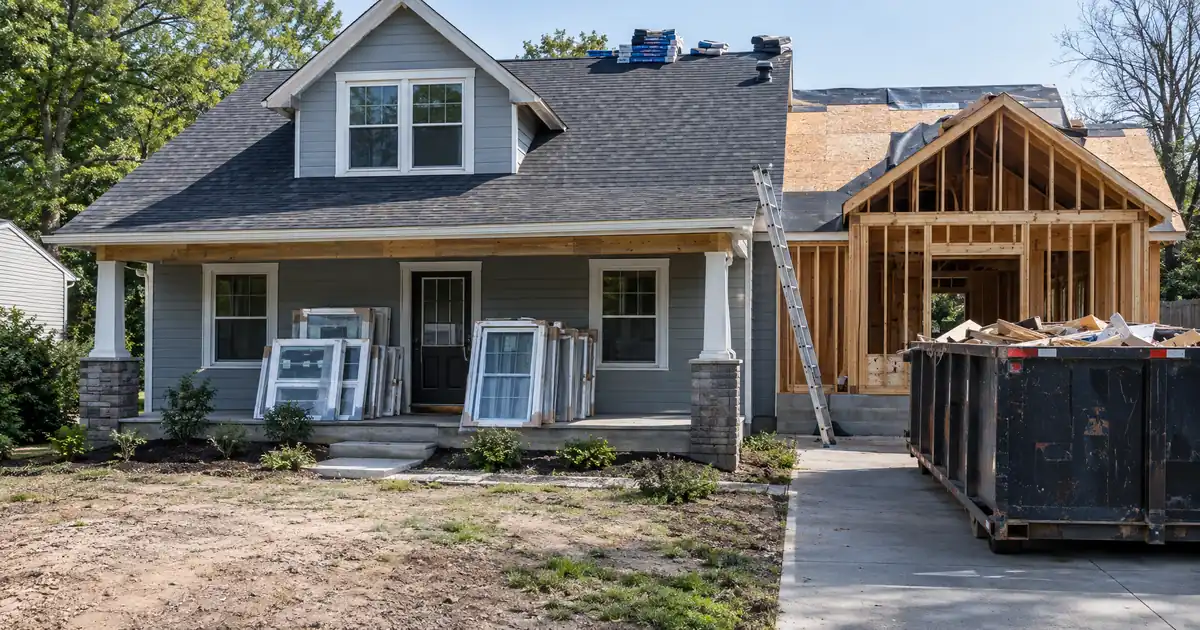
The Quick Read: Yes, you can stack both, and the usual setup is a line of credit on a property you already own covering your cash in while hard money funds the rest of the flip, but it only works when the margin can carry two loans. A HELOC (home equity line of credit) is a revolving credit line secured by the equity in real estate you own. Hard money is a short-term, interest-only loan secured by the flip itself and sized on the project, not on your income.
- The HELOC usually covers the cash down payment and some reserves.
- The hard money loan covers the rest of the purchase and the rehab, paid out in draws.
- Both loans are repaid at sale, and the HELOC balance comes back off the line.
- The cost is that one flip now puts two properties at risk.
- Thin flip margins make that exposure matter more than it used to.
How Do the Two Loans Stack?
Each loan sits on a different property and does a different job. That separation is the whole point, and it is also the whole risk.
What this loan actually costs to carry.
Hard money is sized against the project and priced by time. Enter the deal and see how much the program will lend, the cash required at closing, the carry while you hold it, and what is left at the exit.
Leverage tiers on the current program: 85% with fewer than 2, 90% with 2 or more, 93% with 5 or more completed projects — every tier capped at 75% of after-repair value. Loan amounts up to $5,000,000, larger by exception; terms of 6 to 18 months, interest-only, no prepayment penalty. The rehab portion funds in draws against completed work, not at closing.
Program parameters shown update from Lendmire’s centralized guideline source. Rate, points, and months are editable assumptions, not quoted terms.
Cost cap sets the loan · positive spread
Illustrative estimate only — not a quote, Loan Estimate, approval, or commitment to lend. Rate, points, and months are editable assumptions. Hard money is business-purpose financing for real estate investors, not a consumer mortgage. Leverage on the current program tops out at 93% of project cost for investors with a documented track record, capped at 75% of after-repair value, with rehab funding up to 100% of the documented budget released in draws; actual terms vary by lender, borrower experience, property, and exit. Lendmire is a mortgage broker, not a lender.
| Layer | Secured by | What it typically funds |
|---|---|---|
| HELOC | Equity in a property you already own | Cash down payment, closing costs, reserves |
| Hard money loan | The flip property | Rest of the purchase, rehab budget in draws |
| Your exit | Sale of the flip | Repays hard money, then the HELOC balance |
Across the wholesale network Lendmire places hard money files with, leverage is tiered by how many projects you have finished. The tiers are loan-to-cost figures, meaning a percentage of total project cost, and every tier is capped at 75% of after-repair value (ARV, the property’s expected value once the work is done).
- With 5 or more completed projects, leverage runs up to 93% of project cost.
- With 2 or more completed projects, it runs up to 90% of project cost.
- With fewer than 2, it runs up to 85% of project cost.
Those figures vary by lender, property, and experience, and nothing here is a commitment to lend. The gap between the loan and total cost is your cash. That gap is what the HELOC fills, along with closing costs and a contingency cushion.
Why Do Investors Combine Them?
Investors combine them to start a flip with little of their own cash and to reuse the same capital on the next deal. The HELOC is revolving. Once the flip sells and the balance is paid down, the line is available again.
The cost structure is part of the appeal. A HELOC charges interest only on the amount you draw. Some hard money structures charge interest on the full loan amount from the start, so a draw-only line for your down payment can be a cheaper place to park the equity piece of the deal. A longer or slower project changes that comparison.
The combination also keeps your cash free for the surprises that rehabs produce. Cash in the bank covers an overrun without a second draw on the line.
Rehab money is separate from purchase money in this setup. Hard money lenders in the network typically release up to 100% of the rehab budget in draws against completed work. That is a rehab-budget figure, not a purchase loan-to-value number, and it means you front some costs until each inspection clears.
What Is the Catch?
The catch is that a late or underpriced flip now pressures two properties at once. A lender can foreclose on your home if you do not repay a HELOC as agreed. That applies when the line is secured by the home. HELOCs also typically carry a variable rate, so a long hold adds payment risk on the HELOC side while the hard money side is generally fixed.
The federal consumer-finance regulator’s guide to using home equity says the draw period is usually ten years, with interest-only payments during it. That sounds roomy. Then the repayment period starts, you can no longer borrow, and the balance must be paid down. A flip that stalls can leave you carrying both loans while the line’s repayment clock moves.
A few more edge cases matter:
- Occupancy. Lenders see a line on an investment property as higher risk than one on a primary home. In the files Lendmire brokers, investment-property HELOC lines cap at $500,000 total, and there is no higher tier.
- Line terms. Some lines restrict business or rental use, so read your agreement before you draw.
- Availability. A line can be reduced or frozen if your lender changes the terms, so do not plan a flip that fails when the line shrinks.
- Two lenders, two sets of rules. Neither lender is responsible for the other’s loan, but both want to be repaid.
Tax treatment can depend on how the funds are used and how the property is held; investors should keep clear records and speak with a qualified tax professional before relying on any deduction.
Do Thin Flip Margins Change the Answer?
Yes, because the cushion that absorbs a bad outcome keeps shrinking. ATTOM’s latest quarterly flipping report puts the typical flip margin at 21.5%, continuing a two-year decline. Coverage of the same report in FAIRS says margins were 27.6% a year earlier and that the typical flip took 161 days. It also reports a typical loss on homes bought at $50,000 or less.
Run the logic without dollars. A margin of roughly one-fifth must pay the sale costs, the interest on the hard money loan, the HELOC’s interest on whatever you drew, and any overrun. A modest drop in resale price can consume most of what remains.
The hold time matters as much as the price. Hard money terms in the network run 6 to 18 months, interest-only, with no prepayment penalty. A 161-day typical flip fits inside that window, but a project that doubles its timeline burns both the term and the HELOC’s patience. Build a schedule with room to spare, then add more.
How Do Lenders See This Structure?
Each lender tests something different. The hard money lender underwrites the asset: the property, the rehab plan, and the exit. The HELOC lender tests you and the equity you already hold.
On the hard money side, these are typical network guidelines, and they vary by lender, property, and experience:
- Credit starts around a 620 minimum score, with additional conditions below 660.
- First-time investors generally qualify at the lower leverage tier, not the top one.
- Collateral is non-owner-occupied residential property, 1 to 4 units.
- Loan amounts run up to $5,000,000, with larger loans by exception.
On the HELOC side, the lender checks that your first mortgage plus the new line fits under its combined loan-to-value ceiling, along with your income, credit, and title. A HELOC lender does not test the flip’s rent coverage or profit. It tests the property that secures the line.
Expect the hard money lender to ask where your down payment came from. Borrowed cash is common in this business, but the source should be documented. Plan to hand over the line agreement, a draw record, and bank statements showing the funds landing in your account. Open the HELOC before you need the cash, because a line still in underwriting cannot fund an offer.
What Is the Step-by-Step Sequence?
The order matters more than the speed. Here is how the strongest files run:
1. Open the line first. Confirm in writing that the line allows investment use and has no draw minimums or early-closure fees that bite.
2. Size the HELOC to the gap. Cover your share of cost, closing costs, and a contingency cushion, not just the minimum down payment.
3. Contract the flip and apply for hard money. The lender reviews the plan, the budget, and your project history to set the leverage tier.
4. Draw only what you need. Pull the HELOC cash close to the purchase so interest does not run early.
5. Manage rehab draws. Hard money releases rehab money against finished work, so keep spare cash for the gap between work and reimbursement.
6. Sell and repay in order. The hard money loan is paid at sale, then the HELOC balance is cleared from proceeds, and the line is available again.
Many investors who decide to hold the property refinance out of hard money into long-term rental financing once it stabilizes. Lendmire brokers that path through DSCR lenders, and it is covered in its piece on refinancing a hard money loan after a BRRRR purchase. A DSCR loan compares rent to the full monthly obligation of principal, interest, taxes, insurance, and any dues. It qualifies primarily on property-level rental income covering the payment, subject to lender guidelines. Clearing 1.00x is not the same as positive cash flow, since repairs, vacancy, and management sit outside that ratio. The complete DSCR loans guide walks through the mechanics, and how a leftover HELOC balance is treated in that refinance depends on the program.
Should You Do It?
Run yourself through this screen before you open the line.
| Factor | Good fit | Caution | Avoid |
|---|---|---|---|
| Equity left after the draw | Wide cushion | Thin cushion | Little left |
| Flip margin | Wide, with a budget buffer | About typical | Below typical |
| Experience | Several finished flips | One or two | First deal, tight budget |
| Carry ability | Both payments covered from income | Covered, barely | Depends on a fast sale |
| Line terms | Investment use allowed | Unclear | Restricted |
If you land mostly in the right-hand column, the stack is the wrong tool. The wide-margin, experienced-investor profile is where the structure earns its keep. Honestly, a first-time flipper with a tight budget is usually better off shrinking the project than adding a second loan.
What Are the Alternatives?
A few other ways to fill the cash gap carry less cross-collateral risk.
| Option | How it fills the gap | Main tradeoff |
|---|---|---|
| Partner or joint venture | Splits cash and profit | Gives up part of the upside |
| Private money | Borrowed from an individual | Terms vary widely |
| Smaller project | Needs less cash in | Lower profit ceiling |
| More of your own cash | No second lien | Ties up capital |
Key Terms Defined
HELOC: A revolving credit line secured by the equity in a property you own, where you pay interest only on what you draw.
Combined loan-to-value (CLTV): The total of all loans on a property divided by its value, which caps how much a HELOC lender will let you borrow.
Loan-to-cost: The share of total project cost a hard money lender will fund.
After-repair value (ARV): The expected value of the flip once the rehab is finished.
Draw: A release of loan funds, either from a HELOC to you or from a hard money lender against completed rehab work.
Frequently Asked Questions
Can I use a HELOC for a hard money down payment?
Often yes. Many investors do exactly this, as long as the line allows investment use and the source of funds is documented. Hard money lenders in the network care mostly about the property, the plan, and your exit. Whether a borrowed down payment works still depends on the lender, the property, and your experience.
Should I open the HELOC before or after I find the deal?
Before. A line in underwriting cannot fund an offer, and a deal that needs cash now should not wait on a lender’s review. Open it, confirm the terms, and keep the unused balance as your cushion.
What happens if my flip does not sell on time?
You keep paying interest on both loans while the clock runs. Hard money terms in the network run 6 to 18 months, interest-only, with no prepayment penalty, so one option is to refinance into long-term rental financing if you decide to hold. If the HELOC enters repayment first, the payment can rise sharply because you can no longer borrow and must pay the balance down.
Is it risky to use my home?
It can be, if the HELOC is secured by your home. A missed payment can put that home at risk, even when the flip is the reason you missed it. Keep a cash cushion, and do not size the line to the full limit.
Does stacking make sense for a first-time flipper?
Rarely at the full amount. First-time investors typically qualify at the lower leverage tier, so you bring more cash, and the HELOC covers a bigger piece of your risk. A smaller first project often teaches the same lessons with less exposure.
Next Step
If you are buying, rehabbing, or refinancing an investment property on a short timeline and want to see how the numbers work, Lendmire can help you compare hard money options based on the project, the exit plan, leverage, and your goals. Lendmire is a broker arranging financing through select lenders in its wholesale network across 41 markets, including Washington, D.C.
About Lendmire
As a DSCR and non-QM mortgage broker, Lendmire — NMLS# 2371349 — connects investors with wholesale lending channels across 41 markets, including Washington, D.C. The property’s rental income, not the borrower’s tax returns, is central to lender review, which works for self-employed operators and portfolios beyond four financed properties. Scotsman Guide named Lendmire a Top Mortgage Workplace in both 2025 and 2026.
Get Started
Ready to find the right loan for you?
In about 30 seconds you can review financing options available for your investment property. No commitment required.
Informational only. Not a Loan Estimate, approval, or commitment to lend. Program availability and eligibility are subject to lender guidelines, credit approval, property review, and underwriting.
References
1. CFPB – Using home equity guide
2. ATTOM – Home flipping profits continue gradual two-year decline
3. FAIRS
This article is part of Lendmire’s hard money loan program — full qualification details, guidelines, and scenarios live on the program page.
Related reading: HELOC vs Hard Money for a First Flip: When Each One Wins · HELOC Structure vs Hard Money Costs for a First-Time Flipper · Hard Money Loan Structure vs HELOC Pricing and Draw Terms for Flips
Brandon Miller
Founder & CEO, Mortgage Loan Originator, Lendmire LLC
- Mortgage Loan Originator · NMLS# 1129696 · Verify on NMLS Consumer Access
- North Carolina Real Estate Broker · License# 343312 · Verify on NCREC
- North Carolina Insurance Producer · License# 19053198 · Property, Casualty, Life, Health · Verify on NAIC SBS
- Lendmire LLC · Firm NMLS# 2371349 · Verify firm licensure
Legal disclosures. Lendmire (NMLS# 2371349) is a state-licensed mortgage brokerage that arranges financing through wholesale lender relationships. Lendmire is not a direct lender, depository institution, or registered financial advisor. The discussion above is general informational content about real estate financing — it is not financial, legal, or tax advice, and readers should consult licensed professionals for guidance on their individual circumstances. Loan inquiries are subject to lender underwriting; this article does not represent a commitment to lend. Loan terms, rates, and qualification standards vary by borrower, property, and state, and are subject to change at any time. Equal Housing Opportunity. NMLS Consumer Access: nmlsconsumeraccess.org.