
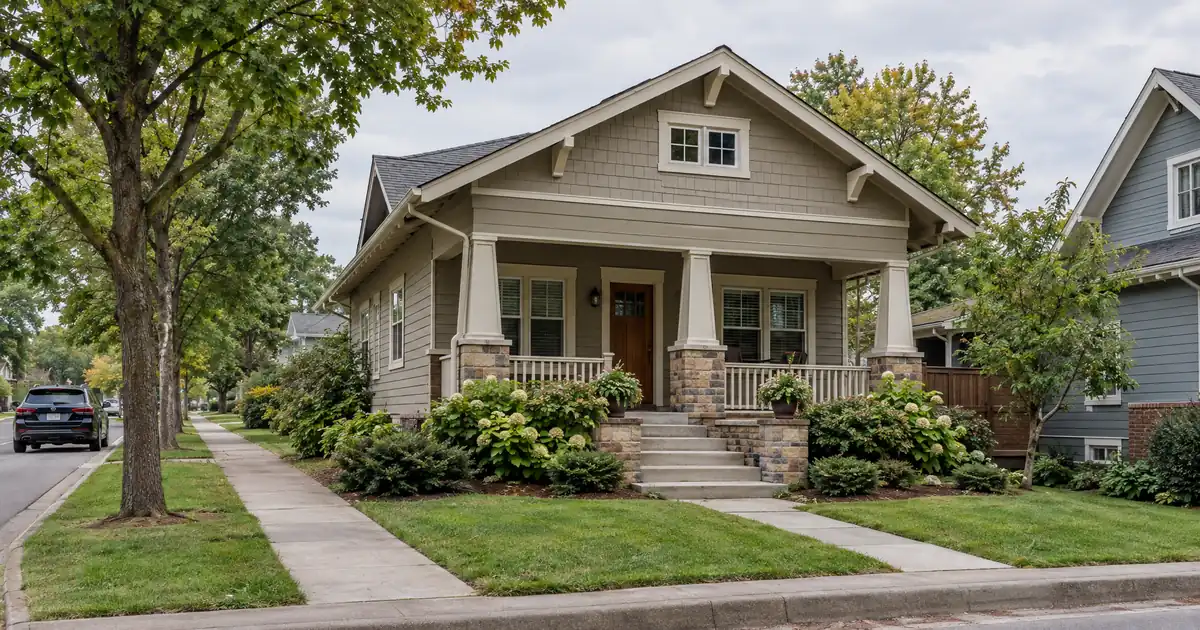
The Quick Read: On a primary home, your tier comes from your credit profile and the combined loan-to-value you need, and “first-time” is a label, not a tier. Across Lendmire’s wholesale network, lines are sized by credit band, with the ceiling and the dollar cap both stepping up as the score rises.
- A 720-or-better profile reaches 90% CLTV on a primary residence, but only up to $500,000.
- The same 720 borrower can instead take a line up to $750,000 at a reduced 75% CLTV.
- Credit bands step down from there: 85% at 660 and above, 80% at 640, 70% at 620, 60% at 600.
- At least 75% of the line is drawn at closing, and pricing floats for the life of the line.
- Availability is limited to Lendmire’s 16 full-service states, and every figure is subject to lender guidelines and full file review.
Most people searching this topic have never borrowed against their house. They want to know which bucket they land in and what line that means. This article walks through the grid, the sizing math, and the places where the rules bend. It also covers what the decision looks like when the line is meant to fund a rental purchase.
How large a line the equity supports.
An equity line is sized by combined loan-to-value, occupancy, and credit — not by rental coverage. Switch the occupancy or the credit band and the ceiling moves with it.
Investment-property lines require a 700 minimum credit score; second-home lines start at a 640 minimum and primary-residence lines at 600, and the combined-LTV ceiling steps down as the credit band drops on primary-residence and second-home lines and holds on investment-property lines; the line cap steps down on primary-residence lines and holds at every tier on investment-property and second-home lines.
A debt-to-income ratio above 45% requires 680+ credit. Profiles under 640 are limited to single-family homes. At least 75% of the approved line is drawn at closing. Ceilings, floors, and caps update from Lendmire’s centralized guideline source.
Line estimate
Illustrative estimate only — not a quote, Loan Estimate, approval, or commitment to lend. The rate is an editable assumption; equity-line pricing is variable through both the draw and repayment periods and never converts to fixed. Occupancy and credit drive the ceiling together: an investment property tops out at 70% combined LTV (minimum credit 700, line cap $500,000); a second home tops out at 90% combined LTV (minimum credit 640, line cap $500,000), with the ceiling stepping down as the credit band drops (the cap holds at every tier); a primary residence tops out at 90% combined LTV (minimum credit 600), and its $750,000 maximum line is available only at 75% combined LTV or below with a 700-or-better credit profile (720 on the longer-runway program) and a full appraisal. Lines above $500,000 require a full appraisal. Credit, debt-to-income, property type, and full underwriting review all affect the final line.
Key Terms Defined
HELOC: A revolving line of credit secured by your home, where you borrow during a draw period and repay afterward.
CLTV: Combined loan-to-value, meaning all liens on the home divided by its value. It counts the full credit limit, not just what you have drawn.
Tier: A lender-set band that pairs a credit score range with a maximum CLTV and a maximum line size. No regulator defines tiers.
Draw period: The stretch when you can borrow, usually paying interest only.
Repayment period: The stretch after the draw ends, when borrowing stops and principal-and-interest payments begin.
First-time equity borrower: A homeowner tapping equity for the first time. It describes your history, not a program.
What Does “Tier” Actually Mean on a Primary Home?
A tier is a lender’s grid, not a rule of law. Occupancy sorts the grid first, credit sorts it second, and the dollar cap follows from both. A primary residence sits at the top because it is the lowest-risk collateral.
On Lendmire’s network, the 90% CLTV ceiling exists only at a 720-or-better credit profile. Market surveys report a wide spread of ceilings for equity lines, and those describe the broader market, not this network. The numbers below apply to a primary residence only.
Being a first-time borrower does not move you between rows. A lender does not ask whether you have borrowed before. It asks what your credit looks like, how much equity you hold, and whether your debt load fits.
The Primary-Residence Tier Table
Here is the grid as it works across the network’s wholesale programs. Treat it as eligibility guidance, not a promise.
| Credit profile | Max CLTV | Max line |
|---|---|---|
| 720+ | 90% | $500,000 |
| 720+ | 75% | $750,000 |
| 700+ | 85% | $500,000 |
| 700+ | 75% | $750,000 |
| 680+ and 660+ | 85% | $500,000 |
| 640+ | 80% | $500,000 |
| 620+ | 70% | $400,000 |
| 600+ | 60% | $400,000 |
The program floor is a 600 score, and lines range from $25,000 to $750,000. Two things deserve a closer look.
The 720 tradeoff. A 720 borrower faces a real choice. You can take the highest leverage, 90% CLTV, with a line up to $500,000. Or you can take a bigger line, up to $750,000, at 75% CLTV. Which is better depends on your equity. Someone with a modest equity cushion usually needs the 90% tier to pull meaningful cash. Someone with deep equity in a high-value home may find the larger line at lower leverage gives more actual dollars.
The line above $500,000. Anything above $500,000 is primary-residence only. It requires a 700 credit profile or better (720 on the longer-runway structure described below), caps at 75% CLTV, and needs a full appraisal.
One more gate catches people. Business bank accounts used for deposit analysis require a 680 minimum. A 640 borrower can qualify for the line but cannot use business accounts to document it.
From Tier to Dollars: How the Line Gets Sized
The line is the lesser of what the CLTV ceiling allows and what the cap allows. Then a debt-to-income test can shrink it further. Run it in five steps: value, ceiling, existing liens, cap and payment test.
1. Establish value. For lines at or below $500,000, the network ordinarily runs automated valuation, with no traditional appraisal. A higher CLTV may call for a secondary valuation. A full appraisal is required on every line above $500,000, and you can request one in any case.
2. Apply the ceiling. Multiply value by your tier’s maximum CLTV.
3. Subtract existing liens. Whatever remains is the most the line could be. This is the same mechanic the CFPB’s HELOC booklet describes, where a lender takes a percentage of appraised value and subtracts what you still owe.
4. Check the cap. If the remainder exceeds your tier’s dollar cap, the cap wins.
5. Test the payment. DTI is qualified on the interest-only payment calculated on the maximum draw.
Run the logic on a home worth $600,000 with a $300,000 first mortgage. At 85% CLTV, the ceiling allows liens up to $510,000, which leaves room for a line of about $210,000. That sits well under the $500,000 cap, so equity binds first. Now put a 640 score on the same home at 80% CLTV. The ceiling allows $480,000 in total liens, so the line shrinks to about $180,000. Same house, same mortgage, a different line, and only credit changed.
Because CLTV counts the full credit limit, a small planned balance does not shrink the math. You are sized, and tested, on the limit.
Which Limit Binds First?
Four constraints compete, and whichever tightens first sets your outcome. In rough order of how often they bite a first-time borrower:
1. Equity. A recent buyer with a small down payment often has little room under the ceiling.
2. Credit tier. Your score sets the ceiling and the cap together.
3. DTI. The maximum is 50%, and it drops to 45% for profiles from 600 to 679. A ratio above 45% requires a 680 minimum.
4. Title. If the home is not in your name or a revocable living trust, none of the above matters yet.
Check title before you gather paperwork. Fee simple or leasehold held by the individual borrower, or an inter vivos revocable living trust, is acceptable. LLCs, corporations, partnerships, and irrevocable, blind, or land trusts cannot hold title. That is the sharpest structural difference from a DSCR loan. A property already deeded to an LLC needs a vesting change, or a DSCR cash-out refinance instead.
What the Draw and Repayment Structure Looks Like
There are two draw structures on primary residences. One runs a 3-year interest-only draw with a 17-year fully amortizing repayment. The other, the longer-runway structure, runs a 5-year draw with a 25-year repayment. Tennessee shortens both, to 3 years and 12 years, and 5 years and 10 years. A quoted figure always carries its own structure.
Three mechanics catch first-timers off guard:
- Required draw at closing. At least 75% of the line is drawn at closing on both structures. This is not a line you open and leave idle.
- Floating pricing. Pricing floats across both the draw and the repayment period and never converts to fixed.
- Payment step-up. The CFPB booklet warns that payments are often significantly higher once the draw ends, because principal begins to amortize.
After closing, the minimum subsequent draw is $1,000 on the longer-runway structure (Texas is $4,000). Lenders can also freeze or reduce a line if the home’s value falls significantly or your finances change materially, even when you are current on payments.
Where the General Rules Break
The grid above is the rule. These are the named exceptions.
Credit history standards. The longer-runway structure wants two tradelines seasoned 12 months, or one seasoned 24. Housing history must be 0x30x6 and 1x30x12 at 640 and above, or 0x30x12 from 600 to 639. A bankruptcy needs 4 years of seasoning from discharge or dismissal. Foreclosure history splits: one structure seasons a foreclosure at 7 years and a short sale or deed-in-lieu at 4, while the other declines that history regardless of age.
Low scores. A profile below 640 is limited to single-family residences with a clean 12-month housing history on the longer-runway structure.
Property type. Eligible: single-family, 2-4 units (640 minimum on the longer-runway structure), PUD, townhome, and condominium, including non-warrantable. Modular factory-built homes are eligible on the longer-runway structure only. Not offered: manufactured homes, co-ops, condotels, log homes, commercial, mixed-use, or agricultural zoning.
State overlays. A Texas primary residence is a homestead and caps at 80% combined loan-to-value, so the matrix tiers above that figure never apply there. Texas primaries also carry a 12-day waiting period, a one-lien-at-a-time rule, and 12-month seasoning. New Mexico and Ohio apply a CLTV cap that depends on the credit profile. A property listed for sale within the past 60 days is ineligible in NC, PA, TN, TX, and WA. Availability overall is limited to Lendmire’s 16 full-service states, which is narrower than its 41-market DSCR footprint.
Exposure. A borrower is limited to three lines. Combined exposure caps at $2,000,000 on the higher-leverage structure and $750,000 on the longer-runway one, and owning more than 15 financed properties makes you ineligible.
Rescission. On a principal dwelling, federal rules give a three-business-day right to rescind when the plan opens. That right does not attach to each later draw under an established limit.
Three Borrower Profiles
| Profile | Tier read | What likely binds |
|---|---|---|
| 735 score, deep equity | 90% up to $500,000, or 75% up to $750,000 | The choice between leverage and size |
| 665 score, moderate equity | 85% up to $500,000 | Equity cushion |
| 625 score, thin equity | 70% up to $400,000 | Credit tier and DTI at the 45% limit |
The 735 borrower is choosing, not qualifying. The 665 borrower will likely find equity is the constraint rather than credit. The 625 borrower sits where every limit tightens at once, and a few points of score improvement can move both ceiling and cap.
The Investor Decision: Using Primary-Home Equity for a Rental
Many first-time equity borrowers want the line for one purpose: the down payment on a rental. The practical question is whether that stacks up.
A DSCR loan is reviewed primarily on property-level rental income covering the payment, subject to lender guidelines. The line on your home is a separate approval, and its payment does not appear in the DSCR ratio. Clearing 1.00 on the rental is also not the same as positive cash flow. Repairs, vacancy, management, utilities, and capex all sit outside the calculation. If you borrow your down payment, your real cushion has to cover the line payment too.
Leverage is the other cost. On a DSCR purchase, most files land at 75%-80% LTV, and select programs reach 85% with roughly a 700+ score. If a borrowed down payment funds the rest, you may be financing close to 100% of the purchase, with your home pledged behind it. Investor discussion on BiggerPockets flags the same risk: the primary residence is exposed if the rental underperforms. Another BiggerPockets thread points out that principal payments arrive on top of interest once the draw ends.
The tradeoff flips by profile. If you have a strong score, deep equity, and a rental whose coverage is well above the baseline, a primary-home line can be a sensible down payment source. If your equity is thin, your DTI is near 45%, or the rental barely clears coverage, the combination leaves little room for error. In that case a DSCR cash-out refinance on an existing rental, which tops out around 75% LTV, may keep the risk off your home.
For a fuller picture of how the rental side works, see Lendmire’s complete DSCR loans guide. Tax treatment can depend on how the funds are used and how the property is held; investors should keep clear records and speak with a qualified tax professional before relying on any deduction.
If you are considering a home equity line and want to see how the numbers work, Lendmire can help you compare HELOC options based on the property, the equity available, credit profile, combined leverage, and your goals. Call 828-256-2183 or request a quote.
Frequently Asked Questions
Does being a first-timer change my tier?
No. Tiers come from credit profile, CLTV, and occupancy. A first-time borrower with a 720 score sits in the same row as a repeat borrower with a 720. What changes is unfamiliarity with sizing, not underwriting.
How much equity do I need before a line makes sense?
Enough that your value times your tier’s ceiling exceeds your existing liens by a useful margin. A recent buyer with a small down payment often has little room at 80% or 85%. The 90% tier, available at 720 or better, helps most when equity is thin.
Can I use a line above $500,000?
Only on a primary residence, with a 700 credit profile or better (720 on the longer-runway structure), at 75% CLTV maximum, and with a full appraisal. The maximum line is $750,000.
Does the line need an appraisal?
Not usually at or below $500,000, where automated valuation is ordinary, though a higher CLTV may require a secondary valuation. Every line above $500,000 needs a full appraisal, and you can request one at any size.
Can my LLC-owned property secure one of these lines?
No. LLCs and several trust types cannot hold title on these lines. Title must sit with you individually or in a revocable living trust, so an LLC-held property would need a vesting change or a DSCR cash-out instead.
For current guidelines and terms, see Lendmire’s HELOC programs page.
About Lendmire
As a mortgage broker (NMLS# 2371349), Lendmire helps homeowners in its 16 full-service states open home equity lines of credit on their primary residences, arranged through wholesale lenders. Lendmire is never the lender; line amounts, ceilings and terms are set by the lender under its guidelines. Scotsman Guide named Lendmire a Top Mortgage Workplace in both 2025 and 2026.
Get Started
Ready to find the right loan for you?
In about 30 seconds you can review financing options available for your home or investment property. No commitment required.
Informational only. Not a Loan Estimate, approval, or commitment to lend. Program availability and eligibility are subject to lender guidelines, credit approval, property review, and underwriting.
References
2. CFPB Regulation Z § 1026.15
3. BiggerPockets: using a HELOC for down payment or full purchase
4. BiggerPockets: using a HELOC for investment property down payment
This article is part of Lendmire’s home equity line of credit program — full qualification details, guidelines, and scenarios live on the program page.
Related reading: Should a Homeowner Use a HELOC to Build an ADU or Pool? · HELOC vs Cash-Out Refinance for a Retiree on Pension Income · How to Get a HELOC After a Quitclaim in a High-Cost Closing State
Brandon Miller
Founder & CEO, Mortgage Loan Originator, Lendmire LLC
- Mortgage Loan Originator · NMLS# 1129696 · Verify on NMLS Consumer Access
- North Carolina Real Estate Broker · License# 343312 · Verify on NCREC
- North Carolina Insurance Producer · License# 19053198 · Property, Casualty, Life, Health · Verify on NAIC SBS
- Lendmire LLC · Firm NMLS# 2371349 · Verify firm licensure
Disclosure information. Lendmire is a state-licensed mortgage brokerage under NMLS# 2371349. Lendmire is not a depository institution, direct lender, or financial advisor — all loans referenced are placed through wholesale lender partners and are subject to each lender's underwriting standards. This article is provided for general informational purposes and is not a commitment to lend, nor does it constitute financial, legal, or tax advice. Loan programs, terms, rates, and qualification standards change without notice and depend on borrower profile, property type, and the state in which the subject property is located. Equal Housing Opportunity provider. NMLS Consumer Access: nmlsconsumeraccess.org.