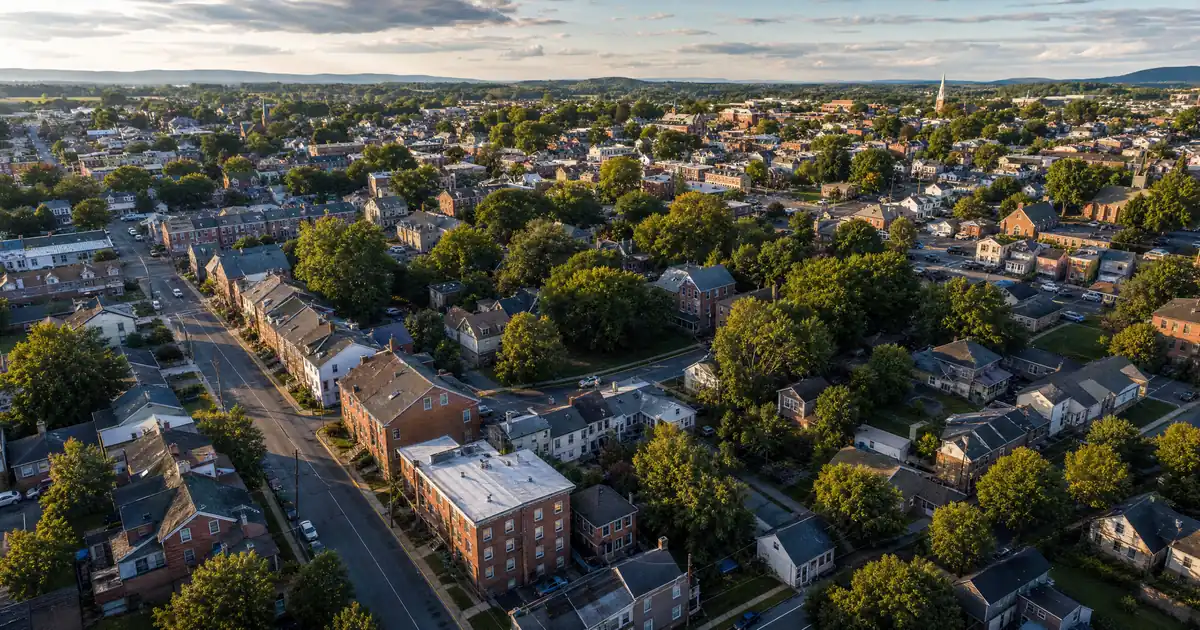
The objection comes up in almost every conversation about buying rental property in Gettysburg: there’s barely any market to comp against. Redfin recorded only four home sales in the borough during April of a recent year, down from six the year before, even as the median sale price climbed 8.4% year-over-year to $420,000 (Redfin). Investors hear “thin transaction volume” and assume that means the appraisal will be a fight and the lender file will stall out. That’s a fair worry. It’s also a solvable one, provided the file is built around the right property type and the appraisal expectations are set before the purchase contract is signed, not after.
The Quick Read: DSCR lender review for investment property loans in Gettysburg, Pennsylvania is underwritten primarily against the property’s rental income measured against its full monthly housing obligation, and with only four recorded borough sales in April per Redfin, appraisers routinely pull comps from surrounding Adams County townships rather than the borough alone.
DSCR Calculator
Run the numbers in Gettysburg, PA
Rate source: Freddie Mac 30-yr average via FRED® — Federal Reserve Bank of St. Louis · effective Jul 2, 2026
Prefilled with local estimates — enter your own rent or nightly figures, taxes, insurance, and HOA for a more accurate picture.
As of Jul 2, 2026 · General Freddie Mac market benchmark, not a Lendmire loan offer. Rent, nightly rate, occupancy, taxes, and insurance are editable estimates. Short-term rental figures are estimates only and vary significantly by season, property type, management approach, and local short-term-rental rules — confirm local regulations before relying on them. Qualifying income for short-term rentals varies by program — some use appraisal market rent, others use documented STR history or projections — and is confirmed in underwriting. Not a Loan Estimate, approval, or commitment to lend. Program availability and eligibility are subject to lender guidelines, credit approval, property review, and underwriting.
- Median borough sale price sits at $420,000 with four closed sales in the reference month (Redfin)
- Citywide rent averages range from $1,200 to $1,737 depending on the data provider — no single number is reliable
- Adams County rental vacancy runs about 4%, a landlord-favorable but low-growth signal
- New-construction single-family rent-to-value runs near 0.43% monthly, a structural DSCR problem
- Gettysburg College enrolls 2,086 degree-seeking undergraduates, with 95% living on campus
Gettysburg Market Snapshot
A quick read on the Gettysburg investor landscape — figures come from the cited sources below. Confirm current property-level numbers before underwriting.
| Metric | Detail |
|---|---|
| Home prices | $420K median sale price (Redfin) |
| Typical rents | $1,737 average (RentCafe) |
| University enrollment | Enrollment 2,086 (Gettysburg College) |
| Population | 8,254 population (Census Reporter) |
| Vacancy | 4% (Affordable Housing Online) |
Why the Appraisal Is the Real Underwriting Bottleneck Here
Gettysburg’s transaction volume is the single biggest operational wrinkle on a DSCR file, and it shows up as comp selection risk rather than income risk. With single-digit monthly closings inside the 1.7-square-mile borough, an appraiser working a purchase file often has to reach into Straban Township, Cumberland Township or even toward Hanover to find three genuinely comparable closed sales. That’s standard appraisal practice in a thin market — but it means the value conclusion on a Gettysburg file can swing more on which comps got selected than it would in a deeper suburban market with far more monthly closings.
The price spread across public sources reinforces the point. Zillow’s home value index puts the typical Gettysburg home at $317,680, up 3.3% over the past year (Zillow). Redfin’s transaction-based median sits at $420,000. A third source drawing on broader metro-area listing data shows a median in a similar range. Three legitimate sources, three different numbers — not because any one is wrong, but because sale-price, index-value and list-price methodologies diverge more sharply in a market this small. An investor underwriting a Gettysburg purchase should treat these as a range, not a single figure, and should expect the appraiser’s opinion of value to land somewhere inside that spread rather than pinned to whichever number came up first in a Google search.
Rent comps carry the same fragmentation. RentCafe’s Yardi Matrix data puts average apartment rent at $1,737, up 6.78% year-over-year, with two-bedroom units running $1,845 to $2,020 (RentCafe). Zillow’s own rental manager tool shows a $1,356 average with two-bedrooms at $1,400 (Zillow Rental Manager). Zumper’s February snapshot put the median at $1,200 across all bedroom counts and property types, well below the national figure. A $500-plus gap between platforms on the same eight-thousand-person borough means none of them should anchor a rent schedule on their own — the file needs unit-specific comps pulled from properties of similar size, age and submarket, not a citywide average lifted from whichever aggregator ranks first.
Where the Duplex Math Actually Clears
Small multifamily near downtown and College Hill is the strongest DSCR play in Gettysburg relative to the borough’s other property types, and the reason is structural: older two- and three-unit buildings carry enough combined rent to get meaningfully closer to workable coverage than newer single-family product does — even though clearing a standard file here still takes more equity or program flexibility than a quick look at the rent roll suggests.
A recent downtown-adjacent duplex listing illustrates the mechanism directly. The seller discloses in-place rents of $760 per unit under legacy month-to-month leases, alongside a stated current market rent of $1,600 per unit (Homes.com) — essentially double the trailing collected rent. That gap matters for how the file gets built. A lender’s rent schedule for DSCR qualification is typically pulled from an appraiser’s market-rent opinion (the 1007 rent schedule), not from the seller’s trailing collections, so a duplex priced against under-market legacy leases can qualify on the appraiser’s market-rent figure rather than the seller’s actual income statement. That’s a documentation nuance worth flagging to a loan officer before the file goes in, because a rent roll that looks weak on paper can still support a stronger coverage number once the appraisal comes back.
Run the numbers on a modeled version of that deal. Assume a duplex priced near $372,500 — Homes.com’s reported median for Gettysburg multifamily listings — purchased at 75% LTV, meaning roughly 25% down. Using market-reset rent of $1,600 per unit (both units combined, or $3,200 monthly), and modeling the full monthly obligation under the current rate environment together with typical Pennsylvania-area property tax and insurance costs for a purchase at this price point, the coverage ratio comes in well under breakeven — in the roughly 0.65x-0.70x range on this modeled scenario, short of even the roughly 1.00x floor that some select DSCR programs use as a baseline, let alone a comfortable cushion above it. That’s a modeled assumption built from research-supported rent figures, not a quote on any specific loan, and it means this particular price-and-leverage combination would need meaningful adjustment before it clears on a standard file — a larger down payment to reduce the obligation, a sub-1.00x select program, an interest-only structure, or a documented market rent above the $1,600-per-unit figure used here. Actual coverage depends on the appraiser’s final rent conclusion and the borrower’s specific loan terms, and none of those paths is guaranteed; terms vary by lender guidelines, property type, leverage, credit profile, and full file review.
This kind of under-market-rent duplex is still the file type where a broker who understands appraisal-based rent schedules earns their keep, walking the loan officer through why the seller’s collected rent doesn’t have to be the ceiling on qualifying income — and through which combination of down payment, rent documentation and program actually gets a specific duplex to a workable coverage number. A three-unit mixed-use property near Gettysburg College, marketed as one of the few turnkey cash-flowing multi-unit assets currently on the market, makes the same point from the supply side: multi-unit product that’s already stabilized is scarce enough that sellers can command a premium for it (Homes.com). Investors who can’t find a turnkey duplex may need to create one — buying a legacy-rent building and repositioning it to market on turnover.
New Construction Doesn’t Pencil the Same Way
New-construction single-family product in Gettysburg is a weak DSCR fit at standard leverage, and the Zillow data on individual properties makes the case cleanly. A 2015-built three-bedroom home valued at $418,300 carries a Rent Zestimate of $1,802 a month. A 2023-built two-bedroom valued at $578,600 carries a Rent Zestimate of $2,493 (Zillow). Both work out to roughly 0.43% monthly rent-to-value — well below the 0.8%-1% range that typically supports comfortable coverage under prevailing carrying costs.
Modeling that first property at 75% LTV under the same rate-environment and tax/insurance assumptions used above, the monthly obligation runs well ahead of the $1,802 rent figure — coverage lands further under 1.00x than the duplex example above, not over it. That’s not a knock on the properties themselves; it’s a function of new-construction pricing outrunning what the local rent ceiling supports. This is precisely why product like Amblebrook — the 55+ active-adult community with its clubhouse and pools — and Wade Run at the Links at Gettysburg, the new-build community roughly ten minutes from the battlefield with an easy commute toward Hanover, Harrisburg or Maryland, tend to draw retiree and commuter buyers rather than DSCR investors. Not ideal territory for a long-term rental file. Skip it unless the plan involves a much larger down payment or a rent structure well above what these Zestimates suggest — and even then, a sub-1.00x coverage scenario would need a lender’s sub-1.00 program, an interest-only structure, or additional compensating factors, none of which is guaranteed and all of which depend on lender guidelines and credit profile.
Twin Oaks, Colt Park and the Workforce Single-Family Layer
Established single-family stock in Twin Oaks and Colt Park is the steadier — if less spectacular — purchase play, built on long-tenured workforce and family tenants rather than tourism cycles or campus turnover. Twin Oaks is a mid-century brick-ranch subdivision close to the grocery store and battlefield; Colt Park offers split-level homes walkable to downtown, near Rec Park, the pharmacy corridor and WellSpan Gettysburg Hospital. Neither submarket has a dedicated rent index in the research, so the honest read is qualitative: these are older, moderately priced homes serving tenants who work locally and tend to stay — the kind of low-churn base that supports a straightforward long-term-rental DSCR file rather than a value-add repositioning play.
That low-churn character lines up with the county-level vacancy data. Adams County’s rental vacancy rate runs about 4%, which Affordable Housing Online characterizes as lower than average (Affordable Housing Online). Zillow separately tags the Gettysburg rental market’s demand temperature as “cool,” meaning renter demand isn’t accelerating relative to the national pace even as existing vacancy stays tight. Read together, that’s a market where existing tenants are unlikely to leave and current rents hold — but where an investor underwriting aggressive rent growth on turnover is probably overreaching. Twin Oaks and Colt Park are buy-and-hold plays, not rent-arbitrage plays.
Steinwehr Avenue and the Tourism-Hospital Tenant Base
Steinwehr Avenue’s residential side streets sit inside a tenant pool defined by two things: roughly a million annual visitors to the 6,000-acre Gettysburg National Military Park (Homes.com) and the staffing needs of WellSpan Gettysburg Hospital a short walk away. The corridor blends tourist-facing commercial use with residential rentals housing hospitality workers and hospital staff who need to be close to both. WellSpan Gettysburg Hospital has earned the Leapfrog Group’s top “A” safety grade and a 4-Star CMS quality rating while serving more than 100,000 residents across greater Adams County (WellSpan) — a stable, non-cyclical employer base that anchors year-round rental demand even as tourist foot traffic swings seasonally with the July reenactment crowds and summer visitor peak.
The borough’s daytime population swells by more than 3,100 people through commuting workers alone, a 37.4% increase over the resident base (Census Reporter) — accommodation and food services account for 503 local jobs, behind only educational services at 1,323. That’s a tenant base built on service-sector shift work rather than white-collar salaries, which matters for how a lender views the durability of a rent roll here: steady, but not high-growth.
College Hill’s Enrollment Headwind
Gettysburg College is one of the borough’s largest employers and its most visible institution, but its enrollment trend cuts against the usual college-town rental thesis. Fall 2025 enrollment stood at 2,086 degree-seeking undergraduates, down from 2,213 the year before (Gettysburg College) and down from a peak above 2,700 roughly a decade earlier. Ninety-five percent of students live in college-owned or -affiliated housing, leaving only a thin slice of off-campus demand to begin with — and that slice is shrinking, not growing.
This is worth saying plainly because it cuts against a common assumption: college towns usually see compounding off-campus rental demand as enrollment climbs. Gettysburg is running the opposite direction. A four-bedroom brick townhouse walkable to campus can still work as a room-by-room rental — the tenant pool of staff, graduate hires and remaining off-campus students is real — but an investor underwriting rent growth here on the assumption that a growing student body will keep pushing rents up is working from the wrong premise. College Hill product should be underwritten on today’s rent, not tomorrow’s enrollment.
Appreciation Spike Versus the Ten-Year Trend
Gettysburg’s most recent quarterly appreciation ran at 4.49%, an annualized pace of 19.2% — one of the strongest short-term prints in the country per NeighborhoodScout’s FHFA-based data (NeighborhoodScout). But the ten-year average annual appreciation rate sits at just 5.71%, lower than 70% of U.S. communities over the same span. That’s a meaningful gap, and it’s the kind of thing an investor building a purchase thesis around future value needs to weigh honestly.
The stronger case for buying in Gettysburg right now is cash flow off in-place or resettable rents, not a bet that 19% annualized appreciation becomes the new baseline. A duplex or small multifamily purchase that clears coverage on today’s rent roll works whether the next decade tracks the recent hot quarter or reverts to the slower ten-year average. A single-family purchase that only pencils if appreciation keeps running at last quarter’s pace is a much riskier bet — one where the downside case (reversion to the 5.71% trend) leaves very little room for error.
The File-Level Friction Points
Files coming out of markets structurally similar to Gettysburg — small transaction volume, fragmented rent data, a mix of legacy and market-rate leases — tend to share a common friction point at the deal desk: the appraiser’s rent schedule and the seller’s actual collected rent rarely match, and the deal works faster once the loan officer has both figures in hand up front rather than discovering the gap mid-underwriting. The cleaner files also tend to include recent, unit-specific rent comps pulled by the listing agent or a local property manager rather than a citywide average pasted from an aggregator site — since Gettysburg’s rent data spread ($1,200 to $1,737 depending on source) is wide enough that an underwriter reviewing a thin comp set will ask for support anyway.
Loan parameters worth knowing before shopping a Gettysburg property: standard DSCR purchase programs generally run 75%-80% LTV, meaning 20%-25% down on most files, with some select programs allowing a coverage floor as low as roughly 1.00x on the property’s rent against its full monthly obligation — though many programs require a stronger cushion above that floor. Credit tiers commonly reviewed run from a 620 floor up through 700-plus for higher-leverage scenarios, with reserve requirements typically around six months of PITIA. None of this is guaranteed on any individual file — eligibility depends on lender guidelines, credit profile, property review and program terms, and figures should be confirmed directly before an investor writes an offer.
Investors can review the DSCR lender review mechanics or where DSCR and conventional diverge before deciding which structure fits a given Gettysburg property. Investors who already hold Pennsylvania rental property and are weighing a pull toward acquisition capital can also look at investor refinance options, though the purchase-side math above is the more immediate opportunity in this market. Lendmire’s Pennsylvania DSCR platform covers the full range of property types discussed here, from downtown duplexes to Twin Oaks single-family homes, subject to program eligibility for LLC-titled purchases where applicable.
About Lendmire
Lendmire (NMLS# 2371349), founded by CEO Brandon Miller, is a non-QM DSCR mortgage broker arranging investment property financing across 39 states plus Washington, D.C. — 40 markets total. As a broker rather than a direct lender, Lendmire works with loan officers to match investors with programs suited to a specific property, rent roll and credit profile, which is particularly relevant in thin-comp markets like Gettysburg where appraisal and rent-schedule nuances shape the outcome of a file.
DSCR vs. conventional financing
Two common ways to finance an investment property in Gettysburg, PA. They qualify you differently — here’s how investors weigh them.
Why investors choose it
- Qualifies on the property’s rental income — no personal tax returns, W-2s, or pay stubs needed to document income.
- No personal debt-to-income ceiling to clear, so existing mortgages and obligations don’t cap your borrowing the same way.
- Can be closed in an LLC, keeping the property inside a business entity.
- Built for scaling — not held to the limit on number of financed properties that conventional financing applies.
- Underwriting centers on the deal: generally qualifies when the rent covers the payment, a 1.00x coverage ratio being a common baseline (confirmed in underwriting).
- Designed specifically for investment property, including long-term and, where the program allows, short-term rentals.
Where it’s strong
- Often the lowest ongoing financing cost for a buyer who fully qualifies on personal income — a fit for a first property or a cost-first purchase.
Trade-offs for investors
- Requires full personal income documentation and must fit within a debt-to-income limit — salary, existing debts, and other mortgages all count.
- Typically held in your personal name rather than a business entity.
- Caps how many financed properties you can carry, which can become a ceiling as a portfolio grows.
- Evaluates you as a borrower as much as the property, which usually means more paperwork.
How investors usually choose: a first or single property often optimizes for the lowest financing cost; portfolio builders often optimize for leverage, vesting in an LLC, and scaling past conventional caps. The right answer depends on your goals, the property, and current guidelines — both paths run through select lenders in Lendmire’s wholesale network, with eligibility and terms confirmed in underwriting.
Investors weighing whether a duplex reset, a workforce single-family hold or a College Hill room-by-room rental fits their capital and timeline best should talk through the specific file with a loan officer — Lendmire can be reached at 828-256-2183, and investors ready to move can start a quote directly. The firm was recognized as a top-ranked workplace in 2026 by Scotsman Guide, following recognition the prior year as well.
Frequently Asked Questions
How do you qualify for a DSCR loan in Gettysburg, Pennsylvania? Qualification centers on the property’s rent measured against its full monthly housing obligation rather than the borrower’s personal income. Standard purchase programs generally run 75%-80% LTV, with credit tiers commonly reviewed from a 620 floor up through 700-plus for higher-leverage scenarios and reserves typically around six months of PITIA — all subject to lender guidelines and full file review.
What are the requirements to qualify for an investment property loan in Gettysburg, Pennsylvania? Beyond the coverage ratio itself, lenders generally want a clean appraisal-based rent schedule, documentation of the property’s condition and use, and sufficient reserves. In a thin-transaction market like Gettysburg, having unit-specific rent comps and clarity on how borough versus township comps were selected tends to move a file along faster.
What documentation slows a Gettysburg file down most? Rent verification, more than anything else. Because citywide rent aggregators disagree by $500 or more, an underwriter reviewing a Gettysburg DSCR file will often ask for a comparable-unit rent survey or a signed lease rather than accepting a market-average figure at face value.
Does the appraiser have to use borough-only comps? No — appraisers routinely pull from Straban Township, Cumberland Township and other Adams County areas bordering the borough when borough-only sales data is too thin to support three comparable closings, which is common given the four-sale April volume Redfin recorded.
Is a duplex with under-market legacy tenants a problem for qualification? Not necessarily — DSCR lender review typically runs off the appraiser’s market-rent opinion rather than the seller’s trailing collected rent, so a building renting well below market on paper can still support a stronger coverage ratio once the appraisal rent schedule comes back, subject to program review of the specific file and, in tighter scenarios, additional structure such as a larger down payment or a select program.
Why doesn’t new construction near Amblebrook or Wade Run work as well for DSCR? The rent-to-price ratio is too thin — Zillow rent estimates on comparable new-construction homes run near 0.43% of value monthly, which typically falls well short of standard coverage thresholds at 75%-80% leverage without a larger down payment or added compensating factors.
Should a College Hill purchase be underwritten assuming rising student demand? No — Gettysburg College’s enrollment has declined from a peak above 2,700 to 2,086 degree-seeking undergraduates, so College Hill rentals should be underwritten on current rent levels and a mixed staff-and-student tenant base, not projected enrollment growth.
Program availability, loan terms, and eligibility are subject to lender guidelines, credit approval, property review, and full underwriting. This article is educational and is not a loan offer or commitment to lend.
Investment property review
See how the DSCR math works for Gettysburg, Pennsylvania
Lendmire can review rent, leverage, property type, and DSCR fit before you get too far into the deal.
Informational only. Not a Loan Estimate, approval, or commitment to lend. Program availability and eligibility are subject to lender guidelines, credit approval, property review, and underwriting.
References
1. Redfin — Gettysburg Housing Market
2. RentCafe — Average Rent in Gettysburg, PA
3. Gettysburg College — Facts and Figures
5. Affordable Housing Online — Adams County
6. Zillow — Gettysburg PA Home Values
8. Homes.com
9. Homes.com
10. Zillow
11. Homes.com
12. WellSpan Health — Gettysburg Hospital
13. Census Reporter — Gettysburg borough, Adams County, PA
14. NeighborhoodScout — Gettysburg Real Estate
15. a top-ranked workplace in 2026
Brandon Miller
Founder & CEO, Mortgage Loan Originator, Lendmire LLC
- Mortgage Loan Originator · NMLS# 1129696 · Verify on NMLS Consumer Access
- North Carolina Real Estate Broker · License# 343312 · Verify on NCREC
- North Carolina Insurance Producer · License# 19053198 · Property, Casualty, Life, Health · Verify on NAIC SBS
- Lendmire LLC · Firm NMLS# 2371349 · Verify firm licensure
Disclosures. The information presented in this article is general market commentary, not financial, legal, or tax advice. Lendmire is a mortgage brokerage (NMLS# 2371349) — not a direct lender or depository institution — and loan placement is subject to lender underwriting. Nothing in this content represents a commitment to lend. Loan terms, pricing, and program availability vary based on borrower qualifications, property characteristics, and state of subject property, and are subject to change at any time. Lendmire complies with Equal Housing Opportunity requirements. Consumer access: nmlsconsumeraccess.org.