
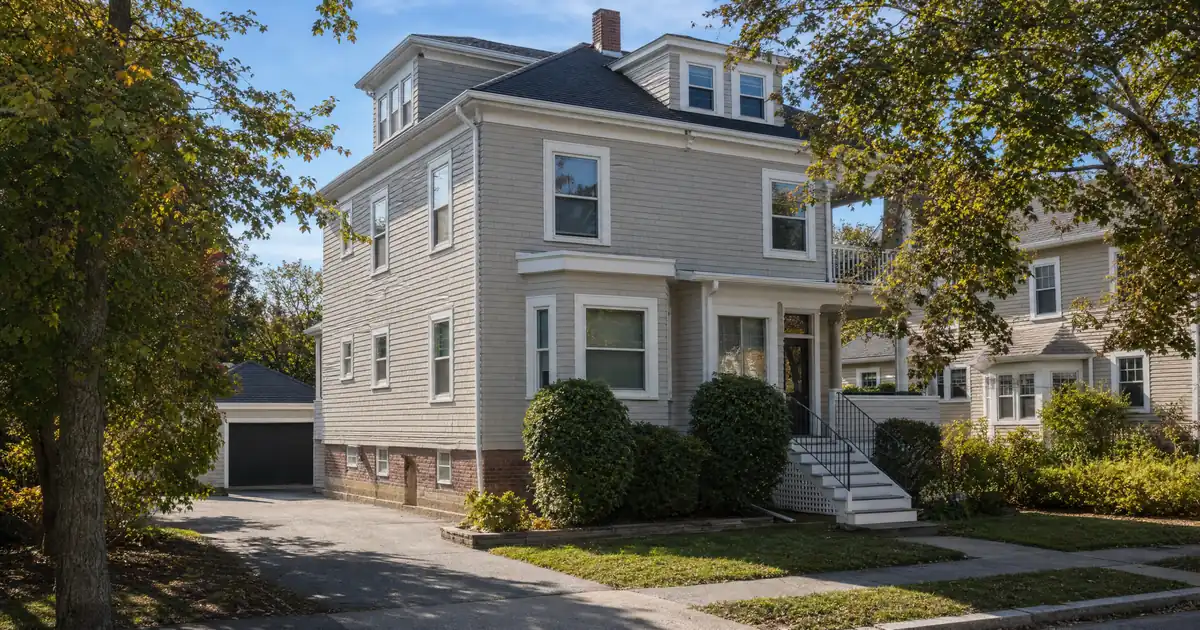
If you’re pricing out a rental purchase in Newport, here’s what the listing photos won’t tell you: the same 7.7-square-mile peninsula runs two completely different rental economies, and only one of them clears a coverage ratio without a fight. The mansions on Bellevue Avenue photograph beautifully. The fourplex three blocks from the Naval Station gate pays the mortgage.
The Quick Read: Investment property loans in Newport, Rhode Island are underwritten primarily on the property’s rental income measured against its full monthly obligation, a structure that favors small multi-unit buildings in the Fifth Ward and North End over trophy single-family purchases on Bellevue Avenue, where sale prices routinely outrun achievable rent.
DSCR Calculator
Run the numbers in your market
Rate source: Freddie Mac 30-yr average via FRED® — Federal Reserve Bank of St. Louis · effective Jul 30, 2026
Prefilled with starting assumptions — enter your own rent or nightly figures, taxes, insurance, and HOA for a more accurate picture.
Program parameters update from Lendmire’s centralized guideline source. Taxes and insurance are editable estimates.
As of Jul 30, 2026 · General Freddie Mac market benchmark, not a Lendmire loan offer. Rent, nightly rate, occupancy, taxes, and insurance are editable estimates. Short-term rental figures are estimates only and vary significantly by season, property type, management approach, and local short-term-rental rules — confirm local regulations before relying on them. Qualifying income for short-term rentals varies by program — some use appraisal market rent, others use documented STR history or projections — and is confirmed in underwriting. Not a Loan Estimate, approval, or commitment to lend. Program availability and eligibility are subject to lender guidelines, credit approval, property review, and underwriting.
- Historic Hill multi-family lists at a $1,716,250 median, a 20-30 percent premium over county-wide multi-family stock (Homes.com)
- North End/Newport Heights unit-level rents run $1,385-$1,645 per one-to-two-bedroom
- Newport households split 50/50 renter-owner, an unusually high renter share for a small coastal city (RentCafe)
- Naval Undersea Warfare Center Division Newport pays an average government-civilian salary of $122,000 (What’s Up Newp)
- Newport County multi-family currently lists at a $1.5 million median versus $1.82 million citywide (Redfin)
Newport Market Snapshot
A quick read on the Newport investor landscape — figures come from the cited sources below. Confirm current property-level numbers before underwriting.
| Metric | Detail |
|---|---|
| Home prices | $746,900 median property value (Data USA) |
| Typical rents | $1,599 avg (Apartments.com) |
| University enrollment | 17,000 students/yr (U.S. Naval War College) |
| Population | 24.9K population (Data USA) |
| Employment | ~10,000 employees (U.S. Naval War College) |
Fifth Ward Runs the Best DSCR Math in Newport
Fifth Ward is Newport’s strongest DSCR submarket, and it isn’t close. It offers modest historic homes and small apartment buildings at a meaningfully better price point than the downtown core, while sitting close enough to the harbor and the base gates to pull the same tenant base without the tourist-season price tag, according to neighborhood commentary compiled by Apartment List.
The reason this matters for underwriting: Fifth Ward’s tenant demand doesn’t evaporate in January. Thames Street fills with visitors in summer and empties out by October. Fifth Ward doesn’t, because its renters work at Newport Hospital, the naval commands, or the municipal offices year-round, not seasonally. That’s the distinction a DSCR file actually cares about — a coverage ratio calculated on a July rent roll and a February rent roll should look roughly the same here. In the historic core, they won’t.
This is the submarket where small 2-4 unit acquisitions make the most sense for an investor buying on rental income rather than betting on appreciation. It’s also, per the research, where rent-to-value math holds up best against Newport’s otherwise expensive base of housing — most of the city’s rental apartment stock was built 1939 or earlier, per Point2Homes data citing Yardi Matrix, which means “multifamily” in Newport usually means a converted antique building, not a purpose-built complex, and Fifth Ward has more of that stock at a workable basis than Historic Hill does.
North End and Newport Heights — the Navy’s Rental Base
The North End, clustered near John H. Chafee Boulevard and the northern gates of Naval Station Newport, is Newport’s most ordinary workforce housing zone — and that’s precisely its investment appeal. Unit-level listings in the corridor show one- and two-bedroom base rents in the $1,385 to $1,645 range, tenant demand driven by military and hospital-adjacent renters rather than tourism.
Naval Station Newport is the anchor that makes this corridor different from anything else in Rhode Island. Roughly 10,000 employees work across the base’s 50 commands, with an additional 17,000 students passing through its schools annually — a mix of Navy Supply Corps School, the Center for Service Support, and the U.S. Marine Corps Aviation Logistics School. Layered on top of the base is a separate, high-wage tenant: Naval Undersea Warfare Center (NUWC) Division Newport, which reported a $2 billion funded program in its most recent fiscal year and a workforce that’s 51 percent government civilian, 48 percent support contractor, with 68 percent of employees living in Rhode Island and an average civilian salary of $122,000, according to What’s Up Newp. That’s a materially higher-earning renter than the tourism-sector tenant found downtown, and it skews toward longer, more stable leases rather than seasonal turnover.
The U.S. Naval War College sits inside the same base footprint and adds a tenant type Newport has that almost no other small city does: transient, well-funded officers. More than 600 intermediate- and senior-level officers and civilian leaders pass through its ten-month resident program every year, and a share of them need furnished, mid-term housing rather than a standard 12-month lease. An investor holding a well-located duplex or triplex near the gates can realistically underwrite to a longer-term civilian tenant while keeping a furnished mid-term unit in reserve for the officer-rotation niche — a demand layer largely unique to Newport among comparably sized New England cities.
Historic Hill and Thames Street — Conversion Stock, Conversion Prices
Historic Hill, the Kay-Catherine-Old Beach corridor, is walkable to Bellevue Avenue, Broadway’s restaurants, and Easton’s Beach, and its turn-of-the-century buildings have been steadily converted into condos and small multifamily units — which sounds, on paper, like ideal DSCR territory. The math tells a tougher story. As of last spring, multi-family listings in Historic Hill ranged from $1,385,000 to $2,750,000, with a median around $1,716,250, according to Homes.com — a premium over the $1.5 million multi-family median across Newport County per Redfin. Buy the same unit count a few blocks or a few miles outside the historic core, and the acquisition price drops meaningfully while achievable rent barely moves.
Thames Street, the working waterfront running through downtown, carries the same conversion-stock character — divided sea captain’s homes and apartments stacked above storefronts, per Apartment List’s description of the corridor. It’s genuine small-multifamily territory, and tenant demand from hospitality and tourism-sector workers is real. But rent assumptions here need a seasonal discount built in. Tourist season brings heavy foot traffic and short-term noise from June through September; winter brings quieter streets and fewer open businesses. A DSCR file modeled purely on a peak-season rent roll is modeling the wrong number. Underwrite to the shoulder-season rent, not the July rent, and the file holds up better under an appraisal reconsideration if one becomes necessary.
Bellevue Avenue, Ocean Drive, and The Point — Not a Stacking Play
Skip the waterfront if cash flow is the goal. Bellevue Avenue and Ocean Drive are Newport’s trophy corridors — Gilded Age mansions, scarce inventory, premium land values — and they’re built for appreciation and lifestyle ownership, not unit-stacking income math. Multifamily stock is almost nonexistent in either corridor. The Point, Newport’s National Historic Landmark waterfront district of colonial-era single-family homes and small conversions, sits in between: a strong long-term hold for an investor targeting affluent professional tenants and seasonal renters willing to pay for harbor proximity and historic character, but strict historic-district rules apply to any exterior work, and that’s a detail to confirm with the city before underwriting a renovation-dependent purchase.
For an investor with the equity to buy here outright or at a low leverage point, a single-family long-term rental on Bellevue Avenue or Ocean Drive can still work — it just isn’t a cash-flow strategy in the way a Fifth Ward duplex is. It’s a different bet, on a different curve, and conflating the two is a common mistake an out-of-market investor makes when shopping Newport by zip code alone.
What Does the Purchase Math Actually Look Like?
Run the numbers on two hypothetical Newport purchases and the submarket gap becomes concrete rather than theoretical. Both scenarios below are modeled assumptions built on the research figures above, financed at 75 percent loan-to-value with a 30-year structure — not sourced sale comps, and not a promise of what any specific property will produce.
A three-unit Historic Hill conversion modeled at the $1,716,250 multi-family median, with each unit renting near the Apartments.com two-bedroom average of $1,981, runs the total rent roll to just under $5,950 a month. Once principal, interest, property tax, and insurance are all stacked into the monthly obligation, that rent produces roughly 0.55x coverage — a file that doesn’t clear a 1.00x benchmark on long-term rent alone and would need a lower purchase basis, a larger equity injection, or a sub-1.00 program path reviewed against credit and reserves.
Compare that to a fourplex modeled at $900,000 — meaningfully below Historic Hill’s median and closer to the county-wide multi-family entry point — with four units renting across the North End’s documented $1,385-$1,645 range, averaging out near $1,515 per unit. At 75 percent LTV, that rent roll models to roughly 1.05x to 1.10x coverage once taxes and insurance are folded into the monthly obligation. That’s the difference a few blocks and a lower acquisition price make in this city: same unit count, same lender math, a completely different outcome.
Most standard DSCR programs are built around a 1.00x benchmark because rent needs to cover the payment at that level; some lenders review lower or no-ratio scenarios, but those typically require stronger reserves, lower leverage, or a larger down payment, and every outcome is subject to lender guidelines, credit profile, and property review. For the fuller mechanics of how that ratio gets calculated, the guide “What Is a DSCR Loan” covers the formula in detail, and the program-to-program comparison lays out where DSCR underwriting diverges from a conventional income-and-tax-return file.
The Appraisal Problem Newport’s Median Doesn’t Solve
Newport’s reported median sale price swings by hundreds of thousands of dollars month to month, and that’s not a data error — it’s a function of a small transaction pool. January’s median sat at $865,000 on just 16 homes sold, down nearly 25 percent year over year, while a separate pull put the June median at $1,150,000 across 135 sales, and a February snapshot showed a $1,195,000 median with a $1,645,312 average, per Redfin and Movoto data. When 16 to 24 sales can move a citywide median by six figures, a handful of mansion-tier closings on Bellevue Avenue can swing the number that shows up in a quick market pull — and that number has nothing to do with what a Fifth Ward duplex is actually worth.
The practical implication for a purchase appraisal: comps need to be property-type matched, not citywide-median matched. A fourplex in the North End should be compared against other small multi-unit sales in similar corridors, not against a citywide figure that includes a $2.75 million Historic Hill conversion in the same data set. Investors who walk into an appraisal expecting the citywide median to anchor their unit’s value are the ones most likely to see a number come in light — and then need an appraisal reconsideration built on genuinely comparable small-multifamily sales, not a broader market average.
DSCR files coming out of markets with this kind of thin-volume, luxury-skewed sales data tend to show a consistent pattern at the deal desk: the cleanest files are the ones where the appraisal order already flags the correct comp set — small multi-unit against small multi-unit — rather than letting the appraiser default to whatever recently closed nearby. Files that skip that step are the ones that come back light and need a reconsideration request before they can move forward.
Rental data shows the same divergence problem. Apartments.com puts Newport’s average rent at $1,599 a month with rents up 7.3 percent year over year, Point2Homes puts the average apartment rent at $1,999, and Zillow’s house-rent figures range from $1,500 to $65,000 with a median near $3,600 — a number skewed hard by high-end seasonal listings. The workable baseline for underwriting a standard long-term rental sits in that $1,600-$2,000 range, not the Zillow luxury-segment median, and a lender reviewing rent comps on a Newport file should be pulling from the workforce baseline, not the vacation-home tail.
Where Newport Diverges From Every Other Rhode Island Market
Newport carries two non-overlapping rental economies inside one 7.7-square-mile city, and that structural split is what separates it from Providence or Warwick. One curve is seasonal and luxury-driven — the mansions, the Jazz Festival crowds, the summer sailing culture. The other is year-round and federal-employment-driven — the Naval Station, NUWC, the Naval War College, and Newport Hospital.
That second curve is bigger than it looks from the outside. Newport Hospital, part of Brown University Health, employs 742 people and works with 694 affiliated physicians across 129 licensed beds. Salve Regina University enrolls 2,791 students, though its three-year on-campus residency requirement caps off-campus renter demand to roughly the senior class rather than flooding Historic Hill with underclassmen — a real but modest demand supplement, not a primary underwriting driver. Population figures diverge by source, as they often do in small cities: Census Reporter’s ACS estimate puts the city at 24,874 people, while a separate projection shows a slight decline since the 2020 count. Median household income sits at $86,313, roughly 25 percent above the Providence-Warwick metro, per the same Census Reporter data — a wealthier-than-average base that supports both rental curves at once.
The honest read: an investor buying purely for appreciation might still lean toward Bellevue Avenue or The Point, betting on Newport’s brand as a permanent East Coast luxury destination. But an investor underwriting on rental income against a monthly obligation gets a cleaner file, and a more defensible coverage ratio, sticking to the federal-employment side of the city — Fifth Ward, North End, and the workforce-priced pockets of Historic Hill that haven’t been bid up to conversion-premium levels.
Frequently Asked Questions
How do you qualify for a DSCR loan in Newport, Rhode Island?
Qualification centers on the property’s rental income measured against its full monthly obligation rather than the borrower’s traditional personal-income documentation, subject to lender guidelines and credit approval. Most programs look for the rent roll to clear or approach a 1.00x coverage benchmark, along with a credit profile in the mid-600s or better and enough reserves on hand — typically around six months of PITIA — to satisfy the lender’s file review.
What are the requirements for an investment property loan in Newport, Rhode Island?
Standard purchase programs generally run 75 to 80 percent loan-to-value, meaning 20 to 25 percent down, with a stronger-file ceiling up to 85 percent available in select cases where guidelines allow. Credit tiers run from a 620 floor up to 700 for the higher-leverage options, and reserve requirements step up to roughly nine months of PITIA on loan amounts above $1.5 million — relevant given how many Newport multi-unit properties price above that threshold.
Why do Historic Hill multifamily properties struggle to clear DSCR coverage?
Historic Hill’s conversion stock carries a 20-30 percent price premium over county-wide multi-family listings, but the rent those converted units command doesn’t rise at the same pace. A three-unit building priced near the $1,716,250 Historic Hill median, renting at typical two-bedroom rates, can land well below a 1.00x coverage ratio — which is why the stronger DSCR entry points sit in Fifth Ward and the North End rather than inside the historic core itself.
DSCR vs. conventional financing
Two common ways to finance an investment property in Newport, RI. They qualify you differently — here’s how investors weigh them.
Why investors choose it
- Qualifies on the property’s rental income — no personal tax returns, W-2s, or pay stubs needed to document income.
- No personal debt-to-income ceiling to clear, so existing mortgages and obligations don’t cap your borrowing the same way.
- Can be closed in an LLC, keeping the property inside a business entity.
- Built for scaling — not held to the limit on number of financed properties that conventional financing applies.
- Underwriting centers on the deal: generally qualifies when the rent covers the payment, a 1.00x coverage ratio being a common baseline (confirmed in underwriting).
- Designed specifically for investment property, including long-term and, where the program allows, short-term rentals.
Where it’s strong
- Often the lowest ongoing financing cost for a buyer who fully qualifies on personal income — a fit for a first property or a cost-first purchase.
Trade-offs for investors
- Requires full personal income documentation and must fit within a debt-to-income limit — salary, existing debts, and other mortgages all count.
- Typically held in your personal name rather than a business entity.
- Caps how many financed properties you can carry, which can become a ceiling as a portfolio grows.
- Evaluates you as a borrower as much as the property, which usually means more paperwork.
How investors usually choose: a first or single property often optimizes for the lowest financing cost; portfolio builders often optimize for leverage, vesting in an LLC, and scaling past conventional caps. The right answer depends on your goals, the property, and current guidelines — both paths run through select lenders in Lendmire’s wholesale network, with eligibility and terms confirmed in underwriting.
Does Newport’s seasonal tourism affect year-round rental underwriting?
Yes, mainly on Thames Street and in the downtown core, where summer crowds and winter quiet create a real swing in the rent a property can realistically command month to month. Fifth Ward and North End properties, tied to Navy, hospital, and municipal employment, don’t carry the same seasonal swing — which is one reason those submarkets model more predictably for a long-term rental file.
What can limit DSCR cash-out proceeds in Newport?
Newport’s own median sale price swings by hundreds of thousands of dollars month to month due to thin transaction volume, which pushes appraisers toward wider comp variance than in a larger market — a factor that can compress the value a cash-out appraisal supports. Lendmire (NMLS# 2371349) arranges DSCR financing through wholesale channels reaching 40 states plus Washington, D.C., and program features like reserve requirements and LTV caps vary by lender and file, subject to program guidelines.
Is Newport a good market for a first-time DSCR investor?
It can be, provided the entry point is chosen carefully. A first-time buyer targeting a small multi-unit property in Fifth Ward or the North End, priced below the Historic Hill conversion premium, has a more straightforward path to a coverage ratio a lender can underwrite than someone starting with a Bellevue Avenue or Ocean Drive purchase, where price-to-rent compression makes income-stacking math far harder to clear.
Lendmire works with Newport, Rhode Island investors to place DSCR financing through wholesale lenders, and its team spends real time on the submarket-level fluency that a generic state landing page skips, from historic-district conversion pricing to the Naval War College’s transient-officer rental niche. For an investor ready to run actual numbers against a specific Newport property, see what the numbers look like or call 828-256-2183 to talk through the file before it goes anywhere near an appraiser. The Rhode Island DSCR investor loans page covers the state-level program parameters in more depth, and the Lendmire DSCR programs at a glance lays out the broader footprint.
Lendmire is a non-QM mortgage brokerage, arranging DSCR investor loans through wholesale and investor-lending channels. Lenders evaluate these loans primarily on a property’s rental income rather than a borrower’s personal income documentation, subject to lender guidelines — a structure built for LLC-titled portfolios (subject to program eligibility), self-employed investors, and operators scaling past conventional loan caps.
The plain read a local appraiser would give you: Newport’s price tag and Newport’s rent roll are set by two different markets, and pretending they’re the same one is how a DSCR file gets underwritten wrong from the start.
About Lendmire
Lendmire is a non-QM mortgage brokerage (NMLS# 2371349) arranging DSCR investor loans in 41 markets, including Washington, D.C., through wholesale and investor-lending channels. DSCR loans are evaluated by the lender on rental income rather than personal income, subject to lender guidelines — a fit for LLC-owned portfolios, self-employed investors, and operators scaling beyond conventional loan caps. Recognized as a Scotsman Guide Top Mortgage Workplace in 2025 and 2026.
Get Started
Ready to find the right loan for you?
In about 30 seconds you can review financing options available for your investment property. No commitment required.
Informational only. Not a Loan Estimate, approval, or commitment to lend. Program availability and eligibility are subject to lender guidelines, credit approval, property review, and underwriting.
References
1. Homes.com — Historic Hill Multi-Family Listings
2. RentCafe — Newport, RI Average Rent Market Trends
3. What’s Up Newp — NUWC Division Newport Economic Impact
4. Redfin
5. Data USA
7. U.S. Naval War College — About Naval Station Newport
8. Apartment List — Newport, RI City Guide
9. Point2Homes — Average Rent, Newport, RI
10. Redfin — Newport County Multi-Family Homes
11. Redfin — Newport City Housing Market
12. Movoto — Newport, RI Market Trends
13. Brown University Health — Newport Hospital Facts and Statistics
15. Census Reporter — Newport, RI Profile
16. Scotsman Guide — Top Workplaces 2025
17. a 2026 Scotsman Guide Top Mortgage Workplace
This article is part of Lendmire’s DSCR loan program — full qualification details, guidelines, and scenarios live on the program page.
Related reading: DSCR Loans in Newport, Rhode Island: Investor Financing for the Historic Hill, Thames Street, Middletown & Real Estate Investors · DSCR Loans Rhode Island: Investor Financing for Providence, Newport, Block Island, and Real Estate Investors · Luxury Rental DSCR Loans In Newport Beach: A Complete Guide
Guides: DSCR Loans in Newport, RI · DSCR Loans in Rhode Island
Brandon Miller
Founder & CEO, Mortgage Loan Originator, Lendmire LLC
- Mortgage Loan Originator · NMLS# 1129696 · Verify on NMLS Consumer Access
- North Carolina Real Estate Broker · License# 343312 · Verify on NCREC
- North Carolina Insurance Producer · License# 19053198 · Property, Casualty, Life, Health · Verify on NAIC SBS
- Lendmire LLC · Firm NMLS# 2371349 · Verify firm licensure
Important disclosures. Lendmire (NMLS# 2371349) is a licensed mortgage brokerage. Lendmire is not a direct lender, depository institution, or financial advisor. All loan inquiries are subject to lender underwriting; this article does not constitute a commitment to lend. Rates, terms, and program guidelines are subject to change without notice and vary by borrower profile, property type, and state. Information in this article is general in nature and is not financial, legal, or tax advice. Equal Housing Opportunity. NMLS Consumer Access: nmlsconsumeraccess.org.