
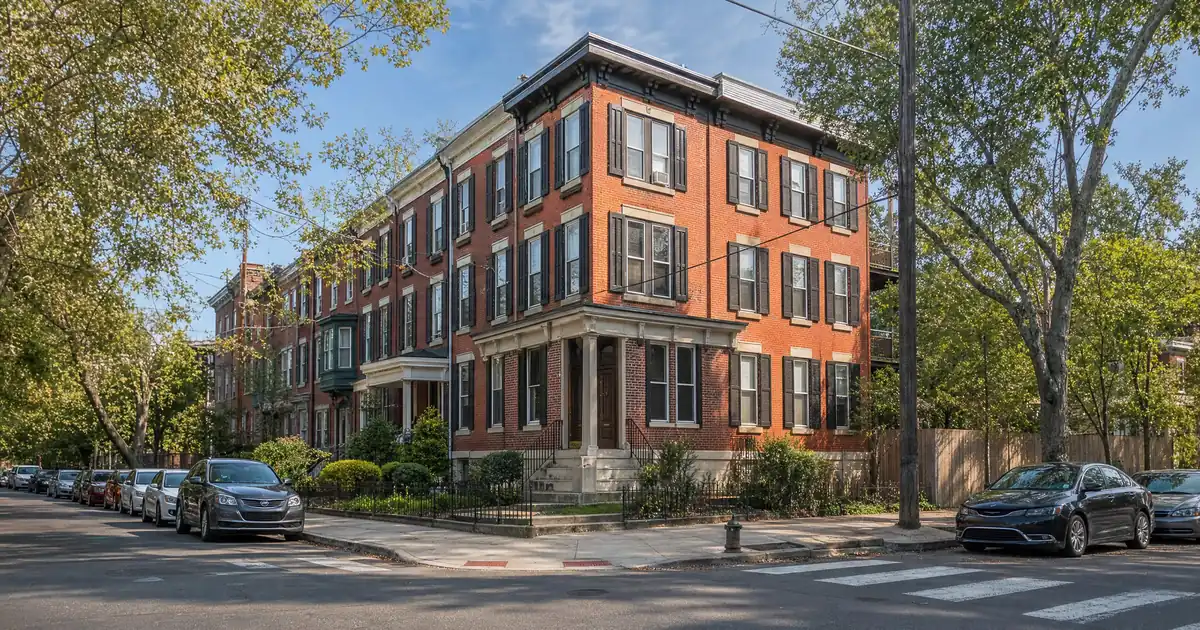
Investment property loans in Philadelphia reward investors who look past Fishtown. One investor sees Fishtown — the rowhouses that flipped from $300s to $450s in under two years, the coffee shops, the Instagram appeal. The other investor sees a triplex three miles west in Cobbs Creek or West Philadelphia, unglamorous, generating real rent against a real price. The math favors the second investor. Fishtown’s basis has run ahead of its rents; West Philadelphia’s basis hasn’t caught up to its income yet. That gap is the whole story for anyone financing an investment property in Philadelphia right now.
The Quick Read: An investor buying in Philadelphia typically identifies a rowhouse-convertible property in an RM-1-zoned corridor, gets a rent-roll or comparable-rent estimate for each unit, and has a lender measure that combined rent against the full monthly obligation — taxes, insurance, and principal and interest together — to land on a DSCR ratio before the file goes to underwriting.
DSCR Calculator
Run the numbers in your market
Rate source: Freddie Mac 30-yr average via FRED® — Federal Reserve Bank of St. Louis · effective Jul 30, 2026
Prefilled with starting assumptions — enter your own rent or nightly figures, taxes, insurance, and HOA for a more accurate picture.
Program parameters update from Lendmire’s centralized guideline source. Taxes and insurance are editable estimates.
As of Jul 30, 2026 · General Freddie Mac market benchmark, not a Lendmire loan offer. Rent, nightly rate, occupancy, taxes, and insurance are editable estimates. Short-term rental figures are estimates only and vary significantly by season, property type, management approach, and local short-term-rental rules — confirm local regulations before relying on them. Qualifying income for short-term rentals varies by program — some use appraisal market rent, others use documented STR history or projections — and is confirmed in underwriting. Not a Loan Estimate, approval, or commitment to lend. Program availability and eligibility are subject to lender guidelines, credit approval, property review, and underwriting.
- West Philadelphia multi-unit rowhouse rents run $950 to $1,000-plus per unit, per Redfin’s West Philadelphia listings
- Greater Philadelphia multifamily occupancy sat at 96.7 percent in the second quarter, per Newmark’s 2Q25 report
- Fishtown rents fell 2 percent year over year through October, even as sale prices climbed
- RM-1 zoning permits by-right duplex/triplex conversion in much of West and North Philadelphia — no variance required
Philadelphia’s investor pool skews local and regional, and the properties that pencil best — small rowhouse conversions — are exactly the property type DSCR underwriting was built to handle: qualify the deal on what the units actually rent for, not on the borrower’s Schedule E.
Philadelphia Market Snapshot
A quick read on the Philadelphia investor landscape — figures come from the cited sources below. Confirm current property-level numbers before underwriting.
| Metric | Detail |
|---|---|
| Home prices | $243,100 median property value (Data USA) |
| Typical rents | $1,762→$1,815 effective rents (MMG Real Estate Advisors) |
| Cap rates | 5.2-5.7% cap rates (Northmarq) |
| University enrollment | ~2,400 first-year students (University of Pennsylvania) |
| Population | 1,573,916 residents (U.S. Census Bureau QuickFacts:) |
| Employment | Employer rank order 1–14 (PA Center for Workforce) |
The Jobs Story Isn’t Just Eds and Meds Anymore
Philadelphia’s employment base gained 12,444 jobs year over year, a 1.67 percent increase that outpaced the national rate of 1.04 percent — only New York, at 2.15 percent, grew faster among major Northeastern cities, per Newmark’s regional multifamily report. That growth has since cooled — a more recent Northmarq insight puts year-over-year job additions closer to 5,000, with healthcare still doing most of the lifting. Worth flagging honestly: this is a deceleration, not a collapse, and it lines up with a national slowdown rather than something Philadelphia-specific.
The employer roster still explains where the tenant demand sits. Per the Pennsylvania Department of Labor and Industry’s Top 50 Employers list for Philadelphia County, the largest institutional employers are the Trustees of the University of Pennsylvania, the City of Philadelphia, the federal government, the School District of Philadelphia, Children’s Hospital of Philadelphia, Thomas Jefferson University Hospital, Temple University, Temple University Hospital, SEPTA, American Airlines, and Comcast. On the private side, Select Greater Philadelphia counts 13 Fortune 500 companies headquartered in the region, including Aramark, Johnson & Johnson, DuPont, Merck, and Rite Aid alongside Comcast, whose Comcast Technology Center — per Wikipedia — is the tallest building in Pennsylvania and the tallest in the Western Hemisphere outside Manhattan and Chicago.
Hospital revenue tells the same concentration story. The Hospital of the University of Pennsylvania posts $3.3 billion in net patient revenue, the highest in the city, with CHOP second at $2.6 billion, per Definitive Healthcare. Jefferson Health runs more than 30 hospitals and 700-plus care sites across the region. None of this is new information to anyone who’s looked at Philadelphia before. What is newer, and underused in most investor content, is the Navy Yard.
Philadelphia’s Navy Yard is doing something no comparable Northeast city is replicating at this scale: converting a decommissioned military base into a live employment and residential engine. Public and private investment there has reached roughly $2.8 billion, current employment tops 16,000 across more than 150 companies in shipbuilding, biotech, logistics, and professional services, and the site now generates about $71.9 million in annual city tax revenue, per the South Philly Review. Shipbuilding itself returned to the site, and JPMorgan Chase CEO Jamie Dimon, referencing new Hanwha Defense investment, put it bluntly: “there’s 16,000 workers here. That number may very well double over the next 5 years.” An initial residential phase of 614 units is underway, with Ensemble/Mosaic and PIDC targeting 4,000 total units and eventually 3,900 apartments as part of a $6 billion master plan, per Metro Philadelphia. That’s a real, in-progress employment-to-rental-demand pipeline — not a marketing pitch about “future growth.”
West Philadelphia and University City: Where the Rowhouse Math Actually Works
University City is the strongest DSCR submarket in Philadelphia because institutional demand from Penn, Drexel, and CHOP holds vacancy near zero while the housing stock — rowhouses built for conversion — lets an investor stack rent per door instead of betting on a single tenant.
The mechanics are worth spelling out. Redfin’s live multi-family listings in West Philadelphia show individual units renting in line with the neighborhood’s going rates, with one CMX3-zoned quadplex listing a ground-floor commercial unit alongside four residential units above it — that’s five income streams off one parcel. A separate West Philadelphia triplex generates solid combined rent across three units, and a Cobbs Creek duplex projects comparable combined monthly rent across its two units, per Redfin’s West Philadelphia multi-family data. Run the numbers on that triplex: modeling a purchase at 80 percent leverage (20 percent down), with taxes and insurance layered on at Pennsylvania-typical rates, that rent roll clears a DSCR comfortably above 1.80x — including full PITIA, not just principal and interest. That result reflects an aggressive gross-yield scenario, and it should be treated as illustrative rather than typical; a turnkey acquisition at a higher basis in the same neighborhood is more realistically going to land in the 1.15x to 1.30x range, which is still solid.
Ark7’s research on the submarket cites a $1.07 billion development pipeline tied to University City and near-zero vacancy — a third-party figure worth treating as directional, but consistent with what the institutional occupancy data shows for the metro broadly.
Working DSCR brokers see a recurring pattern in rowhouse-dense multi-unit markets like West Philadelphia: the file underwrites cleanest when the rent roll is documented per unit with either signed leases or a market-rent schedule, rather than a single blended number. Lenders reviewing a triplex or quadplex want to see each door’s rent stand on its own, because that’s how the DSCR ratio gets tested against the full obligation — and it’s also how an appraiser builds out the income approach on a small multifamily conversion.
The zoning underneath this is not incidental. Much of West and North Philadelphia carries RM-1 zoning, which permits converting a single-family rowhouse into a duplex or triplex by right — no Zoning Board of Adjustment variance required, subject only to lot size and code compliance, per Flagstone’s Philadelphia zoning guide. Compare that to Fishtown, Northern Liberties, and Kensington, where legacy industrial I-1/I-2 zoning often requires a variance to add residential units. That’s a real, structural cost and timeline difference between submarkets that otherwise get lumped together as “Philadelphia investment neighborhoods.”
Point Breeze and Passyunk Square: The Middle Ground
Point Breeze and Passyunk Square split the difference between West Philadelphia’s yield and Center City’s polish — livable, walkable, and still priced for a mortgage-driven buyer rather than a cash buyer. Point Breeze buyers finance 92 percent of purchases and Passyunk Square 89 percent, per Venture Philly Group data, signaling neighborhoods where conventional and investor mortgage buyers, not cash-heavy speculators, are setting the pace. That’s a meaningfully different buyer pool than Rittenhouse Square, where only 43 percent of purchases are financed at all.
For DSCR purposes, that financing mix is a useful signal. A market where most buyers need a loan tends to have appraisers and comps built around mortgageable pricing rather than cash-market premiums — which keeps a DSCR-financed acquisition from getting stretched on the appraisal side the way it sometimes does in cash-dominant pockets of the city.
Skip Fishtown for Cash Flow. Here’s Why.
Fishtown is an appreciation story right now, not a coverage story, and conflating the two is where investors get hurt. Home prices there hit a median of $458,000 in March, up 20.6 percent year over year, per Redfin’s Fishtown housing data. Rents, meanwhile, moved the wrong direction — down 2 percent over the same period, landing at a median around $2,000 per month as of October, per TrustArt Realty’s Fishtown market data. That’s not a rounding error. It’s a building boom outpacing lease-up: new supply flooding a neighborhood faster than tenants can absorb it, which is exactly the kind of submarket-specific oversupply risk that gets buried under citywide averages.
Run the numbers and Fishtown’s rent-to-price ratio simply doesn’t clear a comfortable DSCR at current basis without a large down payment cushion or a strong renovation angle. The gentrified-core appreciation is real — 45-year cumulative appreciation in Center City/Fairmount runs 665.3 percent, per Drexel’s Kevin Gillen house-price index — but the historically cheaper submarkets have actually outpaced it: North Philadelphia compounded at 1,079.4 percent and West/Southwest Philadelphia at 1,296.9 percent over the same window. That’s the counterintuitive finding most Fishtown-focused investor content skips entirely — the gentrified core with the flashiest recent headlines has the weakest long-run percentage growth of the three.
What About Northern Liberties and the Navy Yard?
Northern Liberties gets grouped with Fishtown for a reason — same new-construction-driven growth story, same zoning friction, and the same caution applies to underwriting rents there against elevated basis. One third-party fractional-investing source puts a median price near $573,000, though that figure should be treated as directional rather than confirmed. Skip the deep dive here; the Fishtown analysis above largely transfers.
The Navy Yard is different, and it deserves its own line of thinking precisely because it isn’t a legacy residential neighborhood yet. Nobody is buying a DSCR rental there today in the way they would in University City — the 614-unit initial residential phase is new construction, largely delivered as market-rate and affordable apartments rather than small investor-scale product. But for an investor thinking two or three years out, the Navy Yard’s employment trajectory — 16,000-plus jobs now, potentially doubling per Dimon’s comments on Hanwha’s investment — is worth tracking as a future demand driver for the surrounding South Philadelphia and Grays Ferry rental stock, which is buyable today at investor scale.
The Border Neighborhoods Nobody’s Talking About Yet
Kensington, Mantua, Grays Ferry, and Kingsessing sit just outside University City and Fishtown’s already-established boundaries, and they’re posting the fastest current value growth in the city. Kensington’s median assessed value jumped 15.3 percent, from $115,700 to $133,400, while Mantua rose 15 percent and Kingsessing 12 percent, per an Inquirer analysis of city assessment data. These aren’t cash-flow darlings in the way West Philadelphia’s rowhouse conversions are — but they’re the practical signal for where the next wave of appreciation is compounding fastest, bordering neighborhoods where institutional demand is already established. An investor buying here today is underwriting current rent against a basis that hasn’t fully priced in the spillover effect from Fishtown and University City next door.
Is the Metro Oversupplied? Not the Way People Assume.
Philadelphia’s multifamily supply picture looks scary in isolation and reassuring in context. Annual completions hit roughly 9,500 units through the close of 2025 — the steepest supply wave in more than a decade, driven partly by a rush of 5-plus-unit permits filed ahead of a tax abatement phase-out. Multifamily starts had actually fallen sharply the year before, to 4,705 units from 7,445, a 36.8 percent drop, well below the 10-year average of 8,050 units, per MMG Real Estate Advisors’ 2025 forecast. Completions are projected to settle back to roughly 7,000 units in 2026, in line with the long-term average, per Northmarq — meaning Greater Philadelphia entered its current stretch past the peak of the supply cycle, not in the middle of it.
And unlike Sun Belt metros where new units sit half-empty for quarters at a time, Philadelphia absorbed 2.02 percent of its inventory in 2024 and 1.96 percent in the first half of 2025 — the highest absorption rate among major Northeastern cities even as it delivered the largest share of new inventory, 1.09 percent, per Newmark’s 2Q25 report. Occupancy held at 96.7 percent through the same window. Rent growth is expected to accelerate to 3.0 percent year over year by the fourth quarter, with effective rents climbing from $1,762 to roughly $1,815, per MMG — and suburban submarkets like Cherry Hill/Haddonfield and Main Line are seeing gains above 4.0 percent, a spillover pattern worth watching if it starts pulling city rents up alongside it.
The honest read: Fishtown’s supply glut is real and localized. The metro’s is not. Investors buying in 2026 and 2027 are buying into the back half of a supply wave, not the front of one — a meaningfully different underwriting environment than the one Fishtown buyers faced eighteen months ago.
For anyone weighing whether DSCR financing or a conventional investor loan makes more sense on a Philadelphia rowhouse purchase, the comparison comes down largely to how the property’s income, rather than the borrower’s traditional personal-income documentation, gets weighed — worth reviewing before locking into a structure. And for investors deciding whether a purchase or a later cash-out makes more sense given a specific property’s appreciation trajectory, the refinance pathway for investor properties is a separate conversation worth having once the acquisition closes and seasoning starts.
Lendmire’s programs typically run 75 to 80 percent loan-to-value on standard purchase files, with a minimum DSCR benchmark around 1.00x and reserve requirements generally around six months of PITIA — reflecting wholesale-network guidelines rather than a fixed promise, and subject to lender program eligibility and credit review on any file titled to an LLC. Investors working through West Philadelphia’s stronger-yielding rowhouse conversions typically clear that 1.00x floor with room to spare; Fishtown acquisitions at current basis are the ones worth stress-testing before assuming they’ll clear it at all. Investors can review their scenario or call Lendmire at 828-256-2183 to run a specific address through the numbers before making an offer.
Frequently Asked Questions
How do you qualify for a DSCR loan in Philadelphia, Pennsylvania?
Qualification centers on the property’s rental income measured against its full monthly obligation, not the borrower’s personal income. A lender typically wants a signed lease or a market-rent comparable for each unit — critical in Philadelphia given how many properties are 2-4 unit rowhouse conversions — plus a credit profile that clears the program’s floor, generally 620 and up depending on leverage requested.
What are the requirements for an investment property loan in Philadelphia, Pennsylvania?
Most files require 20 to 25 percent down (75 to 80 percent LTV), a DSCR at or above roughly 1.00x on standard programs, and reserves around six months of PITIA, rising near nine months on loans above $1,500,000. Higher-leverage options up to 85 percent exist for the strongest files with stronger credit and reserves, subject to lender program eligibility.
Does a rowhouse duplex or triplex conversion in West Philadelphia qualify for DSCR financing?
Yes, subject to lender guidelines and property review — small multi-unit rowhouse conversions are exactly the property type DSCR loans were built around, since each unit’s rent can be documented and summed against the full monthly obligation. RM-1 zoning in much of West Philadelphia permits these conversions by right, which simplifies the property-review side of the file compared to a parcel needing a zoning variance.
DSCR vs. conventional financing
Two common ways to finance an investment property in Philadelphia, PA. They qualify you differently — here’s how investors weigh them.
Why investors choose it
- Qualifies on the property’s rental income — no personal tax returns, W-2s, or pay stubs needed to document income.
- No personal debt-to-income ceiling to clear, so existing mortgages and obligations don’t cap your borrowing the same way.
- Can be closed in an LLC, keeping the property inside a business entity.
- Built for scaling — not held to the limit on number of financed properties that conventional financing applies.
- Underwriting centers on the deal: generally qualifies when the rent covers the payment, a 1.00x coverage ratio being a common baseline (confirmed in underwriting).
- Designed specifically for investment property, including long-term and, where the program allows, short-term rentals.
Where it’s strong
- Often the lowest ongoing financing cost for a buyer who fully qualifies on personal income — a fit for a first property or a cost-first purchase.
Trade-offs for investors
- Requires full personal income documentation and must fit within a debt-to-income limit — salary, existing debts, and other mortgages all count.
- Typically held in your personal name rather than a business entity.
- Caps how many financed properties you can carry, which can become a ceiling as a portfolio grows.
- Evaluates you as a borrower as much as the property, which usually means more paperwork.
How investors usually choose: a first or single property often optimizes for the lowest financing cost; portfolio builders often optimize for leverage, vesting in an LLC, and scaling past conventional caps. The right answer depends on your goals, the property, and current guidelines — both paths run through select lenders in Lendmire’s wholesale network, with eligibility and terms confirmed in underwriting.
Is Fishtown a good market for DSCR cash flow right now?
Not at current basis. Fishtown’s median sale price has climbed sharply while rents in the same neighborhood declined roughly 2 percent year over year, a supply-driven mismatch that compresses coverage ratios at acquisition. Investors chasing Fishtown appreciation should model rent conservatively and stress-test the DSCR rather than assuming rents will “catch up” to the new construction pipeline anytime soon.
How much down payment do investors typically need for a Philadelphia multi-unit rowhouse?
Standard purchase programs generally call for 20 to 25 percent down, translating to 75 to 80 percent loan-to-value, with select high-leverage options available near 85 percent for the strongest borrower and property profiles. Exact terms depend on credit tier, reserves, and the property’s documented rent roll, per lender program guidelines.
Can Lendmire help investors explore DSCR financing for properties outside Pennsylvania?
Yes.
Where This Market Goes From Here
Philadelphia’s next 18 to 24 months look like a market working through the tail end of a supply wave rather than heading into one. Completions ease back toward the historical average through 2026, absorption has already proven the metro can eat new units faster than most Northeastern peers, and the Navy Yard’s employment build-out is still in its early innings relative to its stated targets. The submarkets worth watching aren’t the ones already priced for it — Fishtown and Northern Liberties have largely had their re-rating — but the border neighborhoods like Kensington, Mantua, and Kingsessing, plus the rowhouse-dense corridors of West Philadelphia, where rent is still catching up to what the city’s institutional job base can support.
About Lendmire
As a DSCR and non-QM mortgage broker, Lendmire — NMLS# 2371349 — connects investors with wholesale lending channels across 41 markets, including Washington, D.C., an arrangement described more fully through DSCR loan options for Pennsylvania investors. The property’s rental income, rather than the borrower’s traditional personal-income documentation, sits at the center of lender review under this structure, which tends to work well for self-employed operators and for investors carrying portfolios beyond the four-financed-property mark that trips up conventional lending. Recognized as a 2026 Scotsman Guide Top Workplace, the firm’s approach to how DSCR lender review works leans on the property’s numbers first.
Get Started
Ready to find the right loan for you?
In about 30 seconds you can review financing options available for your investment property. No commitment required.
Informational only. Not a Loan Estimate, approval, or commitment to lend. Program availability and eligibility are subject to lender guidelines, credit approval, property review, and underwriting.
References
1. Redfin’s West Philadelphia listings
3. Data USA
4. MMG Real Estate Advisors’ 2025 forecast
5. Northmarq
7. U.S. Census Bureau QuickFacts:
8. Top 50 Employers list for Philadelphia County
10. Children’s Hospital of Philadelphia
11. Select Greater Philadelphia
12. Wikipedia
14. Jefferson Health
17. Redfin’s Fishtown housing data
18. Drexel’s Kevin Gillen house-price index
19. Inquirer analysis of city assessment data
20. a 2026 Scotsman Guide Top Workplace
21. Scotsman Guide 2025 Top Mortgage Workplace
This article is part of Lendmire’s DSCR loan program — full qualification details, guidelines, and scenarios live on the program page.
Related reading: DSCR Loans in Philadelphia, Pennsylvania: Investor Financing for Fishtown, South Philly, West Philly & Real Estate Investors · DSCR Loans Pennsylvania: Investor Financing for Philadelphia, Pittsburgh, Pocono Mountains, and Real Estate Investors · Investment Property Loans in Pittsburgh, PA: Where the City Outgrows Its Region
Guides: DSCR Loans in Philadelphia, PA · DSCR Loans in Pennsylvania
Brandon Miller
Founder & CEO, Mortgage Loan Originator, Lendmire LLC
- Mortgage Loan Originator · NMLS# 1129696 · Verify on NMLS Consumer Access
- North Carolina Real Estate Broker · License# 343312 · Verify on NCREC
- North Carolina Insurance Producer · License# 19053198 · Property, Casualty, Life, Health · Verify on NAIC SBS
- Lendmire LLC · Firm NMLS# 2371349 · Verify firm licensure
Disclosures. The information presented in this article is general market commentary, not financial, legal, or tax advice. Lendmire is a mortgage brokerage (NMLS# 2371349) — not a direct lender or depository institution — and loan placement is subject to lender underwriting. Nothing in this content represents a commitment to lend. Loan terms, pricing, and program availability vary based on borrower qualifications, property characteristics, and state of subject property, and are subject to change at any time. Lendmire complies with Equal Housing Opportunity requirements. Consumer access: nmlsconsumeraccess.org.