
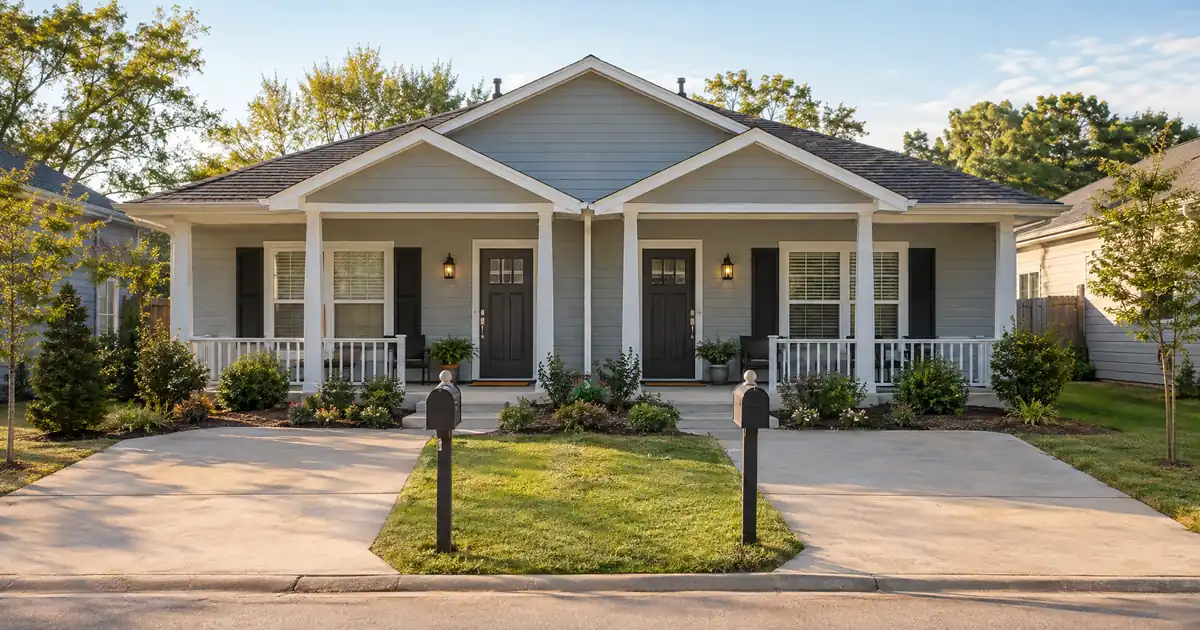
The Quick Read: A DSCR lender counts rent as one monthly figure per property, divided by that property’s full payment: principal, interest, taxes, insurance and association dues. On a house the appraiser’s rent opinion and the lease set that figure. On a duplex the unit rents are added together against one building payment. On a condo the dues sit in the payment, not out of the rent.
- A leased property typically uses the lower of the signed lease and the appraiser’s market rent.
- A vacant property typically uses the appraiser’s market rent alone.
- A duplex, triplex or fourplex on one loan is one rental, not several separate ratios.
- Condo dues lower the ratio because they go in the denominator.
- Other properties’ rents and payments are not pooled into a single-property loan, subject to lender guidelines.
Brokering these files across a wholesale network of DSCR lenders shows the same pattern. Most surprises come from the rent input, not the loan math. The sections below walk through each step.
What Is the Formula, and What Goes in It?
The formula is monthly rent divided by PITIA. PITIA is principal, interest, taxes, insurance and association dues, all for that one property. Rent of 1.2 times the payment gives a coverage ratio of 1.2x.
Two things are left out. The borrower’s personal debts are not in the ratio. Other properties are not either. This is why DSCR loans qualify primarily on property-level rental income covering the payment, subject to lender guidelines.
The ratio is not a cash-flow number. It compares rent to PITIA only. Repairs, vacancy, management, utilities and capex sit outside it. A file can clear 1.00 and still lose money each month.
On the floor itself: 1.00 is where select programs start, not a universal rule. Stronger coverage opens better pricing and leverage. A separate select-lender path takes coverage below 1.00, with leverage and terms adjusted. For the full program picture, see the complete DSCR loans guide.
Key Terms Defined
PITIA: The monthly payment of principal, interest, taxes, insurance and association dues on one property.
Market rent: The appraiser’s opinion of what the property would rent for today, based on comparable rentals.
Lower-of rule: The common convention of using the smaller of the signed lease rent and the appraiser’s market rent.
Form 1007: The appraisal rent schedule used on single-family houses and condos.
Form 1025: The small residential income property appraisal used on two- to four-unit buildings.
Coverage ratio: Rent divided by PITIA for the property.
Which Rent Number Does the Lender Use?
The lender picks the rent by situation. Across most programs in the network, the rule runs like this.
| Situation | Rent used |
|---|---|
| Leased property | Lower of lease and market rent |
| Vacant property | Appraiser’s market rent |
| Short-term rental | Hosting history or market projection |
| Above-market lease | Market rent caps it |
An above-market lease does not lift the ratio. A below-market lease pulls it down, so coverage and loan size shrink. Seller pro formas matter even less. Advertised rents often run above what the appraiser’s comps support, and the appraiser’s number is the one that counts.
Some programs also want a lease or rental history first on a vacant property. Ask before ordering the appraisal.
The appraiser’s number is an opinion, and the lender decides how to use it. As McKissock’s appraiser education puts it, income is ultimately decided by the lender. The appraisal forms are borrowed from the agency world, but agency income rules do not govern DSCR files. DSCR loans run on the network’s own program rules.
How Is Rent Counted on a Single-Family House?
On a house, the appraiser completes Form 1007, a comparable rent grid. It uses comparables, adjusts only for significant differences, and ends with one reconciled monthly market rent.
Then the lender compares that number with the lease, if one exists. The lower figure goes into the numerator. The denominator is the house’s PITIA, with association dues added only if the house sits in an HOA.
Picture a house with a lease signed a little above what the comps show. The appraiser concludes a lower market rent. The ratio runs on the lower number. The investor who priced the deal on the lease rent finds coverage a notch short, and the loan sizing follows.
The trap on houses is leverage and rent interacting. Value sets one limit and rent sets another. Purchases on most files land at 75%-80% LTV on investment property, and either test can bind first.
How Is Rent Counted on a Duplex, Triplex or Fourplex?
On two- to four-unit buildings, the lender adds the rent from every unit and divides by one building payment. The appraiser uses Form 1025, which the Fannie Mae Selling Guide lists as the report for two- to four-unit properties, including those in condo or PUD projects. Form 1007 is generally not needed on top of it.
So a duplex gets one ratio, not two. The mechanics:
1. Each unit gets a rent figure: the lower of lease and market rent where leased, market rent where vacant.
2. The unit figures are summed.
3. The sum is divided by one PITIA for the whole building.
Mixed units are where files get messy. Say a fourplex has two leased units, one month-to-month and one vacant. The leased units use the lower-of rule. The vacant unit leans on the appraiser’s schedule. The month-to-month unit depends on lender documentation standards. A clean rent roll with lease copies saves a round of questions.
HUD uses the same form logic. A HUD mortgagee letter calls for a Form 1025 appraisal showing fair market rent on two- to four-unit properties with no rental history. That is an agency contrast only. It shows the forms are common across programs but sets no DSCR rule.
Two limits matter. Commercial space in a mixed-use building is not blended in, and only residential units count. Mixed-use property is also not eligible in pooled structures. And residential rent-over-PITIA generally stops at four units. Larger buildings are often underwritten on net operating income over debt service, a different formula. Where that switch happens is program-specific.
How Is Rent Counted on a Condo?
Condo rent is counted like house rent, but the dues change the denominator. The appraiser uses the same Form 1007, which Fannie Mae’s June appraiser update says can be used for condominium investment properties. Dues go into PITIA. They are never subtracted from rent.
That is why the same rent can pass on a house and fall short on a condo. Adding dues to the payment lowers the ratio. Model them first, before the offer goes in.
Special assessments are a softer area. They are generally left out unless recurring, but lenders differ. Ask early if the building has a pending assessment.
Condo project status is a separate eligibility question from rent. The HOA questionnaire has to come back complete, and rental restrictions in the project can affect eligibility regardless of how strong the rent is. Strong coverage never fixes an ineligible project.
Side-by-Side: House, Duplex, Condo
| Factor | House | Duplex–Fourplex | Condo |
|---|---|---|---|
| Rent form | 1007 | 1025 | 1007 |
| Rent input | Lower of lease or market | Sum of unit rents | Lower of lease or market |
| Payment | PITIA | One building PITIA | PITIA plus dues |
| Main trap | Lease above comps | Mixed unit status | Dues, project status |
What About Short-Term Rentals?
Form 1007 does not capture nightly stays. It documents monthly market rent, and the Fannie Mae update says the Selling Guide is silent on whether short-term income counts.
Short-term files use hosting history or a market projection instead, and lenders often haircut it before running the ratio. On the network’s programs, short-term rental purchases reach up to 75% LTV, with a 640+ score and about 12 months of hosting history typical, and 1.00 coverage as the floor on purchases and on refinances. Cash-out on short-term collateral tops out at 70%, against 75% on standard rentals. For the deeper mechanics, see Lendmire’s piece What Counts As Short Term Rental Income For A Lender?. Short-term rental rules can vary by city, county, HOA, and property type, so investors should confirm local rules before relying on projected rental income.
Do Several Houses Get Pooled Into One Ratio?
Not on separate loans. Each property is tested on its own rent and its own payment. A strong rental does not rescue a weak one, and another property’s rent does not lift the file in front of the lender.
Pooling exists, but it is a different structure. Two portfolio structures are available through the network’s lenders:
| Structure | Properties | Coverage tested on |
|---|---|---|
| 30-year portfolio DSCR loan | 2 to 20 under one note | The pool |
| Rental portfolio term loan | 5 or more | The pool |
On the 30-year portfolio loan, leverage runs up to 80% of value on a purchase or rate-and-term refinance, with loan sizes typically $300,000 to $5,000,000. The term loan runs up to 75% of value, with fixed terms and a balloon at maturity. Both measure coverage on pooled rent against pooled debt service, so stronger properties can offset weaker ones. A rental below 1.00 coverage can sit in the pool, but the pooled coverage, leverage and terms are what underwriting tests, subject to underwriting. Cash-out on a portfolio never exceeds 75% of pooled value.
Every property in the pool still needs a lease or appraiser-supported market rent. Owner-occupied property, mobile homes, co-ops, mixed-use and commercial property are not eligible in the pool. Partial releases and selling one property out of the pool follow the loan documents, and the remaining portfolio must still cover its debt service. Terminology is loose in the market. Blanket, portfolio and cross-collateralized loans often mean the same thing, so ask what the note actually covers.
Where the Rules Break
- Owner-occupied units. DSCR loans are for non-owner-occupied investment property only. DSCR loans are designed for non-owner-occupied investment properties. Because they are business-purpose investor loans, they are reviewed differently from a standard owner-occupied mortgage.
- Ineligible property types. Manufactured homes, log homes and barndominiums are not offered in the network’s DSCR programs.
- Vacancy, management and repairs. In residential DSCR these are generally not subtracted from rent. The exception is the haircut on short-term income.
- Credit and reserves still apply. Most programs want around 660, a 620 floor exists in parts of the network, and 700+ unlocks the strongest leverage tiers. Reserves commonly run about 6 months of PITIA, stepping up to about 9 months on loans above $1,500,000. Subject to lender guidelines.
- Larger down payment. More equity lowers the payment and can lift the ratio. It does not erase leverage caps, credit floors, reserve rules or property eligibility.
Entity paperwork matters too. If the property is held in an LLC, the entity documents have to match the title, subject to lender program eligibility.
What the Decision Looks Like in Practice
Run the rent first, then the leverage. Before making an offer, order the right appraisal form for the property type, get the lease and rent roll in one package, and add dues and the full payment into the denominator.
For a duplex, treat the appraiser’s unit schedule as the real number. For a condo, check dues and project status before anything else. For several houses, decide whether separate loans or a pool fits, because that choice sets which rent gets counted against which payment. An investor stress-testing a rental can also read Lendmire’s piece How to Stress-Test an Airbnb at Long-Term Rent Before Your DSCR Lender Does.
Rent paperwork to gather:
1. Signed leases for every leased unit.
2. A rent roll showing vacant and month-to-month units.
3. HOA dues and any pending assessment notice.
4. Current tax and insurance figures for the property.
5. Entity documents, if the property sits in an LLC.
Frequently Asked Questions
Does a DSCR lender use my lease or the appraiser’s rent?
Usually the lower of the two on a leased property. On a vacant property, the appraiser’s market rent carries the file alone. A lease above market does not raise the ratio.
Do HOA dues come out of the rent?
No. Dues go into the payment in the denominator, which lowers the ratio. Rent stays whole in the numerator.
Does a duplex get two coverage ratios?
No. On one loan, all unit rents are added and divided by one building payment. Buildings of five or more units are often underwritten on net operating income over debt service instead, depending on the program.
Can a strong rental offset a weak one?
Not on separate loans, where each property stands alone. A portfolio loan tests the pool, so pooled rent covers pooled debt service, subject to underwriting and lender guidelines.
Does Form 1007 capture Airbnb income?
No. It documents monthly market rent. Short-term files use hosting history or a market projection, and lenders typically haircut that income before running the ratio.
If you are buying or refinancing a rental property and want to see how the numbers work, Lendmire can help you compare DSCR loan options based on the property income, credit profile, leverage, and investor goals. Tax treatment varies; consult a qualified professional.
About Lendmire
Lendmire — NMLS# 2371349 — is a mortgage brokerage specializing in DSCR investor loans, helping arrange financing across 41 markets, including Washington, D.C., through wholesale and investor-lending channels. The model centers on property-level rental income reviewed by the lender rather than W-2 documentation, subject to lender guidelines, suiting entity-owned and multi-property investors. Lendmire holds Scotsman Guide Top Mortgage Workplace recognition for 2025 and 2026.
Get Started
Ready to find the right loan for you?
In about 30 seconds you can review financing options available for your investment property. No commitment required.
Informational only. Not a Loan Estimate, approval, or commitment to lend. Program availability and eligibility are subject to lender guidelines, credit approval, property review, and underwriting.
References
1. McKissock on Form 1007 and short-term rental appraisals
2. Fannie Mae Selling Guide B4-1.2-01
3. HUD
This article is part of Lendmire’s DSCR loan program — full qualification details, guidelines, and scenarios live on the program page.
Related reading: Can a Permit-Capped Airbnb Still Qualify for a DSCR Loan on Long-Term Rent? · Does a DSCR Lender Require an STR Permit Before Closing on a Cabin? · Does a DSCR Lender Count All Airbnb Income for a First STR Purchase?
Brandon Miller
Founder & CEO, Mortgage Loan Originator, Lendmire LLC
- Mortgage Loan Originator · NMLS# 1129696 · Verify on NMLS Consumer Access
- North Carolina Real Estate Broker · License# 343312 · Verify on NCREC
- North Carolina Insurance Producer · License# 19053198 · Property, Casualty, Life, Health · Verify on NAIC SBS
- Lendmire LLC · Firm NMLS# 2371349 · Verify firm licensure
Disclosure information. Lendmire is a state-licensed mortgage brokerage under NMLS# 2371349. Lendmire is not a depository institution, direct lender, or financial advisor — all loans referenced are placed through wholesale lender partners and are subject to each lender's underwriting standards. This article is provided for general informational purposes and is not a commitment to lend, nor does it constitute financial, legal, or tax advice. Loan programs, terms, rates, and qualification standards change without notice and depend on borrower profile, property type, and the state in which the subject property is located. Equal Housing Opportunity provider. NMLS Consumer Access: nmlsconsumeraccess.org.