
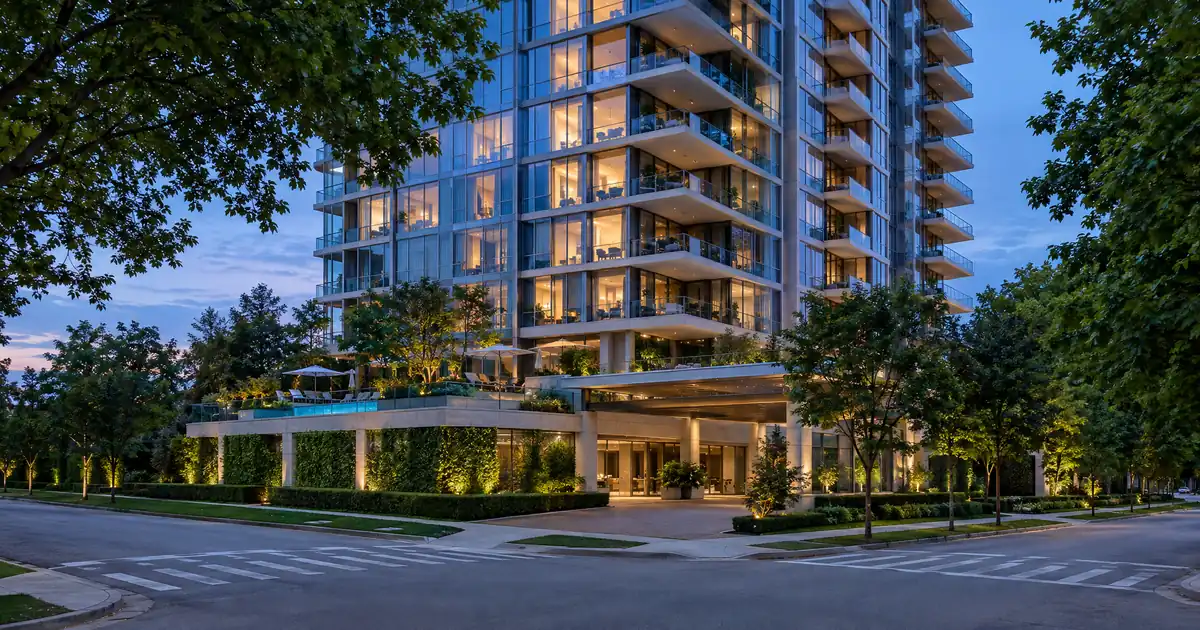
The Quick Read: A luxury condo tower pool, in lending terms, is a group of condo units financed under one note. It is not the rooftop swimming pool, though that amenity feeds the math through HOA dues. Underwriting reviews the building first, then tests the combined rent of the group against the combined payment, subject to lender guidelines.
- The collateral “pool” is one note secured by several condos. A blanket loan, a portfolio DSCR loan and a cross-collateralized loan all describe this same structure.
- Coverage is measured on the whole pool, so strong units can offset weak ones. One vacancy can also pull the whole pool down.
- A tower with rich amenities carries higher dues, and dues sit inside the payment side of the ratio.
- Owning several units in one tower makes you a concentrated owner, which many buildings and lenders limit.
- Release terms, cross-default language and reserves matter as much as the coverage number.
Two Pools, One Word
Search for this phrase and you will find rooftop infinity pools. That is the amenity. This article covers the other meaning, the loan collateral, and how the amenity shows up inside it.
| Item | Amenity pool | Collateral pool |
|---|---|---|
| What it is | Rooftop, indoor or terrace swimming pool | Several condo units under one note |
| Who cares | Residents and tenants | Lender and investor |
| What it affects | Dues, rent appeal, building upkeep | Pooled coverage, leverage, release terms |
| Where it hits the loan | HOA dues in the monthly payment | One combined ratio and one set of cross-default terms |
The link between them is simple. The swimming pool is paid for through dues. Dues are part of the payment the lender compares against rent.
What Makes a Tower Pool “Luxury”?
A luxury tower pool is usually an elevated deck with service attached. That means rooftop or terrace placement, an infinity edge, cabanas, and food or towel service. Some towers add indoor pools for year-round use. A few penthouses carry private pools.
Those features signal a building that spends heavily on amenities. That spending is the point for a lender. Every amenity needs staff, insurance, waterproofing and eventual structural repair. Those costs flow through the association budget and into your monthly dues.
A private penthouse pool is mostly a value and appraisal question. It can support a higher unit value, depending on comps and appraiser review. It does not change how the pool is tested.
What Does the Pool Do to the Monthly Payment?
It raises the dues, and dues are counted. DSCR (debt service coverage ratio) divides monthly rent by monthly PITIA. PITIA is principal, interest, taxes, insurance and association dues. For a condo, that last item can be large.
A luxury tower often carries heavier dues than a mid-market building. The dues line can be where a tower condo loses coverage. The rent may be strong while the payment side is heavy.
Two warnings follow. First, clearing 1.00 is not positive cash flow. Repairs, vacancy, management, utilities and capital costs sit outside the ratio. Second, a special assessment can change the picture overnight. Deferred pool-deck waterproofing is a classic trigger.
Does the Pool Earn Its Keep?
Test it with a simple method. Compare similar units in the same tower: one that benefits from the amenity and one that does not, if any exist. Then compare the rent difference with the dues difference.
If the rent premium is smaller than the dues the amenity adds, the pool is costing you coverage. If tenants in the building pay a clear premium, it may be paying for itself. Pull actual lease or appraiser-supported market rent, not brochure claims.
Do this per unit before you pool anything. A pool is only as good as its weakest member.
How to Vet the Tower First
A lender reviews the project before it looks at your rents. Get the project questionnaire early. Read it in this order:
1. Ownership concentration. How much of the building does one owner hold, including you after your purchase?
2. Investor mix. What share of units is rented rather than owner-occupied?
3. Commercial or hotel components. Retail space or a hotel-style operation in the building raises questions in project review.
4. Rental rules. Governing documents may limit leases or ban short-term rentals. Short-term rental rules can vary by city, county, HOA, and property type, so investors should confirm local rules before relying on projected rental income.
5. Litigation and insurance. Open suits or thin coverage can end a review.
6. Budget and reserves. Read the reserve study. An underfunded pool deck is a red flag.
7. Special assessments. Past, pending or likely.
One brief contrast helps here. A recent Fannie Mae lender letter retired the investor-concentration limit for established projects under agency full review. The same letter keeps the presale rule for new and newly converted projects. That is agency lending, not DSCR lending. It matters only because the Michigan Community Association Law Blog points out that individual lenders may keep their own investor-concentration rules. The Community Associations Institute summarizes the same update.
So do not assume a retired agency limit frees your tower. A separate analysis from Governing Docs warns that the single-entity ownership rule did not go away with it. Each lender in the network applies its own project guidelines.
Assembling the Collateral Pool, Step by Step
Start with a clear definition. A portfolio DSCR loan, also called a blanket loan or cross-collateralized loan, is one note secured by several rentals. Every property backs the whole debt. Holding several loans in one LLC does not make them one loan. Pooling happens only through this structure, subject to program terms.
(A bank’s own “portfolio loan” means a loan the bank keeps on its books. That is a different use of the word.)
Step 1: Pick the structure. The network offers two, and they fit different pools.
| Item | 30-year portfolio DSCR loan | Rental portfolio term loan |
|---|---|---|
| Properties | 2 to 20 under one note | 5 or more rentals or units |
| Loan size | $300,000 to $5,000,000 | $500,000 to $50,000,000 |
| Leverage | Up to 80% on purchase and rate-and-term | Up to 75% of value |
| Term | 30-year, fixed or adjustable, interest-only available | Fixed 3, 5, 7 or 10 years, balloon at maturity |
| Recourse | Per program | Recourse or non-recourse options |
| Property types | SFR, 2-4 unit, condo, townhome | Adds small multifamily |
Larger balances can go on review in both. Every figure is a program ceiling or range, subject to lender guidelines. Five or more units in a single building count only under the rental portfolio term loan.
Step 2: Qualify the pool. The credit floor is typically 640 on the portfolio programs, and some structures want 680 or 720. Some require a special-purpose entity, usually an LLC, subject to program terms. Recourse loans carry a personal guarantee. Non-recourse loans exist on the term structure, with recourse limited to carve-outs such as fraud and bankruptcy.
Step 3: Build pooled coverage. Total monthly rent across the pool is divided by total monthly PITIA. The 30-year structure uses a 1.00 floor measured on the whole pool. Each unit still needs a lease or appraiser-supported market rent.
Step 4: Appraise every unit. Each condo gets its own valuation. Cost and effort stack with unit count.
Step 5: Paper the exit. Negotiate release terms before closing. That means the allocated loan amount per unit, the release price, and whether the remaining pool must be retested. The release price runs above the property’s allocated balance. A release clause is common but never automatic, so read it.
A Worked Pooled-Coverage Example
Run the numbers on four tower units, labeled as modeled assumptions rather than market data. Assume each carries the same debt service, which keeps the weighting equal.
| Unit | Standalone coverage | Note |
|---|---|---|
| Unit 1 | 1.30x | Lower dues, strong rent |
| Unit 2 | 1.20x | Solid |
| Unit 3 | 0.90x | Amenity-heavy dues |
| Unit 4 | 0.80x | Weak rent for the dues |
| Pool | about 1.05x | Clears a 1.00 floor |
Units 3 and 4 sit below 1.00 alone. Inside the pool, underwriting tests the pooled coverage, the leverage and the terms. Here the combined number clears.
Now vacate Unit 1. The pool drops to roughly 0.73x, well under the floor. One empty unit broke the whole loan test.
That is the tradeoff in plain terms. Pooling lets strong units carry weak ones. It also lets one vacancy hurt everything. Many investors in this position compare one big pool with two smaller ones, because two pools contain the damage better than one.
Purchase leverage on the 30-year structure tops out at 80%. On a cash-out, the pooled ceiling is 75% of pooled value. Inside the first six months, the loan is also capped at 90% of total cost (purchase price plus documented improvements), and 100% of total cost from six to twelve months. The leverage ceiling still applies, and the loan is the lower of the two. After twelve months the appraised value alone is the basis. A rate-and-term refinance is not subject to the cost-basis cap.
Where the General Rule Breaks
You are the concentration. Buying several units in one tower makes you the single-entity owner. Many buildings and lenders cap that share, and a multi-unit pool can fail review before the DSCR math starts. Spreading the pool across buildings is the usual fix. The rental portfolio term loan also allows cross-collateralization across several markets, subject to program terms.
New construction and developer-held units. A developer that still owns many unsold units is a concentration flag. A new tower with thin sales has weaker project metrics.
Reserves can be the failure point. The PKF O’Connor Davies analysis reports agency reserve minimums moving from 10% to 15%. That is an agency rule, but it shows where building finances are being scrutinized. In the network, the portfolio term loan holds reserves for taxes, insurance and capital expenditures. Individual lenders set their own reserve views.
Property types that do not fit. Owner-occupied property, co-ops, mixed-use property and commercial property are ineligible in the pool.
Manufactured homes are not reviewable on any of these programs.
Short-term rental towers. Hotel-style or rental-pool operations in a building are a project-review issue. Rental history and permitted use decide which income counts.
Low-value units. In general, small-balance units are harder to place in a pool. Luxury units usually clear that problem, but loan-size ranges apply.
Risks Worth Sizing
- One tower, one risk. A special assessment, lawsuit or insurance event hits every unit at once.
- Cross-default. One default can reach every unit. This is the structure’s biggest risk.
- Exit friction. A release price above allocated balance, plus a retest, slows unit-by-unit sales.
- Dues creep. Amenity upkeep raises dues over time, and your coverage falls with it.
On the question of how lenders view these files differently, see Lendmire’s piece How Much Non-QM vs Portfolio Lenders Lend on a Non-Warrantable Luxury Condo. On valuation, see its article Desk vs Field vs Second Appraisal on a Luxury Tower Condo DSCR.
Document Checklist, in Order
1. Project questionnaire for each building.
2. Association budget and reserve study.
3. Governing documents, including rental rules.
4. Current leases, or support for appraiser market rent.
5. Entity documents, if the program requires a special-purpose entity.
6. Appraisal orders for every unit.
7. Draft release, substitution and cross-default terms.
For the full product picture, the complete DSCR loans guide covers qualification across all structures.
Key Terms Defined
Blanket loan: One note secured by several properties, with every property backing the whole debt.
Pooled coverage: Total rent for all properties divided by total payment for all properties.
Release price: The amount you pay to free one property from the note, which runs above that property’s allocated balance.
Cross-default: A clause that lets a default on one property reach all the others.
Single-entity ownership: One owner holding a large share of units in the same building.
Special assessment: A one-time charge the association levies on owners, often for major repairs.
Frequently Asked Questions
Do pool amenities raise rent?
Sometimes, but test it unit by unit. Compare the rent difference against the dues the amenity adds. If the premium is smaller than the dues, the amenity lowers your coverage.
Do HOA dues count against coverage?
Yes. Dues are part of PITIA, the payment side of the ratio. Heavy amenity dues can pull a strong-rent unit below 1.00 on its own.
Can I combine several tower units in one loan?
Often yes, subject to program terms and building review. The 30-year portfolio DSCR loan takes 2 to 20 properties, including condos. Concentration limits on single-entity ownership can still block several units in one building.
What if the building has a special assessment?
It can change the file. A lender may reduce eligibility, adjust terms or decline the building. An assessment also raises your costs, which lowers coverage.
Can a private penthouse pool matter to a lender?
It matters mainly to value. It can support a higher appraised figure, depending on comps and underwriter review. It does not change how pooled coverage is tested.
If you are buying or refinancing a rental property and want to see how the numbers work, Lendmire can help you compare DSCR loan options based on the property income, credit profile, leverage, and investor goals. Lendmire is a broker arranging financing through select lenders in its wholesale network across 41 markets, including Washington, D.C. Nothing here is a commitment to lend.
About Lendmire
Lendmire (NMLS# 2371349) is a DSCR-focused mortgage broker that helps arrange investor financing across 41 markets, including Washington, D.C., through wholesale and investor-lending channels. DSCR eligibility is generally reviewed by the lender around the property’s rental income rather than personal income documentation, subject to lender guidelines — which works for self-employed investors, LLC operators, and portfolios above four financed properties. Scotsman Guide named Lendmire a Top Mortgage Workplace in both 2025 and 2026.
Get Started
Ready to find the right loan for you?
In about 30 seconds you can review financing options available for your investment property. No commitment required.
Informational only. Not a Loan Estimate, approval, or commitment to lend. Program availability and eligibility are subject to lender guidelines, credit approval, property review, and underwriting.
References
1. Fannie Mae Lender Letter LL-2026-03
2. Michigan Community Association Law Blog
3. Community Associations Institute update
This article is part of Lendmire’s DSCR loan program — full qualification details, guidelines, and scenarios live on the program page.
Related reading: Can a Six-Unit Building and Two Houses Get a Portfolio DSCR Loan? · Portfolio Loan vs DSCR Loan Terms for a BRRRR Batch · Can a DSCR Portfolio Loan Work When a Bank Caps Your Pool?
Brandon Miller
Founder & CEO, Mortgage Loan Originator, Lendmire LLC
- Mortgage Loan Originator · NMLS# 1129696 · Verify on NMLS Consumer Access
- North Carolina Real Estate Broker · License# 343312 · Verify on NCREC
- North Carolina Insurance Producer · License# 19053198 · Property, Casualty, Life, Health · Verify on NAIC SBS
- Lendmire LLC · Firm NMLS# 2371349 · Verify firm licensure
Compliance and disclosures. Lendmire (NMLS# 2371349) is a licensed mortgage broker and is not a direct lender, depository institution, financial advisor, or tax professional. Content in this article is general market analysis and educational information — not financial, legal, or tax advice for any specific situation. Lendmire does not guarantee loan approval; every transaction is subject to underwriting by the funding lender. Mortgage pricing and loan program guidelines are subject to change at any time without notice and vary by borrower characteristics, property type, and state regulations. Lendmire complies with Equal Housing Opportunity. Licensure verification: NMLS Consumer Access.