
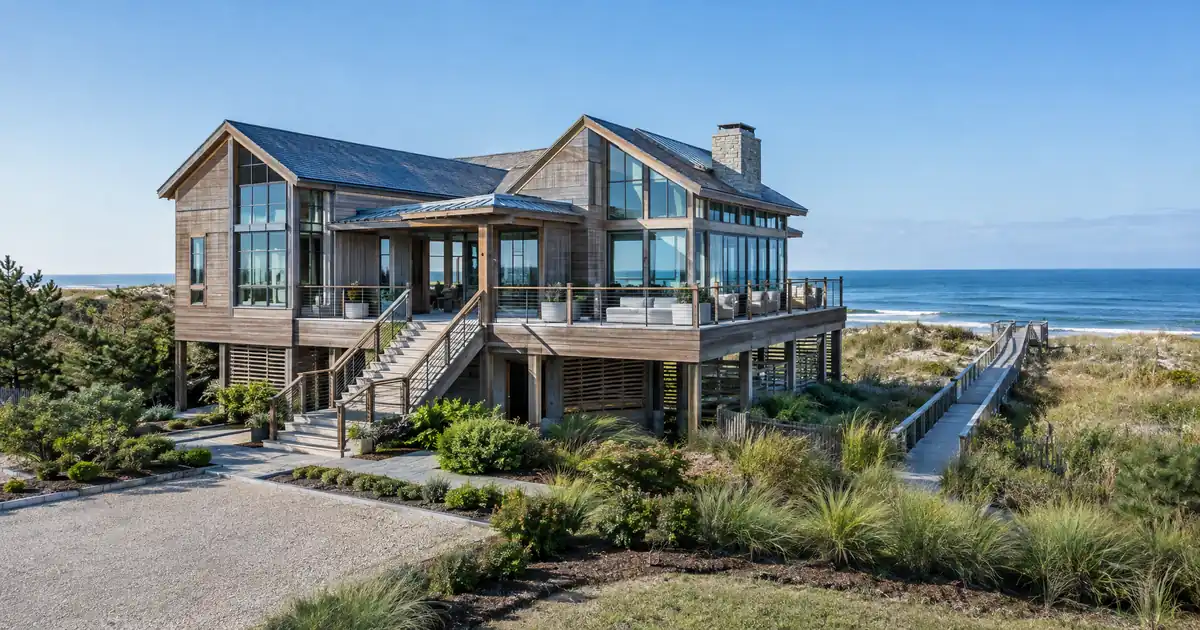
Luxury Rental DSCR Loans in Coronado — The Quick Read: A DSCR loan is reviewed for a rental property on its own income, not the borrower’s traditional personal-income documentation. For a luxury coastal property, the hard part is deciding which income number the lender actually uses — a nightly-rate projection, a trailing twelve months of platform history, or an appraiser’s monthly rent estimate. In a place like Coronado, where the city treats anything shorter than 26 nights as prohibited, that decision changes the entire file. Get the income source wrong before you make an offer, and the deal can look strong on paper and still not clear underwriting.
Key Terms Defined
DSCR (debt service coverage ratio): the property’s monthly rental income divided by its monthly housing payment — principal, interest, taxes, insurance, and HOA dues where they apply. A ratio of 1.00 means the rent covers the payment exactly.
Short-Term Rental Calculator
Run the STR numbers in your market
Rate source: Freddie Mac 30-yr average via FRED® — Federal Reserve Bank of St. Louis · effective Sep 17, 2026
Prefilled with local estimates — enter your nightly rate, occupancy, taxes, and insurance for a more accurate picture.
Short-term rental income is documented with a 12-month history or a market data report. Program parameters update from Lendmire’s centralized guideline source.
As of Sep 17, 2026 · General Freddie Mac market benchmark, not a Lendmire loan offer. Nightly rate, occupancy, taxes, and insurance are editable estimates. Qualifying income for short-term rentals varies by program — some use appraisal market rent, others use documented STR history or projections — and is confirmed in underwriting. Not a Loan Estimate, approval, or commitment to lend. Program availability and eligibility are subject to lender guidelines, credit approval, property review, and underwriting.
PITIA: the full monthly obligation lenders measure against rent — principal, interest, taxes, insurance, and association dues.
Non-QM loan: a mortgage underwritten outside Fannie Mae and Freddie Mac’s standard rulebook, which is where DSCR loans live. Non-QM lenders set their own guidelines for how they measure rent.
Form 1007: the standard appraisal form used to estimate a single-family property’s market rent, based on comparable long-term leases — not nightly rates.
AirDNA: a data platform that estimates short-term rental revenue by comparing a subject property against similar listings nearby. It’s the tool most DSCR lenders lean on when a property has no rental history yet.
No-ratio loan: a program that qualifies a borrower without measuring a DSCR number at all, usually at reduced leverage and with a stronger credit and reserve profile.
What “Reading STR Rents” Actually Means
Underwriting a short-term rental isn’t one calculation — it’s a choice among three income sources, and the choice matters more on a luxury property than almost anywhere else. A beachfront home that could earn strong nightly income might get valued, on paper, as if it were rented by the year instead. That gap is the whole story.
The appraiser assigned to the file typically uses Form 1007, and Fannie Mae’s own appraisal guidance is direct about the method: an appraiser should not take a nightly rate, multiply it by 30, and call that the monthly rent. That shortcut ignores furniture, services, vacancy, and operating costs, according to Fannie Mae’s Appraiser Update. Instead, the 1007 rent figure comes from comparable long-term leases, which almost always produces a lower number than what a strong vacation rental actually earns on a nightly basis. That rule is echoed in the same Fannie Mae guidance reprinted by a state regulatory agency, and it’s the reason a 1007 on a luxury coastal home can look conservative to the point of misleading.
That’s why most programs in Lendmire’s wholesale network don’t stop at the 1007 for a genuine STR file. When the property has operating history, twelve months of platform statements from Airbnb or VRBO carry real weight. When it doesn’t, an AirDNA-style market projection fills the gap. The appraisal still gets ordered — Form 1007 remains the standardized tool for estimating monthly market rent — but it’s one input among several, not the last word.
How Underwriting Treats the Income, Step by Step
Across the files Lendmire places, short-term rental income moves through five checkpoints before it ever reaches a DSCR calculation.
Step one: pick the income source. A property with a documented operating history usually is reviewed on trailing actuals. A property without one — a new purchase, a recent renovation, a home converted from long-term to short-term use — leans on a market projection instead.
Step two: assign the right appraisal form. Single-family homes get a 1007 rent schedule; small multifamily runs on the parallel operating-income form. Either way, the appraiser’s number sets a conservative floor.
Step three: apply the haircut. Most programs discount projected short-term income rather than taking it at face value — a gross projection isn’t the same as qualifying income, and lenders build in a cushion for vacancy and seasonality.
Step four: run the math. The lender annualizes the accepted income figure, divides by twelve for a monthly number, and measures it against the full PITIA payment to land on a coverage ratio.
Step five: confirm the property can legally operate the way the income assumes. This is a gate, not a footnote. A lender won’t build a file around nightly-rental income for a property that can’t legally rent nightly — which is exactly where Coronado becomes the sharpest edge case in the country.
The Coronado Problem: Why the Nightly-Rate Model Doesn’t Apply
Most STR markets have ordinances that limit or license short-term rentals. Coronado doesn’t have that kind of rule — it has a minimum-stay requirement that functions as an outright ban on anything resembling a classic Airbnb stay. Under Coronado Municipal Code Chapter 86.78, Section 86.78.060, rentals of fewer than 26 consecutive nights are prohibited citywide. That threshold — current through a 2025 city ordinance — puts Coronado well outside the range of a typical weekend-and-week booking calendar.
The city has enforced this rule for decades, and its own published rationale hasn’t changed: short-term turnover in a residential neighborhood brings traffic, noise, and disruption that the ordinance is meant to prevent, according to a city notice reported by Patch. Violations carry fines and potential legal action from the city, the same reporting notes — this isn’t a rule that goes unenforced.
For underwriting, that changes everything about which income number is even usable. A published report built on comparable nightly listings assumes a rental pattern that isn’t legal on a residential property in this city. A lender’s local-rules review isn’t a formality here — it’s the deciding factor. The practical qualifying income instead has to come from a 26-night-and-longer furnished rental comp set. This behaves more like an extended-stay or corporate-housing market than a vacation-rental one, and it typically produces a lower number than headline nightly-rate math would suggest.
This is worth sitting with before shopping for a property: an investor running Rentalizer-style nightly projections on a Coronado listing is pricing a business model the file can’t actually use. The math that matters is furnished monthly rent, not nightly ADR — a fundamentally different comp exercise. It’s worth pricing out before an offer goes in, not after the appraisal comes back.
Short-term rental rules like this vary by city, county, HOA, and property type — Coronado’s minimum-stay rule is one specific example, not a regional norm, and it says nothing about how a neighboring coastal city treats the same question. Investors should confirm the local rule for the exact address before assuming any projected rental income will hold up.
The Structures and Loan Sizes Built for This
Luxury rental buyers need loan sizes that regular DSCR programs weren’t built for, and the sizing ladder Lendmire works with steps down leverage as the loan amount climbs — a structure that matters more, not less, on a high-value coastal property.
On the size side, Lendmire’s standard portfolio DSCR program tops out at $3,000,000, but a broader ladder in its wholesale network runs from $150,000 up to $10,000,000 for qualified investors. Short-term-rental files and no-ratio files are capped lower, at $2,000,000, which matters directly for a Coronado-style purchase if the file ultimately has to be built on furnished-rental rather than nightly income.
Leverage steps down as the loan gets bigger. On loans from $150,000 to $1,000,000, purchase and rate-and-term leverage typically reach 80%, with cash-out around 75%, at a 660-plus credit floor. From $1,000,000 to $1,500,000, purchase and rate-and-term commonly run 75% with cash-out closer to 70%, and credit expectations move up to 700-plus. Between $1,500,000 and $3,000,000, purchase and rate-and-term still sit near 75%, but cash-out compresses to roughly 60%, again with a 720-plus credit profile — these are typical figures on select wholesale-network files, subject to underwriting. Above $3,000,000, leverage drops further, to roughly 65% between $3,000,000 and $4,000,000, and around 60% from $4,000,000 up through $10,000,000 — with every file above $4,000,000 reviewed case by case before submission, purchase or rate-and-term only, no cash-out at that tier.
Coverage of 1.00 or better typically earns the best leverage on the ladder. Below that, a real select-program path exists to $2,000,000 at reduced leverage — LTV and terms adjust, subject to underwriting. A no-ratio path also reaches $2,000,000 through select wholesale programs. It’s generally paired with a seven-year clean housing history and stronger reserves, subject to underwriting; no minimum ratio applies to that path. On the reserve side, most files call for six months of PITIA held on the subject property (interest-only equivalent for interest-only loans), stepping up to twelve months for a first-time investor. Interest-only structuring is common on this program too — a 120-month interest-only period on 30- and 40-year terms, up to 75% LTV, with coverage of roughly 0.75 or better qualified on the interest-only payment.
For the short-term-rental income path specifically, most programs in Lendmire’s network want at least twelve months of prior income-property ownership. They apply the twelve-month operating history — or the appraiser’s short-term-rent analysis on a purchase — at roughly 80% of gross projected income. That haircut reflects the same conservatism found in Fannie Mae’s appraisal guidance: lenders discount projected income before they trust it.
DSCR vs. conventional financing
Two common ways to finance an investment property in this market. They qualify you differently — here’s how investors weigh them.
Why investors choose it
- Qualifies on the property’s rental income — no personal tax returns, W-2s, or pay stubs needed to document income.
- No personal debt-to-income ceiling to clear, so existing mortgages and obligations don’t cap your borrowing the same way.
- Can be closed in an LLC, keeping the property inside a business entity.
- Built for scaling — not held to the limit on number of financed properties that conventional financing applies.
- Underwriting centers on the deal: generally qualifies when the rent covers the payment, a 1.00x coverage ratio being a common baseline (confirmed in underwriting).
- Designed specifically for investment property, including long-term and, where the program allows, short-term rentals.
Where it’s strong
- Often the lowest ongoing financing cost for a buyer who fully qualifies on personal income — a fit for a first property or a cost-first purchase.
Trade-offs for investors
- Requires full personal income documentation and must fit within a debt-to-income limit — salary, existing debts, and other mortgages all count.
- Typically held in your personal name rather than a business entity.
- Caps how many financed properties you can carry, which can become a ceiling as a portfolio grows.
- Evaluates you as a borrower as much as the property, which usually means more paperwork.
How investors usually choose: a first or single property often optimizes for the lowest financing cost; portfolio builders often optimize for leverage, vesting in an LLC, and scaling past conventional caps. The right answer depends on your goals, the property, and current guidelines — both paths run through select lenders in Lendmire’s wholesale network, with eligibility and terms confirmed in underwriting.
Where the General Rule Breaks: More Edge Cases
Coronado’s minimum-stay rule is the sharpest example, but it’s not the only place the standard STR-income playbook falls apart.
HOA rules can override city law entirely. Even where a city allows short-term rentals, a condo association or planned-community deed can prohibit them outright — and the HOA’s rule controls. Coastal luxury properties skew heavily toward condo and HOA governance, which makes this a live issue on exactly the property type this article is about.
Business-income treatment changes the paperwork. If a lender treats short-term rental activity as business income rather than rental income, Form 1007 doesn’t apply at all — the file runs on business-income underwriting instead. That’s a different documentation path with different requirements.
Thin comp markets make AirDNA less reliable. In dense vacation markets with hundreds of comparable listings, AirDNA’s projections tend to be solid. In a comp-thin luxury submarket, one outlier listing can skew the whole number — independent reviews of the platform flag exactly this limitation, since published accuracy figures describe market-level aggregates, not individual luxury properties.
Weak trailing performance triggers a fallback. A property with a documented history that’s been underperforming — occupancy trending down, revenue softening — tends to push a file toward more conservative, long-term-rental-style underwriting rather than a full nightly-rate qualification.
Regional rules don’t travel. Neighboring cities in the same county can have completely opposite STR policies. A rule that works two towns over says nothing about the address in front of you — every jurisdiction, and often every HOA inside it, sets its own terms.
None of this changes the core appeal of a DSCR loan for a property like this: the lender isn’t reading traditional personal-income documentation, where STR depreciation often shows a paper loss that has nothing to do with real cash flow. The file is built around what the property earns, subject to lender guidelines — which is exactly why getting that number right matters this much.
What the Investor Decision Actually Looks Like
Working through Coronado-style luxury files, the same pattern shows up again and again. Buyers price the deal off a nightly-rate tool before they confirm whether that income model is even usable at the address in question. The stronger move is to run the local-rules check first. Then model the qualifying income on whatever legal rental structure the property actually supports — furnished monthly, in a market like this. Do this before making an offer, not after the appraisal lands and the number comes back lower than expected.
For a straight coastal comparison, a market with a more conventional STR ordinance produces a very different underwriting path. See how that plays out in Lendmire’s Sarasota luxury rental coverage, or check the broader mechanics in Lendmire’s guide to DSCR loans for luxury short-term rentals. For the full mechanics of how DSCR lender review works property by property, Lendmire’s complete DSCR loans guide walks through the underlying math in depth.
DSCR loans are designed for non-owner-occupied investment properties. Because they’re business-purpose investor loans, they’re reviewed differently than a standard owner-occupied mortgage. Tax treatment can depend on how the funds are used and how the property is held; investors should keep clear records and speak with a qualified tax professional before relying on any deduction.
Lendmire arranges business-purpose DSCR financing through select lenders in 40 markets, including Washington, D.C. Lendmire works with investors to size a luxury-rental file against the property’s actual, legally permissible income. It does not use a nightly-rate projection that the file can’t use.
Frequently Asked Questions
Can a Coronado property still qualify for a DSCR loan if it can’t legally operate as a nightly rental? Yes — the file just gets built on the income the property can legally generate, typically a furnished monthly-rental comp analysis rather than nightly-rate projections. Coverage still runs through the same DSCR math; the input income is different.
Does an AirDNA report help at all in a market with a minimum-stay rule like this? Generally no, if the property can’t legally operate under that nightly model. AirDNA projections assume short-stay bookings, and a lender’s local-rules review will typically set that data source aside in favor of income the property can actually earn under local law.
What credit score does a luxury rental purchase in this price range usually need? On most files in Lendmire’s network, 660 is the floor at lower loan amounts, stepping up toward 700 or higher as the loan size climbs past roughly $3,000,000. Exact requirements depend on loan amount, leverage, and program.
Is a no-ratio loan an option if the rental income is uncertain in a market like Coronado? A no-ratio path exists through select wholesale programs up to $2,000,000, generally requiring a seven-year clean housing history, subject to underwriting — leverage and terms adjust compared with a standard coverage-based file. It isn’t automatic, and it isn’t available on every file.
How much can an investor pull out on a cash-out refinance of a luxury coastal rental? Cash-out leverage steps down as loan size increases — commonly around 75% on smaller balances, tightening toward 60% on higher loan amounts, with no cash-out available above roughly $3,000,000 on this program. Short-term-rental collateral is generally capped closer to 70% where cash-out applies at all.
For current guidelines and terms, see Lendmire’s super jumbo DSCR loan programs page.
Self-employed borrowers can compare both super jumbo programs on Lendmire’s self-employed mortgages page.
About Lendmire
Lendmire — NMLS# 2371349 — is a DSCR and non-QM mortgage brokerage with investor loan programs in 40 markets, including Washington, D.C. DSCR eligibility is commonly reviewed by the lender around property-level rent rather than personal income documentation, subject to lender guidelines, and the brokerage helps arrange financing for LLC-owned portfolios beyond conventional financed-property limits. Recognized by Scotsman Guide as a Top Mortgage Workplace in 2025 and 2026.
Investors focused on short-term rentals can review DSCR loans for Airbnb and short-term rentals.
Lendmire’s Top Mortgage Workplace recognition is documented by Scotsman Guide 2025 Top Mortgage Workplace and Scotsman Guide 2026 Top Mortgage Workplace.
Get Started
Ready to find the right loan for you?
In about 30 seconds you can review financing options available for your home or investment property. No commitment required.
Informational only. Not a Loan Estimate, approval, or commitment to lend. Program availability and eligibility are subject to lender guidelines, credit approval, property review, and underwriting.
References
1. Fannie Mae Single Family — Appraiser Update
2. Fannie Mae Appraiser Update (via state agency reprint)
3. Blueprint — What Is Form 1007
4. STR Profit Map — Coronado, CA STR Regulations
5. Patch — Coronado Vacation Rental Law Reminder
Brandon Miller
Founder & CEO, Mortgage Loan Originator, Lendmire LLC
- Mortgage Loan Originator · NMLS# 1129696 · Verify on NMLS Consumer Access
- North Carolina Real Estate Broker · License# 343312 · Verify on NCREC
- North Carolina Insurance Producer · License# 19053198 · Property, Casualty, Life, Health · Verify on NAIC SBS
- Lendmire LLC · Firm NMLS# 2371349 · Verify firm licensure
Required disclosures. Lendmire (NMLS# 2371349) operates as a licensed mortgage broker, not a direct lender or depository. The discussion in this article is general in nature and should not be relied upon as financial, legal, or tax advice — every investment scenario is unique and should be reviewed by a qualified professional. Any loan inquiry is subject to lender underwriting, and this article is not a commitment to lend or a guarantee of approval. Mortgage rates, loan terms, and program guidelines vary by borrower, property, and state, and may change without notice. Equal Housing Opportunity. Verify licensure at NMLS Consumer Access.


