
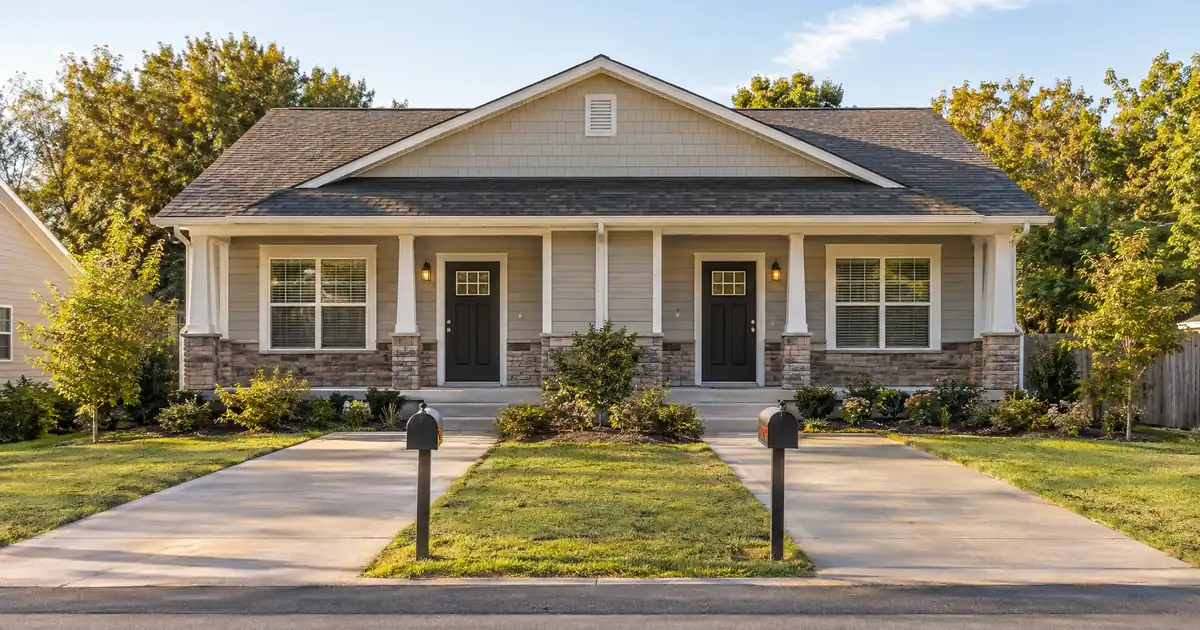
The Quick Read: To mix houses, duplexes and condos under one portfolio (blanket) DSCR loan, you pool them as collateral under a single note. The lender values each property on its own, adds up the rents and the monthly obligations across the whole pool, and tests that pooled number against the program’s coverage floor. The weakest property in the pool usually decides how far the whole deal can go.
- Portfolio structures typically allow single-family, 2-4 unit, condo and townhome collateral in one note, subject to lender guidelines.
- Every property still needs its own appraisal and rent evidence. One loan does not mean one appraisal.
- Coverage is measured on the pool, so stronger rentals can offset weaker ones, but leverage is tiered property by property.
- Owner-occupied homes, mobile homes, co-ops, mixed-use and commercial property are not eligible in the pool.
- Separate loans can still beat a blanket if you hold only two or three rentals or want clean exits.
Investors with a scattered portfolio often ask whether the mix itself is a problem. It usually isn’t. The mix changes the paperwork, though, and it changes which property sets your ceiling. The sections below walk through how that works. For the broader program picture, see Lendmire’s complete DSCR loans guide.
What Does “One Loan” Actually Mean?
One loan means one note secured by several properties. A lender places a lien on each one, and a default can reach all of them. That is cross-collateralization, and it is the central tradeoff of the structure.
“DSCR” and “blanket” are two separate design choices. DSCR describes how the file qualifies: on property-level rental income covering the payment, subject to lender guidelines. A DSCR loan can sit on one rental or on twenty.
Across the wholesale network Lendmire works with, the portfolio DSCR structure typically covers 2 to 20 properties under one note. Loan sizes run from $300,000 to $5,000,000, with larger balances reviewed case by case. Leverage goes up to 80% of value on a purchase or rate-and-term refinance, with a 30-year term and an interest-only period available. A second structure, a rental portfolio term loan, is built for five or more rental properties or units. It runs from $500,000 into the tens of millions at up to 75% of value, with fixed terms and a balloon at maturity. Both are program ceilings, not quotes.
House, Duplex, Condo: Three Different Files
Each property type is documented differently, even inside one note. A house gets a rent schedule. A duplex gets per-unit rents. A condo adds association dues and a project review.
The appraisal products differ. Fannie Mae’s Selling Guide describes Form 1025 as the small residential income report for two- to four-unit properties, including those in condo projects. Fannie Mae’s Appraiser Update notes that Form 1007, the monthly market-rent schedule, can also be used for condo investment units. Those are appraisal forms, not DSCR rules; the DSCR guidelines come from the lenders in the network.
| Property type | Rent evidence | Goes in the payment | Extra review |
|---|---|---|---|
| Single-family house | Lease or market rent schedule | Principal, interest, taxes, insurance | Usually none |
| Duplex (2-4 unit) | Per-unit rents, rent roll | Same, for the whole building | Unit-by-unit rent support |
| Condo unit | Lease or market rent schedule | Same, plus association dues | Condo project review |
On terms. A condo is an ownership structure, not a building shape. A two-unit building held as a condo still gets the 2-4 unit treatment. A duplex counts as one rental building whose unit rents add together.
How Underwriting Treats the Pool, Step by Step
Underwriting runs in a predictable order. Here is how most programs in the network handle a mixed file.
1. Classify each asset. Every property must be a non-owner-occupied rental. Owner-occupied homes, mobile homes, co-ops, mixed-use and commercial property sit outside the pool. Manufactured homes, log homes and barndominiums are not offered in these programs at all.
2. Order the right appraisal per property. Each asset is valued separately. McKissock, an appraiser-education provider, explains that Form 1025 covers duplexes through fourplexes, while Form 1007 documents monthly rent.
3. Pick the rent number. Every property needs a lease or an appraiser-supported market rent. Lenders typically credit the lower of the two.
4. Add the payment side. Pooled debt service means principal, interest, taxes, insurance and any association dues, summed across every property.
5. Compute pooled coverage. Total rent divided by total payment. Select programs start at 1.00 on the pool, and stronger ratios open better pricing and leverage.
6. Tier the leverage. Each property gets its own leverage ceiling by type and profile. Those ceilings blend into one pool-wide number, and the weakest tier often pulls the blend down. No property can contribute more than its own ceiling.
7. Review credit and structure. The credit floor on portfolio programs is typically around 640, with some structures wanting 680 or 720. Some require a special-purpose entity, usually an LLC, subject to program terms.
Reserves vary by lender, leverage and loan size. Around six months of payment is common, stepping up to about nine months on larger balances. Review details are subject to lender guidelines and individual underwriting.
Pooled Versus Per-Property Testing
Pooled testing lets strong properties carry weak ones. Per-property testing does not. Ask which one the lender applies before you pick assets, because it changes the pool you should build.
On the portfolio programs described here, coverage is measured on pooled rents against pooled debt service. A rental that sits below 1.00 on its own can be in the pool, but underwriting then tests the pooled coverage, the leverage and the terms together, subject to underwriting. A lender using per-property testing would treat that same rental as a problem file.
Run the numbers on a three-property pool. A house covers its payment at roughly 1.25x. A duplex covers at about 1.35x. A condo, loaded with association dues, sits near 0.90x on its own. Pooled, those three can land around 1.15x to 1.20x, well above the 1.00 floor. Tested one by one, the condo is the outlier. These ratios are modeled assumptions, not market data.
Notice what pooling hides, too. The condo is still a weak asset. If its project is under review or its appraisal comes in low, the whole pool gets re-cut.
Where the Rule Breaks
The general rule is that a mixed pool works. These edge cases are where it stops working.
Non-warrantable condos. That label is an agency term, and it doesn’t by itself end a non-QM file. Many programs in the network will look at these projects, though leverage and loan size often adjust. Typical triggers include investor concentration, thin project reserves, litigation and a high share of short-term rentals. The lender’s condo questionnaire covers ownership mix, finances, litigation, rental program and development status.
Short-term rentals inside a pool. Form 1007 is a monthly market-rent tool. McKissock notes it does not capture nightly rent, so the lender decides how to treat STR income. Standalone STR programs carry their own terms: purchase to 75% LTV, refinance around 70%, and about 12 months of hosting history. Short-term rental rules can vary by city, county, HOA, and property type, so investors should confirm local rules before relying on projected rental income. Final terms depend on the lender’s guidelines, the property type, and the borrower’s complete credit picture.
Vacant units. A vacant unit has no lease. It needs appraiser-supported market rent, and a vacant asset can weaken the whole pool.
Cash-out on a pool. Cash-out never goes above 75% of pooled value. In the first six months of ownership, a seasoning rule caps the amount. Lendmire’s piece Investment Property Cash-Out Refinance for Condos and Duplexes covers that side of it.
Small portfolios. Many programs set minimum property counts and loan sizes. An investor with two or three rentals may find separate loans fit better.
Changing form names. Fannie Mae’s UAD 3.6 FAQ says the standalone 1004, 1025 and 1007 forms are being replaced by a redesigned report in agency delivery. Expect form names to shift. The underlying need, a supportable rent for each property, won’t.
Building the Pool: What Goes In, What Stays Out
Pool construction is where experienced investors earn their margin. Across the files that come through the network, the pattern is consistent: the strongest pools are built by subtraction.
- Leave out the asset that needs the most explaining. A condo in a troubled project or an unleased unit can force a re-cut of the entire pool.
- Keep in properties with seasoned leases and clean appraisals. They lift pooled coverage without adding documentation risk.
- Watch the weakest tier. If the condo caps at a lower leverage tier than the house, the blend drops. Adding a stronger asset doesn’t raise the weak one’s ceiling.
- Check the exit. Release terms are not standardized. A sale of one property out of the pool follows the loan documents and the lender’s release terms. The release price typically runs above the property’s allocated balance, and the remaining pool must still cover its debt service.
Clearing 1.00 is not the same as positive cash flow. DSCR compares rent to the payment only. Repairs, vacancy, management, utilities and capital expenses all sit outside the calculation, and a pooled 1.10x with an aging roof on one house is thinner than it looks.
A larger down payment lowers the payment and can lift coverage. It does not erase leverage caps, credit floors, reserve rules or eligibility. The strongest files have enough equity and enough rental coverage.
Blanket or Separate Loans? A Decision Table
The right call depends on how many rentals you hold and how you plan to exit them. It is a real tradeoff, not a default.
| Factor | One portfolio loan | Separate DSCR loans |
|---|---|---|
| Closing and servicing | One note, one payment | Several of each |
| Weak property | Pooled coverage can absorb it | Each loan must stand alone |
| Collateral risk | Cross-collateralized | Isolated per property |
| Selling one asset | Release terms apply | Typically simpler |
| Minimums | Property count and size thresholds | Fewer thresholds |
A blanket tends to fit investors with five or more rentals, one entity and a hold-long plan. Separate loans tend to fit two-to-four-property investors, or anyone planning to sell within a few years. Whether a blanket sidesteps per-borrower financed-property counts is contested, so don’t plan around it as a loophole.
Document checklist, by type: entity documents, leases for every unit, a rent roll for multi-unit buildings, association and condo questionnaires, and title and insurance for each property.
Key Terms Defined
Blanket (portfolio) loan: one note secured by several properties.
Pooled DSCR: total rent divided by total payment across all properties in the loan.
PITIA: principal, interest, taxes, insurance and association dues.
Cross-collateralization: each property backs the whole debt, not just its own share.
Release clause: the term that lets one property leave the pool under set conditions.
Non-warrantable condo: a condo project that falls outside agency guidelines, which some non-QM programs still review.
Frequently Asked Questions
Can one DSCR loan cover a house, a duplex and a condo together?
Yes, portfolio programs typically accept single-family, 2-4 unit, condo and townhome collateral in one note. Each property still gets its own valuation, and approval is subject to lender guidelines, credit and property review.
Does every property need its own appraisal?
Yes. Each property is valued separately, with its own rent evidence. A house and a condo typically use a monthly rent schedule, while a 2-4 unit building uses a report that supports rent per unit.
Can a strong property cover a weak one?
On a pooled test, yes, to a point. Coverage is measured on total rent against total payment. Leverage is still tiered per property, so the weakest asset can pull down the blended ceiling.
What if one condo is non-warrantable?
It may still be reviewed. Many programs in the network look at these projects, usually with adjusted leverage and loan size. Investor concentration, litigation and thin reserves are the common sticking points.
Can I include a home I live in?
No. Owner-occupied property is ineligible in the pool.
Next Step
If you are buying or refinancing rental properties and want to see how the numbers work, Lendmire can help you compare DSCR loan options based on the property income, credit profile, leverage, and investor goals. Lendmire is a mortgage broker arranging financing through select lenders in its wholesale network across 41 markets, including Washington, D.C. Programs change, and every file is underwritten individually. Tax treatment varies; consult a qualified professional.
About Lendmire
Lendmire, NMLS# 2371349, is a non-QM mortgage broker serving real estate investors in 41 markets, including Washington, D.C., through DSCR investor loan programs. Qualification is generally reviewed around the subject property’s rental income, not the borrower’s W-2 history — a practical fit for LLC-titled portfolios and self-employed investors. All scenarios remain subject to lender review and program guidelines. Two consecutive Scotsman Guide Top Mortgage Workplace recognitions (2025, 2026).
Get Started
Ready to find the right loan for you?
In about 30 seconds you can review financing options available for your investment property. No commitment required.
Informational only. Not a Loan Estimate, approval, or commitment to lend. Program availability and eligibility are subject to lender guidelines, credit approval, property review, and underwriting.
References
1. Fannie Mae Selling Guide B4-1.2-01
2. Fannie Mae Appraiser Update
3. McKissock: Form 1007 and short-term rental appraisals
This article is part of Lendmire’s DSCR loan program — full qualification details, guidelines, and scenarios live on the program page.
Related reading: Can You Get a DSCR Loan for an Airbnb in Tennessee? · Can You Get a DSCR Loan for an Airbnb in Washington, DC? · Can You Get a DSCR Loan for an Airbnb in Montana?
Brandon Miller
Founder & CEO, Mortgage Loan Originator, Lendmire LLC
- Mortgage Loan Originator · NMLS# 1129696 · Verify on NMLS Consumer Access
- North Carolina Real Estate Broker · License# 343312 · Verify on NCREC
- North Carolina Insurance Producer · License# 19053198 · Property, Casualty, Life, Health · Verify on NAIC SBS
- Lendmire LLC · Firm NMLS# 2371349 · Verify firm licensure
Important disclosures. Lendmire (NMLS# 2371349) is a licensed mortgage brokerage. Lendmire is not a direct lender, depository institution, or financial advisor. All loan inquiries are subject to lender underwriting; this article does not constitute a commitment to lend. Rates, terms, and program guidelines are subject to change without notice and vary by borrower profile, property type, and state. Information in this article is general in nature and is not financial, legal, or tax advice. Equal Housing Opportunity. NMLS Consumer Access: nmlsconsumeraccess.org.