
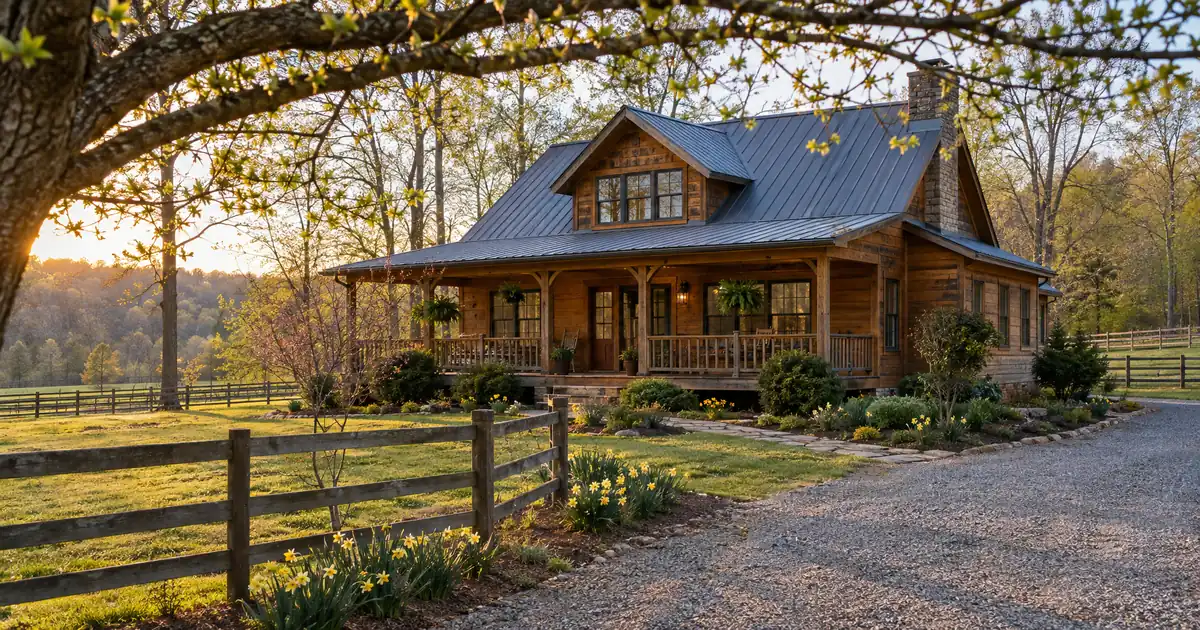
The Quick Read: Moving a cabin into a DSCR loan means re-declaring it as a non-owner-occupied investment property, proving rent, and passing a property-eligibility screen that rural cabins often fail before income is even reviewed. The loan then qualifies primarily on property-level rental income covering the payment, subject to lender guidelines.
- The second-home label comes off. A DSCR file cannot carry it.
- Occupancy is checked first, then rural acreage and access, then construction type, and only then the rent.
- Select programs in the network start at 1.00 coverage, and a cash-out on a standard rental tops out around 75% LTV.
- Log homes, manufactured homes, and barndominiums are not offered in these programs.
- Short-term-rental cabins need booking history, not just a rent schedule. Final terms depend on lender guidelines, property type, leverage, and the borrower’s complete credit picture.
A cabin bought for family weekends and now rented out sits in an awkward spot. The old loan was built around the owner’s income and personal use. The new loan is built around the rent. Moving from one to the other is a re-classification, and the file has to prove that classification is true. This article walks the mechanics in order, shows where cabin files break, and lays out how an investor decides whether to convert at all. DSCR investor loans here are arranged through select lenders in Lendmire’s wholesale network, across 41 markets including Washington, D.C.
DSCR Calculator
Run the numbers in your market
Rate source: Freddie Mac 30-yr average via FRED® — Federal Reserve Bank of St. Louis · effective Oct 29, 2026
Prefilled with starting assumptions — enter your own rent or nightly figures, taxes, insurance, and HOA for a more accurate picture.
Program parameters update from Lendmire’s centralized guideline source. Taxes and insurance are editable estimates.
As of Oct 29, 2026 · General Freddie Mac market benchmark, not a Lendmire loan offer. Rent, nightly rate, occupancy, taxes, and insurance are editable estimates. Short-term rental figures are estimates only and vary significantly by season, property type, management approach, and local short-term-rental rules — confirm local regulations before relying on them. Qualifying income for short-term rentals varies by program — some use appraisal market rent, others use documented STR history or projections — and is confirmed in underwriting. Not a Loan Estimate, approval, or commitment to lend. Program availability and eligibility are subject to lender guidelines, credit approval, property review, and underwriting.
What Does a Second-Home Loan Actually Require?
A second-home loan assumes the borrower really uses the property. It is built around the borrower’s income and debts, not the cabin’s rent. That design is the reason rent cannot simply be added to a second-home file and counted.
The agency definition is useful only as contrast, because DSCR loans are not agency products. Fannie Mae’s Selling Guide describes a second home as a one-unit dwelling the borrower occupies part of the year, with exclusive control, and not a rental or timeshare. If rental income shows up, that guide allows the loan to stay a second home only when the income is not used to qualify.
That is the whole problem in one line. The moment the rent is what makes the file work, the second-home label no longer fits. Because DSCR loans are business-purpose investor loans on non-owner-occupied property, they are reviewed differently from a standard owner-occupied mortgage.
Key Terms Defined
Second home: A property the borrower occupies for part of the year and qualifies for using personal income, not rent.
Non-owner-occupied: A property the borrower does not live in, held for rental income.
DSCR (debt service coverage ratio): Qualifying monthly rent divided by the full monthly payment of principal, interest, taxes, insurance, and any HOA dues (PITIA).
Form 1007: The single-family comparable rent schedule an appraiser completes to estimate monthly market rent.
Form 1025: The small-income-property report used for two-to-four-unit properties.
Seasoning: The ownership period a lender expects before a cash-out refinance is available on a recent purchase.
Should You Convert at All?
Convert when rent is the plan and the family stays are secondary. Keep the second-home loan when the cabin is mostly a personal retreat and rental is occasional. The test is real use, not paperwork.
Three situations come up on cabin files:
| Situation | Better fit |
|---|---|
| Family uses it for weeks each year, rents rarely | Second-home loan |
| Rented most of the year, owner stays are brief | DSCR loan |
| Truly personal use, but income is hard to document | Bank-statement loan |
An LLC does not change this. Use decides the category, not the entity holding title. Calling a personal-use cabin an investment through an LLC will not hold up under review.
The hybrid cabin is the hard one. Some weekends are yours, some weeks are rented. Lenders ask who the property is for. If the honest answer is mostly guests, the DSCR path fits, and the owner stays have to shrink to match what an investment property looks like. If the answer is mostly family, converting creates a file that contradicts itself. Pick one. A bank-statement loan, tested on deposits rather than rent, can sometimes finance a truly personal-use cabin without forcing the rental conversion. Rural limits apply there too.
Is the Cabin Eligible Before Rent Even Comes Up?
On rural cabins, property eligibility ends more files than coverage does. The order of checks is occupancy, then rural and acreage eligibility, then structure type, then the income test. A cabin that fails any earlier check never reaches the income test.
Rural and acreage limits come first among the property checks. Each program sets its own, and they differ by loan size. Very large loans are screened more tightly on rural property. A cabin on a few acres reads differently than one on forty. On an acreage cabin the appraisal may carve out the excess land, so the appraised value can come in below the price paid. That matters because leverage is set against appraised value, not purchase price.
Construction type is the next hard line. Across the network, DSCR programs do not offer loans on manufactured homes (single- or double-wide), log homes, or barndominiums. These fall outside the programs entirely. A frame-built cabin is the clean path. A log cabin that rents beautifully on the booking platforms still will not qualify on rent.
A rural readiness checklist saves a surprising number of files:
- Year-round road access, and whether the road is public or private
- Water source and septic in working order
- Heating adequate for the property to be rented in winter
- Insurance that matches rental use, not the old second-home policy
- Local and HOA short-term rental permissions, where the plan is nightly rental
Short-term rental rules can vary by city, county, HOA, and property type, so investors should confirm local rules before relying on projected rental income.
How to Move the Cabin Into a DSCR Loan, Step by Step
The conversion runs in a fixed order. Skipping ahead is how files stall.
1. Decide the true use. If rent is the plan, DSCR fits. If the family still uses the cabin for weeks each year, the second-home loan may fit better. Settle this before anything is signed.
2. Check property eligibility. Confirm acreage, rural flags, road access, and frame construction against the program. Do this before ordering anything.
3. Assemble rent evidence. Use a signed lease for long-term rental, or booking and payout history for short-term rental. The next section covers this in detail.
4. Order the appraisal. A full appraisal with a rent schedule is standard. On a rural cabin, bring your own rental comps up front, because the appraiser may have few to work with.
5. Re-declare occupancy. The refinance is written as a non-owner-occupied investment-property loan. The borrower signs a business-purpose and non-occupancy certification. The second-home label comes off.
6. Run the coverage test. DSCR is rent used for lender review divided by the full payment. 1.00 is where many select programs start, and stronger ratios open better pricing and leverage. A separate select-lender path takes coverage below 1.00, with leverage and terms adjusted.
7. Size the loan. The loan is the smallest of three limits: what the leverage cap allows on appraised value, what the coverage supports, and what property eligibility permits.
8. Close out the loose ends. Update insurance to match rental use. Confirm permits and HOA rules. If title moves into an LLC, confirm with the existing lender and a title professional that the transfer does not trigger a due-on-sale problem, subject to program terms.
9. Pay off the old loan. The new loan retires the second-home mortgage. Cash-out is optional.
Where this fails: step 2 and step 5 are the usual culprits. Files fail on acreage or construction type, or they fail because the borrower’s stated use contradicts the calendar.
How Do You Prove Rent on a Cabin With Few Comps?
Match the evidence to the rental style. A long-term lease is the simplest. Short-term rental takes more work, because the standard appraisal form was not built for it.
The 1007 is the form most appraisers use for single-family rent. Fannie Mae’s appraiser update says it documents estimated monthly market rent, cannot estimate a nightly fee, and that appraisers must use comparables leased monthly. DSCR lenders borrow the form names, not the agency rules. McKissock, an appraiser-education firm, points to the same limit: the form documents monthly rent, not nightly rent or business income.
That gap shapes how files are built:
| Rent situation | Evidence that helps |
|---|---|
| Existing short-term rental history | Platform payout records, booking calendar |
| Long-term lease in place | Signed lease, deposit proof |
| No rental history yet | Appraiser rent schedule, market comps |
Programs differ on how they count short-term income. Some count long-term market rent only. A cabin can pass on short-term income and fall short on the 1007 figure if the program defaults to long-term rent. In the network, short-term-rental programs expect a 640+ score and about 12 months of hosting history. Purchases go to 75% LTV, refinances run around 70%, and a short-term-rental cash-out tops out at 70%. Purchases need 1.00 coverage, and refinances 1.00 as well, subject to lender guidelines.
Appraiser choice matters. A generalist appraiser applying a monthly-rent form to a nightly-rental cabin often produces a low ratio. Confirm the appraisal scope before it is ordered, and hand over the booking history yourself.
DSCR vs. conventional financing
There are two common ways to finance an investment property, and they qualify you differently — here’s how investors weigh them.
Why investors choose it
- Qualifies on the property’s rental income — no personal tax returns, W-2s, or pay stubs needed to document income.
- No personal debt-to-income ceiling to clear, so existing mortgages and obligations don’t cap your borrowing the same way.
- Can be closed in an LLC, keeping the property inside a business entity.
- Built for scaling — not held to the limit on number of financed properties that conventional financing applies.
- Underwriting centers on the deal: generally qualifies when the rent covers the payment, a 1.00x coverage ratio being a common baseline (confirmed in underwriting).
- Designed specifically for investment property, including long-term and, where the program allows, short-term rentals.
Where it’s strong
- Often the lowest ongoing financing cost for a buyer who fully qualifies on personal income — a fit for a first property or a cost-first purchase.
Trade-offs for investors
- Requires full personal income documentation and must fit within a debt-to-income limit — salary, existing debts, and other mortgages all count.
- Typically held in your personal name rather than a business entity.
- Caps how many financed properties you can carry, which can become a ceiling as a portfolio grows.
- Evaluates you as a borrower as much as the property, which usually means more paperwork.
How investors usually choose: a first or single property often optimizes for the lowest financing cost; portfolio builders often optimize for leverage, vesting in an LLC, and scaling past conventional caps. The right answer depends on your goals, the property, and current guidelines — both paths run through select lenders in Lendmire’s wholesale network, with eligibility and terms confirmed in underwriting.
What Happens to the Old Loan, Title, and Insurance?
The new loan pays off the old one. The second-home mortgage is retired at settlement, and the settlement statement reconciles the payoff. Check the old loan for any prepayment terms before you plan the timing, because those costs come out of the deal.
Title is the quiet risk. Moving the cabin into an LLC at the same time as the refinance can raise due-on-sale questions with the existing lender. Sort the order of operations with a title professional first. Entity documents, operating agreement, and good standing proof should be in the file before it goes in.
Insurance has to match the new use. A policy written for a seasonally occupied second home may not respond the way a rental policy does. Confirm coverage with the insurer before the lender asks.
On the new loan, expect a prepayment commitment on many programs. Leaving early can carry a penalty, so decide how long you plan to hold the cabin before you sign.
What Do the Numbers Look Like in Practice?
Terms generally tighten when a cabin moves from second-home to investment treatment. Expect a larger down payment, more reserves, and different pricing.
The network’s typical figures for a rental cabin:
- Purchase leverage: most files land at 75%–80% LTV on an investment property purchase. Select high-leverage programs reach 85% with roughly a 700+ score.
- Cash-out refinance: about 75% LTV on a standard rental, with about 6 months of seasoning commonly expected.
- Credit: a 620 floor exists in parts of the network, most programs want around 660, and 700+ unlocks the strongest leverage.
- Reserves: commonly around 6 months of PITIA, stepping up to about 9 months on loans above $1,500,000. Conservative rate-and-term files at modest leverage can see reserves waived.
- Loan size: up to $3,000,000 on standard programs.
Picture a frame-built cabin with a strong summer and a dead winter. Suppose summer rent covers the payment at roughly 1.3x, and winter dips to roughly 0.9x on the same payment. A lender looks at the documented, averaged income, not the best month. If that average lands near 1.1x, the file clears the 1.00 floor of select programs, but with thin room. That cushion is what an investor should stress-test. Illustrative ratios only; actual eligibility depends on the program and property review.
Here is the catch. Clearing 1.00 is not the same as positive cash flow. DSCR compares rent to PITIA only. Repairs, vacancy, management, utilities, and capex sit outside the calculation. A large cash-out can leave the payment close to the rent, with no margin for a slow winter or a roof repair.
A larger down payment lowers the payment and can lift coverage. It does not erase leverage caps, credit floors, reserve rules, or property eligibility. The strongest files clear both tests: enough equity and enough rental coverage.
On structure, the spine is the 30-year fixed. Extended terms and interest-only periods are available through select lenders in the network, and ARM structures exist for investors who want them. Above $2,500,000, the network generally holds to 30-year fixed.
The documentation habit that keeps cabin files clean is simple. Put rent evidence, entity documents, insurance, and the permit confirmation in the file before it goes to the lender. Gaps found mid-review cost more than gaps found up front. For a full walkthrough of how the program works, Lendmire’s complete DSCR loans guide covers qualification, leverage, and documents. For the second-home refinance question specifically, see Lendmire’s piece Can a Rural Cabin Bought as a Second Home Be Refinanced Into a DSCR Loan?.
Why Do Rural Cabin Files Stall?
Most stalls trace to five causes, and each has a fix before applying.
- Ineligible construction. Log, manufactured, and barndominium structures are not offered. Check this early.
- Thin comps. The rent estimate is the riskiest step on a rural file. Bring your own rental comps.
- Appraised value below price. Excess acreage carve-outs can pull value down and cut the loan. Ask about acreage treatment early.
- Occupancy contradiction. A calendar full of owner stays undercuts the non-occupancy certification.
- Missing documents. Entity papers, lease evidence, and insurance proof gaps cause preventable pends.
A pre-application document list: government ID, entity documents if applicable, lease or booking and payout history, current insurance, the existing mortgage statement, and the permit or HOA confirmation for rentals.
Frequently Asked Questions
Can I still use the cabin after the conversion?
Only lightly. A DSCR loan requires the property to be a non-owner-occupied investment, and the borrower signs a non-occupancy certification. Occasional personal stays muddy that certification, and heavy use contradicts it. If you plan regular family weeks, a second-home loan is the honest fit.
Does an LLC make the cabin an investment property?
No. Use decides the category, not the entity. An LLC can hold title on a true rental, subject to lender program eligibility, but it will not convert a personal-use cabin into an investment one.
Do log cabins qualify?
No. Log homes, manufactured homes, and barndominiums are not offered in the network’s DSCR programs. A frame-built cabin is the eligible structure type. If yours is log, a different loan type would be the route.
Does acreage matter?
Yes. Acreage limits and rural screens vary by program and by loan size, and the appraiser may carve out excess land, which can pull appraised value below the price paid. Leverage is set against appraised value, so confirm acreage treatment before relying on a loan amount.
Do I need tenants or guests before I apply?
For short-term rentals, yes. The network’s short-term programs expect about 12 months of hosting history. For long-term rental, a signed lease or an appraiser’s rent schedule can support the file.
If you are buying or refinancing a rental property and want to see how the numbers work, Lendmire can help you compare DSCR loan options based on the property income, credit profile, leverage, and investor goals. Reach the team at 828-256-2183 or request a quote.
For a rural cabin, the roof, the road, and the construction type decide the file long before the rent does.
About Lendmire
Lendmire — NMLS# 2371349 — is a mortgage brokerage specializing in DSCR investor loans, helping arrange financing across 41 markets, including Washington, D.C., through wholesale and investor-lending channels. The model centers on property-level rental income reviewed by the lender rather than W-2 documentation, subject to lender guidelines, suiting entity-owned and multi-property investors. Lendmire holds Scotsman Guide Top Mortgage Workplace recognition for 2025 and 2026.
Get Started
Ready to find the right loan for you?
See your offer in seconds. No credit pull, no obligation.
Informational only. Not a Loan Estimate, approval, or commitment to lend. Program availability and eligibility are subject to lender guidelines, credit approval, property review, and underwriting.
References
1. Fannie Mae Selling Guide B2-1.1-01, Occupancy Types
2. Fannie Mae Appraiser Update, June 2024
3. McKissock: Form 1007 and Short-Term Rental Appraisals
This article is part of Lendmire’s DSCR loan program — full qualification details, guidelines, and scenarios live on the program page.
Related reading: Trust vs LLC Vesting for a DSCR Loan on a Rental · Can You Get a DSCR Loan With a Lower Credit Score? · How to Get a DSCR Loan on a Rental Needing Repairs
Brandon Miller
Founder & CEO, Mortgage Loan Originator, Lendmire LLC
- Mortgage Loan Originator · NMLS# 1129696 · Verify on NMLS Consumer Access
- North Carolina Real Estate Broker · License# 343312 · Verify on NCREC
- North Carolina Insurance Producer · License# 19053198 · Property, Casualty, Life, Health · Verify on NAIC SBS
- Lendmire LLC · Firm NMLS# 2371349 · Verify firm licensure
Legal disclosures. Lendmire (NMLS# 2371349) is a state-licensed mortgage brokerage that arranges financing through wholesale lender relationships. Lendmire is not a direct lender, depository institution, or registered financial advisor. The discussion above is general informational content about real estate financing — it is not financial, legal, or tax advice, and readers should consult licensed professionals for guidance on their individual circumstances. Loan inquiries are subject to lender underwriting; this article does not represent a commitment to lend. Loan terms, rates, and qualification standards vary by borrower, property, and state, and are subject to change at any time. Equal Housing Opportunity. NMLS Consumer Access: nmlsconsumeraccess.org.