
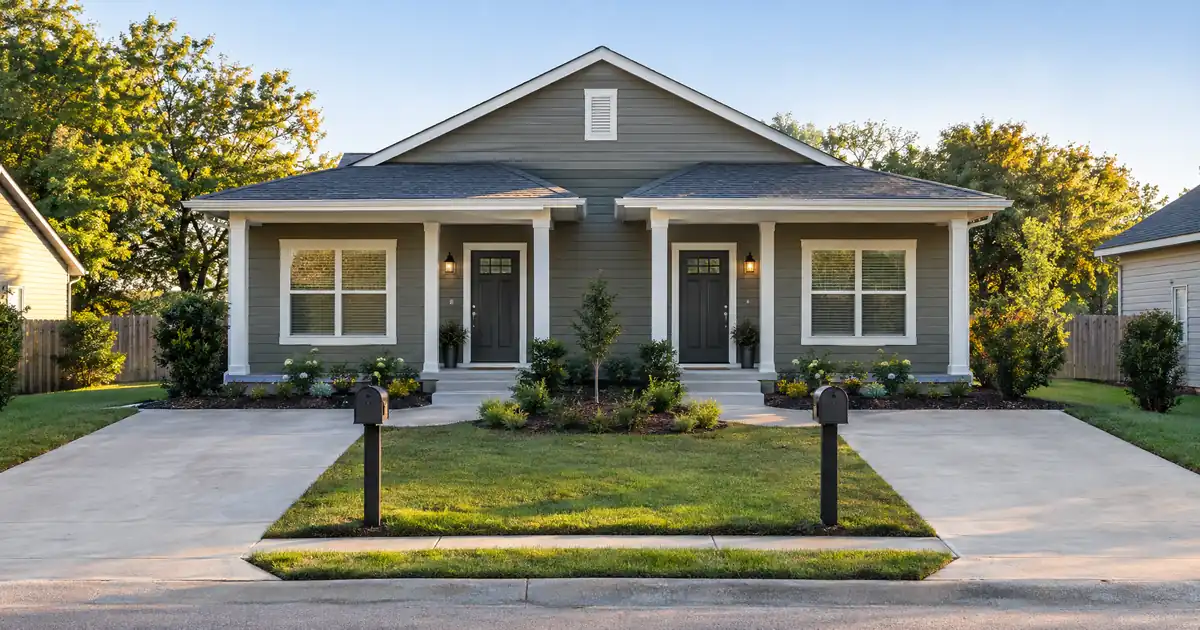
The Quick Read: A portfolio DSCR schedule is a property-by-property table. Each row lists one rental’s rent used for lender review, its monthly payment (principal, interest, taxes, insurance and association dues), and its own coverage ratio, and a pool row underneath divides total rent by total payment. Check the rent source on every row first, then find the row that drags the pool.
- Each row is one property. A duplex is one row with two rents, not two rows.
- The pool ratio is one division of total rent by total payment. It is not an average of the row ratios.
- Rent comes from the appraisal rent schedule, or the lower of lease and market rent where a program uses that rule.
- Clearing 1.00 means rent covers the payment. It does not mean the pool is cash-flow positive.
- Whether a weak row can ride along depends on the structure and the lender’s guidelines.
Most investors get a schedule after the quote stage, and most read only the bottom line. The bottom line hides the work. A schedule is a map of which properties carry the loan and which ones lean on the others. This piece walks through the columns, the totals, the three property types and the places where the usual rule breaks. Program details come from the guidelines Lendmire’s wholesale network works from, and every file is underwritten individually.
Key Terms Defined
PITIA. Principal, interest, taxes, insurance and association dues: the full monthly obligation on one property.
Pooled coverage. Total rent used for lender review across the pool divided by total PITIA across the pool.
Portfolio DSCR loan (also called a blanket loan or cross-collateralized loan). One note secured by several rentals. The three names describe the same structure. A bank’s own portfolio loan, one the bank keeps on its books, is a different use of the word.
Allocated loan amount. The share of the note assigned to each property. It drives the release price when one property leaves the pool.
Release. Removing one property from the pool, by sale or refinance, under the loan documents’ release terms.
Rent used for lender review. The rent figure underwriting accepts for a row, supported by a lease or an appraiser’s market-rent opinion.
What Does a Portfolio DSCR Schedule Look Like?
The schedule has one row per rental and one total row. The columns do the real work, so read them left to right: property, type, rent and its source, PITIA, row coverage, allocated loan amount.
| Column | What it means | Where it comes from | What to check |
|---|---|---|---|
| Property type | House, duplex or condo | Appraisal and title | Type is eligible in the pool |
| Rent used for program review | Rent counted for the row | Lease or appraiser’s opinion | Which number was used |
| PITIA | Full monthly obligation | Note allocation, tax bill, insurance, dues | Taxes, insurance and dues all included |
| Row coverage | Rent divided by PITIA | Calculated | Any row near or below 1.00 |
| Allocated loan amount | Share of the note | Loan documents | Release terms and exit order |
Two of those columns cause most of the trouble: rent and PITIA. If the rent was entered from a listing instead of an appraisal, or the dues column is blank on a condo, the pool ratio on the page is not the one underwriting will use.
Where Does Each Rent Figure Come From?
Rent on the schedule traces to an appraisal form. DSCR loans are not agency products, but they borrow the appraisal form names. According to Fannie Mae’s form list, Form 1007 is the Single-Family Comparable Rent Schedule and Form 1025 is the Small Residential Income Property Appraisal Report. Houses and condos get a market-rent opinion on the 1007. A two-to-four-unit property uses the 1025 income and rent analysis.
Where a lease exists, many programs use the lower of lease rent and market rent. A vacant property runs on the appraiser’s number alone. So the “my lease rent is what counts” assumption fails whenever the lease sits above market. Price every deal on conservative rent, because appraised rent, not asking rent, drives the top of every row.
One contrast helps. An agency selling guide requires Form 1007 for a one-unit investment property when rental income is used to qualify. That is an agency rule. It does not set DSCR program terms, which come from the lender’s own guidelines.
How Is the Pool Ratio Calculated?
The pool ratio is one division: add every row’s rent used for eligibility review, add every row’s PITIA, and divide the first total by the second. It is not the average of the row ratios, and the difference matters. A large property with a low ratio pulls the true pool down further than a simple average shows.
Here is a teaching illustration using only ratios. Picture three rentals: a house at about 1.30x, a duplex at about 1.15x and a condo at about 0.95x. If the three payments are similar in size, the pool lands near 1.13x. If the condo carries the largest payment, the pool slides toward 1.05x. Same three row ratios, different pool. That is why the schedule shows each row’s share of the total payment.
Add one more column of your own: the pool ratio with that row removed. If dropping the condo lifts the pool from the low 1.0s to the mid 1.1s, the condo is the drag row. That one comparison tells you more than the bottom line does.
On the 30-year portfolio DSCR loan, the coverage floor of 1.00 is measured on the pool. That is a program floor, not a universal standard, and stronger coverage can open better terms. Programs and files vary.
Gross Rent Over PITIA, Not Net Operating Income
Rental-loan DSCR divides gross rent used for the lender’s review by the full payment. Commercial and textbook DSCR divides net operating income by annual debt service. The two methods give different answers on the same pool because the NOI version subtracts operating costs first.
So check which method a schedule uses. If a calculation subtracts repairs, management and vacancy before dividing, it is the commercial method, not the one these residential programs use. Break-even logic is the same either way: MMCG Invest explains that 1.0 means income exactly covers the payment, above 1.0 is a cushion and below 1.0 is a shortfall.
How Houses, Duplexes and Condos Show Up Differently
The property type decides the form, and the form decides how rent is built. Eligible types in the pool are single-family houses, two-to-four-unit properties, condos and townhomes. Owner-occupied property, co-ops, mixed-use and commercial property are ineligible in the pool. Manufactured and mobile homes are not reviewable on these programs.
Houses. One rent line from the 1007 market-rent opinion. The payment column is taxes, insurance and principal and interest, and there are no dues unless an association exists. Houses are the cleanest rows to read.
Duplexes. One property, two rents. The rent comes from the 1025 analysis, and a leased two-to-four-unit property may also be supported by an operating income statement. Never count a duplex as two rows, or the schedule overstates the property count.
Condos. The dues belong in PITIA. A condo with a strong rent and heavy dues can look fine until the dues line is added. Condos also bring the association questionnaire and certification items, which sit outside the schedule but can hold up a file. Read the condo’s row coverage after dues, not before.
Small multifamily of five or more units is eligible only inside the rental portfolio term loan, not on the 30-year portfolio structure or a single-property DSCR loan.
Pooled Test or Property-Level Test?
On the 30-year portfolio DSCR loan, coverage is measured on the pool, so stronger properties can offset weaker ones. A rental below 1.00 can sit in the pool, but underwriting tests the pooled coverage, the leverage and the terms. The pool must still clear its floor.
| Test | Strong property helps weak one? | What to read on the schedule |
|---|---|---|
| Pooled | Yes, within the pool floor | Total row and each row’s share |
| Property-level | No, each row must stand | Every row’s own ratio |
Programs differ here, so confirm which test a given lender applies before building the pool around a weak row. Every property still needs a lease or an appraiser-supported market rent. The lesson: a pool floor can mask a weak row for approval, but it cannot hide it from your own cash-flow picture.
What the Number Does Not Tell You
Clearing 1.00 does not mean positive cash flow. DSCR compares rent to PITIA only. Repairs, vacancy, management, utilities and capital expenditures sit outside the calculation. A pool at 1.05x can be thin once a roof and two turnovers hit.
Three sensitivity checks are worth running on any schedule:
1. Remove the weakest row and see how far the pool moves.
2. Mark one unit vacant and use the appraiser’s rent for it.
3. Raise the dues on any condo row and see which ratio moves first.
Short-term rentals need extra care. A nightly rate multiplied by 30 is not valid market rent. On the network’s short-term rental programs, purchase leverage tops out at 75%, and a 640+ score and about 12 months of hosting history are typical.
Reading the Allocation and Release Columns
On a blanket note, each property carries an allocated loan amount. That column sets the release price, which runs above the property’s allocated balance. It also shapes exit order: selling the property with the highest allocation first can leave the remaining pool short on coverage. Partial releases, substitutions and sales follow the loan documents, and the remaining portfolio must still cover its debt service.
The rental portfolio term loan adds more to read. It covers five or more properties or units, with fixed terms of 3, 5, 7 or 10 years and a balloon at maturity. Prepayment on that structure is yield maintenance, and reserves are held for taxes, insurance and capital expenditures. Non-recourse versions exist, with recourse limited to carve-outs such as fraud and bankruptcy. All of these are program ceilings and floors, not quotes.
Stacking separate loans instead changes closing cost, exit flexibility and release terms, so the schedule is also the place to compare structures. The complete DSCR loans guide covers the single-property basics.
Where the Program Numbers Sit
The 30-year portfolio DSCR loan takes two to twenty properties under one note, with loan sizes from $300,000 to $5,000,000 and leverage up to 80% of value on a purchase or rate-and-term refinance. The rental portfolio term loan runs $500,000 to $50,000,000 at up to 75% of value. Credit floors typically start at 640, and some structures want 680 or 720. A special-purpose entity, usually an LLC, is required on some structures, subject to lender guidelines.
Cash-out on a pooled loan stays at or below 75% of pooled value. Inside the first six months of ownership the loan is also capped at 90% of total cost (purchase price plus documented improvements), and at 100% of total cost from six to twelve months. The loan is the lower of that cap and the leverage ceiling. After twelve months the appraised value alone is the basis, and a rate-and-term refinance is not subject to the cost-basis cap.
Red Flags Before You Submit
- A rent figure with no lease or appraisal behind it.
- A condo row with no dues, or any row missing taxes or insurance.
- A duplex entered as two properties.
- Row ratios averaged instead of pooled.
- A pool that clears only because one strong row carries three weak ones.
- Quote built on assumed rent, which fails when the 1007 comes back lower. That is the usual reason a quote shifts after the appraisal.
- An owned rental with no mortgage assumed to count. Pool eligibility is a program decision.
Frequently Asked Questions
How many properties does a portfolio DSCR loan need?
The 30-year portfolio DSCR loan takes two to twenty properties under one note. The rental portfolio term loan is built for five or more properties or units. Both are program ranges, subject to lender guidelines.
Can a short-term rental sit in the pool?
It can be reviewed, but the rent side is harder. The 1007 uses monthly-leased comps, so expect underwriting to look at documented history and an expense reduction. Short-term rental programs have their own leverage limits and hosting-history expectations.
What happens if one property is vacant?
Underwriting uses the appraiser’s market-rent opinion for that row, with no lease to compare. Leasing the unit before the appraisal gives the appraiser an actual data point and can strengthen the row.
Can a weak property sit in the pool?
A rental below 1.00 can sit in a pool, but underwriting tests the pooled coverage, the leverage and the terms. The pool itself must still clear its floor, and each property still needs supported rent.
Is a blanket loan different from a portfolio loan?
No. In this context portfolio DSCR loan, blanket loan and cross-collateralized loan all describe one note secured by several rentals.
Does a high-dues condo hurt the pool?
Yes, because dues sit in PITIA. A condo with strong rent can still be the drag row once dues are counted, which is why the condo row should always be read after dues.
If you are buying or refinancing rental properties and want to see how the numbers work, Lendmire can help you compare DSCR loan options based on the property income, credit profile, leverage, and investor goals, arranged through select lenders in its wholesale network across 41 markets, including Washington, D.C. Qualification is subject to lender guidelines. This is not a commitment to lend. Tax treatment varies; consult a qualified professional.
About Lendmire
Lendmire — NMLS# 2371349 — is a mortgage brokerage specializing in DSCR investor loans, helping arrange financing across 41 markets, including Washington, D.C., through wholesale and investor-lending channels. The model centers on property-level rental income reviewed by the lender rather than W-2 documentation, subject to lender guidelines, suiting entity-owned and multi-property investors. Lendmire holds Scotsman Guide Top Mortgage Workplace recognition for 2025 and 2026.
Get Started
Ready to find the right loan for you?
In about 30 seconds you can review financing options available for your investment property. No commitment required.
Informational only. Not a Loan Estimate, approval, or commitment to lend. Program availability and eligibility are subject to lender guidelines, credit approval, property review, and underwriting.
References
1. Fannie Mae Selling & Servicing Guide Forms
2. Fannie Mae Selling Guide B4-1.2-01
3. MMCG Invest, coverage ratios
This article is part of Lendmire’s DSCR loan program — full qualification details, guidelines, and scenarios live on the program page.
Related reading: How a Portfolio DSCR Loan Escrows Rentals in Two States · How a Portfolio DSCR Loan Counts Duplexes, Condos and Houses · How a DSCR Portfolio Loan Works When You Sell the Pool
Brandon Miller
Founder & CEO, Mortgage Loan Originator, Lendmire LLC
- Mortgage Loan Originator · NMLS# 1129696 · Verify on NMLS Consumer Access
- North Carolina Real Estate Broker · License# 343312 · Verify on NCREC
- North Carolina Insurance Producer · License# 19053198 · Property, Casualty, Life, Health · Verify on NAIC SBS
- Lendmire LLC · Firm NMLS# 2371349 · Verify firm licensure
Required disclosures. Lendmire (NMLS# 2371349) operates as a licensed mortgage broker, not a direct lender or depository. The discussion in this article is general in nature and should not be relied upon as financial, legal, or tax advice — every investment scenario is unique and should be reviewed by a qualified professional. Any loan inquiry is subject to lender underwriting, and this article is not a commitment to lend or a guarantee of approval. Mortgage rates, loan terms, and program guidelines vary by borrower, property, and state, and may change without notice. Equal Housing Opportunity. Verify licensure at NMLS Consumer Access.