
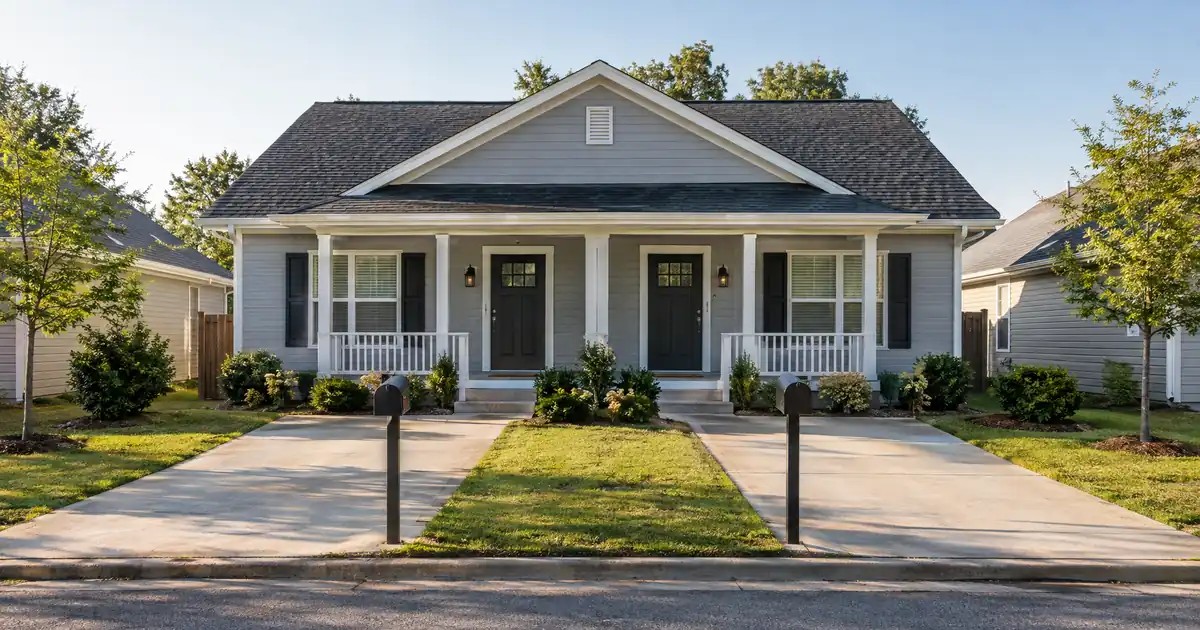
The Quick Read: A portfolio DSCR lender treats two duplexes under one note as a single loan secured by two properties. Each duplex is appraised and rent-tested on its own. The combined rent is then measured against the combined monthly obligation, and each duplex backs the entire debt until a release is negotiated. On the network’s 30-year portfolio structure, the pooled coverage floor starts at 1.00, subject to lender guidelines.
- Four units in total count as two properties, and two properties is the entry point for a single-note portfolio loan.
- The coverage test is blended, but the appraisal, the rent evidence and the property eligibility are still checked one duplex at a time.
- Pooling lets a stronger duplex offset a weaker one, and it also ties the two together if either one struggles.
- Selling one duplex later is a release negotiation, not a simple payoff, so read the release terms before you sign.
Key Terms Defined
Five terms carry most of this topic. Learn them once and the rest reads easily.
- DSCR (debt service coverage ratio): monthly rent divided by the monthly housing obligation on the property. A result of 1.00 means rent equals the obligation.
- PITIA: principal, interest, taxes, insurance and association dues. It is the full monthly obligation the rent is measured against.
- Blanket loan (cross-collateralized): one loan secured by more than one property, so every property backs the whole balance.
- Portfolio loan: a loan that covers several rentals. People also use the phrase for a loan a lender keeps on its own books, so check which meaning is in play.
- Release price: the amount you pay down to free one property from the pool so you can sell it while the loan stays in place on the rest.
What Does One Note Mean for Two Duplexes?
One note means one promise to repay, with liens recorded against both duplexes. You make one payment. You sign one set of loan terms. The lender holds a security interest in each property, and each duplex secures the full balance, not half of it.
That detail drives everything else here. The lender does not see two small loans. It sees one credit exposure with two pieces of collateral behind it.
Many investors mix up “DSCR loan” and “portfolio loan.” A DSCR loan describes how the file is qualified: primarily on property-level rental income covering the payment, subject to lender guidelines. A portfolio or blanket structure describes how several properties are financed together.
If you want the full background on how the qualification itself works, the complete DSCR loans guide walks through it.
How Does the Lender Read One Duplex First?
Before any pooling happens, each duplex stands on its own. The lender wants a value opinion and a rent opinion for every property. For a two-unit building, that rent opinion is built unit by unit and then added up to one property-level figure.
Appraisers use named forms for this. Fannie Mae’s appraiser resources list Form 1007 as the single-family comparable rent schedule and Form 1025 as the report for small income properties. A duplex generally falls under the small income property report. These are appraisal form names only. They do not set DSCR program rules, which come from the lenders in the network.
For a pool of two duplexes, you end up with:
- Two appraisals.
- Two rent schedules.
- Four unit-level rent opinions.
- Two property-level rent figures.
Every property in the pool needs either a lease or an appraiser-supported market rent. A unit that sits empty does not break the file by itself, but it changes the rent figure the lender can use for that duplex. Underwriting is individual to each file, so a lender may treat leased and vacant units differently.
Condition and eligibility are checked here too. A duplex that fails on property type or condition is a problem for the whole note, not only for itself.
How Do Two Duplexes Become One Pooled Number?
The lender adds the rent from both duplexes and divides it by the combined PITIA. That single result is the pooled coverage. On the network’s 30-year portfolio structure, the pooled floor typically starts at 1.00, subject to lender guidelines. Stronger coverage generally opens better pricing and leverage.
Here is the sequence a lender typically follows:
1. Check each duplex for eligibility, condition and rent evidence.
2. Add the property-level rents into one pooled rent figure.
3. Add the monthly obligations into one pooled PITIA figure.
4. Divide pooled rent by pooled PITIA.
5. Check leverage and credit against the structure’s limits.
6. Review how the loan is allocated across the two properties.
Run the numbers on a modeled pair. Assume duplex A covers its own obligation at 1.35x and duplex B covers its own at 0.95x. Assume the two obligations are equal in size. These are illustrative assumptions, not market data.
With equal obligations, the pooled result is the average, about 1.15x. Duplex B alone sits under 1.00, but pooled coverage, leverage and terms are what underwriting tests, subject to underwriting. If the obligations were not equal, the larger one would pull the pooled number toward its own ratio.
One more point matters here. A DSCR result compares rent to PITIA and nothing else. Clearing 1.00 is not the same as positive cash flow. Repairs, vacancy, management, utilities and capital spending all sit outside the calculation, so a pool at 1.15x can still be tight in a bad year.
Why Does the Lender Test Both the Pool and Each Property?
Pooling is flexible, but it is not a blindfold. A lender that only looked at the blend would let a failing building hide behind a strong one. So the property-level checks come first, and the pooled test comes second.
The tradeoff runs both ways. A strong duplex can carry a weak one through qualification. In return, you are asking the strong duplex to stand behind the weak one for the life of the loan. If duplex B loses a tenant and falls behind, duplex A’s equity is the cushion the lender is relying on.
That is also why leverage caps still bind. The network’s portfolio structure reaches up to 80% of value on a purchase and on a rate-and-term refinance, subject to lender guidelines. Strong pooled coverage does not move that cap.
Credit and reserves still matter as well. The portfolio structure typically looks for a credit score around 640, with 680 or 720 on some structures. Reserves vary by lender, leverage and loan size. A larger down payment lowers the payment and can lift coverage, but it never erases credit floors, reserve rules or property eligibility. The strongest files clear both tests: enough equity and enough rental coverage.
Which Portfolio Structures Exist?
Two structures matter for investors with small pools. Pick the one that matches the property count and the hold plan.
The 30-year portfolio DSCR loan is the natural fit for two duplexes. It typically covers 2 to 20 properties under one note, with loan sizes from $300,000 to $5,000,000 (larger balances on review). It offers fixed or adjustable rates, a 30-year term and an interest-only period. Eligible property types include single-family, 2-4 unit, condo and townhome. Coverage is measured on the pool, which is where the offset between strong and weak properties comes from.
The rental portfolio term loan is built for five or more rental properties or units under one loan, with loan sizes from $500,000 to $50,000,000 (larger balances on review). It uses fixed terms of 3, 5, 7 or 10 years with a balloon at maturity, and it can be recourse or non-recourse. A non-recourse loan looks to the real estate, with recourse limited to carve-outs such as fraud and bankruptcy. A recourse loan carries a personal guarantee. It also carries a yield-maintenance prepayment structure and allows properties in several markets under one loan. Two duplexes total four units, which sits below its entry point.
Cash-out follows its own limits. On a portfolio cash-out, leverage never goes above 75% of the pooled value, and the first six months of ownership cap the cash-out amount under the seasoning rule. Eligibility always depends on lender guidelines and the individual file.
What Happens When One Duplex Struggles?
Think of cross-collateralization as a shared guarantee between buildings. Each duplex is pledged for the entire note. If payments stop, the lender can look to both properties, not just the one that caused the trouble.
That makes a sale of the healthy duplex harder during a default. The lender has little reason to release its best collateral while the loan is behind. Whether any workout is possible depends entirely on the loan documents, so those terms deserve a careful read before you sign.
Three habits reduce the risk:
- Read the release language before you commit, not after.
- Ask how the loan is allocated across the two duplexes, since allocation drives release terms.
- Hold enough reserves that one vacant unit does not turn into a missed payment.
How Does Selling One Duplex Work?
Selling one duplex from a two-property pool means paying a release price. That price typically runs above the property’s allocated balance. Partial releases, substitutions and the sale of one property out of the pool follow the loan documents and the lender’s release terms. Nothing here is standardized across lenders.
The sequence usually looks like this:
1. You identify the duplex you want to sell and request a release.
2. The lender confirms the allocated balance for that property.
3. You pay the release price at the sale, which retires part of the debt.
4. The lender retests the remaining duplex against the remaining loan.
5. The loan stays in place on the duplex you kept.
The retest is the step investors forget. The remaining portfolio must still cover its debt service. If you sell the stronger duplex and keep the weaker one, the weaker duplex now carries the loan alone. A higher release price pays down more debt, which can help that retest, but it also takes more cash out of your sale.
When no release clause exists, the options narrow. You may need to refinance the whole note or pay it off. Lendmire’s piece How to Sell One of Two Rentals Under a Blanket DSCR Cash-Out Loan goes deeper on that exit.
Where Does the General Rule Break?
Several edge cases change how a pool of two duplexes is read.
Owner-occupancy. If you live in one of the units, the loan stops being a standard DSCR file. Owner-occupied property is ineligible in the pool. DSCR loans are designed for non-owner-occupied investment properties. Because they are business-purpose investor loans, they are reviewed differently from a standard owner-occupied mortgage. Federal rulemaking likewise treats investment-purpose loans as business-purpose loans, and that business purpose is why the file turns on the properties rather than on a personal debt-to-income calculation.
Ineligible property types. Mobile homes, co-ops, mixed-use property and commercial property are ineligible in the pool. Manufactured homes, log homes and barndominiums are not offered in the network’s DSCR programs at all. A duplex with a storefront unit is mixed-use, so it does not fit.
One weak building. Pooling can offset a duplex that is thin on its own, but only if the other duplex has coverage to spare. If both are thin, the blend does not rescue anything.
Loan size. The portfolio structure starts around $300,000. Two small duplexes at modest prices may fall below that, which can push the file toward separate single-property loans.
Unequal values. When one duplex is worth much more than the other, the allocation is lopsided. The larger allocation then dominates both the pooled ratio and the release math.
What About Entity and Title?
There is one note, but each duplex keeps its own recorded lien. Each property sits under its own deed or recorded security instrument, and ownership typically sits in one entity. A special-purpose entity, typically an LLC, is required on some structures, subject to lender program eligibility.
The guaranty question is separate. Recourse loans carry a personal guarantee, and non-recourse structures exist on the term loan with carve-outs. How a guaranty behaves after a partial release is a documents question, so ask for it in writing.
Two names on title or two different entities for the two duplexes add complexity. Most pools work best when one entity owns both properties.
What Will the Lender Ask For?
Expect paperwork for each duplex and for the borrower. A typical checklist includes:
- A lease for each unit, or an appraiser-supported market rent.
- A rent roll that lists all four units.
- Current insurance evidence for each duplex.
- Property tax information for each duplex.
- Entity documents for the borrowing LLC, where one is required.
- Evidence of reserves, with the amount depending on lender, leverage and loan size.
- Credit information for the guarantor.
Across the network, the lenders that ask for the cleanest rent evidence tend to move through a pooled file with the fewest questions. A neat rent roll helps.
One Note or Two? A Decision Table
The real choice is between one pooled note and two separate loans. The right answer turns on how long you plan to hold and whether each duplex can qualify on its own.
| Factor | One pooled note | Two separate loans |
|---|---|---|
| Coverage test | Blended across both | Each duplex alone |
| Weak duplex | Can ride on the stronger one | Must clear by itself |
| Selling one | Release negotiation | Simple payoff |
| Default exposure | Both duplexes at risk | Each stands alone |
| Payments | One payment, one set of terms | Two of each |
Choose one note when the weaker duplex needs help from the stronger one and you plan to hold both. Choose two loans when you expect to sell one within a few years, or when both clear 1.00 comfortably on their own. Tax treatment varies; consult a qualified professional.
Frequently Asked Questions
Is two properties enough for a portfolio DSCR loan?
Yes. The network’s 30-year portfolio structure typically covers 2 to 20 properties under one note. Two duplexes meet that count. The loan size must also fit, since balances typically start around $300,000, and every file is underwritten individually, subject to lender guidelines.
Does a duplex count as one property or two?
One. Two duplexes are two properties containing four units in total. The unit count matters for the rent roll and the rent opinion, while the property count matters for the pool and the allocation of the loan.
Can a duplex that falls short on its own still sit in the pool?
Possibly, if the stronger duplex lifts the pooled number. The pooled coverage, the leverage and the terms are what underwriting tests, subject to underwriting. A property that fails on eligibility or condition is a separate issue and is not rescued by the blend.
What happens to the remaining duplex if I sell the other one?
The lender retests the remaining duplex against the remaining loan after the release price is paid. Release terms follow the loan documents, and the release price typically runs above the allocated balance.
Does a pooled ratio above 1.00 mean the duplexes cash flow?
No. DSCR compares rent to PITIA only. Repairs, vacancy, management, utilities and capital spending sit outside the calculation, so a pool can clear the floor and still produce thin cash flow.
Next Step
If you are buying or refinancing a rental property and want to see how the numbers work, Lendmire can help you compare DSCR loan options based on the property income, credit profile, leverage, and investor goals. As a broker, Lendmire arranges financing through select lenders in its wholesale network, across 41 markets including Washington, D.C. Programs change and every file is underwritten individually. This is not a commitment to lend.
About Lendmire
Lendmire — NMLS# 2371349 — is a mortgage brokerage specializing in DSCR investor loans, helping arrange financing across 41 markets, including Washington, D.C., through wholesale and investor-lending channels. The model centers on property-level rental income reviewed by the lender rather than W-2 documentation, subject to lender guidelines, suiting entity-owned and multi-property investors. Lendmire holds Scotsman Guide Top Mortgage Workplace recognition for 2025 and 2026.
Get Started
Ready to find the right loan for you?
In about 30 seconds you can review financing options available for your investment property. No commitment required.
Informational only. Not a Loan Estimate, approval, or commitment to lend. Program availability and eligibility are subject to lender guidelines, credit approval, property review, and underwriting.
References
1. Fannie Mae appraiser resources
2. Federal Register, Ability-to-Repay and Qualified Mortgage Standards Rule
This article is part of Lendmire’s DSCR loan program — full qualification details, guidelines, and scenarios live on the program page.
Related reading: How to Handle Vacancies Before a DSCR Portfolio Loan · Can You Swap One Rental for Another in a Portfolio DSCR Loan? · Can a Maturing Portfolio Loan Be Refinanced Into a 30-Year DSCR Loan?
Brandon Miller
Founder & CEO, Mortgage Loan Originator, Lendmire LLC
- Mortgage Loan Originator · NMLS# 1129696 · Verify on NMLS Consumer Access
- North Carolina Real Estate Broker · License# 343312 · Verify on NCREC
- North Carolina Insurance Producer · License# 19053198 · Property, Casualty, Life, Health · Verify on NAIC SBS
- Lendmire LLC · Firm NMLS# 2371349 · Verify firm licensure
Disclosure information. Lendmire is a state-licensed mortgage brokerage under NMLS# 2371349. Lendmire is not a depository institution, direct lender, or financial advisor — all loans referenced are placed through wholesale lender partners and are subject to each lender's underwriting standards. This article is provided for general informational purposes and is not a commitment to lend, nor does it constitute financial, legal, or tax advice. Loan programs, terms, rates, and qualification standards change without notice and depend on borrower profile, property type, and the state in which the subject property is located. Equal Housing Opportunity provider. NMLS Consumer Access: nmlsconsumeraccess.org.