
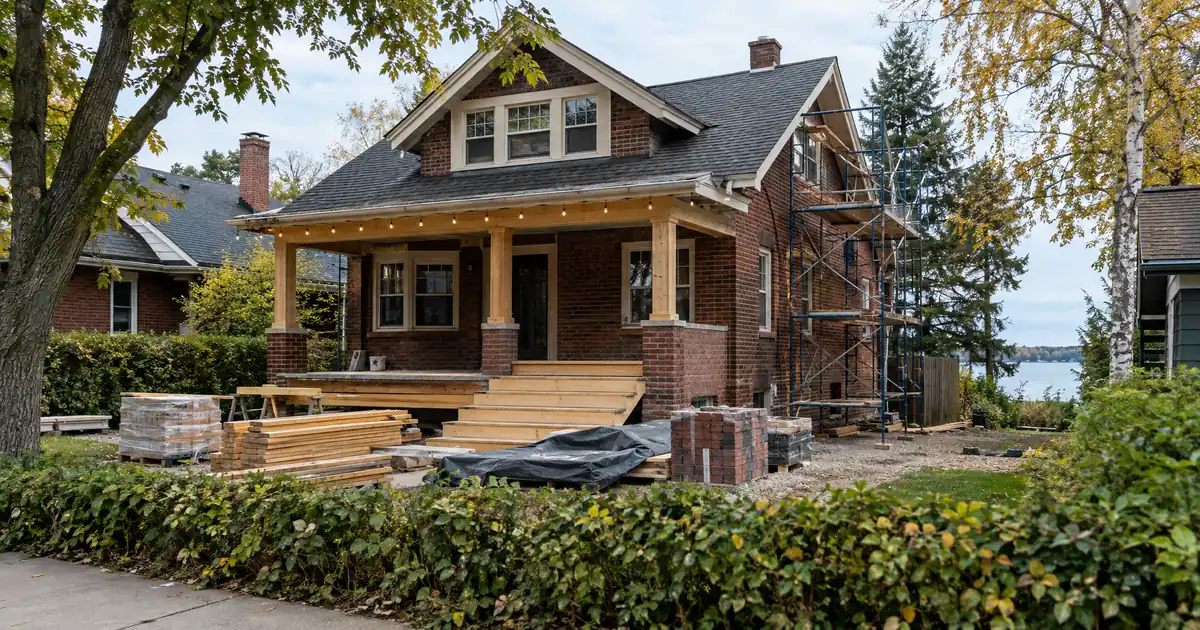
The Quick Read: The exit works by replacing short-term, interest-only bridge debt with a long-term DSCR loan that must clear three separate tests (seasoning, appraised value against the leverage cap, and rent coverage), so the plan has to start before the bridge matures, not after the rehab ends.
- The usual exit for a rental is a DSCR loan, which qualifies primarily on property-level rental income covering the payment, subject to lender guidelines.
- Hard money terms run 6 to 18 months, interest-only, so the maturity date sets the whole calendar.
- A payoff-only refinance returns no cash. Any cash back makes it a cash-out, and the stricter rules apply.
- The new lender’s appraisal sizes the loan. Your after-repair estimate does not.
- Wisconsin sets statutory payoff-statement and lien-release duties that title will work through at the exit.
Key Terms Defined
Payoff-only (rate-and-term) refinance: a new loan that covers the old balance and closing costs, with no cash returned to the borrower.
Cash-out refinance: a new loan that returns any cash to the borrower after paying off the old debt.
Seasoning: the ownership period a lender wants to see, measured from the recorded deed, before it sizes a loan on appraised value.
DSCR: monthly rent divided by the monthly principal, interest, taxes, insurance and any HOA dues.
ARV: your estimate of value after repairs. The new lender’s appraisal is the number that counts.
Maturity: the date the hard money balance comes due in full.
DSCR Cash-Out Calculator
Run the cash-out numbers in Wisconsin
Rate source: Freddie Mac 30-yr average via FRED® — Federal Reserve Bank of St. Louis · effective Oct 15, 2026
Prefilled with starting assumptions — enter your property’s value, balance, taxes, and insurance for a more accurate picture.
Program parameters update from Lendmire’s centralized guideline source. Taxes and insurance are editable estimates.
As of Oct 15, 2026 · General Freddie Mac market benchmark, not a Lendmire loan offer. Property value, balance, taxes, and insurance are editable estimates. Maximum loan-to-value varies by lender, program, property type, and seasoning. Not a Loan Estimate, approval, or commitment to lend. Program availability and eligibility are subject to lender guidelines, credit approval, property review, and underwriting.
What the Exit Actually Swaps
A hard money loan is interest-only debt sized on project cost and the after-repair plan. The long-term loan that replaces it is amortizing debt sized on the property’s appraised value and its rent. Those are different underwriting questions, which is why a clean rehab can still produce a messy exit.
Hard money sizing varies by lender, property, and experience. Fix-and-flip programs commonly fund a share of project cost, with the loan capped at 75% of after-repair value. The DSCR cash-out on an investment property tops out at 75% of value across the network. The two caps sit close together. A rehab funded near the top of the hard money range leaves little cushion if the appraisal lands below your ARV.
Many investors exit through long-term DSCR financing once the property is stabilized. Lendmire arranges that path through select lenders in its wholesale network, and the hard money exit refinance program page covers how it is set up.
Your Exit Options at a Glance
Most files end in one of five places. Which one fits depends on whether the property is finished, leased and valued where you planned.
| Exit | Best for | What must be true | Main risk |
|---|---|---|---|
| DSCR payoff-only | Stabilized rental, no cash needed | Rent covers payment; value clears payoff | Equity stays trapped |
| DSCR cash-out | Seasoned, leased rental | About 6 months from deed; 75% cap | Low appraisal shrinks loan |
| Extension | Seasoning not yet met | Lender agrees to terms | Fee plus added carry |
| Sale | Thin coverage or low value | Buyer at a workable price | Gives up the hold |
| Other private capital | Rehab unfinished | New lender accepts the plan | Same maturity pressure |
The comparison that matters is simple. Does the extra cash from waiting beat the extension fee plus the added carry? If it does not, the payoff-only exit or a sale usually wins.
Working Backward From Maturity
Count back from the maturity date, not forward from the end of the rehab. The exit is a calendar problem before it is a pricing problem.
1. Pin down the maturity and any extension terms. Read the note. Know the extension fee, what triggers it, and whether the lender will grant one.
2. Classify the exit. If the new loan covers only the payoff and closing costs, it is payoff-only. If any cash returns to you, it is a cash-out.
3. Confirm seasoning from the recorded deed. Rehab completion, lease signing and payoff do not start the clock. The deed does.
4. Get the lease in place. The signed lease, the deposit and proof of the first month’s rent support the rent schedule the appraiser prepares.
5. Order the payoff statement and clear title. Wisconsin has statutory rules for this step, covered below.
6. Assemble the exit file before the application goes in, so the lender reviews a complete package.
7. Compare payoff-only against cash-out once the appraisal is in, using the real value rather than the ARV.
Seasoning, Value and Rent: Three Separate Tests
The new loan has to clear all three. Passing one does not carry the others.
Seasoning. Across the network, cash-out refinances typically want about 6 months of ownership measured from title recording. That is lender policy, not law. Inside the window, many lenders size the loan on cost basis, meaning the purchase price plus documented rehab. After it, they size on appraised value. Retitling between entities can disturb the count, so a deed moved into an LLC mid-project is worth a conversation before you apply. Loans to LLC-titled entities are available subject to lender program eligibility.
Value. On an investment property, the DSCR cash-out ceiling is 75% of appraised value. A rate-and-term refinance with no cash back can reach up to 85% of value, subject to lender guidelines. The appraiser, not you, sets the value in that equation.
Rent. The appraisal includes a rent schedule. On a single-family home that is Form 1007. On a 2-4 unit property it is Form 1025. Rent is then divided by the full monthly obligation. On a DSCR loan, 1.00 is where select programs start, and stronger ratios open better pricing and leverage. A separate select-lender path goes below 1.00, with leverage and terms adjusted.
One caution. Clearing 1.00 is not the same as positive cash flow. The calculation compares rent to the payment only. Repairs, vacancy, management, utilities and capex sit outside it.
Credit and reserves matter too. A 620 floor exists in parts of the network, most programs want about 660, and 700 or more unlocks the strongest leverage tiers. Reserves commonly run about 6 months of PITIA, and about 9 months on larger loans above $1,500,000. Standard programs go up to $3,000,000. All of this is subject to lender guidelines, and none of it is a commitment to lend. DSCR is not offered on manufactured homes, log homes or barndominiums.
A Worked Example in Ratios
These are modeled assumptions, not market data. The example uses percentages and ratios only.
Say a rehabbed single-family rental was bought with a hard money loan, and the investor planned around an ARV. Two outcomes follow.
Passing case. The appraisal lands near the ARV. The investor wants payoff only. The payoff plus closing costs sits well inside the rate-and-term ceiling of up to 85% of value, rent coverage clears 1.00, and the DSCR loan pays off the bridge. No cash returns, and the equity stays in the property.
Appraisal-miss case. The appraisal comes in 10% under the ARV. A cash-out is capped at 75% of the lower number, so the shortfall cuts the loan by 75 cents for every dollar of value lost. If the hard money balance was sized near the top of the lender’s range, the new loan may no longer cover the payoff. The options are then a payoff-only structure, bringing cash to closing, an extension, or a sale.
The lesson is to build the ARV from sold comps rather than hope. A conservative number protects the exit.
Wisconsin Payoff and Lien Release Mechanics
Wisconsin is one illustration of how payoff and lien release work. Other states set different deadlines and penalties, and a Wisconsin title company or attorney should confirm the specifics on your file.
A borrower, or an authorized agent such as the title company, can request a payoff statement from the secured creditor. On residential property, the creditor may not qualify the payoff amount as subject to change before the payoff date. The statute’s text, as reproduced by Justia, requires the creditor to issue the statement within a set period after an effective request on residential property, and a Wisconsin title company or attorney can confirm how that timing applies to your file.
After full payment, the creditor must submit a satisfaction for recording within the period the statute sets. Under Wisconsin Statutes §708.15, failing to do so carries a monetary penalty plus actual damages and reasonable attorney fees. A Wisconsin law firm’s summary of the same law describes the same recording deadline and penalty.
The practical point: the lien does not vanish at the closing table. Someone has to record the satisfaction, and title should track it until it records.
Contractor liens are a separate issue on a rehab exit. Wisconsin’s construction lien chapter sets notice and filing rules for contractors. An unreleased contractor lien can complicate title, so have title confirm there are none before the new lender reviews the file.
Where the Rule Breaks
A financed purchase does not get an immediate cash-out. Rules that let an all-cash buyer pull cash out right away generally do not fit a purchase financed with hard money. DSCR seasoning is set by the lender’s own policy, not by those rules.
The bridge matures before seasoning clears. The choices are a payoff-only exit, an extension, a cost-basis refinance or a sale. Price each one against the cost of waiting.
A low appraisal shrinks the loan. Value and rent are separate tests. Strong rent does not rescue a value shortfall.
Do not count on the hard money lender as the takeout. Some pause or change their own long-term programs. Line up the DSCR exit separately.
An unfinished rehab. A lender generally wants a finished, leasable property. If the work is not done, the exit is not ready, and that is an extension conversation, not a refinance application.
Entity changes. A property moved between entities can restart the lender’s thinking on seasoning. Document the chain of title.
If the Exit Falls Short
When the numbers do not work, the fallback order is usually the same.
1. Ask for an extension if the lender will grant one and the added carry is smaller than the benefit of waiting.
2. Switch to a payoff-only structure if the cash-out math fails but the bridge balance still fits under the leverage cap.
3. Bring cash to closing to cover a value or coverage gap.
4. Sell, or bring in an equity partner or a private lender to carry the note.
Coverage below 1.00 is a different path, not a lower bar on the same program. It is available through select lenders in the network, with leverage and terms adjusted. Related reading: Lendmire’s piece on whether a hard money loan can refinance a property covers the DSCR conversion side in more depth.
The Exit File
Gather these before the application goes in. They are what the lender needs to see.
| Document | Why it is needed |
|---|---|
| Purchase settlement statement | Proves cost basis and deed date |
| Hard money note and payoff statement | Shows the balance being retired |
| Lien release or satisfaction | Confirms the old lien is cleared |
| Rehab scope, invoices, draw history | Documents cost basis inside seasoning |
| Signed lease, deposit, first rent | Supports the rent schedule |
Documenting construction funds on the settlement statement helps when you refinance them out. Entity documents also belong in the file if the property is held in an LLC.
Mistakes That Derail the Exit
The common ones are predictable. Investors build the plan on an ARV rather than a sold-comp value. They assume seasoning starts when the rehab ends or the tenant signs, when it starts at the recorded deed. They treat payoff-only and cash-out as the same thing. They clear the rent test and assume the loan works, when value is a separate gate. And they start the process too close to maturity, when the carry cost of delay builds fast.
Tax treatment can depend on how the funds are used and how the property is held; investors should keep clear records and speak with a qualified tax professional before relying on any deduction.
Frequently Asked Questions
Can I refinance a hard money loan in Wisconsin?
Yes, if the property is finished, leased and valued high enough. Hard money loans are short-term bridge debt, and a DSCR loan is the common long-term replacement for a rental, subject to lender guidelines. Wisconsin adds statutory payoff and lien-release duties that title will handle.
Do I need the rehab finished?
Generally yes. The lender wants a leasable property with a rent schedule behind it. An unfinished rehab usually points to an extension rather than a refinance application.
What if my appraisal comes in low?
The loan shrinks, because the leverage cap applies to the appraised value, not your ARV. The options are a payoff-only structure, bringing cash, an extension or a sale. A cash-out is capped at 75% of value on an investment property.
Can an LLC refinance out of hard money?
Often yes, subject to lender program eligibility. Keep the entity documents in the file, and watch for retitling, which can disturb the seasoning count measured from the recorded deed.
Should I refinance or sell?
It depends on coverage, value and what you want to hold. If rent comfortably covers the monthly obligation and the appraisal supports the payoff, refinancing keeps the asset. If coverage is thin or value is short, selling can be cleaner than carrying an extension.
Next Step
If you are buying or refinancing a rental property and want to see how the numbers work, Lendmire can help you compare DSCR loan options based on the property income, credit profile, leverage, and investor goals. Call 828-256-2183 or request a quote. The complete DSCR loans guide covers the program basics.
A hard money exit rewards the investor who plans the takeout at purchase, not at maturity.
For current guidelines and terms, see Lendmire’s DSCR loan programs page.
About Lendmire
Lendmire (NMLS# 2371349), a non-QM mortgage broker serving investors in 41 markets including Washington, D.C., helps structure DSCR scenarios commonly evaluated around a property’s rental income rather than personal income paperwork, subject to lender guidelines. A Scotsman Guide Top Mortgage Workplace in 2025 and 2026, Lendmire places loans through wholesale investor lenders and is not a direct lender.
Get Started
Ready to find the right loan for you?
In about 30 seconds you can review financing options available for your investment property. No commitment required.
Informational only. Not a Loan Estimate, approval, or commitment to lend. Program availability and eligibility are subject to lender guidelines, credit approval, property review, and underwriting.
References
1. Wisconsin Statutes §708.15 on Justia (payoff statement timing)
2. Wisconsin Statutes §708.15 (satisfaction recording duty and penalty)
3. Axley law firm: Mortgage Satisfaction Act summary
4. Wisconsin Statutes Chapter 779 (construction liens)
This article is part of Lendmire’s hard money loan program — full qualification details, guidelines, and scenarios live on the program page.
Related reading: How a 40-Year DSCR Loan Works in an LLC · How to Refinance LLC-Held Airbnbs Into One Portfolio DSCR Loan · Interest-Only DSCR Loan vs Rate-and-Term Investment Refinance
Guides: Hard Money Loans in Wisconsin
Brandon Miller
Founder & CEO, Mortgage Loan Originator, Lendmire LLC
- Mortgage Loan Originator · NMLS# 1129696 · Verify on NMLS Consumer Access
- North Carolina Real Estate Broker · License# 343312 · Verify on NCREC
- North Carolina Insurance Producer · License# 19053198 · Property, Casualty, Life, Health · Verify on NAIC SBS
- Lendmire LLC · Firm NMLS# 2371349 · Verify firm licensure
Disclosure information. Lendmire is a state-licensed mortgage brokerage under NMLS# 2371349. Lendmire is not a depository institution, direct lender, or financial advisor — all loans referenced are placed through wholesale lender partners and are subject to each lender's underwriting standards. This article is provided for general informational purposes and is not a commitment to lend, nor does it constitute financial, legal, or tax advice. Loan programs, terms, rates, and qualification standards change without notice and depend on borrower profile, property type, and the state in which the subject property is located. Equal Housing Opportunity provider. NMLS Consumer Access: nmlsconsumeraccess.org.