
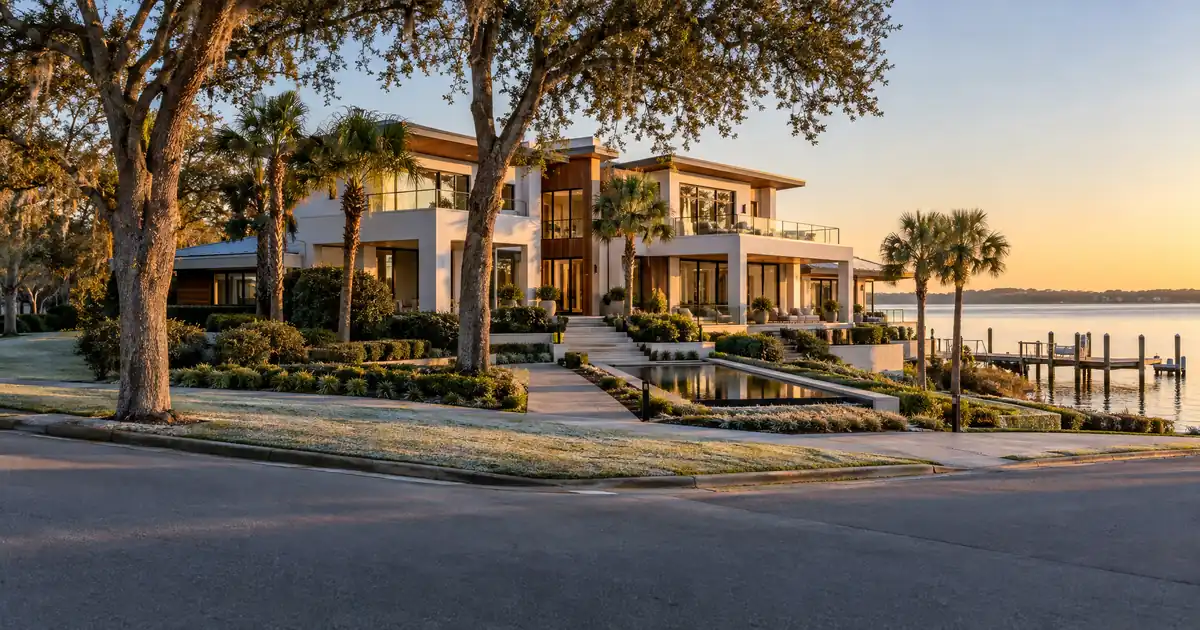
The Quick Read: It can count, but only when the pool house is a legal dwelling and the appraisal supports a rent line for it. A permitted unit with its own kitchen, bath and sleeping area can add to the income side of the coverage ratio. An unpermitted, kitchenless or purely recreational structure is usually left out, and collected rent does not change that.
- Legal use comes first: permit, final inspection, and zoning that allows a rental.
- The appraiser’s classification and rent schedule drive the number, not the lease alone.
- Above $2,000,000, two appraisals give a second check on that call.
- Short-term rental income on a pool house stops at $2,000,000 loan size.
- Owner occupancy of either structure takes the file out of a business-purpose investor loan.
Nobody writes a rule about pool houses. The label is marketing. What matters is what the structure is in law and on the appraisal.
DSCR Calculator
Run the numbers in your market
Rate source: Freddie Mac 30-yr average via FRED® — Federal Reserve Bank of St. Louis · effective Oct 15, 2026
Prefilled with starting assumptions — enter your own rent or nightly figures, taxes, insurance, and HOA for a more accurate picture.
Program parameters update from Lendmire’s centralized guideline source. Taxes and insurance are editable estimates.
As of Oct 15, 2026 · General Freddie Mac market benchmark, not a Lendmire loan offer. Rent, nightly rate, occupancy, taxes, and insurance are editable estimates. Short-term rental figures are estimates only and vary significantly by season, property type, management approach, and local short-term-rental rules — confirm local regulations before relying on them. Qualifying income for short-term rentals varies by program — some use appraisal market rent, others use documented STR history or projections — and is confirmed in underwriting. Not a Loan Estimate, approval, or commitment to lend. Program availability and eligibility are subject to lender guidelines, credit approval, property review, and underwriting.
Four Things “Count” Can Mean
Four different questions hide inside the word “count.” Mixing them up is where most pool-house files go sideways.
| Question | Pool house answer |
|---|---|
| Living-area square footage | Usually no, if detached |
| Appraised value | Valued separately as an outbuilding or unit |
| Rental income | Only if legal and supported |
| Unit count | Depends on appraiser classification |
A pool house can add value without adding rent. It can add rent on a lease without adding any qualifying income. Treat these as separate decisions, because lenders do.
Pool House vs. ADU vs. Guest House
Casita, guest house and pool house are all labels. Underwriters look at function. Does the structure have a kitchen, a full bath, a sleeping area, its own entrance, and a permit as a dwelling? Then it behaves like a second unit. Does it have a wet bar and a half bath, used for parties? Then it is accessory space.
For context on what a dwelling means in the wider market, Fannie Mae’s Selling Guide defines an accessory dwelling unit as extra living area, possibly detached, with living, sleeping, cooking and bathroom facilities on the same parcel as the main home. That is an agency definition and does not govern DSCR files. It is useful only because it matches how most appraisers think about what makes a structure a unit.
| Feature | Pool house as accessory space | Pool house as a unit |
|---|---|---|
| Kitchen | None or wet bar | Full kitchen |
| Bath | Half bath or none | Full bath |
| Permit | Often not as a dwelling | Permitted as a dwelling |
| Likely treatment | No separate rent | Possible rent line |
Finishing a pool house with a kitchenette or HVAC does not settle it. A permit for dwelling use does.
The Income Test: Lease or Appraiser’s Rent?
Qualifying income is generally not the rent you collect. It is the appraiser’s market rent or an eligible lease figure, depending on the program. Across the wholesale network, most programs lean on the appraisal’s rent schedule, and a few will weigh a lease against it. That varies by lender and by file.
The appraisal forms matter here. A one-unit investment property gets a rent schedule on Form 1007, which Fannie Mae’s appraisal forms page describes for one-unit properties using rent to qualify. A two-to-four unit property is reported unit by unit on Form 1025. A main house plus a legal rentable second dwelling may be reported as two units. Whether it is a 1007 with an added line or a 1025 depends on how the appraiser classifies the structure.
Here is the catch. If the appraisal, the listing and the lease describe the pool house three different ways, the income tends to get ignored. Consistency across documents is worth more than a higher rent number.
The Legal-Use Gate
Run this checklist before ordering the appraisal:
- Building permit and final inspection or certificate of occupancy for dwelling use.
- Zoning and any rental registration that allows a second rental unit.
- Lease and payment history, if already rented.
- Separate utility or meter setup, where it exists.
- An insurance policy that reflects how the structure is actually used.
- HOA or deed restrictions that limit a separate rental.
An unpermitted structure is likely to be excluded from both value and rental income, or it brings conditions. Programs vary by lender overlay and local legal status. Counting on unpermitted income is a bet that the file survives review, and it often does not. Resolve legal status first, so appraisal fees are not wasted on a structure that gets left out.
Manufactured-style or barndominium-type structures are a separate problem. Several lenders in the network do not offer those construction types, so a prefab pool house deserves an early check.
Worked Example: Three Cases, Modeled Ratios
These are modeled assumptions, not market data. Take one luxury rental where the main house alone covers the full monthly obligation at about 0.95x.
1. Pool house ignored. The appraisal gives no separate rent. Coverage stays near 0.95x. On a standard path that sits below the 1.00 benchmark that earns full leverage.
2. Pool house counted via the appraisal. The appraiser classifies it as a legal unit and reports rent for it. Coverage lifts toward 1.10x. That clears the 1.00 benchmark.
3. Pool house on a lease only. The tenant pays, but the appraisal gives no rent line. Most programs will not credit it. Coverage stays near 0.95x.
Coverage below 1.00 is a real path through select programs to $2,000,000 at reduced leverage, with LTV and terms adjusting, subject to underwriting. Above that size, the working test is 1.00x. The fix then is more cash in or a smaller loan.
What Changes at Super Jumbo Size
The loan size does not redefine what counts as income. A legal unit is a legal unit at any balance. What changes is how much margin the file has for being wrong.
Across the network, the standard program stops at $3,000,000, and the super jumbo ladder carries qualified investors up to $10,000,000. Leverage steps down as size rises: on a purchase, typically 80% to $1,000,000, 75% to $3,000,000, 65% to $4,000,000, and 60% above that on review. Cash-out runs lower and stops above $3,000,000. The credit floor is 660 on loans to $3,000,000 and 700 above it. Reserves are typically 6 months on the subject property. All of it is subject to underwriting.
Two appraisals above $2,000,000 matter for a pool house. Each carries a value opinion and a rent schedule, and the lower value commonly governs loan size. Two appraisers can classify the same structure differently. If one counts the pool house as a unit and the other does not, expect the file to be reviewed against the more conservative read.
For reference, the conforming loan limit for one-unit properties is set annually, with a baseline limit and a higher ceiling in high-cost areas. That is the conventional-world line for “jumbo.” Super jumbo has no legal definition. Lenders set their own, and $3,000,000 is a common marker.
For how the program fits together, see the complete DSCR loans guide.
Rented Short-Term? Different Rules
A pool house on a short-term rental runs into three limits. Short-term-rental files cap at $2,000,000 in loan size. Income is typically 80% of gross, built on twelve months of operating history on a refinance or the appraisal’s short-term-rent analysis on a purchase. And coverage must be 1.00 or higher. Form 1007 documents monthly rent rather than nightly rent, as McKissock’s appraisal education explains, and the lender decides how short-term income is used.
So a short-term pool house on a $3,000,000-plus loan cannot lean on that income at that size. Municipal permission to operate must also be documented for the specific property. Short-term rental rules can vary by city, county, HOA, and property type, so investors should confirm local rules before relying on projected rental income.
DSCR vs. conventional financing
There are two common ways to finance an investment property, and they qualify you differently — here’s how investors weigh them.
Why investors choose it
- Qualifies on the property’s rental income — no personal tax returns, W-2s, or pay stubs needed to document income.
- No personal debt-to-income ceiling to clear, so existing mortgages and obligations don’t cap your borrowing the same way.
- Can be closed in an LLC, keeping the property inside a business entity.
- Built for scaling — not held to the limit on number of financed properties that conventional financing applies.
- Underwriting centers on the deal: generally qualifies when the rent covers the payment, a 1.00x coverage ratio being a common baseline (confirmed in underwriting).
- Designed specifically for investment property, including long-term and, where the program allows, short-term rentals.
Where it’s strong
- Often the lowest ongoing financing cost for a buyer who fully qualifies on personal income — a fit for a first property or a cost-first purchase.
Trade-offs for investors
- Requires full personal income documentation and must fit within a debt-to-income limit — salary, existing debts, and other mortgages all count.
- Typically held in your personal name rather than a business entity.
- Caps how many financed properties you can carry, which can become a ceiling as a portfolio grows.
- Evaluates you as a borrower as much as the property, which usually means more paperwork.
How investors usually choose: a first or single property often optimizes for the lowest financing cost; portfolio builders often optimize for leverage, vesting in an LLC, and scaling past conventional caps. The right answer depends on your goals, the property, and current guidelines — both paths run through select lenders in Lendmire’s wholesale network, with eligibility and terms confirmed in underwriting.
Owner Occupancy Ends the Conversation
If the borrower lives in the main house or the pool house, that is occupancy. A business-purpose DSCR loan is built for non-owner-occupied investment properties, and living in one structure while renting the other does not fit. Owner-occupied property is ineligible.
If the Pool House Does Not Count
Run the file on the main house alone. That is the clean test, and it is what an excluded structure leaves anyway. Then pick the fix that fits:
- Cure the permit and re-run the appraisal, if the local process allows it.
- Put more cash down or take a smaller loan to bring leverage in line.
- Below $2,000,000, look at the sub-1.00 path through select programs, with reduced leverage.
- Consider interest-only, which runs up to 120 months at 75% maximum and is reviewed on interest, taxes and insurance, subject to underwriting.
- Choose a different loan lane if the property cannot meet the 1.00x test above $2,000,000.
Agency rules are a different regime. FHA guidelines set their own ADU rent documentation protocols for agency loans. Those protocols do not govern DSCR files, and nobody should read them as if they did.
Two related reads: Lendmire’s piece Luxury vs Workforce Pool on Super Jumbo DSCR for an Owner Selling One and its explanation of how reserves work on a trust-held super jumbo DSCR pool. (Note that “pool” in Lendmire’s portfolio content means a loan pool, not a swimming pool.)
Key Terms Defined
DSCR: The ratio of a property’s monthly rent to its full monthly obligation: principal, interest, taxes, insurance and any HOA dues.
Rent schedule: The appraiser’s opinion of market rent, reported on Form 1007 for one unit or Form 1025 for two to four units.
Accessory dwelling unit (ADU): A second living space on the same parcel with its own kitchen, bath and sleeping area.
Legal use: The structure’s permitted status under local zoning and building rules.
Super jumbo: A market label for very large loans. It has no legal definition.
Frequently Asked Questions
Can a pool house with no kitchen add rental income?
Almost never. Without a kitchen it is typically treated as accessory space, so no separate rent is credited. The main house carries the ratio.
Does my actual lease on the pool house set the income?
Not by itself. Qualifying income is generally the appraiser’s market rent or an eligible lease figure, depending on the program. Some lenders in the network will weigh a lease against a lower appraisal figure, but many use the appraisal alone.
Why do two appraisals matter for a pool house?
Above $2,000,000, two appraisals are required, and the lower value commonly governs loan size. Each carries its own rent schedule. If the appraisers classify the structure differently, expect the more conservative read to drive the review.
Can an unpermitted pool house still help the file?
It is more likely to be left out of income and value, or to bring conditions. Programs vary by lender overlay and local legal-use status. Sorting out the permit before ordering appraisals is the safer sequence.
Does a larger loan loosen these rules?
No. Leverage steps down and credit floors tighten as the balance rises. A legal unit counts the same at any size, and the sub-1.00 paths stop at $2,000,000.
If you are buying or refinancing a high-balance rental property and want to see how the numbers work, Lendmire can help you compare super jumbo DSCR loan options based on the property income, the loan balance, credit profile, leverage, and investor goals. Lendmire is a broker arranging business-purpose financing in 41 markets, including Washington, D.C., and every program figure here is subject to underwriting and is not a commitment to lend.
Tax treatment varies; consult a qualified professional.
Lendmire’s self-employed mortgages page presents both super jumbo programs, bank statement and DSCR, side by side.
About Lendmire
Lendmire (NMLS# 2371349), a non-QM mortgage broker serving investors in 41 markets including Washington, D.C., helps structure DSCR scenarios commonly evaluated around a property’s rental income rather than personal income paperwork, subject to lender guidelines. A Scotsman Guide Top Mortgage Workplace in 2025 and 2026, Lendmire places loans through wholesale investor lenders and is not a direct lender.
Get Started
Ready to find the right loan for you?
In about 30 seconds you can review financing options available for your investment property. No commitment required.
Informational only. Not a Loan Estimate, approval, or commitment to lend. Program availability and eligibility are subject to lender guidelines, credit approval, property review, and underwriting.
References
1. Fannie Mae Selling Guide B2-3-04, Special Property Eligibility Considerations
2. Fannie Mae’s appraisal forms page
3. McKissock, Form 1007 and Short-Term Rental Appraisals
This article is part of Lendmire’s super jumbo DSCR loan program — full qualification details, guidelines, and scenarios live on the program page.
Related reading: How to Refinance 5 to 50 Doors in LLCs on a Super Jumbo DSCR Loan · How to Prepare a Trust-Held Rental Pool for a Super Jumbo DSCR Loan · Is a Non-Recourse Super Jumbo DSCR Loan Available for a Rental Pool?
Brandon Miller
Founder & CEO, Mortgage Loan Originator, Lendmire LLC
- Mortgage Loan Originator · NMLS# 1129696 · Verify on NMLS Consumer Access
- North Carolina Real Estate Broker · License# 343312 · Verify on NCREC
- North Carolina Insurance Producer · License# 19053198 · Property, Casualty, Life, Health · Verify on NAIC SBS
- Lendmire LLC · Firm NMLS# 2371349 · Verify firm licensure
Compliance and disclosures. Lendmire (NMLS# 2371349) is a licensed mortgage broker and is not a direct lender, depository institution, financial advisor, or tax professional. Content in this article is general market analysis and educational information — not financial, legal, or tax advice for any specific situation. Lendmire does not guarantee loan approval; every transaction is subject to underwriting by the funding lender. Mortgage pricing and loan program guidelines are subject to change at any time without notice and vary by borrower characteristics, property type, and state regulations. Lendmire complies with Equal Housing Opportunity. Licensure verification: NMLS Consumer Access.