
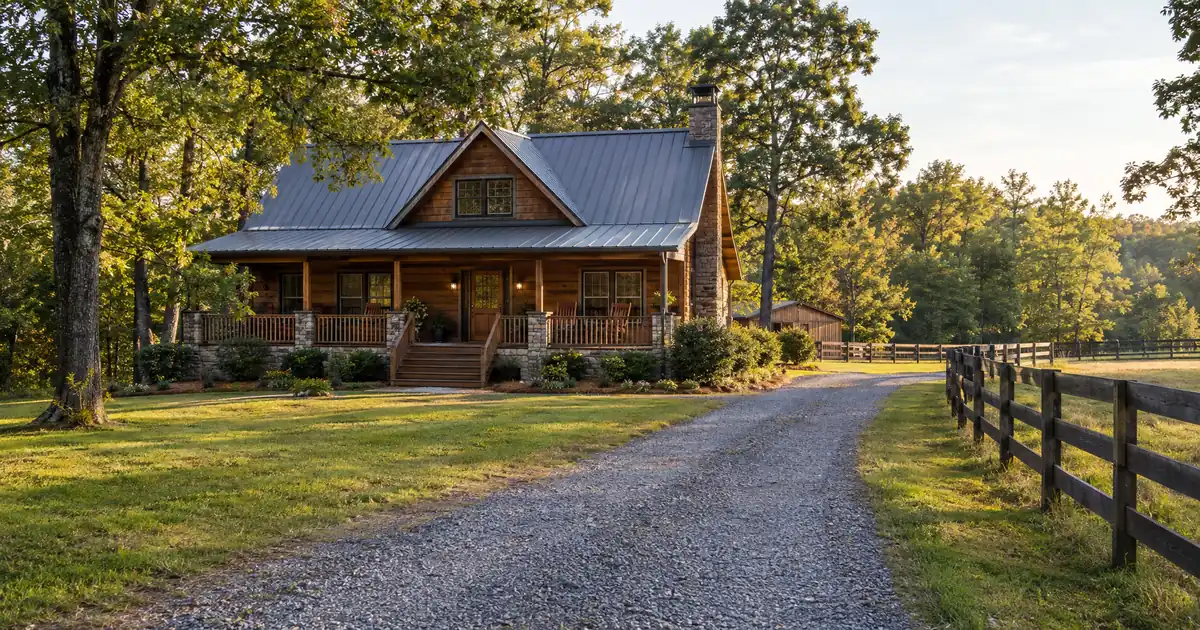
The Quick Read: A DSCR cash-out refinance on a rental house sitting on acreage can work, but three tests set the loan size: whether the property type and land fit the program, what the appraiser says the house and usable land are worth, and whether market rent covers the full payment on the new, larger loan. Rural is a label lenders weigh, not an automatic no.
- Cash-out on a standard investment rental typically tops out around 75% LTV, with about 6 months of ownership measured from title recording.
- The lender’s appraisal sets the value. Your purchase price and your own estimate do not, and land beyond a program’s acreage limit is often left out of that value.
- A 1.00 coverage ratio is where select programs start. Stronger coverage can open better pricing and leverage.
- Working farms, ranches, orchards, manufactured homes, log homes, and barndominiums are not offered through the network’s DSCR programs.
- Thin rental and sales comparables are the biggest practical risk on rural files.
What Counts as a Rural Rental With Acreage?
No single national definition exists. “Rural” is a lender judgment built from what the appraisal shows, and each program sets its own acreage limit. Across the wholesale network Lendmire works with, the label matters less than two questions. Are there enough comparable sales and rentals to support the numbers? Does the property look like a house that rents, or like a farm?
DSCR Cash-Out Calculator
Run the cash-out numbers in your market
Rate source: Freddie Mac 30-yr average via FRED® — Federal Reserve Bank of St. Louis · effective Oct 8, 2026
Prefilled with starting assumptions — enter your property’s value, balance, taxes, and insurance for a more accurate picture.
Program parameters update from Lendmire’s centralized guideline source. Taxes and insurance are editable estimates.
As of Oct 8, 2026 · General Freddie Mac market benchmark, not a Lendmire loan offer. Property value, balance, taxes, and insurance are editable estimates. Maximum loan-to-value varies by lender, program, property type, and seasoning. Not a Loan Estimate, approval, or commitment to lend. Program availability and eligibility are subject to lender guidelines, credit approval, property review, and underwriting.
Lenders read the appraisal for specific signals. These are the usual ones:
| Signal | Why it matters | What you can do |
|---|---|---|
| Few nearby sales comps | Value is harder to support | Ask for a wider comp radius |
| Far from town amenities | Weaker rental demand evidence | Document tenant demand |
| Open land or farms nearby | Can trip built-up area tests | Check program rules first |
| Unpaved or private road | Access and condition questions | Confirm easements and upkeep |
| Small-town location | May trigger rural overlays | Ask the program’s definition |
| Barns or agricultural use | Can make property ineligible | Disclose early |
None of these automatically disqualifies a file by itself. Several together, with sparse comps, make a lender cautious. Plenty of rural houses on a few acres qualify every year, because a well-supported appraisal and a clean lease carry the file.
How Does Underwriting Treat the File, Step by Step?
Underwriting runs in a fixed order. DSCR loans are designed for non-owner-occupied investment properties. Because they are business-purpose investor loans, they are reviewed differently from a standard owner-occupied mortgage. Qualification rests primarily on property-level rental income covering the payment, subject to lender guidelines. Here is the sequence.
1. Screen eligibility. The lender checks property type, acreage against the program limit, and how built-up the surrounding area is. Outbuildings or agricultural use can push a property toward ineligible, even when the house alone would support the rent.
2. Order a full appraisal. Rural ZIP codes and large lots usually rule out automated valuation shortcuts. Expect a full appraisal with a rent opinion.
3. Let value set the ceiling. Appraised value times the cash-out LTV cap gives the maximum loan. Excess acreage is often excluded from the value, which lowers the number the cap applies to.
4. Let rent set coverage. The appraiser’s market-rent opinion is the numerator. For a one-unit house, the appraiser typically completes a single-family comparable rent schedule, known as Form 1007. A two-to-four-unit property uses the companion income form, Form 1025. These are appraisal forms only. They do not bring agency loan rules into a DSCR file.
5. Run the coverage test. Rent used for lender review is divided by the full payment: principal, interest, taxes, insurance, and any HOA dues. Management, repairs, utilities, and vacancy are not deducted.
6. Gather the rest of the file. That means ownership history, entity documents, title vesting, insurance, and reserves. When the title is held in an LLC, that works subject to lender program eligibility.
7. Take the lowest limit. The final loan is the smallest of what value, coverage, and the program’s loan-size rules allow. Cash out is the new loan minus the payoff, closing costs, and any prepayment charge.
That last point trips up borrowers. Passing the coverage test does not mean the loan is large enough to pay you anything. Value usually binds first on rural parcels.
One more clarification on the coverage test. Clearing 1.00 does not mean the property produces positive cash flow. The ratio compares rent to PITIA only. Repairs, vacancy, management, utilities, and capital expenses sit outside it, and a rural house with a well, septic system, and long driveway tends to carry a few of those.
What Are the Core Cash-Out Requirements?
On a standard rental, the network’s cash-out programs typically look like the table below. Ranges are guidance from select lenders, not commitments to lend, and each file is underwritten individually. The right column shows how a rural or acreage property tends to push on each requirement.
| Requirement | Typical range | Rural or acreage effect |
|---|---|---|
| Cash-out LTV, standard rental | Up to about 75% | Land excluded from value shrinks the base |
| Cash-out LTV, short-term rental | Up to about 70% | Same, with thinner rent evidence |
| Seasoning | About 6 months from title recording | Inherited land needs a title review |
| Coverage | 1.00 is where select programs start | Thin rent comps make ratio harder to prove |
| Credit score | 620 floor; most want about 660; 700+ for top tiers | Rural overlays may lean on higher scores |
| Reserves | About 6 months PITIA; about 9 above $1,500,000 | Larger rural loans reach the higher tier |
| Loan size | Up to $3,000,000 on standard programs | Rarely the constraint on a rural parcel |
Two notes on the coverage row. First, 1.00 is a floor for specific programs, not a universal standard. A separate path through select lenders in the network takes coverage below 1.00, with leverage and terms adjusted. Second, coverage above 1.00 can improve pricing and leverage, which helps when the appraisal is already pulling proceeds down.
The usual term structure is a 30-year fixed. Select lenders add extended terms and interest-only periods, and ARM structures exist for investors who want them. Above $2,500,000, the network generally holds to 30-year fixed structures. For a plain walkthrough of the credit and equity side, Lendmire’s piece Who Qualifies For A DSCR Cash Out Refinance On A Rental? covers it without the rural overlay. The broader program mechanics are in the complete DSCR loans guide.
How Is Excess Acreage Handled?
Excess acreage usually does not kill a deal. It more often gets carved out of the appraised value. If the property sits above a program’s acreage limit, the file typically goes one of three ways. The appraiser values only the house and a limited home site. A different program that allows larger lots reviews the file case by case. Or you split the land off before applying, if that is feasible where the property sits.
Each path costs something. A carve-out cuts the value the 75% cap applies to. A case-by-case review may bring lower leverage or tighter terms. A lot split takes time and surveying, and it changes what you own.
Acreage limits vary by program, so ask for the specific limit before you order anything. Also confirm which acres count. Check the deed, the county tax record, and any survey. A separate adjacent parcel, road frontage, or an easement can make “the property” mean something different to the lender than it does to you.
Seasoning gets odd on land. The ownership clock for cash-out runs from title recording. If you inherited the land, bought it in pieces, or held it before the house was built, how and when title was recorded matters. Lender review decides how that history is treated, so gather the recording documents early.
Proving Rent When Comps Are Thin
Rural rent evidence comes from the appraiser’s schedule plus your lease. Start with a signed lease at a market-supported rent. A handshake arrangement, a below-market lease to a relative, or a lease that bundles land use with the house will draw questions. When nearby rentals are rare, the appraiser may reach a wider radius, and a wider radius means less certainty in the number.
You can help the file in three ways. Keep the lease clean, with the tenant, term, rent, and deposit stated. Keep payment records. Gather local listings and recent rentals that show real demand for houses like yours, described by price and lease length rather than by anything about the tenants.
Short-term and seasonal rentals follow different rules. For short-term-rental collateral, cash-out typically tops out at 70% LTV, against 75% for a standard long-term rental. Expect a credit score around 640 or higher, about 12 months of hosting history, and a 1.00 coverage floor on refinances. Rural vacation properties often rent this way, but the income is harder to support in a thin market. Short-term rental rules can vary by city, county, HOA, and property type, so investors should confirm local rules before relying on projected rental income.
Run the Math: A Worked Example
Run the numbers on a modeled rural house. Every input here is an assumption for illustration, not market data. All amounts are shown as a share of the value you expect the appraisal to confirm, which we set at 100.
- Existing loan balance: 55% of expected value.
- Closing costs and any prepayment charge: 2% of expected value.
- Cash-out LTV cap: 75%.
- Modeled rent coverage on the new loan: about 1.15x.
| Scenario | Value used | Max loan | Cash out |
|---|---|---|---|
| Appraisal confirms expectation | 100% | 75.00% | 18.00% |
| Appraisal comes in 10% low | 90% | 67.50% | 10.50% |
| Excess land carved out (15% of value) | 85% | 63.75% | 6.75% |
Max loan and cash out are shown as a share of the originally expected value. In the second row the balance and costs stay put while the value drops, so a 10% appraisal miss cuts the cash out by roughly 42%. The third row shows why the carve-out matters. Land that lenders exclude is value you cannot borrow against.
Coverage can bind too. A larger cash-out loan means a larger payment, so coverage on the new loan is lower than on the old one. If that pushes the ratio below 1.00, the loan amount has to shrink, or the file needs a path built for coverage below 1.00 through select lenders in the network, with leverage and terms adjusted.
Before applying, work backward. Add your payoff and costs, then divide by the LTV cap. That tells you the minimum appraisal that produces any cash out at all. If you would need an appraisal well above what comps suggest, the numbers will not work yet.
Where Does the General Rule Break?
Several rural situations have their own rules.
- Barns and outbuildings. Stables, barns, and agricultural buildings can make a property ineligible, even when the house alone supports the rent. A workshop or detached garage is different from a working agricultural improvement. Disclose both early.
- Working farms, ranches, and orchards. These are generally outside DSCR programs. Renting out pasture, hunting rights, or farm ground alongside the house pushes a file toward a farm classification.
- Second dwellings. A barn apartment or guest cottage changes the property type and the rent evidence. It can change the loan options entirely.
- Property types the network does not offer. Manufactured homes (single- and double-wide), log homes, and barndominiums fall outside these DSCR programs. Some rural properties that look like normal houses at first glance turn out to be one of these, so confirm construction type before spending money on an appraisal.
- Third-party “rural” tags. Some lenders rely on a data vendor’s rural designation rather than their own read of the town. That can tag a file rural even in a sizable town. If a lender flags rural, ask what definition it uses.
- The government rural tool. The CFPB’s rural and underserved areas tool was built for small-creditor exemptions under mortgage rules. Practitioners sometimes use it as a quick reference, but it does not set DSCR eligibility.
Also budget for ordinary rural conditions: private roads, easements, a well, and septic. These show up in the appraisal and sometimes in insurance. Taxes and insurance feed straight into PITIA, and both vary by county and parcel, so get actual quotes before you trust a coverage ratio.
DSCR vs. conventional financing
There are two common ways to finance an investment property, and they qualify you differently — here’s how investors weigh them.
Why investors choose it
- Qualifies on the property’s rental income — no personal tax returns, W-2s, or pay stubs needed to document income.
- No personal debt-to-income ceiling to clear, so existing mortgages and obligations don’t cap your borrowing the same way.
- Can be closed in an LLC, keeping the property inside a business entity.
- Built for scaling — not held to the limit on number of financed properties that conventional financing applies.
- Underwriting centers on the deal: generally qualifies when the rent covers the payment, a 1.00x coverage ratio being a common baseline (confirmed in underwriting).
- Designed specifically for investment property, including long-term and, where the program allows, short-term rentals.
Where it’s strong
- Often the lowest ongoing financing cost for a buyer who fully qualifies on personal income — a fit for a first property or a cost-first purchase.
Trade-offs for investors
- Requires full personal income documentation and must fit within a debt-to-income limit — salary, existing debts, and other mortgages all count.
- Typically held in your personal name rather than a business entity.
- Caps how many financed properties you can carry, which can become a ceiling as a portfolio grows.
- Evaluates you as a borrower as much as the property, which usually means more paperwork.
How investors usually choose: a first or single property often optimizes for the lowest financing cost; portfolio builders often optimize for leverage, vesting in an LLC, and scaling past conventional caps. The right answer depends on your goals, the property, and current guidelines — both paths run through select lenders in Lendmire’s wholesale network, with eligibility and terms confirmed in underwriting.
Pre-Application Self-Test
Run your own parcel through this list before anyone orders an appraisal.
- Is the property a conventionally built house, not a manufactured home, log home, or barndominium?
- Do you know the exact acreage on the deed and tax record?
- Are there barns, stables, or farm buildings, and does anyone farm the land?
- Is there a signed lease at a market-supported rent?
- Have you owned the property for about 6 months from recording?
- Does your credit sit around 660 or higher, with at least 620 as the floor?
- Do you hold roughly 6 months of PITIA in reserves?
- Can you name three recent sales and rentals near the property?
What If Your Parcel Does Not Fit?
You have several options, and the right one depends on which test failed.
If acreage is the problem, ask whether a lot split or a carve-out is feasible, or whether a program that allows larger lots fits your file. If the appraisal is the problem, wait for better comps or improve the property, noting that an improvement may support a higher appraised value, depending on comps and underwriter review. If coverage is the problem, a lower loan amount, a longer term, or an interest-only period through select lenders can help. A sub-1.00 path through select lenders is also possible, with leverage and terms adjusted.
You can also step back and ask whether cash-out is the right tool. A payoff-only refinance is sized differently. Lendmire’s comparison of a variable HELOC vs fixed cash-out on a rental you won’t refinance lays out the tradeoff. Investment-property HELOC lines cap at $500,000 total.
The honest toss-up sits here: a smaller cash-out on a clean file can beat a larger one that depends on a stretched appraisal. The stronger play is usually the one with room to spare on both value and coverage.
Tax treatment can depend on how the funds are used and how the property is held; investors should keep clear records and speak with a qualified tax professional before relying on any deduction.
Key Terms Defined
DSCR (debt service coverage ratio): monthly rent used for lender review divided by the full monthly payment on the loan.
PITIA: principal, interest, taxes, insurance, and association dues, the payment the rent has to cover.
LTV (loan-to-value): the loan amount as a percentage of the appraised value.
Seasoning: the waiting period between buying a property and refinancing it for cash.
Comps: recent sales or rentals of similar nearby properties that an appraiser uses to support value and rent.
Carve-out: excluding excess land from the appraised value so only the house and home site count.
Frequently Asked Questions
What counts as rural for a DSCR loan?
It depends on the program. Lenders judge it from the appraisal, looking at population, distance to amenities, surrounding land use, road access, and how many comps exist. No single national definition applies, so ask the specific program how it defines the term before you apply.
Is there an acreage limit on a DSCR cash-out refinance?
Yes, in most programs, and the limit varies by lender. Land above the limit is often excluded from the appraised value, or the file gets a case-by-case review. Get the limit in writing before ordering an appraisal.
Can I refinance a rural rental with no nearby comps?
Sometimes. A full appraisal with wider-radius comps and a clean lease can support the file. Expect more scrutiny, and expect the appraisal to carry more weight than usual.
Does a barn or outbuilding matter?
It can matter a great deal. Agricultural buildings or farm use can make a property ineligible, even if the house alone supports the rent. A detached garage or workshop is a different case, but disclose everything to the lender early.
Can I use short-term rental income on a rural property?
Yes, under short-term-rental programs. Cash-out typically tops out at 70% LTV on short-term-rental collateral, with about 12 months of hosting history and a 640+ score expected. Rural short-term income is harder to prove, so documentation matters.
Next Step
If you are buying or refinancing a rental property and want to see how the numbers work, Lendmire can help you compare DSCR loan options based on the property income, credit profile, leverage, and investor goals. Lendmire is a DSCR-focused mortgage broker arranging investor loans through select lenders in its wholesale network, across 40 states plus Washington, D.C. (41 markets total). Call 828-256-2183 to talk through a parcel before you spend money on an appraisal.
On rural land, the appraisal decides more than the label does, so start with the value and work back to the loan.
A deeper walk-through of investment-property equity extraction lives in Lendmire’s guide to cash-out refinance on an investment property.
About Lendmire
Lendmire (NMLS# 2371349) is a mortgage brokerage built around DSCR investor lending, with programs available in 41 markets, including Washington, D.C. DSCR lenders commonly evaluate rental-income coverage instead of personal income paperwork — a practical fit for LLC-owned and multi-property investors. Terms vary by lender, property, leverage, and program. Scotsman Guide named Lendmire a Top Mortgage Workplace in both 2025 and 2026.
Get Started
Ready to find the right loan for you?
In about 30 seconds you can review financing options available for your investment property. No commitment required.
Informational only. Not a Loan Estimate, approval, or commitment to lend. Program availability and eligibility are subject to lender guidelines, credit approval, property review, and underwriting.
References
1. Single-Family Comparable Rent Schedule (Form 1007), Freddie Mac
2. CFPB Rural and Underserved Areas Tool
This article is part of Lendmire’s investment property cash-out refinance program — full qualification details, guidelines, and scenarios live on the program page.
Related reading: Cash-Out Refinance Title Requirements on an Inherited Tenanted Rental · Probate and Title Requirements for an LLC-Held Inherited Rental Refinance · How to Stress-Test DSCR on a Short-Term Rental Cash-Out Refinance
Brandon Miller
Founder & CEO, Mortgage Loan Originator, Lendmire LLC
- Mortgage Loan Originator · NMLS# 1129696 · Verify on NMLS Consumer Access
- North Carolina Real Estate Broker · License# 343312 · Verify on NCREC
- North Carolina Insurance Producer · License# 19053198 · Property, Casualty, Life, Health · Verify on NAIC SBS
- Lendmire LLC · Firm NMLS# 2371349 · Verify firm licensure
Important disclosures. Lendmire (NMLS# 2371349) is a licensed mortgage brokerage. Lendmire is not a direct lender, depository institution, or financial advisor. All loan inquiries are subject to lender underwriting; this article does not constitute a commitment to lend. Rates, terms, and program guidelines are subject to change without notice and vary by borrower profile, property type, and state. Information in this article is general in nature and is not financial, legal, or tax advice. Equal Housing Opportunity. NMLS Consumer Access: nmlsconsumeraccess.org.