
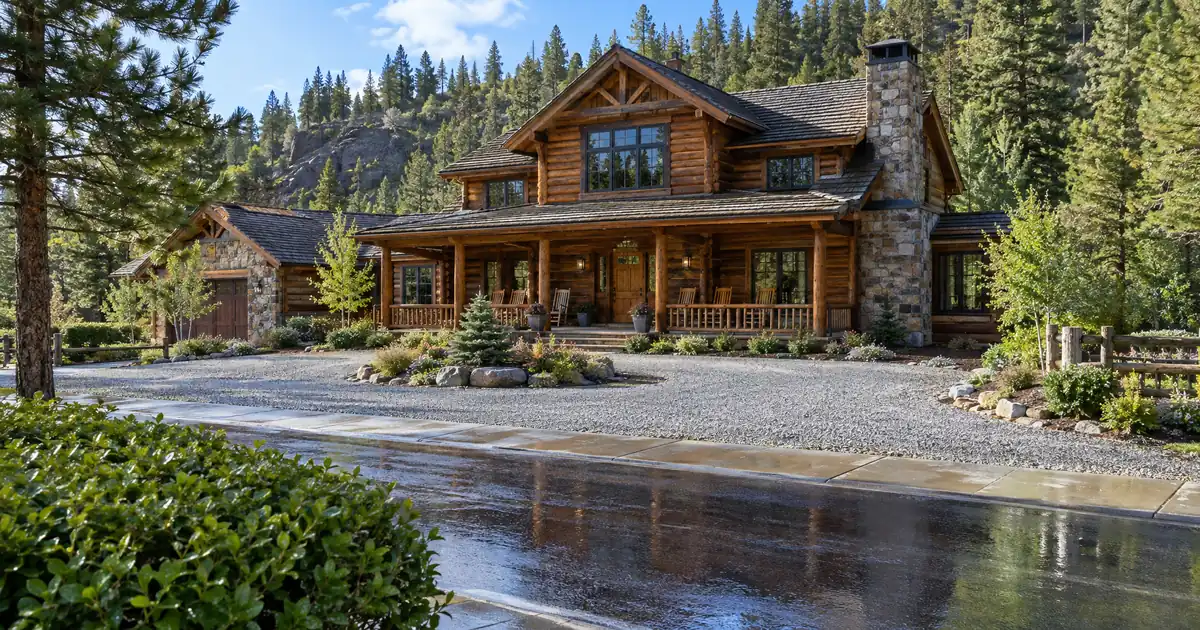
The Quick Read: Usually, yes: a short sale does not block a DSCR loan, which qualifies primarily on property-level rental income covering the payment, subject to lender guidelines, as long as the cabin is an eligible property type, short-term renting is legal at the address, and the seller’s lender approves a sale that fits your financing window. The short sale is the easy part of the file. The Airbnb income is where underwriting gets serious.
- A short sale is a purchase with an extra approval layer. It is not a loan-eligibility problem.
- Short-term rental purchases typically reach up to 75% LTV, and refinances up to 70%, with a 640 credit score and 1.00 coverage as the usual starting points.
- Log homes, manufactured homes, and barndominiums are not offered in DSCR programs across our wholesale network. Many mountain cabins are log-built, so check this before you make an offer.
- A lender underwrites twelve months of income. A strong peak season does not carry a weak winter.
- The appraisal sets value. It does not prove your nightly income.
Key Terms Defined
DSCR (debt service coverage ratio): the property’s monthly rent divided by its monthly housing payment. A result of 1.00 means rent equals the payment.
PITIA: principal, interest, taxes, insurance, and association dues. This is the payment a DSCR calculation measures rent against.
Short sale: a sale where the owner owes more than the property is worth, and the owner’s lender agrees to accept less than the loan balance.
STR (short-term rental): a property rented by the night or week, usually through a platform like Airbnb, rather than on a long lease.
LTV (loan-to-value): the loan amount as a percentage of the property’s value or price.
Hosting history: a record of running rentals, which lenders use to judge whether you have operated a short-term rental before.
Short-Term Rental Calculator
Run the STR numbers in your market
Rate source: Freddie Mac 30-yr average via FRED® — Federal Reserve Bank of St. Louis · effective Oct 15, 2026
Prefilled with starting assumptions — enter your nightly rate, occupancy, taxes, and insurance for a more accurate picture.
Short-term rental income is documented with a 12-month history or a market data report. Program parameters update from Lendmire’s centralized guideline source.
As of Oct 15, 2026 · General Freddie Mac market benchmark, not a Lendmire loan offer. Nightly rate, occupancy, taxes, and insurance are editable estimates. Qualifying income for short-term rentals varies by program — some use appraisal market rent, others use documented STR history or projections — and is confirmed in underwriting. Not a Loan Estimate, approval, or commitment to lend. Program availability and eligibility are subject to lender guidelines, credit approval, property review, and underwriting.
Which Kind of Short Sale Are You Dealing With?
There are two different questions hiding in this title. One is buying a property that is being sold as a short sale. The other is being a borrower who went through a short sale on a past property. They hit your file in completely different ways.
| Situation | What it affects | What to do |
|---|---|---|
| Buying a short-sale property | Approval wait, as-is condition, price certainty | Build in time and run coverage at a counter price |
| Your own past short sale | Lender credit-event waiting period | Ask each lender for its policy before applying |
This article is mostly about the first case. If your own history includes a short sale, the waiting period is set by each lender, not by one universal rule. Programs across the network treat it differently, so ask before you apply rather than guessing from a forum post.
Why the Short Sale Itself Rarely Blocks the Loan
The loan looks at the property and the borrower. It does not care whether the seller’s lender took a loss. Once you are under contract, the file reads like any other purchase: price, appraisal, rental income, credit, reserves, and title.
What a short sale adds is uncertainty. The seller’s lender must approve the price and terms, and it can counter, delay, or reject. LRG Realty notes that secondary liens and judgments can slow a short sale or kill it. The same source points out that these properties usually sell as-is. You inherit whatever deferred maintenance a distressed owner left behind.
Three practical consequences follow.
First, the approval wait runs in months, and your financing paperwork has to survive it. Quotes, income reports, and appraisals can go stale during a long wait, so plan to refresh them. Second, the price is not final until the seller’s lender signs off. Run your coverage ratio at the counter-offer price, not the hopeful one. Third, a lower price only helps your DSCR if the loan amount is sized to that lower price.
Lendmire’s piece Can You Buy a Short-Sale Suburban Airbnb on a DSCR Loan? covers the same purchase mechanics for a different property profile. The mountain version adds income and construction questions on top.
How a DSCR Lender Reads Mountain Airbnb Income
Qualifying income for a short-term rental comes from documented rental performance or a market projection, never from your own paystubs. Most files use either twelve months of actual history or a third-party market data report. The lender then applies a haircut to the income side only, and the payment side is never discounted.
Here is how that plays out across a typical file.
Actual history. Platform statements, manager statements, or bank deposits show what the cabin earned. Ask whether the seller’s history is complete, tied to this exact property, and something you can obtain. A distressed seller often has patchy records, or none that transfer to you.
Market data report. On a purchase with no usable history, many programs accept an AirDNA-type projection. Lenders typically discount projections more than actuals. Refinances generally want real history.
Long-term rent fallback. The appraiser’s rent schedule is a floor, not proof of nightly income. Form 1007 covers a single unit, and Form 1025 covers two to four units.
The appraisal matters less for income than most buyers expect. McKissock, an appraiser-education provider, explains that Form 1007 documents monthly rent rather than nightly rent or business income. Appraisers value the real property only, not furniture or income. The same article makes a point that matters for your LTV math: a short-term rental has the same value as an identical property not used that way. Your Airbnb income does not raise the appraised value. Whether the income counts at all is the lender’s decision.
The Seasonality Problem
Mountain markets swing hard. A lender underwrites twelve months, so a slow shoulder season counts against you. Peak-season income never stands alone, and gross platform revenue is not qualifying income.
Run the numbers on a hypothetical cabin, using modeled assumptions rather than market data. Say peak months cover the payment at roughly 1.60x, and slow months cover it at about 0.70x. The twelve-month blend might land near 1.05x before the lender’s income haircut. After the haircut, the file could land closer to 0.90x.
That cabin looks strong in January and fails the annual test. A second cabin with a milder shoulder season might blend to 1.30x and clear the same test comfortably. Same market, same price range, different result. If your file lands below 1.00, you have options a lender would review. Many select programs start at 1.00, while a separate select-lender path takes coverage below 1.00 with leverage and terms adjusted. A larger down payment, a lower purchase price, or a different structure can also help. Approval remains subject to lender guidelines, credit review, and property review.
The Mountain Property Screen
Run this screen before you write an offer, not after the short sale is approved. Each row can sink a deal on its own.
| Item | Pass | Flag or stop |
|---|---|---|
| Construction | Stick-built or similar | Log, manufactured, or barndominium: not offered |
| STR legality | Confirmed lawful at the address | Unpermitted or HOA-banned: income may be excluded |
| Access | Year-round road access | Seasonal or unmaintained road |
| Systems | Roof, septic, well, heat sound | Deferred maintenance on a distressed sale |
| Comparables | Nearby sales to support value | Few rural comps, so value risk |
| Use | Mostly rented | Mostly personal use: consider a second-home loan |
Construction type deserves the loudest warning. Many mountain cabins are log-built, and log homes, manufactured homes, and barndominiums are not offered in DSCR programs across the network. A beautiful cabin can be a dead end for this loan.
Short-term rental rules can vary by city, county, HOA, and property type, so investors should confirm local rules before relying on projected rental income. Do this before the contract. A property that cannot legally host guests has no usable STR income, however good the projection looks.
Condition is the quiet risk on a short sale. Roofs, septic systems, wells, and access roads can all affect value or insurability. Lender condition rules vary, so ask early what a lender will require on an as-is purchase.
What the Program Numbers Typically Look Like
Across the wholesale network, short-term rental files follow tighter guidelines than long-term rentals. These are typical ranges, and every file is underwritten individually.
- Purchase leverage: up to 75% LTV on a short-term-rental purchase, on the strongest files.
- Refinance and cash-out: up to 70% LTV on short-term-rental collateral.
- Credit score: a 640 minimum for short-term rentals, with higher scores opening better terms.
- Coverage: 1.00 is where select programs start on a purchase, and 1.00 on a refinance.
- Experience: about twelve months of landlord or host experience is usually expected.
- Loan size: up to $3,000,000 on standard programs.
DSCR loans are designed for non-owner-occupied investment properties. Because they are business-purpose investor loans, they are reviewed differently from a standard owner-occupied mortgage. If you want the full picture of how the product works, the complete DSCR loans guide walks through it.
Equity and coverage are separate tests. A bigger down payment lowers the payment and can lift your ratio, but it never erases leverage caps, credit floors, reserve rules, or property eligibility. Reserves vary by lender, leverage, loan size, and transaction type, so ask for the specific requirement on your file. The strongest files clear both tests: enough equity and enough rental coverage.
One more point about timing. If you later refinance out of the purchase loan, seasoning is lender policy, not law. Some lenders care about how long you have held title, and others want a tenant or booking record in place. Ask each lender for its specific rule.
DSCR vs. conventional financing
There are two common ways to finance an investment property, and they qualify you differently — here’s how investors weigh them.
Why investors choose it
- Qualifies on the property’s rental income — no personal tax returns, W-2s, or pay stubs needed to document income.
- No personal debt-to-income ceiling to clear, so existing mortgages and obligations don’t cap your borrowing the same way.
- Can be closed in an LLC, keeping the property inside a business entity.
- Built for scaling — not held to the limit on number of financed properties that conventional financing applies.
- Underwriting centers on the deal: generally qualifies when the rent covers the payment, a 1.00x coverage ratio being a common baseline (confirmed in underwriting).
- Designed specifically for investment property, including long-term and, where the program allows, short-term rentals.
Where it’s strong
- Often the lowest ongoing financing cost for a buyer who fully qualifies on personal income — a fit for a first property or a cost-first purchase.
Trade-offs for investors
- Requires full personal income documentation and must fit within a debt-to-income limit — salary, existing debts, and other mortgages all count.
- Typically held in your personal name rather than a business entity.
- Caps how many financed properties you can carry, which can become a ceiling as a portfolio grows.
- Evaluates you as a borrower as much as the property, which usually means more paperwork.
How investors usually choose: a first or single property often optimizes for the lowest financing cost; portfolio builders often optimize for leverage, vesting in an LLC, and scaling past conventional caps. The right answer depends on your goals, the property, and current guidelines — both paths run through select lenders in Lendmire’s wholesale network, with eligibility and terms confirmed in underwriting.
Clearing the Ratio Is Not the Same as Profit
DSCR compares rent to PITIA and nothing else. Repairs, vacancy, management fees, utilities, snow removal, and capital expenses all sit outside the calculation. A cabin can clear 1.00 and still lose money after a roof repair and a slow winter.
This matters more on a short sale. A distressed seller may have skipped maintenance, and as-is condition means the buyer pays to catch up. Budget for those repairs separately from the loan.
Pre-Offer Checklist
1. Confirm the construction type is eligible. Rule out log, manufactured, and barndominium structures.
2. Confirm short-term renting is lawful at the address and under any HOA rules.
3. Ask for the seller’s booking records and check whether they are complete and transferable.
4. Model coverage on three bases: actual history, a market projection, and long-term rent.
5. Stress the twelve-month average, not the peak season.
6. Run coverage at a possible counter-offer price.
7. Check your credit score, hosting history, and seasoned reserves against the target program.
8. Ask the lender how it treats a prior short sale if one appears in your own history.
9. Build a financing contingency and a plan to refresh reports during the approval wait.
10. Budget repairs separately from the loan.
Frequently Asked Questions
Does buying a short-sale property hurt my chances of getting a DSCR loan?
No. The loan reviews the property’s rental income, your credit, and your reserves, not how the seller got into trouble. The practical costs are a longer wait for the seller’s lender and as-is condition. If you personally had a short sale in your own history, that is a separate question, and each lender sets its own waiting period.
Can I use the seller’s Airbnb history to qualify?
Sometimes, but only if the records are complete, tied to this property, and available to you. Distressed sellers often cannot supply clean statements. In that case many purchases lean on a market data report instead, which lenders typically discount.
Will the appraisal confirm my Airbnb income?
No. McKissock explains that the rent form records monthly rent, and appraisers value the real property rather than business income. The lender decides how your income counts, so build your documentation separately.
What if the cabin is a log home?
Log homes are not offered in DSCR programs across the network, along with manufactured homes and barndominiums. Check the construction type before you make an offer. If the cabin is log-built, you would need a different kind of financing.
What if my coverage lands below 1.00?
Many select programs start at 1.00, and a separate path through select lenders in the network takes coverage below 1.00 with leverage and terms adjusted. You can also improve the file with a larger down payment or a lower price. Qualification stays subject to lender guidelines, credit approval, and property review.
Next Step
If you are buying or refinancing a rental property and want to see how the numbers work, Lendmire can help you compare DSCR loan options based on the property income, credit profile, leverage, and investor goals. Lendmire is a broker that arranges financing through select lenders in its wholesale network, covering 41 markets, including Washington, D.C. Reach the team at 828-256-2183, or use the quote request page.
A distressed mountain cabin rewards the buyer who tests the winter months, the construction type, and the seller’s approval before falling for the view.
For current guidelines and terms, see Lendmire’s DSCR loan programs page.
About Lendmire
Lendmire — NMLS# 2371349 — is a DSCR and non-QM mortgage brokerage with investor loan programs in 41 markets, including Washington, D.C. DSCR eligibility is commonly reviewed by the lender around property-level rent rather than personal income documentation, subject to lender guidelines, and the brokerage helps arrange financing for LLC-owned portfolios beyond conventional financed-property limits. Recognized by Scotsman Guide as a Top Mortgage Workplace in 2025 and 2026.
Get Started
Ready to find the right loan for you?
In about 30 seconds you can review financing options available for your investment property. No commitment required.
Informational only. Not a Loan Estimate, approval, or commitment to lend. Program availability and eligibility are subject to lender guidelines, credit approval, property review, and underwriting.
References
1. LRG Realty – Understanding Short Sales
2. McKissock – Form 1007 & STR Appraisals
This article is part of Lendmire’s short-term rental loan program — full qualification details, guidelines, and scenarios live on the program page.
Related reading: How to Insure a Lake House Short-Term Rental for a DSCR Loan · Liquid Cash vs Retirement vs HELOC as Airbnb DSCR Loan Reserves · Can a First-Time Airbnb Buyer Still Get a DSCR Loan After a Drop?
Brandon Miller
Founder & CEO, Mortgage Loan Originator, Lendmire LLC
- Mortgage Loan Originator · NMLS# 1129696 · Verify on NMLS Consumer Access
- North Carolina Real Estate Broker · License# 343312 · Verify on NCREC
- North Carolina Insurance Producer · License# 19053198 · Property, Casualty, Life, Health · Verify on NAIC SBS
- Lendmire LLC · Firm NMLS# 2371349 · Verify firm licensure
Disclosures. The information presented in this article is general market commentary, not financial, legal, or tax advice. Lendmire is a mortgage brokerage (NMLS# 2371349) — not a direct lender or depository institution — and loan placement is subject to lender underwriting. Nothing in this content represents a commitment to lend. Loan terms, pricing, and program availability vary based on borrower qualifications, property characteristics, and state of subject property, and are subject to change at any time. Lendmire complies with Equal Housing Opportunity requirements. Consumer access: nmlsconsumeraccess.org.