
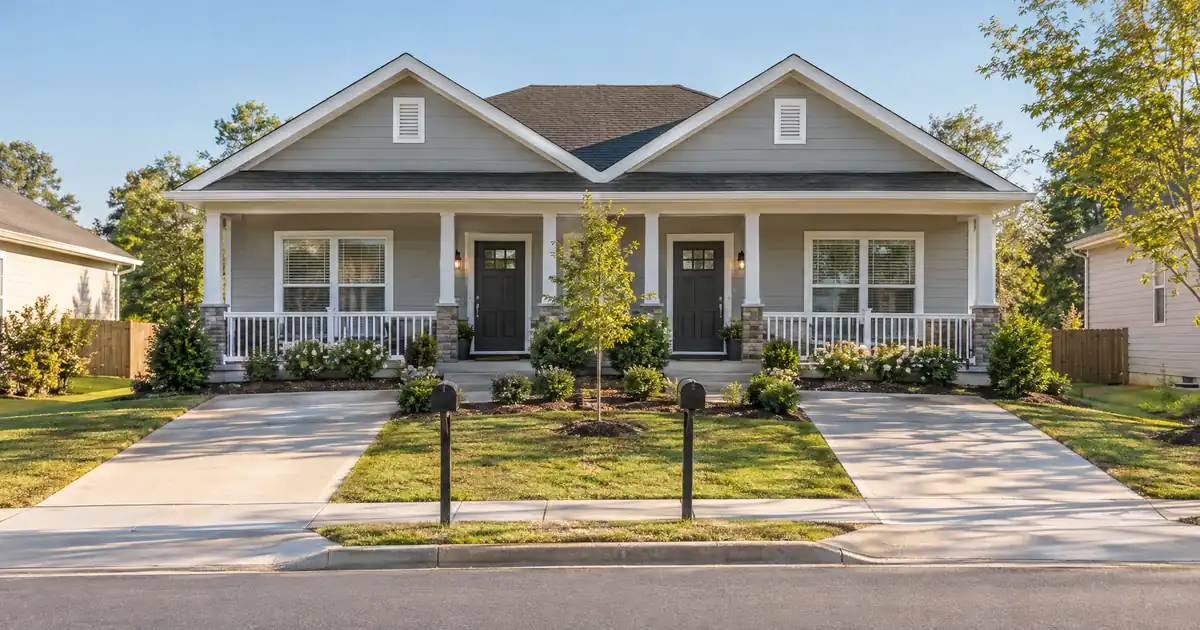
The Quick Read: A duplex becomes two separately reviewable properties only after the legal split is recorded, and DSCR lenders treat nothing as two properties until that happens. Local government creates the split through a plat, a condo declaration, or a recorded party wall agreement. The lender only reviews the result.
- A duplex on one parcel is one 2-unit property with one deed and one tax parcel, so it carries one loan.
- The split is more affordable when it is designed in during construction: separation wall, separate meters, and a zoning check first.
- Two parcel IDs, a recorded plat or declaration, and a recorded party wall agreement are the core documents a lender and title company will want.
- Each half is then reviewed on its own rent and coverage, with rent set by the appraiser rather than the investor’s projection, subject to lender guidelines.
- Leverage on a purchase typically runs 75%-80% LTV and cash-out tops out near 75%, so equity still matters on each parcel.
Builders who plan two deeds from the start get two clean loans. Builders who decide afterward pay for it in surveys, hearings, and delays. This guide walks through the sequence from zoning to refinance, and names the cases where splitting is the wrong call.
DSCR Cash-Out Calculator
Run the cash-out numbers in your market
Rate source: Freddie Mac 30-yr average via FRED® — Federal Reserve Bank of St. Louis · effective Oct 15, 2026
Prefilled with starting assumptions — enter your property’s value, balance, taxes, and insurance for a more accurate picture.
Program parameters update from Lendmire’s centralized guideline source. Taxes and insurance are editable estimates.
As of Oct 15, 2026 · General Freddie Mac market benchmark, not a Lendmire loan offer. Property value, balance, taxes, and insurance are editable estimates. Maximum loan-to-value varies by lender, program, property type, and seasoning. Not a Loan Estimate, approval, or commitment to lend. Program availability and eligibility are subject to lender guidelines, credit approval, property review, and underwriting.
Key Terms Defined
Plat (or re-plat): the recorded map that divides one lot into two legal lots.
Party wall agreement: a recorded document that sets who maintains, repairs, and pays for the shared wall, roof, and foundation.
Fee simple: full ownership of a building half and the ground beneath it.
Condo conversion: dividing the airspace inside a building so each unit has its own title while the land stays shared.
DSCR: debt service coverage ratio, the property’s monthly rent divided by its full monthly obligation (principal, interest, taxes, insurance, and any HOA dues).
What Does “Splitting” a Duplex Actually Mean?
Splitting means turning one legal property into two, and there are two legal routes. LegalClarity describes a lot subdivision as dividing the land into two legal lots. A condominium conversion instead divides the airspace inside the building, while the land and structure stay under shared ownership. A condo conversion gives each unit its own title and tax parcel number.
Layout decides which route fits. Subdivision generally works for side-by-side buildings with a clear physical separation, and each new lot must still meet minimum size, frontage, and setback rules. Stacked duplexes cannot be lot-split. Condo treatment is the usual answer for those.
A tenancy-in-common is not a third option. It does not create separate ownership, so it cannot produce two loans.
Should You Split at All?
Split when you want two separate loans, separate sales, or separate cash-out events. Keep the duplex whole when the lot cannot yield two conforming lots, when the city requires a hearing you do not want to run, or when you plan to hold both units for good.
The case for splitting is exit flexibility. Two deeds open a second buyer pool, owner-occupants, and let you sell one side and keep the other. That is a benefit, not a refinance requirement. A single blended 2-unit loan is a perfectly workable DSCR file.
The case against is cost and friction. Some buyers also treat converted units as harder to resell than an intact duplex, though that is anecdotal and varies by market.
If you plan to hold both halves for years with one lender, the split may not earn its cost. If you want the option to peel off equity or sell half, it usually does.
Lot Split, Condo, or Stay a Duplex?
| Factor | Lot split (fee simple) | Condo conversion | Stay a duplex |
|---|---|---|---|
| Legal mechanism | Re-plat into two lots | Declaration divides airspace | None |
| Layout fit | Side-by-side only | Side-by-side or stacked | Any |
| Lender collateral | Single-unit or townhome | Condo unit | 2-unit property |
| Main hurdle | Zoning, lot size, plat | Association, HOA dues | One loan only |
The condo path brings an association, a declaration, and HOA dues into the coverage math. It can also bring condo-project review questions that a fee simple lot split avoids. The lot split instead leans on the party wall agreement. Neither is free of paperwork.
Plan Before You Pour: Pre-Construction Checks
The split is a build-time decision. Investor Fuel profiles a Tennessee build-to-rent investor who builds a two-hour firewall down the centerline of every duplex, at an extra cost of roughly $6,000. That is one builder’s figure, not a market benchmark. After construction, a surveyor locates the centerpoint and the parcel becomes two zero-lot-line homes.
Run these checks before the design is locked:
1. Zoning. Confirm the lot can yield two conforming lots, or that the building qualifies for condo or townhouse treatment.
2. Process type. Some jurisdictions treat it as an administrative lot split. Others require a full re-plat with a public hearing, and some do not allow it without a subdivision process.
3. Utilities. Separate meters and service lines for water, sewer, and electric make the split far cleaner than shared services.
4. Separation wall. The fire rating is a building-code question. Settle it with the local building official before construction, not after.
The Sequence From Permit to Refinance
The order of operations is where most splits succeed or stall. A workable sequence looks like this:
1. Permit and design. Build in the separation wall, separate meters, and separate service lines.
2. Construction. Complete the building to a certificate of occupancy. Permanent DSCR financing generally follows the certificate of occupancy and an appraisal.
3. Survey. A surveyor locates the centerline and prepares new legal descriptions for each half.
4. Municipal approval. The city or county approves the lot split, re-plat, or condo declaration.
5. Recording. The plat or declaration, the party wall agreement, and any shared driveway or utility easement are recorded. The county issues two parcel IDs.
6. Existing loan check. Splitting without the construction lender’s consent can breach that mortgage. Whether the loan is released, paid off at refinance, or modified is a lender and title matter.
7. Appraisal and refinance. Each half goes to appraisal and is reviewed as its own property.
Do not refinance each half until step five is done. A building with two units on one lot is one legal property, however it is leased.
Documents Lenders and Title Will Ask For
| Document | Who produces it | Why it matters |
|---|---|---|
| Recorded plat or declaration | Surveyor, attorney, city | Proves two legal parcels |
| Two parcel IDs | County | Separate tax bills and liens |
| Party wall agreement | Attorney | Governs shared wall and roof |
| Easements | Attorney, title | Shared driveway or utilities |
| Survey | Licensed surveyor | Locates the centerline |
Title companies care about the party wall agreement for a concrete reason. A title-industry reference explains that fee simple townhouse-style ownership needs a recorded agreement, declaration, or covenant covering the party wall. If none is recorded, the title policy takes an exception for the neighbor’s rights in the wall.
That exception can stop a loan. In one BiggerPockets thread, an investor’s half-duplex refinance nearly failed because lenders balked at an unrecorded agreement. A commenter listed what lenders look for: who pays for what, access for repairs, how costs are collected, and language that runs with title. The thread is old and anecdotal, but the pattern holds across the files a broker sees.
DSCR vs. conventional financing
There are two common ways to finance an investment property, and they qualify you differently — here’s how investors weigh them.
Why investors choose it
- Qualifies on the property’s rental income — no personal tax returns, W-2s, or pay stubs needed to document income.
- No personal debt-to-income ceiling to clear, so existing mortgages and obligations don’t cap your borrowing the same way.
- Can be closed in an LLC, keeping the property inside a business entity.
- Built for scaling — not held to the limit on number of financed properties that conventional financing applies.
- Underwriting centers on the deal: generally qualifies when the rent covers the payment, a 1.00x coverage ratio being a common baseline (confirmed in underwriting).
- Designed specifically for investment property, including long-term and, where the program allows, short-term rentals.
Where it’s strong
- Often the lowest ongoing financing cost for a buyer who fully qualifies on personal income — a fit for a first property or a cost-first purchase.
Trade-offs for investors
- Requires full personal income documentation and must fit within a debt-to-income limit — salary, existing debts, and other mortgages all count.
- Typically held in your personal name rather than a business entity.
- Caps how many financed properties you can carry, which can become a ceiling as a portfolio grows.
- Evaluates you as a borrower as much as the property, which usually means more paperwork.
How investors usually choose: a first or single property often optimizes for the lowest financing cost; portfolio builders often optimize for leverage, vesting in an LLC, and scaling past conventional caps. The right answer depends on your goals, the property, and current guidelines — both paths run through select lenders in Lendmire’s wholesale network, with eligibility and terms confirmed in underwriting.
How DSCR Underwriting Treats Each Half
Once each half is its own parcel, the lender reviews it as its own property. Here is how that works across the wholesale network.
Rent comes from the appraisal. For new construction with no lease history, the appraiser’s rent opinion drives coverage, not the investor’s pro forma. DSCR divides that rent by the full monthly obligation, so a fee simple half with no HOA often clears more easily than a condo half carrying dues.
Collateral type shifts. A split half may be classed as a single-family, townhome, or condo-type property rather than a 2-unit. Appraisal form depends on that class. A 2-unit uses the small residential income report (Form 1025), while a single-family half typically uses the comparable rent schedule (Form 1007).
Program figures apply to each parcel. Most programs in the network want a credit score around 660, with a 620 floor in parts of the network and 700+ unlocking the strongest leverage. Purchase leverage typically runs 75%-80% LTV, with select high-leverage programs reaching 85% at roughly a 700+ score. Cash-out tops out around 75% LTV. Coverage of 1.00 is where select programs start, and stronger ratios open better pricing and leverage. A separate select-lender path takes coverage below 1.00, with leverage and terms adjusted. Reserves commonly sit near 6 months of PITIA and step up to about 9 months on loans above $1,500,000, though they vary by lender and file. All of this is subject to lender guidelines and property review.
Remember what coverage measures. Clearing 1.00 is not positive cash flow. Repairs, vacancy, management, utilities, and capex sit outside the calculation.
For the full program picture, see the complete DSCR loans guide.
One Loan Per Parcel: A Worked Example
Say a builder finishes a side-by-side duplex and completes a lot split. Each half now has its own parcel ID and a recorded party wall agreement. The appraiser values each as an attached single-family home, with rent opinions that support coverage around 1.2x on each.
At 75% LTV on a cash-out refinance, each half is its own file with its own coverage test. That is a modeled illustration, not a quote. The builder can now refinance one half and sell the other, or hold both with two loans. Terms vary by lender guidelines, property type, leverage, credit profile, and full file review.
Compare the unsplit version. The same duplex stays one 2-unit parcel with one blended loan. It has one coverage test, one payoff, and no way to sell half. If one unit leases poorly, the blended number absorbs it. After the split, a weak half shows up on its own.
For related paths, Lendmire’s piece How to Finance a New Construction Rental Then Refinance With DSCR covers the construction-to-permanent handoff in more depth. A retiree weighing a larger balance can read about refinancing a new construction rental into a jumbo DSCR loan.
Where the Plan Breaks
These are the failure points that kill a split or delay the refinance:
- Lot too small. Each resulting lot must meet minimum size, frontage, and setbacks. A lot that cannot yield two conforming lots stops the plan.
- Shared services. One water or electric feed for both halves complicates the split and the title review.
- Stacked layout. A lot split is not available. Condo treatment is the remaining route.
- Missing recorded agreement. No party wall agreement can mean a title exception and a stalled loan.
- Construction loan consent. Splitting without the existing lender’s consent can breach the mortgage.
- Local refusal. Rules differ by jurisdiction, and some places do not allow the split at all.
Ineligible property types are worth a mention. Manufactured homes, log homes, and barndominiums are not offered in the network’s DSCR programs, so a modular or site-built duplex should be documented as such.
Short-term rental use changes the numbers. Purchase leverage tops out at 75% LTV, refinance sits around 70%, and cash-out is 70% on short-term-rental collateral, with about 12 months of hosting history expected. Short-term rental rules can vary by city, county, HOA, and property type, so investors should confirm local rules before relying on projected rental income. Exact terms depend on the lender’s guidelines, property type, leverage, and a full review of the borrower’s file.
What the Investor Decision Looks Like
For a builder planning several duplexes, designing the split in from the start is the clear play. The firewall, meters, and plat are cheap at design stage and expensive afterward. For an investor with one finished duplex and a tight lot, the retrofit cost may outweigh the benefit, and a single 2-unit DSCR loan may be the better structure.
Tax treatment can depend on how the funds are used and how the property is held; investors should keep clear records and speak with a qualified tax professional before relying on any deduction.
If you are buying or refinancing a rental property and want to see how the numbers work, Lendmire can help you compare DSCR loan options based on the property income, credit profile, leverage, and investor goals. Lendmire is a broker arranging DSCR investor loans through select lenders in its wholesale network across 41 markets, including Washington, D.C.; any outcome is subject to lender guidelines and is not a commitment to lend.
Frequently Asked Questions
Can I split the duplex after it is built?
Yes, if zoning and lot size allow it, but it costs more. A retrofit adds survey, legal, and municipal steps that a build-time plan folds into construction. Shared utilities and an unrated separation wall are the usual obstacles.
Do I need two utility meters?
Not always, but separate meters are strongly advisable. They make the split much cleaner for the city, the title company, and the lender. Shared services can be handled with maintenance agreements in some places, but expect more friction.
Does a lease need to exist before the refinance?
Not necessarily on new construction. The appraiser’s rent opinion drives coverage, and permanent financing generally follows the certificate of occupancy and an appraisal. Lender guidelines on leases vary.
Can I sell one half and keep the other?
Yes, once each half has its own deed and parcel ID. Two deeds open the owner-occupant buyer pool. Lenders on each side will want the recorded party wall agreement in place.
One LLC or two?
It depends on how you want to hold and finance each half. Vesting and guarantor questions are best settled with a real-estate attorney and title company before recording. Entity-held loans are reviewed subject to lender program eligibility.
About Lendmire
Lendmire (NMLS# 2371349) is a DSCR-focused mortgage broker that helps arrange investor financing across 41 markets, including Washington, D.C., through wholesale and investor-lending channels. DSCR eligibility is generally reviewed by the lender around the property’s rental income rather than personal income documentation, subject to lender guidelines — which works for self-employed investors, LLC operators, and portfolios above four financed properties. Scotsman Guide named Lendmire a Top Mortgage Workplace in both 2025 and 2026.
Get Started
Ready to find the right loan for you?
In about 30 seconds you can review financing options available for your investment property. No commitment required.
Informational only. Not a Loan Estimate, approval, or commitment to lend. Program availability and eligibility are subject to lender guidelines, credit approval, property review, and underwriting.
References
1. LegalClarity: Can You Split a Duplex Into Two Separate Properties?
2. Investor Fuel: Split a Duplex Into Two Single-Family Homes
3. Agents Title: Party Walls Overview
4. BiggerPockets: Party Wall Agreements
This article is part of Lendmire’s DSCR loan program — full qualification details, guidelines, and scenarios live on the program page.
Related reading: Current Carrier vs Re-Quoted Coverage Before a DSCR Refinance · Current Mortgage vs DSCR Refinance for a New Landlord: What Each Allows · How to Refinance a Newly Leased Rental With a DSCR Loan
Brandon Miller
Founder & CEO, Mortgage Loan Originator, Lendmire LLC
- Mortgage Loan Originator · NMLS# 1129696 · Verify on NMLS Consumer Access
- North Carolina Real Estate Broker · License# 343312 · Verify on NCREC
- North Carolina Insurance Producer · License# 19053198 · Property, Casualty, Life, Health · Verify on NAIC SBS
- Lendmire LLC · Firm NMLS# 2371349 · Verify firm licensure
Required disclosures. Lendmire (NMLS# 2371349) operates as a licensed mortgage broker, not a direct lender or depository. The discussion in this article is general in nature and should not be relied upon as financial, legal, or tax advice — every investment scenario is unique and should be reviewed by a qualified professional. Any loan inquiry is subject to lender underwriting, and this article is not a commitment to lend or a guarantee of approval. Mortgage rates, loan terms, and program guidelines vary by borrower, property, and state, and may change without notice. Equal Housing Opportunity. Verify licensure at NMLS Consumer Access.