
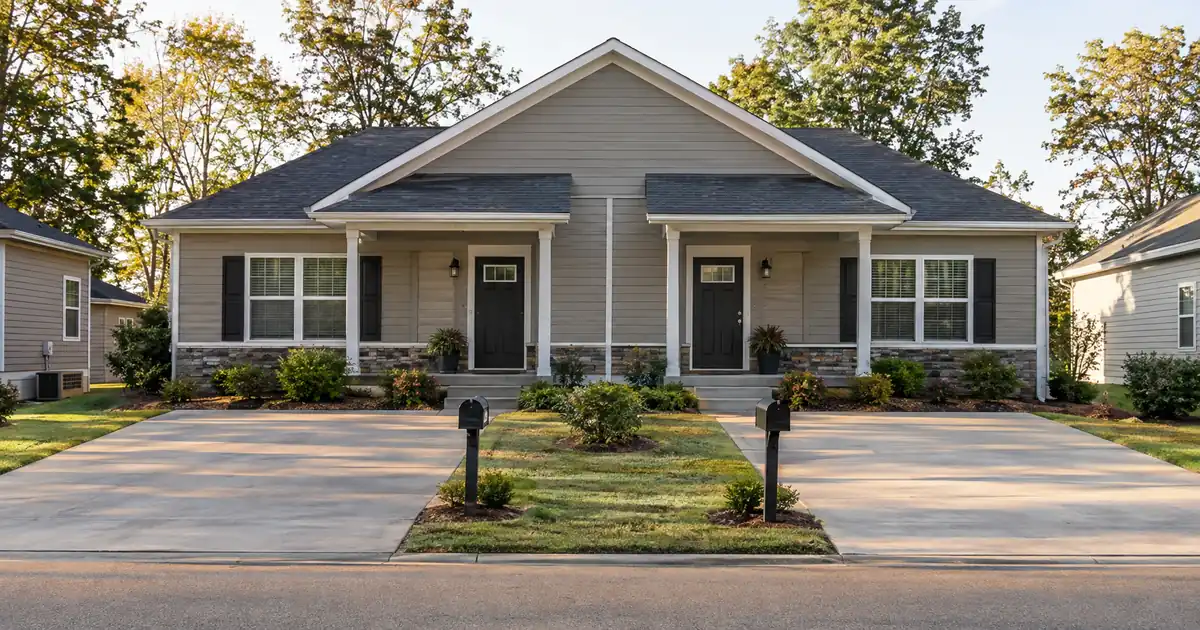
The Quick Read: Only when the structure fits: a DSCR loan does not pay the builder, but once the duplexes are finished, appraised for rent and ready to hold, a portfolio DSCR loan can take out the construction debt under one note, while ten separate loans closed together remain the more common path. The decision comes down to how evenly the buildings finish and whether you want them tied together afterward.
- A DSCR loan is a takeout loan. A construction or bridge loan pays for the build, and the DSCR loan replaces that debt.
- One note across ten duplexes exists, but it is a portfolio (blanket) structure with its own limits. The 30-year version allows 2 to 20 properties under one note.
- A blanket loan tests coverage on the pool. Separate loans test each building alone.
- Buildings that finish at different times usually favor closing in tranches or on individual loans.
- Every figure here is a program range, subject to lender guidelines. It is not a commitment to lend.
Why Doesn’t a DSCR Loan Fund the Build?
A DSCR loan qualifies primarily on property-level rental income covering the payment, subject to lender guidelines. An unfinished building has no rent to measure and no finished value to lend against, so the loan has nothing to test. Construction is funded with cash, a construction loan or a bridge loan. The permanent loan arrives after the work is done.
Single-close products that combine construction and permanent financing do exist. They are a different category from a DSCR loan, and they are underwritten around the builder, the budget and the plans rather than rental coverage. Treat them as an alternative to the two-step path, not a version of it.
The two-step path matters for ten duplexes because the construction loan has a maturity date. The DSCR takeout has to be ready to close before that date arrives. The rest of this article is about making that handoff work at ten-building scale.
How Do Ten New Duplexes Go From Construction Loan to Permanent Financing?
The sequence has five stages: build, complete, document rent, apply, and take out the construction debt. The lender’s checklist changes at each stage. The table below shows what each stage asks for.
| Stage | What happens | What the lender needs |
|---|---|---|
| Construction | Draws tied to finished work | Budget, plans, schedule |
| Completion | Local sign-off on each building | Certificate of occupancy, final inspections |
| Rent evidence | Appraiser sets market rent | Appraisal with rent conclusion |
| Application | Takeout file assembled | Proof work is complete and paid |
| Takeout | New loan pays off construction note | Title, insurance, entity documents |
Start the takeout file well before the last building finishes. Lenders want a finished, paid-for, lien-free property, so a building that is only substantially complete usually is not ready. The certificate of occupancy shows the building is safe to use. It does not release permanent financing by itself.
What does the appraisal look like for a duplex?
A duplex is a two-unit property, and appraisers report two- to four-unit properties on the small residential income property form, which includes a rent conclusion for each unit. The Fannie Mae Selling Guide lists that form for this property size. DSCR files do not follow agency rules. The form name is simply what the appraiser uses.
Ten duplexes mean ten appraisals and ten rent schedules, even if the loan ends up as a single note. Each building still needs a lease or an appraiser-supported market rent. Brand-new buildings often have thin comparable sales, especially when builders dominate the nearby sales. That can slow the rent conclusion, so give the appraiser clean plans, unit mixes and any signed leases.
One Note, Ten Notes, or Tranches?
Ten separate DSCR loans closed in the same window are the most common answer. One blanket note is the right answer for a uniform, fully finished pool you plan to hold together. Tranches work when buildings finish at different times. Each structure has a clear fit.
Here, “portfolio DSCR loan,” “blanket loan” and “cross-collateralized loan” all mean the same thing: one note secured by liens on several rentals. A default on one property can reach every pledged property. A bank’s “portfolio loan,” meaning a loan the bank keeps on its own books, is a different use of the word.
| Factor | One blanket note | Ten separate loans |
|---|---|---|
| Coverage test | Pooled rent vs pooled debt | Each building alone |
| One weak building | Can be offset by strong ones | Stands or falls alone |
| Selling one building | Needs release terms | Sell freely |
| Refinancing one building | Touches the whole note | Independent |
| Closings | One | Ten |
| Phased completion | Awkward | Natural |
What does the network actually offer for a blanket structure?
Across the wholesale network, there are two structures to know. The 30-year portfolio DSCR loan places 2 to 20 properties under one note. Loan sizes run from $300,000 to $5,000,000, with larger balances reviewed case by case. Leverage runs up to 80% of value on a purchase or a rate-and-term refinance. The coverage floor is 1.00, measured on the pool. Fixed and adjustable structures exist, an interest-only period is available, and the property types include 2-4 unit buildings.
The rental portfolio term loan is built for five or more rental properties or units under one loan. Loan sizes run from $500,000 to $50,000,000, with leverage up to 75% of value. Terms are fixed at 3, 5, 7 or 10 years with a balloon at maturity, and recourse and non-recourse versions exist. The non-recourse version looks to the real estate, with recourse limited to carve-outs such as fraud and bankruptcy. Prepayment on that structure uses yield maintenance, so exit planning matters. It is also the only structure here that accepts small multifamily of five or more units, which ten duplexes are not. Terms vary by lender guidelines, property type, leverage, credit profile, and full file review.
For comparison, a DSCR loan on a single rental typically runs 75%–80% LTV on a purchase and tops out around 75% on a cash-out. Those figures belong to loans on one rental, not to the blanket structures above.
Lenders typically want a credit score of 640 or higher on the portfolio programs, and some structures ask for 680 or 720. A special-purpose entity, usually an LLC, is required on some structures, subject to lender program eligibility. Owner-occupied property, co-ops, mixed-use property and commercial property are not eligible in the pool. Lendmire arranges these loans as a broker through its wholesale network, and each lender reviews the file on its own guidelines.
Run the Numbers: Ten Duplexes, One Weak Building
Pooled testing helps when one building lags. The example below is a modeled assumption, not market data. Suppose nine duplexes each cover their full monthly obligation at about 1.15x. A tenth building has a thin rent conclusion and covers only about 0.90x. Assume all ten carry similar monthly obligations.
Tested individually, nine files clear 1.00 and one falls short. That tenth file would need a select-lender path below 1.00 with leverage and terms adjusted. The tenth building could also wait for a stronger rent schedule.
Tested as a pool, the average lands near 1.12x. The pool clears the 1.00 floor even though one building does not. Underwriting tests the pooled coverage, the leverage and the terms on any file that includes a weaker property, and every building still needs supported rent. Pooling can carry a laggard, but it does not erase the building’s weakness.
Keep one limit in mind. DSCR compares rent to the principal, interest, taxes, insurance and any HOA dues on the property, and nothing else. Clearing 1.00 does not mean positive cash flow. Repairs, vacancy, management, utilities and capital reserves sit outside the calculation, so keep a separate operating budget.
What If the Buildings Finish at Different Times?
Staggered completion is the normal case, and it is the main reason individual loans win on new construction. A blanket note works best when the whole pool is finished, rented and appraised at once. If the last building is late, the whole closing waits. Meanwhile the construction loan keeps running toward its maturity.
There are three workable plans for a staggered build:
1. Wait for all ten. This keeps the structure clean, but it concentrates timing risk on the slowest building.
2. Close in tranches. Take out the first group of finished duplexes on individual loans, then move the later buildings into a second note or a second tranche. This is a structuring choice, not a fixed rule, and a broker can frame it with you.
3. Close each building individually as it finishes. This gives the most exit flexibility, but it also creates the most closings.
Ask the construction lender how it handles partial payoffs. Some construction loans are secured across all ten parcels. If so, each takeout needs a release or payoff statement before the lien on that building can clear. Ask for that process in writing before the first building finishes.
How Does Leverage Work Right After Completion?
Leverage on a fresh takeout depends on how the lender treats the transaction. A rate-and-term refinance that only pays off the construction debt is treated differently from one that returns cash. Inside the first six months of ownership, the loan is also capped at 90% of total cost (purchase price plus documented improvements). From six to twelve months the cap is 100% of total cost, and the leverage ceiling still applies, so the loan is the lower of the two. After twelve months the appraised value alone is the basis. A rate-and-term refinance is not subject to the cost-basis cap, subject to lender guidelines.
Cash-out on a portfolio loan never exceeds 75% of the pooled value. That ceiling applies even if the appraisals come in high. A builder who plans to pull profit out of the new buildings should plan around that limit and around the seasoning rule above.
A larger equity contribution lowers the debt and can lift coverage. It does not erase leverage caps, credit floors, reserve rules or property eligibility. The strongest files clear both tests: enough equity and enough rental coverage.
One practitioner pattern shows up repeatedly on new-construction files. The rent schedule is usually the weak link, not the builder’s costs. Buildings with signed leases or tightly documented comparable rents tend to move through review more smoothly. Buildings with only an optimistic projection tend to draw questions.
For lease-up in particular, see Lendmire’s piece How a DSCR Lender Handles Lease-Up on Ten New Duplexes. Some lenders fund on an appraiser’s market rent, and others want leases in place first. Confirm which approach the lender uses before you order appraisals.
What Can Go Wrong, and What’s Plan B?
The failure points are predictable. Each one has an answer if you plan for it early.
- A delayed certificate of occupancy. The construction loan keeps its maturity date. Ask for an extension option before you need it, and consider taking out the finished buildings first.
- A thin rent schedule. If an appraiser’s rent conclusion comes in low, coverage on that building drops. Pooling may absorb it. Individual loans may need a lower-leverage structure or a stronger rent case.
- Release surprises. A release clause is a contract term, not a right. Goliath’s guide to blanket mortgages describes release clauses as common but not guaranteed. Amerisave’s blanket mortgage glossary says release terms are negotiated. On this network’s portfolio programs, partial releases, substitutions and the sale of one property follow the loan documents. The release price runs above the property’s allocated balance, and the remaining portfolio must still cover its debt service. For the mechanics, see Lendmire’s article Can You Release One of Ten Rentals From a Blanket Cash-Out Refinance?.
- Prepayment cost. The rental portfolio term loan carries yield maintenance, so selling or refinancing early has a price. Compare that with the 30-year portfolio structure before you commit.
- Reserves. Reserves vary by lender, leverage, loan size and structure. On the rental portfolio term loan, reserves are held for taxes, insurance and capital expenditures. Ask for the reserve number before you finalize the structure.
- State differences. Some states may limit how many properties can sit under one mortgage, so confirm with the lender that a blanket structure is allowed where your buildings sit.
- Property type surprises. Manufactured homes are not reviewable on these programs, and the pool excludes mixed-use and commercial property. Confirm that every building’s use fits.
Tax treatment varies; consult a qualified professional, especially if you plan to sell or exchange individual buildings.
Who Should Choose Which Path?
Match the structure to the borrower, not the other way around. An investor who plans to hold all ten buildings for years, with a uniform product and similar rents, is the best fit for one blanket note. A builder who may sell several duplexes, or who expects the buildings to finish months apart, usually does better with individual loans or tranches.
The decision tilts on three questions. Do you want to keep the option to sell one building without negotiating with a lender? Are the rents even across buildings, or does one lag? Can all ten be finished before the construction loan matures?
Answering yes to the first and no to the others points toward separate loans.
If the pool exceeds 20 properties, or if you hold five or more units under one roof, the rental portfolio term loan becomes the practical lane. If you are building for a quick sale rather than a hold, none of these structures fits. A DSCR loan is a hold product.
For the broader mechanics, the complete DSCR loans guide walks through coverage, leverage and documentation across every property type.
Key Terms Defined
Takeout loan: the permanent loan that pays off short-term construction or bridge debt once the property is finished.
Blanket loan: one note secured by liens on several properties, also called a portfolio DSCR loan or cross-collateralized loan.
Pooled coverage: the combined rent of all pledged properties divided by their combined debt service.
Certificate of occupancy: the local sign-off that a finished building is safe to use.
Release clause: a loan term that lets one property leave the pool, usually at a price above its allocated balance.
Rent schedule: the appraiser’s market-rent conclusion for each unit.
Frequently Asked Questions
Can a DSCR loan pay for construction?
Generally no. A DSCR loan lends against a finished property and its rent, so it replaces construction financing rather than funding it. Plan the build with cash or a construction or bridge loan, then arrange the DSCR takeout.
Must the duplexes be leased before the takeout?
It depends on the program. Some lenders fund on an appraiser’s market rent, and others want leases in place. Every building needs a lease or supported market rent, so ask the lender which standard applies before ordering appraisals.
Can all ten go on one loan?
Yes, through a portfolio DSCR loan. The 30-year structure covers 2 to 20 properties under one note, and the rental portfolio term loan covers five or more properties or units. Coverage is tested on the pool, and every building still needs its own appraisal and rent support.
Can I sell one building later?
That depends on the release terms in your loan documents. On separate loans you can sell any building freely. On a blanket note, the sale follows the lender’s release terms, and the remaining pool must still cover its debt service.
Are two-unit buildings eligible?
Yes. Duplexes fall within the 2-4 unit property types on both the 30-year portfolio structure and single-property DSCR loans. Five or more units under one roof are eligible only on the rental portfolio term loan.
About Lendmire
Lendmire is a non-QM mortgage brokerage (NMLS# 2371349) arranging DSCR investor loans in 41 markets, including Washington, D.C., through wholesale and investor-lending channels. DSCR loans are evaluated by the lender on rental income rather than personal income, subject to lender guidelines — a fit for LLC-owned portfolios, self-employed investors, and operators scaling beyond conventional loan caps. Recognized as a Scotsman Guide Top Mortgage Workplace in 2025 and 2026.
Get Started
Ready to find the right loan for you?
In about 30 seconds you can review financing options available for your investment property. No commitment required.
Informational only. Not a Loan Estimate, approval, or commitment to lend. Program availability and eligibility are subject to lender guidelines, credit approval, property review, and underwriting.
References
2. Goliath, The Real Estate Beginner’s Guide to Blanket Mortgages
3. Amerisave, What Is a Blanket Mortgage?
This article is part of Lendmire’s DSCR loan program — full qualification details, guidelines, and scenarios live on the program page.
Related reading: Can a 5-Unit Building Qualify for a DSCR Loan? · DSCR Loan Reassessment Rules for a Purchase or Refinance · How to Improve Your Credit Tier for a Super Jumbo DSCR Loan
Brandon Miller
Founder & CEO, Mortgage Loan Originator, Lendmire LLC
- Mortgage Loan Originator · NMLS# 1129696 · Verify on NMLS Consumer Access
- North Carolina Real Estate Broker · License# 343312 · Verify on NCREC
- North Carolina Insurance Producer · License# 19053198 · Property, Casualty, Life, Health · Verify on NAIC SBS
- Lendmire LLC · Firm NMLS# 2371349 · Verify firm licensure
Required disclosures. Lendmire (NMLS# 2371349) operates as a licensed mortgage broker, not a direct lender or depository. The discussion in this article is general in nature and should not be relied upon as financial, legal, or tax advice — every investment scenario is unique and should be reviewed by a qualified professional. Any loan inquiry is subject to lender underwriting, and this article is not a commitment to lend or a guarantee of approval. Mortgage rates, loan terms, and program guidelines vary by borrower, property, and state, and may change without notice. Equal Housing Opportunity. Verify licensure at NMLS Consumer Access.