
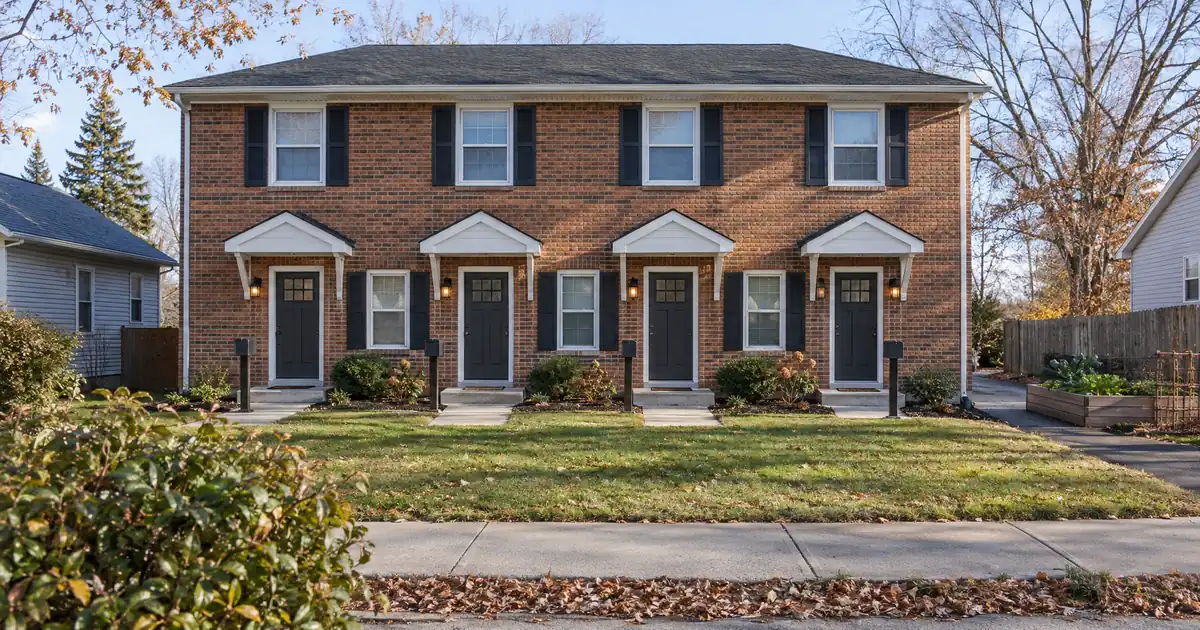
The Quick Read: A fourplex counts as one property with four rent-producing units, and each of the three houses counts as one property, so the pool is four properties and seven units, and the lender then adds all seven rents, adds the combined payment on all four properties, and divides to get one pooled coverage ratio. Which count matters depends on the program, because some loans count properties and others count properties or units. Everything below is subject to lender guidelines and individual underwriting.
- Properties and units are different numbers. Your pool is 4 properties and 7 units.
- One ratio covers the pool. Total rent divided by total PITIA (principal, interest, taxes, insurance, and any HOA dues) across all four properties.
- Every building is still reviewed on its own. Each one needs its own appraisal and its own lease or appraiser-supported market rent.
- Some programs also test each property alone. A strong pooled ratio does not always rescue one weak building.
- One note means shared risk. Selling a single property later runs through a release clause.
What a Portfolio DSCR Loan Actually Is
A portfolio DSCR loan puts several rental properties under one note, and the lender judges them together. DSCR stands for debt service coverage ratio. It compares the rent a property produces to the monthly obligation on the loan.
You will hear this called a blanket loan, a portfolio loan, or a pooled loan. The names overlap, and they all point at one idea: one loan secured by more than one property. The collateral is cross-collateralized, which means every property backs the whole debt.
DSCR loans are designed for non-owner-occupied investment properties. Because they are business-purpose investor loans, they are reviewed differently from a standard owner-occupied mortgage. Qualification runs primarily on property-level rental income covering the payment, subject to lender guidelines.
If you want the foundation first, Lendmire’s complete DSCR loans guide covers how the coverage ratio works on a single rental. This article picks up where that leaves off: how you count a mixed pool.
Key Terms Defined
Property: One parcel with its own title, appraisal, and tax bill. A fourplex is one property.
Unit: One separately rentable space inside a property. A fourplex has four units, and a house has one.
Blanket (portfolio) loan: A single loan secured by multiple properties under one note.
Pooled DSCR: Total rent used for lender review across the pool divided by total PITIA across the pool.
PITIA: The monthly principal, interest, taxes, insurance, and association dues on a property.
Cross-collateralization: Every property in the pool secures the entire loan, not just a slice of it.
Release clause: The loan term that lets you sell one property out of the pool on set conditions.
LTV (loan-to-value): The loan balance as a percentage of the property’s appraised value.
How Is a Fourplex Plus Three Houses Counted?
You hold four properties and seven units. The building is the unit of collateral, appraisal, and title. The unit is the unit of rent. Underwriting uses both counts for different jobs.
| Asset | Units | Counts as properties | Rent lines |
|---|---|---|---|
| Fourplex | 4 | 1 | 4 |
| Three houses | 1 each | 3 | 3 |
| Whole pool | 7 | 4 | 7 |
The appraisal world draws the same line. The Fannie Mae Selling Guide lists Form 1025 as the report for two-to-four-unit properties and Form 1004 as the report for a single unit. DSCR loans are not agency products, so those forms matter here only as the appraisal industry’s shared vocabulary. Your fourplex gets the multi-unit report, and each house gets the single-unit report.
The count matters because programs phrase their minimums differently. Across the wholesale network, a 30-year portfolio loan covers 2 to 20 properties under one note. That counts buildings, so your four properties fit. A separate rental portfolio term loan is built for five or more rental properties or units under one loan. Your seven units clear five on a unit count, while your four properties fall short on a property count. Which reading a given lender applies is a program question, and you should ask it before you build the pool.
How Underwriting Builds the Pooled Ratio, Step by Step
Here is the sequence on a pool like yours. The order is the same on most files we place across the network.
1. Inventory the pool. One fourplex gives four rent lines, and three houses give one each. That is seven rent lines on four properties.
2. Order valuations and rent opinions per building. Consolidating the debt does not skip the appraisals. A rent schedule such as Form 1007 pairs with the appraisal report, and an operating income statement such as Form 216 can sit alongside it, as Steiro Appraisal’s form descriptions lay out.
3. Pick the rent for each unit. Every property needs a lease or an appraiser-supported market rent. A vacant fourplex unit is usually counted at market rent, not at zero, but the lender decides.
4. Build the denominator. Add the new loan’s principal and interest to the taxes, insurance, and HOA dues on all four properties. That total is the pool’s PITIA.
5. Divide. Total rent used for lender review divided by total PITIA gives the pooled ratio.
6. Run the property-level checks. Some programs stop at the pooled ratio. Others also look at each building alone.
One convention note. The textbook version of this ratio uses net operating income divided by debt service. Most non-QM investor programs use the shortcut of rent divided by PITIA, and this article does too. The calculation leaves out repairs, vacancy, management, utilities, and capital spending. Clearing 1.00 is not the same as positive cash flow.
A Worked Example With Ratios Only
Dollar rents would make this look like a quote, so this example uses ratios. Treat every number below as a modeled assumption, not a program term. To keep the math clean, assume each building carries the same monthly obligation.
| Building | Units | Standalone coverage |
|---|---|---|
| Fourplex | 4 | 1.15x |
| House A | 1 | 1.20x |
| House B | 1 | 1.10x |
| House C | 1 | 0.90x |
| Pooled result | 7 | about 1.09x |
With equal obligations, the pooled ratio is the average of the four: 1.15, 1.20, 1.10, and 0.90 add to 4.35, and 4.35 divided by 4 is about 1.09. In a real file the payments differ.
House C sits at 0.90x on its own. It may sit in the pool, subject to underwriting, which tests the pooled coverage, the leverage, and the terms. One building below 1.00 is a pooled-coverage fact, not a separate program.
The Two Tests: Pool and Property
Programs fall into two camps. A pool-only test looks at the blended ratio and stops. A two-level test also checks each building alone. A blended ratio at 1.00 or above does not by itself settle approval when one building sits far outside an acceptable range on its own.
Here is how that plays out in the example. The pool clears at about 1.09x, so a pool-only test passes. A property-level check might flag House C at 0.90x.
The usual fix is a carve-out. You pull House C out of the pool and finance it separately. The remaining three properties (the fourplex plus two houses) average 1.15, 1.20, and 1.10 for a pooled 1.15x. That pool still holds three properties and six units.
The cost is the loss of averaging. Some borrowers accept that trade to keep the pool clean.
Which Program Structure Fits Four Properties?
Two portfolio structures matter for this pool, and they differ more than most people expect.
| Feature | 30-year pooled loan | Rental term loan |
|---|---|---|
| Count | 2 to 20 properties | 5+ properties or units |
| Loan size | $300K to $5M | $500K to $50M |
| Leverage | Up to 80% of value | Up to 75% of value |
| Term | 30-year, interest-only available | 3, 5, 7, or 10-year fixed, balloon |
The 80% figure applies on a purchase or rate-and-term refinance of investment rentals. Cash-out on any portfolio loan stays at or below 75% of pooled value, and only on seasoned properties. Inside the first six months of ownership, a seasoning rule limits the cash-out amount.
The pooled loan measures coverage on the pool, so stronger properties can offset weaker ones. The term loan is a different product. Non-recourse versions exist, with carve-outs for fraud and bankruptcy, while recourse versions carry a personal guarantee. Prepayment on the term loan runs on yield maintenance, which means early payoff costs are built around the lender’s lost interest. Programs vary, and every figure above is a ceiling or floor, not a quote.
What You Need to Clear as the Borrower
The pool has to clear two tests: enough equity and enough rental coverage. A bigger down payment lowers the payment and can lift the ratio, but it never erases leverage caps, credit floors, reserve rules, or property eligibility.
- Credit: A floor around 640 applies on portfolio files, and some structures want 680 or 720.
- Entity: Some structures require a special-purpose entity, typically an LLC, per lender program requirements.
- Reserves: They vary by lender, leverage, and loan size. About 6 months of PITIA is common on many files, and larger loans often step up. On the term loan, reserves are held for taxes, insurance, and capital expenditures. Lendmire’s piece Does a Portfolio Investor’s Brokerage Count Toward DSCR Reserves? covers how liquid assets are treated.
- Rent support: Every property needs a lease or an appraiser-supported market rent.
Tax treatment can depend on how the funds are used and how the property is held; investors should keep clear records and speak with a qualified tax professional before relying on any deduction.
Cross-Collateralization and Releases
One note secures all four properties, and each deed or mortgage pledges the full obligation, not a slice. That is the convenience and the risk in one sentence. If the loan goes into default, every property in the pool is exposed.
Selling one property later runs through the release clause. Partial releases, substitutions, and sales follow the loan documents and the lender’s release terms. The release price runs above the property’s allocated balance, so you pay more than a simple share of the debt to free one building. The remaining portfolio must still cover its debt service after the sale.
Count mechanics matter here. Sell one house from your pool and you have three properties and six units left. That still fits a 2-to-20 property range. On a loan that counts properties or units against a minimum of five, six units might clear. Sell the fourplex instead and you have three properties and three units left, which could fall below that kind of minimum. Plan the release terms before closing, not after.
In many pooled files we see, borrowers focus on the blended ratio and read the release language last. That order is backwards. The release clause decides how flexible the pool is for years.
Pool or Separate Loans?
For a four-property deal, you are choosing between one pooled note and separate notes. Neither wins every time.
| Factor | One pooled loan | Separate loans |
|---|---|---|
| Averaging | Strong buildings offset weak | Each stands alone |
| Closings and payments | One of each | Four of each |
| Selling one building | Needs a release | Clean sale and payoff |
| Default exposure | All four at risk | Contained per loan |
Pooling helps when one building is marginal and the rest are strong. A fourplex often has its own term question. Lendmire’s article Can a Portfolio Owner Get Single-Family DSCR Terms on a Fourplex? walks through that choice.
This one is a real toss-up on smaller pools. The averaging benefit is modest with four properties, and the release friction is the same as with twenty.
Where the General Rule Breaks
Four units versus five. A fourplex stays in the one-to-four unit residential category. Per Appraisal Colorado’s description of the 1025 report, buildings of five or more units move into commercial-style treatment. That is the line to watch if you add a fifth unit.
One vacant unit. A vacant unit in the fourplex can pull that building’s coverage down. A pooled test absorbs it. A property-level test may not.
Ineligible property types. Owner-occupied property, mobile homes, co-ops, mixed-use property, and commercial property cannot sit in the pool. Manufactured homes, log homes, and barndominiums are not offered in these programs.
Short-term rentals. Variable income gets closer scrutiny. Short-term rental rules can vary by city, county, HOA, and property type, so investors should confirm local rules before relying on projected rental income.
Pre-Application Checklist, One Row Per Building
Build one schedule per building before you ask for a quote. For each of the four properties, collect:
- The current lease for each unit, or a market rent opinion if the unit is vacant.
- Annual taxes, insurance, and any HOA dues.
- The vesting entity and title status.
- Any existing loan balance, if this is a refinance.
- Condition notes that might affect the appraisal.
That gives you seven rent lines, four expense sets, and four appraisals to plan around. A clean schedule makes the pooled ratio easy to check before a lender sees it.
Common Misconceptions
A fourplex counts as four properties. It is one property with four units. Your pool is four properties and seven units.
Blanket means one appraisal. Each building is valued on its own, with its own rent schedule.
Blended means weak assets do not matter. A property-level check can still catch an outlier.
One note makes it easy to sell one house. A release clause governs the sale, and the price runs above the allocated balance.
DSCR is always net operating income over debt service. Most non-QM investor loans use rent over PITIA.
Frequently Asked Questions
Does a fourplex count as one property or four toward a portfolio minimum?
It counts as one property with four units. Whether the minimum counts properties or units depends on the program. A property-count minimum sees your pool as four, while a loan that counts properties or units sees seven.
Can one strong building carry a weak one?
On a pooled test, yes, within limits. The blended ratio averages the buildings, weighted by payment size. Some programs also review each property alone, and underwriting still tests pooled coverage, leverage, and terms.
Do I need an appraisal on every property?
Yes. Each building gets its own valuation and rent schedule, even though one loan covers all of them. The fourplex uses a multi-unit report, and each house uses a single-unit report.
What happens to the pool if I sell one house?
The release clause controls it. You pay a release price above that house’s allocated balance, and the remaining properties must still cover the debt. You would be left with three properties and six units.
Is a four-property pool too small?
Not on the 30-year pooled structure, which covers 2 to 20 properties. A term loan built around five or more properties or units may count your seven units instead. Fit depends on the lender’s reading of the count.
Next Step
If you are buying or refinancing a rental property and want to see how the numbers work, Lendmire can help you compare DSCR loan options based on the property income, credit profile, leverage, and investor goals. Lendmire is a broker that arranges financing through select lenders in its wholesale network across 41 markets, including Washington, D.C. Each file is underwritten individually, and nothing here is a commitment to lend.
About Lendmire
Lendmire — NMLS# 2371349 — is a DSCR and non-QM mortgage brokerage with investor loan programs in 41 markets, including Washington, D.C. DSCR eligibility is commonly reviewed by the lender around property-level rent rather than personal income documentation, subject to lender guidelines, and the brokerage helps arrange financing for LLC-owned portfolios beyond conventional financed-property limits. Recognized by Scotsman Guide as a Top Mortgage Workplace in 2025 and 2026.
Get Started
Ready to find the right loan for you?
In about 30 seconds you can review financing options available for your investment property. No commitment required.
Informational only. Not a Loan Estimate, approval, or commitment to lend. Program availability and eligibility are subject to lender guidelines, credit approval, property review, and underwriting.
References
1. Fannie Mae Selling Guide B4-1.2-01
2. Steiro Appraisal form descriptions
3. Appraisal Colorado – Form 1025
This article is part of Lendmire’s DSCR loan program — full qualification details, guidelines, and scenarios live on the program page.
Related reading: Can a Maturing Portfolio Loan Be Refinanced Into a 30-Year DSCR Loan? · How to Handle Vacancies Before a DSCR Portfolio Loan · Can You Swap One Rental for Another in a Portfolio DSCR Loan?
Brandon Miller
Founder & CEO, Mortgage Loan Originator, Lendmire LLC
- Mortgage Loan Originator · NMLS# 1129696 · Verify on NMLS Consumer Access
- North Carolina Real Estate Broker · License# 343312 · Verify on NCREC
- North Carolina Insurance Producer · License# 19053198 · Property, Casualty, Life, Health · Verify on NAIC SBS
- Lendmire LLC · Firm NMLS# 2371349 · Verify firm licensure
Disclosure information. Lendmire is a state-licensed mortgage brokerage under NMLS# 2371349. Lendmire is not a depository institution, direct lender, or financial advisor — all loans referenced are placed through wholesale lender partners and are subject to each lender's underwriting standards. This article is provided for general informational purposes and is not a commitment to lend, nor does it constitute financial, legal, or tax advice. Loan programs, terms, rates, and qualification standards change without notice and depend on borrower profile, property type, and the state in which the subject property is located. Equal Housing Opportunity provider. NMLS Consumer Access: nmlsconsumeraccess.org.