
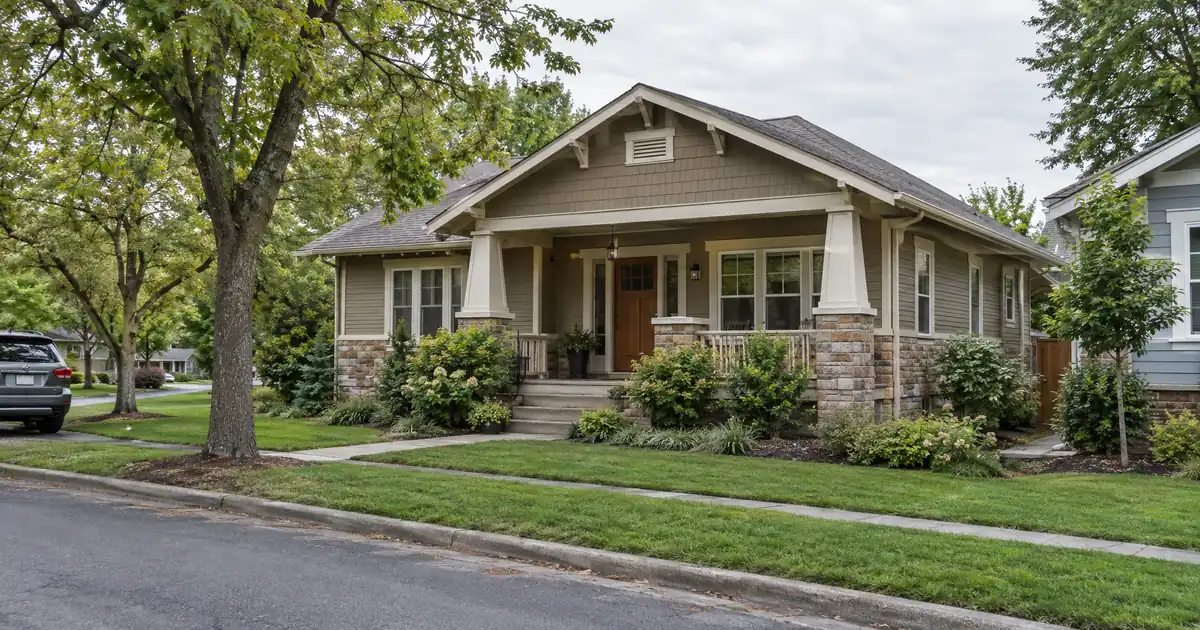
The Quick Read: Yes, you can use one, and where you live is not part of the formula. The lender looks at the property: its appraised value, its market rent, and its full monthly payment. Your home address never enters that math. Geography matters through the property’s state, meaning which lenders can write the loan, how local taxes and insurance shape the ratio, and what state law says about early payoff.
Key Takeaways
- Your home state is not a rating factor. The property’s rent, value, and payment are.
- Most purchases on the wholesale network land at 75%-80% LTV, subject to lender guidelines.
- Clearing 1.00 coverage means rent covers the payment. It does not mean you make money.
- The property’s state affects lender availability, prepayment rules, taxes, and insurance.
- The appraisal is your eyes on the ground when you cannot walk the comps yourself.
How Does a DSCR Loan Work for Out-of-State Real Estate Investing?
A DSCR loan qualifies the property, not the person’s zip code. DSCR means debt service coverage ratio: the property’s monthly rent divided by its monthly PITIA. PITIA is principal, interest, taxes, insurance, and HOA dues where they apply. Qualification runs primarily on property-level rental income covering the payment, subject to lender guidelines.
DSCR Calculator
Run the numbers in your market
Rate source: Freddie Mac 30-yr average via FRED® — Federal Reserve Bank of St. Louis · effective Oct 1, 2026
Prefilled with starting assumptions — enter your own rent or nightly figures, taxes, insurance, and HOA for a more accurate picture.
Program parameters update from Lendmire’s centralized guideline source. Taxes and insurance are editable estimates.
As of Oct 1, 2026 · General Freddie Mac market benchmark, not a Lendmire loan offer. Rent, nightly rate, occupancy, taxes, and insurance are editable estimates. Short-term rental figures are estimates only and vary significantly by season, property type, management approach, and local short-term-rental rules — confirm local regulations before relying on them. Qualifying income for short-term rentals varies by program — some use appraisal market rent, others use documented STR history or projections — and is confirmed in underwriting. Not a Loan Estimate, approval, or commitment to lend. Program availability and eligibility are subject to lender guidelines, credit approval, property review, and underwriting.
Here is the sequence a file follows.
1. You pick the market. This happens before any lender is involved. Rent-to-price ratio, vacancy, landlord-tenant law, and the availability of property managers matter far more than your own address.
2. The loan is classed as business-purpose. DSCR loans are designed for non-owner-occupied investment properties. Because they are business-purpose investor loans, they are reviewed differently from a standard owner-occupied mortgage. You sign certifications that you will not live there.
3. The appraiser sets value and rent. One report does both jobs. Value drives LTV. Market rent drives coverage.
4. The lender picks the rent used for lender review. Most programs use the lower of the in-place lease or the appraiser’s market rent. A vacant property leans entirely on the appraiser. An above-market lease does not lift the number.
5. The ratio gets calculated. Qualifying monthly rent over PITIA. Management fees generally are not subtracted from gross rent here. They hit your real cash flow instead.
6. The entity documents get collected, if you are borrowing through an LLC. That is subject to lender program eligibility.
7. You close remotely. Remote notaries, e-signatures, and virtual walkthroughs make this routine.
Nothing in those steps asks where you sleep at night. That is the whole point of the product.
Where Geography Actually Shows Up
The property’s state changes the file in four places, and none of them punish you for living elsewhere.
| Factor | Why it changes by state |
|---|---|
| Lender roster | Not every lender is licensed in every state |
| Taxes and insurance | They sit inside PITIA, so they move coverage |
| Prepayment rules | State law shapes early-payoff terms |
| Rent comps | Thin local comps make the appraisal harder |
Take the taxes and insurance row seriously. Out-of-state buyers often fall for a rent-to-price ratio and forget that taxes and insurance vary sharply by state and county. The same rent can produce a very different coverage number two states over. Budget for both, then let the actual quotes decide.
Licensing deserves a plain explanation. Business-purpose loans escape much of the federal consumer-mortgage machinery. States, however, still license lenders, and in some states fewer lenders are licensed for this work. That is a lender problem, not a borrower penalty. It is also why a broker with access to many lenders matters more here than it would in your home market.
What Does the Network Look Like for Purchases?
Most purchase files across the wholesale network land at 75%-80% LTV, meaning 20%-25% down. LTV, or loan-to-value, is the loan balance divided by the property’s appraised value. A few high-leverage programs reach 85% LTV with 15% down, generally for borrowers with roughly a 700+ score. All of it is subject to lender guidelines and property review.
Credit works in tiers. A 620 floor exists in parts of the network. Most programs want around 660. A 700+ score unlocks the strongest leverage tiers.
Coverage starts at 1.00 for select programs. That is a floor for specific programs, not a universal standard. Stronger ratios open better pricing and leverage. Sub-1.00 coverage is available through select lenders in the network, with leverage and terms adjusted. No-ratio structures exist only through select lenders, generally for borrowers who already own a primary residence.
Loan sizes run roughly up to $3,000,000 on standard programs, with smaller balances available through select lenders. Above $2,500,000 the network generally holds to 30-year fixed structures. The 30-year fixed is the spine of the product. Extended 40-year terms and interest-only periods are available through select lenders, and ARM structures exist for investors who want them.
Reserves are cash you hold after closing. They vary by lender, leverage, loan size, and transaction type. About 6 months of PITIA is common. Conservative rate-and-term files at modest leverage under $1,500,000 can see reserves waived. Larger loans typically step up to about 9 months.
One more point on money down. A bigger down payment lowers the payment and can lift your coverage ratio. It never erases leverage caps, credit floors, reserve rules, or property eligibility. The strongest files clear both tests: enough equity and enough rental coverage.
Why Is the Appraisal So Important When You Can’t Visit?
Because it is the one set of eyes you did not hire yourself. For a single-family home, the appraiser typically uses Form 1007, a comparable rent schedule. For two-to-four units, it is Form 1025. These are agency form names that non-QM lenders borrowed to document rent. They do not make DSCR loans agency products, and the format may evolve, so do not assume the form names stay fixed. Separately, the CFPB’s RESPA coverage rule exempts business-purpose loans like these from federal RESPA coverage, and it also leaves state law in place.
Out-of-state investors feel the weight of this. You cannot drive by the comps. The appraiser’s comp selection sets the rent number, and the rent number sets your coverage. In rural markets or rent-controlled buildings, comps get thin and the standard rent-schedule process can strain.
Practitioner pattern worth knowing: on remote files, the surprises rarely come from the borrower’s profile. They come from a rent opinion that lands below what the listing or the property manager promised. Ask your manager for actual comparable leases before you go under contract, not after the appraisal comes back.
Edge Cases Where the General Rule Bends
Prepayment penalties. Many DSCR loans carry a prepayment penalty, a fee for paying the loan off early. Once a loan is business-purpose, state law does most of the policing. Some states restrict these penalties on residential-secured loans but leave business-purpose loans more room. Others are unsettled about LLC borrowers. A state’s rules do not make a loan unavailable. They change the cost of an early payoff or refinance, so ask about the structure in the property’s state before you sign.
Short-term rentals. Airbnb-style income does not fit a rent schedule built on monthly lease comps. Short-term rental rules can vary by city, county, HOA, and property type, so investors should confirm local rules before relying on projected rental income. On the financing side, STR purchases go to 75% LTV with a 1.00 coverage floor. STR refinances run around 70% with their own 1.00 floor. Expect a 640+ score and about 12 months of hosting history. These specifics are subject to lender guidelines and a full review of property, leverage, and credit.
Cash-out on a remote property. Cash-out ceilings sit at 75% LTV on standard rentals and 70% on short-term-rental collateral, and about 6 months of seasoning is the common expectation. Seasoning is the waiting period after you buy before a lender will refinance on appraised value. For the mechanics, see this look at cash-out refinancing for real estate investors. Terms vary by lender guidelines, property type, leverage, credit profile, and full file review.
Property types that are out. Manufactured homes (single- and double-wide), log homes, and barndominiums are not offered in the network’s DSCR programs. Cheap rural inventory often falls here. Check the property type before you fall in love with the price.
Entity vesting. Taking title in the LLC at closing, rather than deeding it in later, keeps the business-purpose posture clean. It can also change how a prepayment penalty is analyzed.
Does the Ratio Mean the Deal Makes Money?
No. Clearing 1.00 means rent covers PITIA. Repairs, vacancy, property management, utilities, and capital expenses all sit outside the calculation. A property can clear the ratio and still lose money in a bad quarter.
This matters more when you are remote. You will probably pay a manager, and that fee is not in the ratio. Budget it separately, and size your reserves for the months when a roof or a vacancy lands at the wrong time.
Picture an investor who finds a duplex in a distant Midwest market with rent that clears roughly 1.25x on the appraiser’s number. That sounds comfortable. But if the manager’s fee and a few vacant weeks eat most of the cushion, the real margin is thin. The ratio told the lender the loan fits. It told the investor very little about profit.
DSCR vs. conventional financing
There are two common ways to finance an investment property in this market, and they qualify you differently — here’s how investors weigh them.
Why investors choose it
- Qualifies on the property’s rental income — no personal tax returns, W-2s, or pay stubs needed to document income.
- No personal debt-to-income ceiling to clear, so existing mortgages and obligations don’t cap your borrowing the same way.
- Can be closed in an LLC, keeping the property inside a business entity.
- Built for scaling — not held to the limit on number of financed properties that conventional financing applies.
- Underwriting centers on the deal: generally qualifies when the rent covers the payment, a 1.00x coverage ratio being a common baseline (confirmed in underwriting).
- Designed specifically for investment property, including long-term and, where the program allows, short-term rentals.
Where it’s strong
- Often the lowest ongoing financing cost for a buyer who fully qualifies on personal income — a fit for a first property or a cost-first purchase.
Trade-offs for investors
- Requires full personal income documentation and must fit within a debt-to-income limit — salary, existing debts, and other mortgages all count.
- Typically held in your personal name rather than a business entity.
- Caps how many financed properties you can carry, which can become a ceiling as a portfolio grows.
- Evaluates you as a borrower as much as the property, which usually means more paperwork.
How investors usually choose: a first or single property often optimizes for the lowest financing cost; portfolio builders often optimize for leverage, vesting in an LLC, and scaling past conventional caps. The right answer depends on your goals, the property, and current guidelines — both paths run through select lenders in Lendmire’s wholesale network, with eligibility and terms confirmed in underwriting.
How Do You Choose a Market Without Walking It?
Start with the rent-to-price relationship, then check what the ratio can’t see: vacancy, job base, and how easily you can hire a good manager. Treat the ratio as a filter, not a verdict.
Some market color helps, two data points only. SFR Analytics puts the out-of-state share of purchases at 6.72% in the bottom price decile and 8.71% in the top decile, with the 7.29% figure sitting between those two ends. Cotality defines an investor as a buyer owning three or more properties and ranks Dallas, Houston, and Atlanta highest for purchases. Remote buying is common. You would not be the first.
If you are new to buying away from home, this walkthrough on out-of-state investing for first-time buyers covers the planning side.
What Does the Decision Look Like in Practice?
Run it in this order.
1. Screen markets on rent, vacancy, and manager availability. 2. Confirm the property type is eligible. 3. Get taxes and insurance quotes for that exact county. 4. Model coverage on the lower of lease or likely market rent. 5. Check your credit tier, your equity, and your reserves against the leverage you want. 6. Ask about the prepayment structure in that state. 7. Decide whether an LLC fits your plan, subject to program terms.
Think of it as two tests. Does the property cover itself? Do you have enough equity and liquidity behind it? A DSCR loan is a good fit when both answers are yes and you want to scale without personal income being the limit. Subject to lender guidelines, there is no fixed cap on how many properties you can finance this way, though each file stands on its own.
Tax treatment can depend on how the funds are used and how the property is held; investors should keep clear records and speak with a qualified tax professional before relying on any deduction.
Key Terms Defined
DSCR: Debt service coverage ratio, the property’s qualifying monthly rent divided by its monthly PITIA.
PITIA: Principal, interest, taxes, insurance, and any HOA dues, the full monthly cost of owning the property.
LTV: Loan-to-value, the loan balance as a percentage of the property’s appraised value.
Seasoning: The waiting period after you buy before a lender will refinance against appraised value.
Prepayment penalty: A fee charged if you pay the loan off or refinance before a set period ends.
Reserves: Liquid cash you must hold after closing, usually counted in months of PITIA.
Business-purpose loan: Credit for an investment or commercial use, such as a non-owner-occupied rental, rather than a place you live.
A Note Before You Act
This article is general education, not legal or tax advice. State licensing, prepayment law, entity structure, and tax treatment all depend on your situation. Talk to a qualified attorney or CPA before you act. For the full picture of how these loans work, read the complete DSCR loans guide.
Frequently Asked Questions
Do I need to live in the same state as the property?
No. Your residence is not part of the DSCR calculation. The lender reviews the property’s value, rent, and payment, plus your credit, reserves, and leverage. Anything stricter on a remote file would come from the property or the program, not from where you live.
Do management fees lower my DSCR?
Generally not. The ratio compares the gross rent a lender reviews against PITIA, so a manager’s fee does not appear in it. That fee still reduces your actual cash flow, so budget for it separately.
What if the property comes in below 1.00?
Expect lower LTV and different terms than a file that clears the baseline. Eligibility depends on lender guidelines, credit, reserves, and property review.
Can I close without traveling?
Generally yes. Remote notaries, e-signatures, and virtual inspections are common practice on out-of-state deals. Your title company and closing agent coordinate the signing logistics.
Does a lease above market rent help my ratio?
No. Most programs use the lower of the lease or the appraiser’s market rent, so an above-market lease does not raise the coverage figure. A below-market lease can pull it down.
If you are buying or refinancing a rental property and want to see how the numbers work, Lendmire, a broker arranging DSCR financing through select lenders across 41 markets, including Washington, D.C., can help you compare DSCR loan options based on the property income, credit profile, leverage, and investor goals. Request a quote at 828-256-2183 or through the quote form.
About Lendmire
As a non-QM mortgage broker (NMLS# 2371349), Lendmire facilitates DSCR investor loans across 41 markets, including Washington, D.C. DSCR eligibility is generally reviewed around property-level rental income instead of personal income documentation, subject to lender guidelines, serving LLC-structured portfolios and self-employed borrowers who don’t fit conventional boxes. Lendmire is a two-time Scotsman Guide Top Mortgage Workplace (2025, 2026).
Scotsman Guide’s Top Mortgage Workplace lists for 2025 and 2026 document Lendmire’s recognition.
Get Started
Ready to find the right loan for you?
In about 30 seconds you can review financing options available for your investment property. No commitment required.
Informational only. Not a Loan Estimate, approval, or commitment to lend. Program availability and eligibility are subject to lender guidelines, credit approval, property review, and underwriting.
References
1. CFPB – 12 CFR 1024.5 Coverage of RESPA
2. SFR Analytics – Out of State Investor Trends
This article is part of Lendmire’s DSCR loan program — full qualification details, guidelines, and scenarios live on the program page.
Related reading: Luxury Rental DSCR Loans In New Jersey · Jersey Shore Vacation Rental Loans: DSCR Financing In Ocean City, Cape May And Long Beach Island · DSCR Cash-out Refinance In New Jersey: Pulling Equity From A Rental
Brandon Miller
Founder & CEO, Mortgage Loan Originator, Lendmire LLC
- Mortgage Loan Originator · NMLS# 1129696 · Verify on NMLS Consumer Access
- North Carolina Real Estate Broker · License# 343312 · Verify on NCREC
- North Carolina Insurance Producer · License# 19053198 · Property, Casualty, Life, Health · Verify on NAIC SBS
- Lendmire LLC · Firm NMLS# 2371349 · Verify firm licensure
Disclosure information. Lendmire is a state-licensed mortgage brokerage under NMLS# 2371349. Lendmire is not a depository institution, direct lender, or financial advisor — all loans referenced are placed through wholesale lender partners and are subject to each lender's underwriting standards. This article is provided for general informational purposes and is not a commitment to lend, nor does it constitute financial, legal, or tax advice. Loan programs, terms, rates, and qualification standards change without notice and depend on borrower profile, property type, and the state in which the subject property is located. Equal Housing Opportunity provider. NMLS Consumer Access: nmlsconsumeraccess.org.