
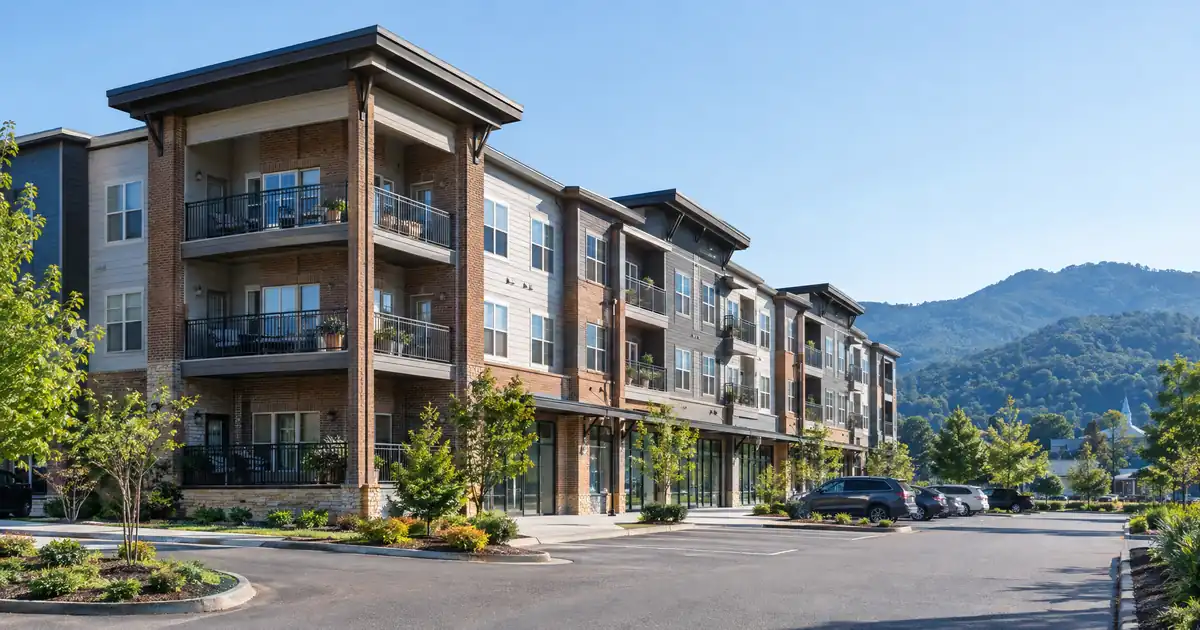
Picture two Lawrenceburg owners who each want equity out of a rental. One holds a renovated three-bedroom on the older central-city streets, renting in the range of $1,450 per Homes.com listings. The other holds a newer house out along the US-64 corridor toward David Crockett State Park, with a higher appraised value and roughly the same rent. On a DSCR cash-out, the first owner has the better file. Price gains don’t create borrowing power here. The rent divided by the full monthly obligation does, and the cheaper house wins that division.
TL;DR: A DSCR cash-out refinance in Lawrenceburg, Tennessee suits owners of renovated three-bedrooms or small multifamily whose equity is real and whose rent holds up on an appraiser’s schedule; it is underwritten primarily on the property’s rental income measured against its full monthly obligation, so the rent, more than the price gain, decides how much equity can come out.
DSCR Cash-Out Calculator
Run the cash-out numbers in Lawrenceburg, TN
Rate source: Freddie Mac 30-yr average via FRED® — Federal Reserve Bank of St. Louis · effective Sep 24, 2026
Prefilled with starting assumptions — enter your property’s value, balance, taxes, and insurance for a more accurate picture.
Program parameters update from Lendmire’s centralized guideline source. Taxes and insurance are editable estimates.
As of Sep 24, 2026 · General Freddie Mac market benchmark, not a Lendmire loan offer. Property value, balance, taxes, and insurance are editable estimates. Maximum loan-to-value varies by lender, program, property type, and seasoning. Not a Loan Estimate, approval, or commitment to lend. Program availability and eligibility are subject to lender guidelines, credit approval, property review, and underwriting.
- The city median rests on only 10 sales in one month, per Redfin.
- Three-bedroom rents cluster around $1,300 to $1,450, per Zillow Rental Manager and Homes.com.
- Small multifamily is 17.85 percent of housing units, per NeighborhoodScout.
- Cash-out caps at 75 percent LTV after about six months of ownership.
Lawrenceburg Market Snapshot
A quick read on the Lawrenceburg investor landscape — figures come from the cited sources below. Confirm current property-level numbers before underwriting.
| Metric | Detail |
|---|---|
| Typical rents | $768 (HomeSnacks) |
| University enrollment | 7,000 students (Homes.com) |
Central-City Three-Bedrooms: Where the Coverage Holds
The older streets around the hospital and the courthouse square are the strongest cash-out ground in Lawrenceburg. Purchase basis on 3 to 4 bedroom houses there is low, and tenant demand comes from hospital staff, factory workers, and families. Rent sits closest to price in this part of town. It isn’t glamorous, but it works.
Southern Tennessee Regional Health System runs a 99-bed acute care hospital in town, and that feeds a steady pool of nurses, techs, and allied-health workers who want a house near work. Manufacturing adds to it. Homes.com’s listing narrative names Plasman, Modine Manufacturing, and AOC Metal Works among the industrial employers. TNECD lists top-employer headcounts of roughly 1,100, 900, 400, and 310 in the county.
Lendmire, a DSCR-focused mortgage broker, arranges investor loans through wholesale lending channels. Lendmire’s DSCR program footprint covers Lawrenceburg, Tennessee as part of a 41-market reach that includes Washington, D.C. For a central-city owner sitting on a paid-down house, the question is how much of the equity survives the coverage test. The full monthly obligation includes taxes and insurance, and the cash-out ceiling is a 75 percent LTV cap. The cash-out refinance walkthrough covers the general mechanics, and the rest of this piece is about how they land in a town this size.
The US-64 Corridor and New Builds (Where Value Outruns Rent)
Coverage gets harder on the western edge. Listings along US-64 toward David Crockett State Park, about half a mile west of town per the City of Lawrenceburg, show newer homes in an asking range of roughly $250,000 to $365,000. Rents on those houses don’t scale with that price. A $365,000 house doesn’t rent for meaningfully more than a $200,000 one in a market where the Zillow Rental Manager range for houses tops out at $1,900.
New-build rentals are a real segment, and Homes.com notes newer homes appearing around town. But the high appraised value that makes an owner feel equity-rich is exactly what dilutes the coverage number. Say a corridor owner pulls a strong appraisal and then finds that rent covers only a sliver of the full obligation at 75 percent LTV. That owner has three options: a lower loan-to-value, a sub-1.00 program from a select lender, or an interest-only structure. Each is a lender-review question, not a promise, and each costs something in leverage or flexibility.
This is not a toss-up for owners weighing which house to refinance first. The corridor house has more absolute equity. The central-city house has more borrowing power per dollar of value. For most owners, borrowing power is the binding constraint.
The Rent Number Is the Whole Ballgame
Rent data in Lawrenceburg contradicts itself, and that matters more here than in a deeper market. Zumper shows an average rent of $1,045, down 13 percent year over year. The Zillow Rental Manager shows a $1,095 average for houses and $1,300 for a three-bedroom. HomeSnacks shows a census-style median of $768. Homes.com shows $1,450 for three-bedroom houses, but off just four listings.
Read that spread as segments, not noise. Legacy stock with legacy tenants rents low. Renovated three-bedrooms rent near $1,300 to $1,450. A lender’s appraiser will produce a rent schedule for the specific property, and that schedule, not a city average and not a listing-site median, is the numerator. Owners who plan to cash out should have current leases in hand and be honest about whether their rent is at market or below it.
Median household income is about $41,458, which helps explain why rents don’t stretch further. The renter pool is real (NeighborhoodScout puts owners at 55.75 percent, leaving roughly 44 percent renters), but incomes cap what any landlord can push.
Worked Scenario: A Modeled Cash-Out on a Central-City Three-Bedroom
Run the numbers on a hypothetical. These are modeled assumptions, not sourced market data: a house valued at $220,000 by an appraiser, a 75 percent LTV cash-out, standard 30-year terms, and coverage computed on the full monthly obligation including taxes and insurance, rounded down.
| Modeled case | Assumed value | Assumed rent | Coverage (75% LTV) |
|---|---|---|---|
| Renovated 3BR, central city | $220,000 | $1,450 | about 1.1x |
| Same house, average-rent tenant | $220,000 | $1,045 | about 0.8x |
| At the city median value | $237,000 | $1,450 | about 1.0x |
| At the county median value | $272,000 | $1,450 | about 0.9x |
The pattern is the point. Same rent, higher value, thinner coverage. The 1.00 benchmark is where most standard DSCR programs start because rent covers the obligation at that level, though exact eligibility depends on lender guidelines, credit, reserves, and property review.
Now the sub-1.00 rows. The average-rent case and the county-median case sit below 1.00 on long-term rent alone. Some lenders in the network may review sub-1.00 programs, and an interest-only structure or a lower loan amount could change the picture. Those usually come with stronger credit, more reserves, or less cash out. Qualification is subject to lender guidelines, credit approval, and property review.
Dropping the same $220,000 house to 65 percent LTV moves the modeled coverage to roughly 1.2x. The tradeoff is less cash out. For an owner whose goal is a specific down payment on the next property, that may still be enough. For an owner who wants to pull every available dollar, it won’t be.
DSCR files in markets like this one typically look like a small stack of documents and a narrow margin. The cleanest file from a documentation standpoint has complete leases, entity paperwork (for LLC-held property, subject to lender program eligibility), clean title, and current property details ready for lender review. In thin markets, the appraisal and the rent schedule tend to move the outcome more than the borrower’s credit tier does. Borrowers who assume the rent will speak for itself are often the ones surprised by the number.
Duplexes and Small Multifamily: The Better Coverage Lever
Small multifamily is where the DSCR math improves. NeighborhoodScout puts duplexes, converted homes, and small apartment buildings at 17.85 percent of Lawrenceburg’s housing units, against 69.13 percent single-family detached. That’s a real segment, not a theoretical one.
Two-bedroom, one-bath units rent for less than a house, but two of them under one roof usually out-earn a single house without doubling the price. That improves the rent-to-value relationship, which the single-family market here does poorly. Homes.com lists a 16-unit duplex portfolio on Mattox Road, all units built in 2017 or later. It’s a bulk purchase, no asking price came through in the research, and in-place rents would need verifying with a rent roll. Treat it as evidence that the product exists locally, not as a deal.
Older converted buildings near downtown deserve a caution. Lower basis is attractive, but condition, deferred maintenance, and unit-level rent documentation can complicate the lender’s review.
Seasoning, Appraisals, and the Thin-Comps Problem
The six-month ownership clock is measured from title recording. An owner who bought a value-add house, renovated it, and leased it up can generally refinance after roughly six months. But in Lawrenceburg the appraisal is the harder gate.
Redfin shows a $237,000 city median up 30.5 percent year over year, but only 10 homes sold in that month and days on market rose to 118 from 40. Movoto shows price per square foot down 1 percent. Zillow’s typical home value is $196,609, up 4.3 percent. With one or two outlier sales able to swing a monthly median, an appraiser may not support the price gains that headlines suggest. And the county series, a steadier read at $272,000 up 4.4 percent, describes a different set of houses than the city does.
Underwrite as if values and rents stay flat. If they rise, good. If the appraiser lands lower than the owner hoped, the 75 percent ceiling applies to that lower number. Reserves on most files run about six months of the full obligation, and credit tiers commonly start around 620 with better positioning at 660, 680, and 700, all subject to lender guidelines. The refinance details page covers structure options.
Where the Proceeds Go (and When Conventional Wins)
Pulling equity to buy another rental in the same submarket makes the argument straightforward, since the coverage math is already proven on the property being refinanced. Pulling it to fund a purchase where the rent-to-value doesn’t work is a different decision, and one worth stress-testing before committing.
The flip point: if the owner is a W-2 borrower holding one or two rentals in their own name with clean traditional personal-income documentation, a conventional cash-out may carry a lower cost and won’t lean on the rent number at all. DSCR earns its place for LLC-held property, for portfolios past the conventional financing limits, for self-employed owners, or where personal income documentation is messy. The conventional-vs-DSCR tradeoffs lay out the comparison. For the basics, see the guide “What Is a DSCR Loan” of how the ratio works.
A note on rural county properties in Loretto, Leoma, Ethridge, and similar towns. Acreage and lower prices attract some investors, but manufactured homes, log homes, and barndominiums fall outside the network’s DSCR programs entirely. Check the structure before assuming it qualifies.
Investors weighing Lawrenceburg against other Middle Tennessee markets can start at the Tennessee DSCR investor loans hub. Questions on a specific file can go to 828-256-2183.
DSCR vs. conventional financing
Two common ways to finance an investment property in Lawrenceburg, TN. They qualify you differently — here’s how investors weigh them.
Why investors choose it
- Qualifies on the property’s rental income — no personal tax returns, W-2s, or pay stubs needed to document income.
- No personal debt-to-income ceiling to clear, so existing mortgages and obligations don’t cap your borrowing the same way.
- Can be closed in an LLC, keeping the property inside a business entity.
- Built for scaling — not held to the limit on number of financed properties that conventional financing applies.
- Underwriting centers on the deal: generally qualifies when the rent covers the payment, a 1.00x coverage ratio being a common baseline (confirmed in underwriting).
- Designed specifically for investment property, including long-term and, where the program allows, short-term rentals.
Where it’s strong
- Often the lowest ongoing financing cost for a buyer who fully qualifies on personal income — a fit for a first property or a cost-first purchase.
Trade-offs for investors
- Requires full personal income documentation and must fit within a debt-to-income limit — salary, existing debts, and other mortgages all count.
- Typically held in your personal name rather than a business entity.
- Caps how many financed properties you can carry, which can become a ceiling as a portfolio grows.
- Evaluates you as a borrower as much as the property, which usually means more paperwork.
How investors usually choose: a first or single property often optimizes for the lowest financing cost; portfolio builders often optimize for leverage, vesting in an LLC, and scaling past conventional caps. The right answer depends on your goals, the property, and current guidelines — both paths run through select lenders in Lendmire’s wholesale network, with eligibility and terms confirmed in underwriting.
Frequently Asked Questions
How do you qualify for a DSCR cash-out refinance in Lawrenceburg, Tennessee?
Qualification centers on the property’s rent measured against its full monthly obligation, with a 1.00 benchmark common across standard programs. Beyond that, lenders look at credit tier, reserves (about six months on most files), and about six months of ownership before cash-out. In Lawrenceburg, the appraiser’s rent schedule usually matters more than any city average, since sources range from $768 to $1,450. Terms vary by lender, borrower, and property.
What are the requirements for an investment property loan refinance in Lawrenceburg, TN?
Expect a 75 percent LTV ceiling on cash-out, a credit floor around 620 with better tiers above it, reserves, and complete leases and title. LLC-held properties are eligible depending on program guidelines. Manufactured homes, log homes, and barndominiums are outside the network’s programs, which matters in the rural parts of Lawrence County.
Does a big jump in the Redfin median mean I can pull more equity?
Not necessarily. The city median is built on very few sales in a given month, so an appraiser will lean on closer comps for the specific house. Owners should plan around flat values and treat any appreciation the appraisal supports as a bonus.
Is a duplex or a single-family house the better cash-out candidate here?
Duplexes and small multifamily generally cover better, because two units improve the rent-to-value relationship that single-family houses struggle with locally. The tradeoff is condition, unit-level rent documentation, and thinner buyer demand if the owner later sells. Single-family renovated three-bedrooms remain the easiest product to document.
Lendmire can help structure a DSCR cash-out refinance scenario for a Lawrenceburg rental property. Lendmire (NMLS# 2371349) is a mortgage broker arranging DSCR investor loans, and it works with lenders whose cash-out programs cap at 75 percent LTV. Anyone ready to talk through a file can talk to Lendmire. Approval decisions rest with the lender.
The Blind Spot
Investors should verify current local rental rules, taxes, and insurance with qualified local professionals. Beyond that, the biggest risk for DSCR-financed owners here is mistaking a headline for a comp. In a town where a single month can show only 10 sales, an appraisal that lands below expectations can shrink both the proceeds and the coverage ratio at once, so the owner who underwrites to flat values and documented rent will be far less exposed than the one banking on the 30.5 percent number.
For current guidelines and terms, see Lendmire’s DSCR loan programs page.
About Lendmire
Lendmire is a non-QM mortgage brokerage (NMLS# 2371349) arranging DSCR investor loans in 41 markets, including Washington, D.C. DSCR eligibility is generally reviewed around property-level rental income rather than personal income, subject to lender and program guidelines, making it a fit for self-employed investors and LLC-owned portfolios. Lendmire was recognized as a Scotsman Guide Top Mortgage Workplace in 2025 and 2026.
Get Started
Ready to find the right loan for you?
In about 30 seconds you can review financing options available for your investment property. No commitment required.
Informational only. Not a Loan Estimate, approval, or commitment to lend. Program availability and eligibility are subject to lender guidelines, credit approval, property review, and underwriting.
References
1. $1,450 per Homes.com listings
2. Redfin, Lawrenceburg housing market
3. Zillow Rental Manager, Lawrenceburg
4. NeighborhoodScout, Lawrenceburg real estate
5. HomeSnacks
6. Homes.com
7. Southern Tennessee Regional Health System, Lawrenceburg
8. Tennessee Department of Economic and Community Development, Lawrence County
9. City of Lawrenceburg, David Crockett State Park
10. Zumper rent research, Lawrenceburg
11. Homes.com
12. Redfin, Lawrence County housing market
13. Scotsman Guide 2025 Top Mortgage Workplace
14. Scotsman Guide 2026 Top Mortgage Workplace
This article is part of Lendmire’s investment property cash-out refinance program — full qualification details, guidelines, and scenarios live on the program page.
Related reading: Cash Out Refinance on Investment Property in Lawrenceburg TN · Cash Out Refinance Investment Property Lakeland Tennessee · DSCR Cash Out Refinance Cleveland TN Investor Guide
Guides: Investment Property Cash-Out Refinance in Tennessee
Brandon Miller
Founder & CEO, Mortgage Loan Originator, Lendmire LLC
- Mortgage Loan Originator · NMLS# 1129696 · Verify on NMLS Consumer Access
- North Carolina Real Estate Broker · License# 343312 · Verify on NCREC
- North Carolina Insurance Producer · License# 19053198 · Property, Casualty, Life, Health · Verify on NAIC SBS
- Lendmire LLC · Firm NMLS# 2371349 · Verify firm licensure
Disclosures. The information presented in this article is general market commentary, not financial, legal, or tax advice. Lendmire is a mortgage brokerage (NMLS# 2371349) — not a direct lender or depository institution — and loan placement is subject to lender underwriting. Nothing in this content represents a commitment to lend. Loan terms, pricing, and program availability vary based on borrower qualifications, property characteristics, and state of subject property, and are subject to change at any time. Lendmire complies with Equal Housing Opportunity requirements. Consumer access: nmlsconsumeraccess.org.