
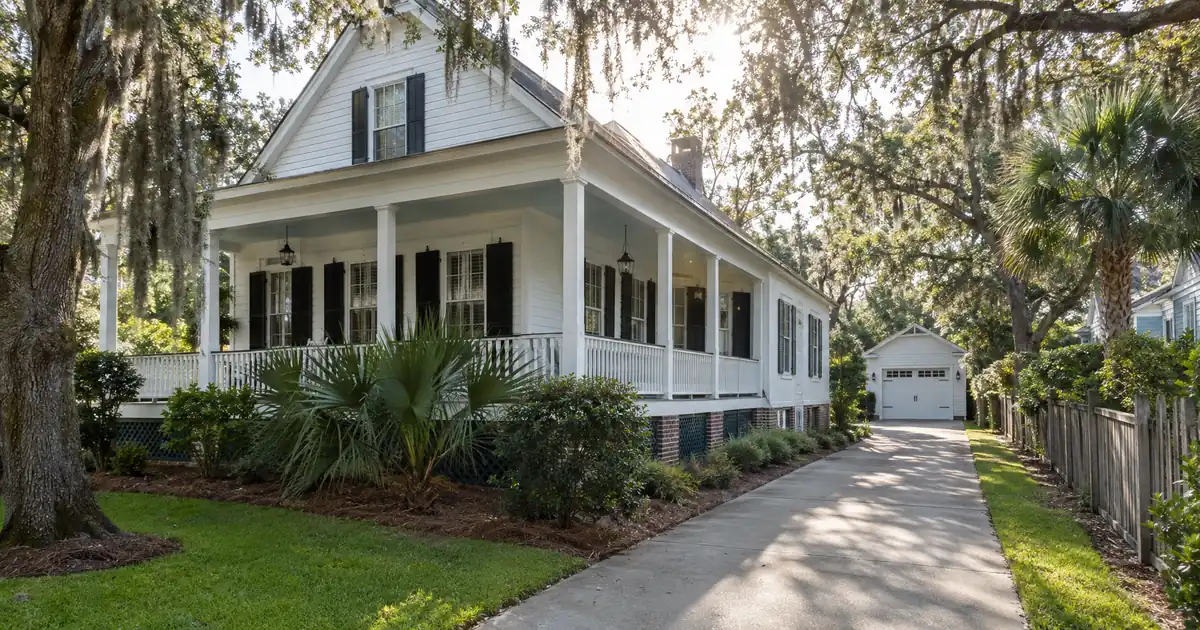
Picture an investor holding a three-bedroom brick rental near Francis Marion University, bought at $228,000 and rented steadily since. The plan is simple: pull equity out, then buy the next property. Two numbers decide whether that works. One is the appraiser’s value. The other is what the rent covers once taxes, insurance, and debt service are stacked on top of each other. In Florence, those two numbers can land further apart than most investors expect.
TL;DR: Cash-out refinancing in Florence, South Carolina fits investors who already hold seasoned one-to-four unit rentals, want capital for the next deal, and can show rent that clears the full monthly obligation, because the loan is underwritten primarily on the property’s rental income measured against taxes, insurance, and debt service, subject to lender guidelines.
DSCR Cash-Out Calculator
Run the cash-out numbers in Florence, SC
Rate source: Freddie Mac 30-yr average via FRED® — Federal Reserve Bank of St. Louis · effective Sep 24, 2026
Prefilled with starting assumptions — enter your property’s value, balance, taxes, and insurance for a more accurate picture.
Program parameters update from Lendmire’s centralized guideline source. Taxes and insurance are editable estimates.
As of Sep 24, 2026 · General Freddie Mac market benchmark, not a Lendmire loan offer. Property value, balance, taxes, and insurance are editable estimates. Maximum loan-to-value varies by lender, program, property type, and seasoning. Not a Loan Estimate, approval, or commitment to lend. Program availability and eligibility are subject to lender guidelines, credit approval, property review, and underwriting.
- Cash-out tops out at 75 percent LTV, with about six months of ownership seasoning.
- Value benchmarks diverge by $50,000 or more, so the appraisal drives proceeds (Halfmoon Realty).
- Two-bedroom units are 41 percent of the rental market, which favors duplexes (Halfmoon Realty).
- Average rent sources span $1,087 to $1,430, so underwrite a range (RentCafe).
Lendmire (NMLS# 2371349) is a DSCR-focused mortgage broker that arranges investor loans across 40 states plus Washington, D.C. This piece is about the equity-extraction side of Florence, not the purchase side. Investors already holding property here need to know how much equity is actually reachable, what the rent has to do to support it, and where the pitfalls sit. Lendmire’s primer on DSCR loans covers the mechanics. The rest of this article is Florence-specific.
Florence Market Snapshot
A quick read on the Florence investor landscape — figures come from the cited sources below. Confirm current property-level numbers before underwriting.
| Metric | Detail |
|---|---|
| University enrollment | Fdtc 4,500+ students (NESA, Florence County) |
| Population | 40,408 (Census Reporter) |
| Employment | 13,500+ medical employees (NESA, Florence County) |
Where the Appraisal Gap Bites
Florence is a market where the appraisal is the single biggest variable in cash-out proceeds. Public value benchmarks for the same period sit far apart, and a 75 percent LTV ceiling applied to a low benchmark returns very different equity than the same ceiling applied to a listing-price pro forma.
Here is the spread. Zillow’s home value index came in at $219,285, Realtor.com’s median listing price was $270,000, and the Pee Dee REALTOR Association reported a year-to-date median sales price of $285,000 against 564 homes for sale, all compiled in the Halfmoon Realty small-rentals guide. Homes.com shows a median of $229,900 and an average sale price of $272,820. Index versus list or sale is a gap of $50,000 or more. That’s not noise.
Appreciation is the second piece, and the honest read is modest. Prop:Metrics puts the 29505 ZIP median at $228,000, up 2.8 percent year over year, with 62 median days on market. Redfin shows Florence County at a $265K median, up 15.2 percent, but the county includes higher-priced suburban and rural pockets and shouldn’t be used to underwrite a city house. Don’t build a refinance thesis on county appreciation.
So in Florence, cash-out is less about riding a rising market and more about basis. Investors who bought below market, or who bought multifamily during the long listing periods (multifamily homes average 94 days listed before selling), are the ones holding real equity. Investors who bought near the top of the listing range may find the appraisal returns less than the pro forma promised.
The program guardrails are straightforward. Cash-out on an investment property is capped at 75 percent LTV, seasoning runs about six months from title recording, and the minimum DSCR benchmark is 1.00 on rent versus full PITIA. Available equity depends on rent used for lender review, reserves, and that ceiling. It is never a guaranteed cash figure, and all of it is subject to lender guidelines.
What the Rent Has to Cover
Florence rents are stable to soft, so coverage math should be built on conservative income. The sources disagree, which is itself a signal. Apartments.com/CoStar puts the average rent at $1,087. RentCafe shows $1,205, with 2-bedrooms at $1,216 and 3-bedrooms at $1,280, but that covers buildings of 50 or more units only, so it excludes small-landlord stock. Prop:Metrics, in the ZIP 29505 data, shows an average of $1,430 with rents moving -6.5 percent year over year, and by bedroom count $982, $1,220, $1,750, and $1,830 for one- through four-bedrooms. RentCafe shows +0.37 percent. Call it flat.
Run the numbers on three modeled cases. These are illustrative inputs, not sourced market data, with coverage computed on full PITIA (taxes and insurance included) at 75 percent LTV and rounded down.
- Three-bedroom house valued at $228,000, rent $1,750. Coverage lands around 1.3x. Clean.
- Same house at the $1,430 average rent. Coverage sits just above 1.0x. It clears, barely, and there’s no cushion for a vacancy.
- Two-bedroom house at $228,000, rent $1,220. Coverage lands below 1.00, around 0.9x.
That last case is the one to plan for. A sub-1.00 file isn’t dead, but it gets harder. A lender may review options such as a sub-1.00 program, an interest-only structure, or reduced leverage. Each usually comes with stronger credit, deeper reserves, or different pricing, and eligibility depends on borrower, property, and lender review. Investors holding small two-bedroom houses should run the coverage before promising themselves a cash-out.
Investors should treat the 1.00 benchmark as a floor for structuring, not a target. Where coverage is just above 1.0x, a vacancy or a re-appraisal at the low end of the value range can flip the file.
Duplexes Over Houses (If the Price Doesn’t Double)
Small multifamily is the best structural fit for cash-out in Florence, because two rents stack against one note. Point2Homes data cited by Halfmoon puts two-bedroom units at 41 percent of the rental market, the largest share. The same guide, citing Zillow, shows rents of $1,200 for two-bedrooms, $1,495 for three-bedrooms, and $1,725 for four-bedrooms. Prop:Metrics separately shows 2-bedroom and 3-bedroom units at 38.9 percent and 31.9 percent of rental stock.
A duplex of two 2-bedrooms grosses roughly $2,400 on those figures, versus about $1,495 for a three-bedroom house. Model a duplex valued at $300,000 with two units at $1,200 each and 75 percent LTV. Coverage comes out around 1.3x including taxes and insurance, better than a single house of similar value. Again, modeled inputs, not sourced pricing. The catch is the price: if the duplex costs double the house, the stacking benefit disappears.
There’s also an under-market-rent wrinkle. One brick duplex listed on Homes.com has two identical 2-bed/1-bath sides leasing at $725 and $1,000. The $275 gap points to legacy rents well under market. An appraiser’s market-rent figure could support more DSCR income than the in-place leases show. Underwrite both numbers, because in-place leases can pull the qualifying figure down. On the modeled $300,000 duplex, in-place rents at that level land right around 1.0x. A market-rent appraisal could push it materially higher.
Two cautions. Rental stock here skews old (most renter-occupied units were built in the 1970s, 1980s, or 2000s, with 1950s and 1960s stock still meaningful), so the appraisal and rehab budget matter. Deferred maintenance can cut the value being refinanced against. And keep cash-out on one-to-four unit buildings. Listings in Florence range from single duplexes to four brick buildings of four units each and a package of eight 2-bed/1-bath units, with asking prices spanning $1,000 to $1,300,000. Five-plus units typically leave standard programs and move into portfolio or commercial-style underwriting, which changes leverage and seasoning rules.
(Manufactured homes, log homes, and barndominiums fall outside these DSCR programs, so those older rural-style rentals aren’t candidates.)
Where in Florence: Corridors, Not Neighborhoods
Reliable neighborhood-level price and rent data for Florence doesn’t exist in the public record, so this section works at the corridor level and says so plainly. Investors should ask a local agent or property manager for MLS-level comps before committing to a specific street.
The Francis Marion University corridor. Francis Marion University enrolled 4,112 students in the most recent fall, and 53 percent live off campus. That’s a built-in tenant pool for two- and three-bedroom rentals nearby. Florence-Darlington Technical College adds more than 4,500 students, per NESA.
The McLeod Regional Medical Center corridor. The 517-bed flagship anchors a system of seven hospitals, per McLeod Health. It sits near the Florence Civic Center, Magnolia Mall, and the university, so the FMU and McLeod areas overlap as demand anchors for nurses and other healthcare workers. NESA counts more than 13,500 medical employees in the county.
Downtown-adjacent: proceed with a cushion. Downtown is where new supply is landing. The city has a goal of adding 1,000 downtown housing units, and a 102-unit, four-story apartment building is under construction as part of the Urban Square project, per the Post and Courier. Six downtown townhomes recently had a ribbon cutting. New Class A units compete for the same renters as renovated older duplexes. Underwrite downtown-adjacent deals with a vacancy cushion and don’t assume rent growth there. Skip it if the only argument is appreciation.
Logistics belts along I-95 and I-20. HelloFlorenceSC describes a growing manufacturing and logistics cluster along I-95, including Cheney Brothers and PRET Advanced Materials. This supports workforce rentals more than it supports any single address. No verified neighborhood boundaries, prices, or rents exist for it, so treat it as a demand thesis, not a comp set.
One low-confidence data point deserves a flag. An aggregator reports a 10 percent rental vacancy rate and calls it higher than average, but its data origin isn’t stated. If accurate, it argues for conservative income haircuts and against stretching coverage to 1.0x. Verify with a local property manager before relying on it.
Why the Tenant Base Holds (With a Caveat)
Florence tenants come from a diversified employment base, though the broader job market isn’t a standout. Per Census Bureau QuickFacts using ACS five-year data, the city has 40,408 residents across 24.8 square miles and a median household income of $56,143, versus $69,324 for South Carolina. RentCafe reports 40 percent of households, 6,628, are renter-occupied. The U.S. Census Bureau QuickFacts page carries the official city profile.
The employer list from the SC Department of Employment and Workforce is alphabetical with no headcounts, but it names the kind of employers that hold steady leases: Florence Public School District #1, HopeHealth, McLeod Health, MUSC Health, National Health Corporation, QVC, Sonoco Products, W. Lee Flowers & Company, and Wal-Mart Associates. NESA adds county employers including GE Healthcare, Honda of South Carolina, Clarios, Niagara Bottling, and Thermo Fisher Scientific. Two competing hospital systems in a city of about 40,000 is a real “eds and meds” signal. Florence’s railroad-junction origins still show up in its role as a regional hub for business, health care, and finance.
The caveat: U.S. News says Florence’s job market is less healthy than similarly sized metros. Read that alongside the flat rent data. The tenant base is stable, but growth isn’t the story here.
Working DSCR brokers see a recurring pattern in small regional hub markets like this one: coverage that clears easily on a house pro forma gets tighter once the appraiser’s market-rent figure and the lender’s full-PITIA calculation are both applied. The files that go smoothly usually pair a documented lease history with a value estimate built on sold comps rather than listing prices, and they run the coverage at the low end of the rent range before anyone talks about proceeds.
What Happens to the Proceeds?
The point of extracting equity is redeployment, and the extraction has to be sized so the next deal is still fundable. Reserves matter here. Programs typically look for about six months of PITIA in reserves, rising to about nine months above $1,500,000, and typical credit tiers step at 620, 660, 680, and 700 with 620 as the floor. Loan amounts run up to $3,000,000 on standard programs, with smaller balances routed through select lenders in the network. All of this varies by borrower, property, and lender.
Here’s the Florence-specific tradeoff. Proceeds from a cash-out on an older duplex can fund the down payment on the next one, and because multifamily sits on the market for long stretches, buyers with cash have negotiating room. A lower basis then raises the equity a future refinance can capture, provided the appraisal comes in at or above the purchase price. But drawing to the 75 percent ceiling on a property whose coverage is only just above 1.00 leaves the whole portfolio exposed to one soft appraisal or one vacancy.
DSCR vs. conventional financing
Two common ways to finance an investment property in Florence, SC. They qualify you differently — here’s how investors weigh them.
Why investors choose it
- Qualifies on the property’s rental income — no personal tax returns, W-2s, or pay stubs needed to document income.
- No personal debt-to-income ceiling to clear, so existing mortgages and obligations don’t cap your borrowing the same way.
- Can be closed in an LLC, keeping the property inside a business entity.
- Built for scaling — not held to the limit on number of financed properties that conventional financing applies.
- Underwriting centers on the deal: generally qualifies when the rent covers the payment, a 1.00x coverage ratio being a common baseline (confirmed in underwriting).
- Designed specifically for investment property, including long-term and, where the program allows, short-term rentals.
Where it’s strong
- Often the lowest ongoing financing cost for a buyer who fully qualifies on personal income — a fit for a first property or a cost-first purchase.
Trade-offs for investors
- Requires full personal income documentation and must fit within a debt-to-income limit — salary, existing debts, and other mortgages all count.
- Typically held in your personal name rather than a business entity.
- Caps how many financed properties you can carry, which can become a ceiling as a portfolio grows.
- Evaluates you as a borrower as much as the property, which usually means more paperwork.
How investors usually choose: a first or single property often optimizes for the lowest financing cost; portfolio builders often optimize for leverage, vesting in an LLC, and scaling past conventional caps. The right answer depends on your goals, the property, and current guidelines — both paths run through select lenders in Lendmire’s wholesale network, with eligibility and terms confirmed in underwriting.
Honestly, this one’s a toss-up for some holders. The stronger play may be a smaller draw on a thinly covered house, or holding off until a duplex’s leases reset toward market rent. Investors with under-market leases could argue for waiting, since the appraiser’s rent figure could improve the file. Investors who need the capital for a deal on the table can’t wait. Neither answer is wrong.
Investors holding LLC-titled property should confirm entity structure early, subject to lender program eligibility. Refi programs and pulling equity out each have their own overlays. Lendmire’s South Carolina DSCR platform covers the state-level program picture, and investors can see how the math pencils or call 828-256-2183 to talk through a specific property. Review details remain subject to lender overlays.
Frequently Asked Questions
How do you qualify for a DSCR cash-out refinance in Florence, South Carolina?
The file is built around the property’s rent versus its full monthly obligation, with 1.00 as the common benchmark. Typical guidance calls for about six months of ownership seasoning, an LTV at or below 75 percent, a credit score at or above 620, and roughly six months of PITIA in reserves. Exact eligibility depends on lender guidelines, credit, and property review.
What are the requirements for an investment property loan in Florence, South Carolina if the property is a duplex?
Duplexes fall within one-to-four unit programs, and rent from both units counts toward coverage, though in-place leases well under market can pull the number down. The appraisal includes a market-rent estimate. Buildings of five or more units usually move to portfolio or commercial-style underwriting instead.
How much equity can a Florence investor actually pull out?
It depends far more on the appraisal than on the pro forma. Public value benchmarks for Florence differ by $50,000 or more, so a low index value and a high list price produce very different proceeds at a 75 percent LTV ceiling. Rent coverage and reserves can limit the draw further, and no cash figure is guaranteed.
Can downtown Florence new construction hurt a cash-out on an older duplex?
It can affect rent assumptions, though not the LTV cap. A 102-unit building under construction and a stated goal of 1,000 new downtown units mean older rentals nearby may face competition. Underwriting with a vacancy cushion and no assumed rent growth is the safer read.
Can a self-employed investor buying in Florence be reviewed for DSCR financing?
Yes. Lendmire arranges DSCR investor loans and eligibility is generally reviewed around property rental income rather than personal income documentation. Self-employed borrowers and LLC-structured owners are reviewed subject to lender guidelines and program terms.
The One Diligence Step Worth Doing First
Before any application, pull recent sold comps for the specific property type and area from a local agent, and compare them against the list-price medians. In a market where the value benchmarks diverge by $50,000 or more, knowing which number an appraiser is likely to land on decides whether Florence equity turns into the next deal or stays in the walls. Investors should also verify current local rental rules, taxes, and insurance with qualified local professionals.
For current guidelines and terms, see Lendmire’s DSCR loan programs page.
About Lendmire
As a non-QM mortgage broker (NMLS# 2371349), Lendmire facilitates DSCR investor loans across 41 markets, including Washington, D.C. DSCR eligibility is generally reviewed around property-level rental income instead of personal income documentation, subject to lender guidelines, serving LLC-structured portfolios and self-employed borrowers who don’t fit conventional boxes. A two-time Scotsman Guide Top Mortgage Workplace, recognized as a 2026 Scotsman Guide Top Workplace and a 2025 Scotsman Guide Top Workplace.
Get Started
Ready to find the right loan for you?
In about 30 seconds you can review financing options available for your investment property. No commitment required.
Informational only. Not a Loan Estimate, approval, or commitment to lend. Program availability and eligibility are subject to lender guidelines, credit approval, property review, and underwriting.
References
2. RentCafe
5. Homes.com
6. Prop:Metrics
7. Redfin
8. Apartments.com — Rent Market Trends Florence SC
9. McLeod Health, Florence facility
10. Post and Courier, downtown Florence housing
11. HelloFlorenceSC
12. aggregator
13. U.S. Census Bureau QuickFacts, Florence city
14. SC Department of Employment and Workforce, Florence MSA Community Profile
16. a 2026 Scotsman Guide Top Workplace
17. a 2025 Scotsman Guide Top Workplace
This article is part of Lendmire’s investment property cash-out refinance program — full qualification details, guidelines, and scenarios live on the program page.
Related reading: Cash Out Refinance Investment Property Florence South Carolina · DSCR Cash Out Refinance in Florence, Alabama: The 2026 DSCR Financing Guide to UNA-Area Rentals · Cash Out Refinance Investment Property in Florence, Kentucky: Amazon Air Hub Equity Strategy
Guides: Investment Property Cash-Out Refinance in Florence, SC · Investment Property Cash-Out Refinance in South Carolina
Brandon Miller
Founder & CEO, Mortgage Loan Originator, Lendmire LLC
- Mortgage Loan Originator · NMLS# 1129696 · Verify on NMLS Consumer Access
- North Carolina Real Estate Broker · License# 343312 · Verify on NCREC
- North Carolina Insurance Producer · License# 19053198 · Property, Casualty, Life, Health · Verify on NAIC SBS
- Lendmire LLC · Firm NMLS# 2371349 · Verify firm licensure
Compliance and disclosures. Lendmire (NMLS# 2371349) is a licensed mortgage broker and is not a direct lender, depository institution, financial advisor, or tax professional. Content in this article is general market analysis and educational information — not financial, legal, or tax advice for any specific situation. Lendmire does not guarantee loan approval; every transaction is subject to underwriting by the funding lender. Mortgage pricing and loan program guidelines are subject to change at any time without notice and vary by borrower characteristics, property type, and state regulations. Lendmire complies with Equal Housing Opportunity. Licensure verification: NMLS Consumer Access.