
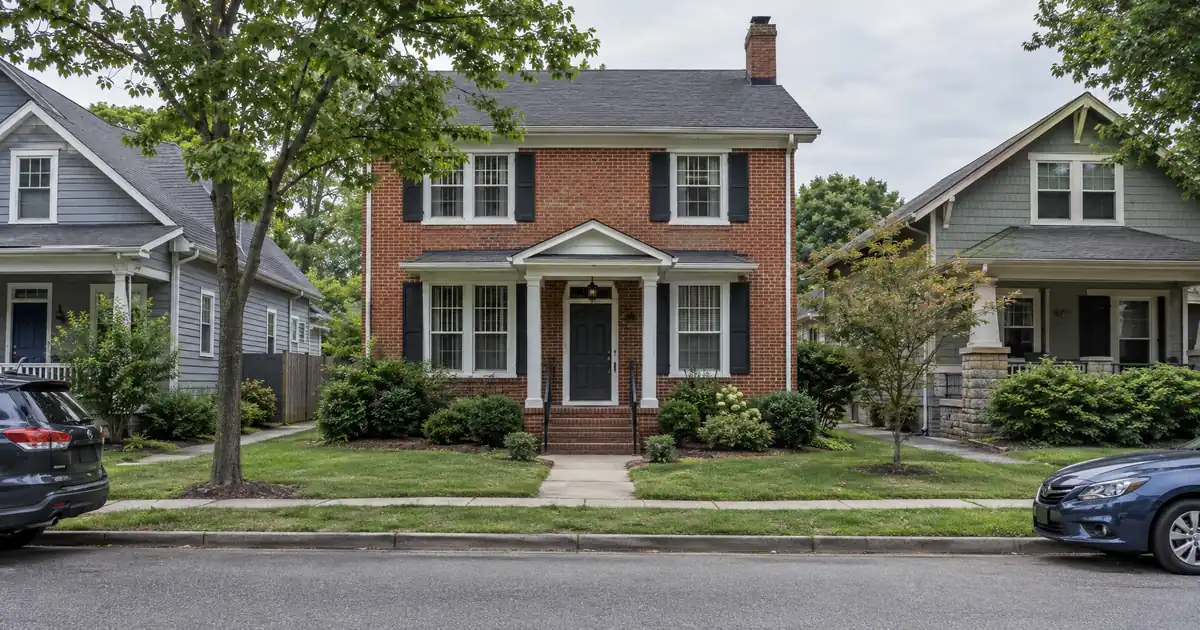
If you own a rental in Nicholasville and the paper value has climbed, the useful question isn’t how much equity you have. It’s how much of that equity the rent can carry. The median sale price here reached $345K, up 7.0% year over year, per Redfin. That’s appreciation worth acting on. But a lender sizing a cash-out against the property’s rent will test whether the building supports a bigger loan, not whether it grew in value. In this market, the answer depends heavily on property type.
At a Glance: A DSCR cash-out refinance in Nicholasville, Kentucky suits investors who already own a rental with real equity and want proceeds underwritten on the property’s rent measured against its full monthly obligation, not personal income. The fit is strongest for duplexes and small multifamily; single-family at the median price runs tight.
DSCR Cash-Out Calculator
Run the cash-out numbers in Nicholasville, KY
Rate source: Freddie Mac 30-yr average via FRED® — Federal Reserve Bank of St. Louis · effective Sep 24, 2026
Prefilled with starting assumptions — enter your property’s value, balance, taxes, and insurance for a more accurate picture.
Program parameters update from Lendmire’s centralized guideline source. Taxes and insurance are editable estimates.
As of Sep 24, 2026 · General Freddie Mac market benchmark, not a Lendmire loan offer. Property value, balance, taxes, and insurance are editable estimates. Maximum loan-to-value varies by lender, program, property type, and seasoning. Not a Loan Estimate, approval, or commitment to lend. Program availability and eligibility are subject to lender guidelines, credit approval, property review, and underwriting.
- Median sale price sits at $345K, up 7.0% year over year, per Redfin.
- Cash-out is capped at 75% LTV with roughly 6 months of seasoning, subject to lender guidelines.
- A modeled 3-bedroom house at the median price lands below 1.00 coverage.
- A modeled duplex at similar value lands around 1.05–1.35 including taxes and insurance.
Nicholasville Market Snapshot
A quick read on the Nicholasville investor landscape. Figures come from the cited sources below. Confirm current property-level numbers before underwriting.
| Metric | Detail |
|---|---|
| Recent appreciation | +7.0% yoy (Redfin) |
| Population | ~30,000, rounded (Greater Lexington) |
| Employment | 1,900+ employees (City of Nicholasville) |
The Equity Math: What 75% Actually Leaves You
Cash-out proceeds are whatever remains after the 75% LTV ceiling, your existing balance, closing costs, and the reserve requirement (about 6 months of full housing obligation, with a higher figure on very large balances). Those rules limit the extraction, and the rent decides whether the property can carry the new balance at all. These specifics are subject to lender guidelines and a full review of property, leverage, and credit.
Take a rental whose existing mortgage balance sits at 50% of current value. The 75% ceiling leaves up to 25 points of value as gross room, before costs and reserves. If the balance sits at 65% of value, only 10 points remain. Seasoning matters too: the clock runs about 6 months from title recording, so a recent purchase can’t be refinanced against a new appraisal immediately. If the property just crossed that mark and the market has moved 7.0% in your favor, the timing is reasonable. If it hasn’t, wait.
Two caveats from the Redfin data. Marketing time has stretched by more than half compared with a year earlier, and Redfin scores the market “somewhat market-rate” at 39 out of 100. Appraisers weigh recent comparable sales, and a slower market makes aggressive valuations harder to defend. Plan around a conservative appraisal, not the top of the Zillow range.
Why Coverage Is the Binding Constraint Here
The 1.00 baseline is standard for DSCR programs: rent used for lender review divided by full monthly obligation, meaning principal, interest, taxes, and insurance. Some lenders may review lower ratios with compensating factors, lower leverage, or more cash in, and all of that depends on lender guidelines, credit profile, and property review. Nicholasville’s problem is that rents are moderate against a price level that has risen.
Rent portals disagree, so a range is the honest way to present them. Trulia shows a 3-bedroom house near $1,750 and a 2-bedroom house near $1,125. Rentometer puts 3-bedrooms across all property types at $1,806 and 2-bedrooms at $1,158. RentCafe reports an average apartment rent of $1,433 and 2-bedroom units at $1,406. Rent growth is also mixed: RentCafe shows +6.12% year over year, Trulia shows +2%, and Zumper says 2-bedroom prices fell 3.7%. Read that as flat to moderately rising, not a growth story to underwrite against.
Now run the numbers on a modeled single-family case. Assume a 3-bedroom house valued at the $345K citywide median, renting at $1,750–$1,800 (from the portal range above). At 75% LTV, rent against full obligation including taxes and insurance comes out in the mid-0.80s. Dropping leverage to around 65% pulls it up to just under 1.00. These are modeled assumptions, not sourced market data. And “just under 1.00” is a coverage miss, not a pass. Terms vary by lender guidelines, property type, leverage, credit profile, and full file review.
A sub-1.00 file isn’t automatically dead. A lender may review a sub-1.00 program, a lower-leverage structure, or a different mix of documentation and reserves, all subject to credit approval and property review. But the real question is whether you should push a cash-out through at all. If the only way to make the number work is shrinking the loan until the proceeds barely matter, that’s a signal to rethink the extraction, not to hunt for a looser lender.
The Duplex Case (Where the Math Gets Better)
Stacking units on one parcel lifts coverage. A duplex with two 2-bedroom units at portal rents of roughly $1,100–$1,400 each grosses about $2,200–$2,800. A separate aggregator, Hud Housing Network, shows 2-bedroom bands of $942 to $1,412 and 3-bedroom bands of $1,279 to $1,919, so the range is wide and the source is a rent aggregator, not an official statistic.
As a modeled assumption, picture a duplex valued near that same $345K median (no sourced duplex count or pricing exists for Nicholasville, so treat the value as hypothetical). At 75% LTV, coverage including taxes and insurance runs roughly 1.05 to 1.35, depending on where in the rent band the units land. Same price, same leverage, and the second income stream moves the ratio from sub-1.00 into pass territory. For equity extraction, this is the clearest structural advantage a Nicholasville owner can hold. Exact terms depend on the lender’s guidelines, property type, leverage, and a full review of the borrower’s file.
Demand supports the unit mix. Point2Homes shows 2-bedroom units at 40% of rentals and studios at about 1%, with the rental stock skewing to buildings from the 1970s through the 1990s. So 2–3 bedroom product fits, and 1-bedroom-heavy buildings chase a thin slice of demand. Triplexes and fourplexes might pencil even better, but no local data supports that thesis. Stay cautious there.
Brannon Crossing: Growth, Yes. Yield, Not Really.
Brannon Crossing at the north end is the growth center. LEX18 reported the annexation of about 120 acres for retail, a grocery, a hotel, and apartments, with a site plan showing 13 apartment buildings. Movoto shows a median listing price of $524K in the neighborhood, though that’s brokerage listing data and indicative only. Against the citywide $345K median, rent-to-value gets thin fast for single-family there.
Here’s the tension. Appreciation is probably strongest where coverage is weakest. An owner of a newer Brannon Crossing home may have the most equity gain on paper but the hardest DSCR file, because rent doesn’t scale with price. The cash-out thesis there depends on low existing leverage, or on using the proceeds to buy something that covers itself.
Supply is the other flag. Listings on Homes.com show new 2–3 bedroom product, including townhomes and apartment communities, already in the market. Newer buildings compete with small-investor duplexes for the same tenant. An underwriter checking rent comps will look at what the newest buildings charge, so use conservative rent assumptions. There’s no sourced vacancy figure for Nicholasville, so the supply risk is a signal, not a number.
Older Corridors: North Main Street and the US-27 Spine
The downtown and North Main Street area carries older housing stock and the county courthouse. The US-27 corridor is the commuter spine into Lexington. No neighborhood-level price or rent data exists for either, so this is qualitative. Older, lower-basis properties generally hold the best rent-to-value in a market like this, because the purchase price was set before recent appreciation. That means more equity relative to the rent, and potentially a cleaner coverage ratio on the cash-out. Owners holding those assets are in the best position to extract capital. It’s a judgment call, not a sourced finding.
The Tenant Base Behind the Rent Roll
Rental demand here rests on Lexington as much as on local employers. Business View Magazine notes that many residents commute to Lexington, which it cites as one reason for the city’s growth. Data USA puts Jessamine County’s commute at 23.8 minutes, and the county’s largest industries are health care and social assistance (4,207 people), retail trade (3,725), and educational services (2,999). The City of Nicholasville says Alltech Biotechnology is headquartered locally and employs more than 1,900 people. Saint Joseph Jessamine operates the county’s only full-service 24/7 emergency room.
That’s a diversified, durable tenant pool for 2–3 bedroom rentals. It also ties tenant demand to the Lexington economy. If that economy softens, local rents follow. Census Bureau QuickFacts shows 32,197 residents and a median age of 37.7. RentCafe’s renter share is 37%, or 4,426 renter-occupied households. That’s a meaningful rental market, not a fringe one.
What Deal Desks Tend to See on Files Like This
In Lexington-adjacent suburbs, the common friction point is a single-family file where the appraisal comes in strong but coverage doesn’t follow. The cleaner files tend to involve small multifamily or lower-basis workforce rentals, where rent comps are easy to document and the owner has built real equity. Files that run into trouble usually lean on the highest end of the rent range, which the appraiser’s rent schedule then won’t support. Pulling a realistic rent schedule before applying saves a lot of rework.
Where the Proceeds Go (and Where They Shouldn’t)
Cash-out only makes sense if the next use of capital outperforms the cost of carrying the new balance. Pulling equity to buy another duplex in the same submarket, where coverage already clears 1.00, is a clean thesis. Pulling it to fund a Brannon Crossing single-family purchase at premium pricing is a different bet, and a thinner one. If the new property can’t cover itself, the proceeds from the old one end up subsidizing it.
An investor with several financed properties, or one holding assets in an LLC (subject to lender program eligibility), often finds the DSCR route the practical one, since the conventional lane tightens quickly. For a W-2 borrower with one rental and clean traditional personal-income documentation, the comparison may favor conventional financing. The flip point is usually portfolio size or income documentation. The guide “What Is a DSCR Loan” explains the mechanics, and the refinance side covers rate-and-term options. For a broader view of Kentucky DSCR financing, the state hub covers the rest of the market. The cash-out refinance walkthrough goes deeper on the mechanics.
To test a specific property, see how the math pencils or call 828-256-2183. Verify current local rental rules, taxes, and insurance with qualified local professionals before committing.
Frequently Asked Questions
How do you qualify for a DSCR loan in Nicholasville?
Qualification rests mainly on the property’s rent measured against its full monthly obligation, with 1.00 as the common baseline. Credit tiers generally run from a 620 floor up through 700, and reserves of about 6 months are typical. In Nicholasville, a duplex with two 2-bedroom units clears that ratio more easily than a single-family at the median price. Final eligibility depends on the lender.
DSCR vs. conventional financing
There are two common ways to finance an investment property in Nicholasville, KY, and they qualify you differently — here’s how investors weigh them.
Why investors choose it
- Qualifies on the property’s rental income — no personal tax returns, W-2s, or pay stubs needed to document income.
- No personal debt-to-income ceiling to clear, so existing mortgages and obligations don’t cap your borrowing the same way.
- Can be closed in an LLC, keeping the property inside a business entity.
- Built for scaling — not held to the limit on number of financed properties that conventional financing applies.
- Underwriting centers on the deal: generally qualifies when the rent covers the payment, a 1.00x coverage ratio being a common baseline (confirmed in underwriting).
- Designed specifically for investment property, including long-term and, where the program allows, short-term rentals.
Where it’s strong
- Often the lowest ongoing financing cost for a buyer who fully qualifies on personal income — a fit for a first property or a cost-first purchase.
Trade-offs for investors
- Requires full personal income documentation and must fit within a debt-to-income limit — salary, existing debts, and other mortgages all count.
- Typically held in your personal name rather than a business entity.
- Caps how many financed properties you can carry, which can become a ceiling as a portfolio grows.
- Evaluates you as a borrower as much as the property, which usually means more paperwork.
How investors usually choose: a first or single property often optimizes for the lowest financing cost; portfolio builders often optimize for leverage, vesting in an LLC, and scaling past conventional caps. The right answer depends on your goals, the property, and current guidelines — both paths run through select lenders in Lendmire’s wholesale network, with eligibility and terms confirmed in underwriting.
What are the requirements for an investment property cash-out refinance in Nicholasville, Kentucky?
Expect a maximum of 75% LTV, about 6 months of ownership from title recording, a minimum DSCR of 1.00, and reserves of roughly 6 months of full housing obligation. Loan amounts run up to $3,000,000 on standard programs. Manufactured homes, log homes, and barndominiums fall outside these programs. Terms vary by lender and property type.
Does a price increase mean I can pull a lot of cash out of a Nicholasville rental?
Not necessarily. Appreciation may support a higher appraised value, depending on comps and underwriter review, but the 75% LTV ceiling and the coverage ratio decide the proceeds. A typical 3-bedroom rental at a median-level price can model below 1.00 at full leverage. Lower existing debt, higher rent, or lower leverage changes that outcome. Every figure here varies by lender and program, and guidelines, property type, leverage, and credit profile all apply.
Which Nicholasville property types are best suited for a cash-out?
Duplexes and small multifamily with 2–3 bedroom units fit the local demand best, followed by workforce 3-bedroom homes in older, lower-basis areas. Newer Brannon Crossing homes show the weakest rent-to-value. No local count of triplexes or fourplexes exists, so avoid assuming they’re available.
The Question Worth Asking
If your Nicholasville rental has gained 7% in value but the rent doesn’t cover a larger balance, is the right move a bigger loan, or a different property to hold the equity?
For current guidelines and terms, see Lendmire’s DSCR loan programs page.
About Lendmire
A non-QM mortgage broker (NMLS# 2371349), Lendmire arranges DSCR financing for real estate investors in 41 markets, 40 states plus Washington, D.C. Because deals are underwritten primarily on property cash flow rather than personal income documentation, the structure suits self-employed buyers and entity-owned portfolios. Lendmire places loans through wholesale investor lenders; it is not a direct lender. The firm has been recognized by Scotsman Guide as a 2026 Top Workplace and as a 2025 Scotsman Guide Top Mortgage Workplace.
Get Started
Ready to find the right loan for you?
In about 30 seconds you can review financing options available for your investment property. No commitment required.
Informational only. Not a Loan Estimate, approval, or commitment to lend. Program availability and eligibility are subject to lender guidelines, credit approval, property review, and underwriting.
References
1. Redfin: Nicholasville Housing Market
2. Greater Lexington (lookatlex)
3. City of Nicholasville: Economic Development
4. Trulia: Nicholasville Rent Trends
5. Rentometer
6. RentCafe: Nicholasville Rent Trends
7. Zumper
9. Point2Homes: Nicholasville Average Rent
10. LEX18
11. Movoto
12. Homes.com
14. Data USA: Jessamine County
16. Census Reporter: Nicholasville
17. recognized by Scotsman Guide as a 2026 Top Workplace
18. a 2025 Scotsman Guide Top Mortgage Workplace
This article is part of Lendmire’s investment property cash-out refinance program — full qualification details, guidelines, and scenarios live on the program page.
Related reading: Luxury Rental DSCR Loans In New Jersey · Jersey Shore Vacation Rental Loans: DSCR Financing In Ocean City, Cape May And Long Beach Island · DSCR Cash-out Refinance In New Jersey: Pulling Equity From A Rental
Guides: Investment Property Cash-Out Refinance in Kentucky
Brandon Miller
Founder & CEO, Mortgage Loan Originator, Lendmire LLC
- Mortgage Loan Originator · NMLS# 1129696 · Verify on NMLS Consumer Access
- North Carolina Real Estate Broker · License# 343312 · Verify on NCREC
- North Carolina Insurance Producer · License# 19053198 · Property, Casualty, Life, Health · Verify on NAIC SBS
- Lendmire LLC · Firm NMLS# 2371349 · Verify firm licensure
Disclosure information. Lendmire is a state-licensed mortgage brokerage under NMLS# 2371349. Lendmire is not a depository institution, direct lender, or financial advisor — all loans referenced are placed through wholesale lender partners and are subject to each lender's underwriting standards. This article is provided for general informational purposes and is not a commitment to lend, nor does it constitute financial, legal, or tax advice. Loan programs, terms, rates, and qualification standards change without notice and depend on borrower profile, property type, and the state in which the subject property is located. Equal Housing Opportunity provider. NMLS Consumer Access: nmlsconsumeraccess.org.