
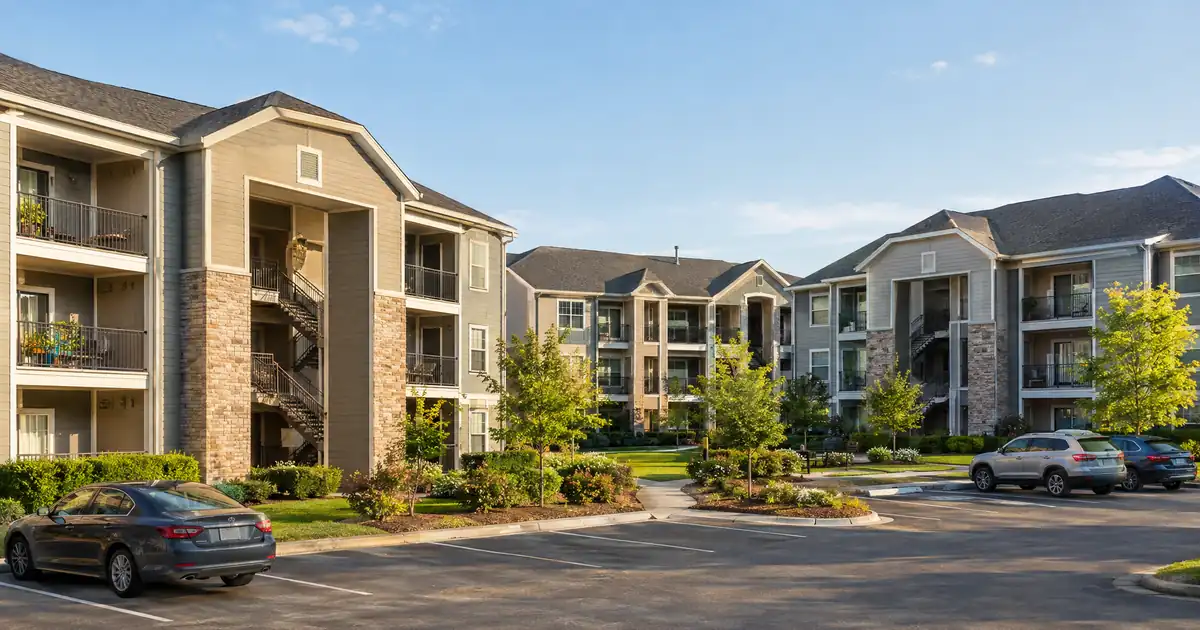
The Quick Read: Refinancing an apartment property means swapping out the loan on a rental building for a new one. The building could be anywhere from a duplex to a full apartment complex. The new loan either improves your terms or pulls out equity as cash. The path splits hard at five units. A 2-4 unit property usually refinances through a residential-style DSCR loan. That loan gets reviewed on rent alone. A 5+ unit building shifts into commercial underwriting instead. Commercial underwriting is built around net operating income and debt yield. Get the lane wrong before you start shopping, and everything changes under you — the leverage, the documentation, the whole conversation.
That five-unit line isn’t just a lender preference. It’s baked into federal housing policy itself. HUD’s Section 207/223(f) insurance program is the primary federal vehicle for refinancing existing multifamily rental housing. It requires a project to have at least five units before it even qualifies for that insurance track. Below five units, you’re in a completely different financing world.
DSCR Calculator
Run the numbers in your market
Rate is an editable market assumption — the live benchmark loads when available.
Prefilled with starting assumptions — enter your own rent or nightly figures, taxes, insurance, and HOA for a more accurate picture.
Program parameters update from Lendmire’s centralized guideline source. Taxes and insurance are editable estimates.
Fallback assumption · General Freddie Mac market benchmark, not a Lendmire loan offer. Rent, nightly rate, occupancy, taxes, and insurance are editable estimates. Short-term rental figures are estimates only and vary significantly by season, property type, management approach, and local short-term-rental rules — confirm local regulations before relying on them. Qualifying income for short-term rentals varies by program — some use appraisal market rent, others use documented STR history or projections — and is confirmed in underwriting. Not a Loan Estimate, approval, or commitment to lend. Program availability and eligibility are subject to lender guidelines, credit approval, property review, and underwriting.
Market Snapshot
Here’s a quick read on the investor landscape. The figures come from the cited sources below. Confirm current property-level numbers before underwriting.
| Metric | Detail |
|---|---|
| Typical rents | $1,388 median (Apartment List) |
| Vacancy | 7.2% (Apartment List) |
Key Takeaways
- A 2-4 unit property can typically refinance through a residential-style DSCR loan. This loan gets reviewed on the property’s rental income instead of traditional personal-income documentation.
- A 5+ unit building generally routes into commercial multifamily underwriting — bank, agency, or HUD-insured. Net operating income and debt yield replace the simple rent-versus-payment test here.
- Cash-out refinances get underwritten more conservatively than rate-and-term refinances across the industry. On the residential side, DSCR cash-out typically caps around 75% loan-to-value.
- Seasoning is the waiting period before a lender will use your new appraised value instead of your original purchase price. Each DSCR lender sets this on their own — there’s no single agency rulebook for it.
- Coverage (rent versus payment) and leverage (loan versus value) are two separate tests. A property can pass one and still fail the other.
Which Lane Applies to You?
The property’s legal unit count decides everything else about the refinance. It doesn’t matter what the loan officer’s marketing says or what the building “feels like.” A fourplex and a fifty-unit complex get financed by entirely different rulebooks, even if they sit on the same block.
| Factor | 2-4 Unit (Residential-Style DSCR) | 5+ Unit |
|---|---|---|
| Underwriting basis | Rent versus full monthly payment (DSCR) | Net operating income and debt yield |
| Appraisal approach | Small residential income-property form | Income-approach commercial appraisal |
| Typical purchase leverage | 75%-80%, up to 85% on select high-leverage files | Set by the specific bank, agency, or HUD program |
| Documentation | Property income and lease data, not personal returns | Full operating statements and financial history |
| Common lender type | Wholesale DSCR/non-QM network | Depository banks, agency multifamily, HUD |
If your property is a duplex, triplex, or fourplex, you’re almost always in the DSCR lane. That’s the lane this article spends most of its time in. It’s also where Lendmire (NMLS# 2371349) arranges financing through select lenders across a wholesale network covering 41 markets, including Washington, D.C. If you own a true apartment building with five or more units, the mechanics below still apply conceptually. But the specific programs come from banks, Fannie Mae or Freddie Mac multifamily desks, or HUD — not from a residential DSCR shelf.
For the small-property side, Lendmire’s complete DSCR loans guide walks through the qualification logic in more depth than any single blog post can cover.
How the Refinance Actually Gets Underwritten
Once the unit count sorts you into a lane, the deal moves through a fairly predictable sequence. Here’s what actually happens, step by step, on a 2-4 unit DSCR refinance.
Step 1: Unit-Count Triage
This is the fork in the road already covered above. Everything downstream depends on getting this right before you apply — the appraisal form, the income analysis, even which lenders will look at the file.
Step 2: The Appraisal Changes Shape
A single-family rental gets appraised on a standard one-unit form. That form combines cost, sales comparison, and income approaches together. A 2-4 unit property uses a different tool instead. It’s called the small residential income-property appraisal report — the industry-standard tool for valuing two- to four-unit properties based on interior and exterior inspection. On a true 5+ unit building, the appraisal widens further. It becomes a full commercial income-approach analysis built around cap rates and comparable sales of similar-sized apartment assets.
Step 3: DSCR Replaces Personal Income Docs
On eligible 2-4 unit properties, the lender takes the property’s gross rental income. That income comes from an existing lease or the appraiser’s market-rent conclusion. The lender then divides it by the full monthly obligation, commonly shortened to PITIA (principal, interest, taxes, insurance, and any association dues). The file qualifies primarily on whether property-level rental income covers the payment, subject to lender guidelines. It doesn’t rely on the owner’s traditional personal-income documentation. That’s the core mechanic behind the DSCR programs Lendmire arranges. If this is your first time working with the structure, it’s worth reading what a DSCR loan actually is.
Step 4: LTV and Coverage Are Separately Enforced
A rent roll that comfortably clears the coverage test doesn’t override the leverage ceiling. A low-leverage request doesn’t get a pass on weak coverage either. Both tests have to clear on their own. This is the single most misunderstood mechanic in apartment refinancing. An investor with 40% equity can still get told no on a cash-out request if the rent hasn’t kept pace with the payment.
Step 5: Seasoning Sets Which Value You Can Use
Here’s where DSCR programs genuinely diverge from anything conventional. Agency loans run on Fannie Mae and Freddie Mac’s own title-seasoning and loan-age rules. Freddie Mac, for instance, enforces its own six-month title-seasoning requirement before certain refinances. None of that governs DSCR loans directly. DSCR loans are business-purpose, non-QM products. They never get sold to Fannie or Freddie, so no agency selling guide applies to them. Instead, each lender in a wholesale network sets its own seasoning clock. Across most of the network Lendmire works with, that clock runs around six months of ownership before a cash-out refinance can use the new appraised value instead of the original purchase price. Delayed financing is a separate exception for cash buyers — it’s not a shortcut on that clock. The loan amount on a delayed-financing file is typically capped near the documented cash invested, not the fresh appraisal.
Step 6: Occupancy Gets Classified, Not Just Counted
A signed lease is not the same thing as collected rent. Underwriters look at four different measures: physical occupancy, economic occupancy, leased occupancy, and actual cash collections. A unit with a lease but unpaid rent doesn’t get treated the same as a fully performing unit. Neither does a unit down for repairs. A stabilized building with a clean occupancy history moves through underwriting cleanly. A property still in lease-up, or one with vacant or non-performing units, often needs a specialized structure, extra reserves, or a later refinance once occupancy stabilizes.
Rate-and-Term vs. Cash-Out: Two Different Transactions
People lump these together in casual conversation. But they’re structurally different requests, with different leverage and seasoning treatment.
| Factor | Rate-and-Term Refinance | Cash-Out Refinance |
|---|---|---|
| Primary goal | Improve terms, exit a maturing loan | Convert equity into new loan proceeds |
| Loan balance effect | Stays close to the existing payoff | Increases above the payoff amount |
| Leverage ceiling | Somewhat more flexible on most files | Typically capped near 75% LTV network-wide |
| Seasoning expectation | Can move with less waiting on some files | Around six months of ownership is common |
| Typical investor motive | Escaping a bridge loan or balloon maturity | Funding the next acquisition or a renovation |
Cash-out gets underwritten more conservatively across the industry, because equity is leaving the transaction rather than simply being restructured. If you’re pulling cash, Lendmire’s DSCR cash-out refinance page and its cash-out-specific breakdown both go deeper into how proceeds and leverage interact on investment property.
Key Terms Defined
DSCR (debt service coverage ratio) — the property’s monthly rent divided by its full monthly payment; a ratio of 1.00 means rent exactly covers the payment.
PITIA — principal, interest, taxes, insurance, and association dues combined into one monthly obligation figure.
LTV (loan-to-value) — the loan amount expressed as a percentage of the property’s appraised value; a lower LTV means more equity in the deal.
Seasoning — the length of time a lender requires you to own a property before it will lend against the current appraised value instead of your original purchase price.
Cash-out refinance — a new loan larger than the existing payoff, with the difference paid to the borrower as proceeds.
Rate-and-term refinance — a new loan that replaces the existing one at close to the same balance, changing only the terms.
Non-QM / business-purpose loan — a loan made for investment purposes rather than personal residence, which is why it isn’t subject to standard owner-occupied consumer-mortgage disclosure rules. DSCR loans are business-purpose products, and that’s part of why DSCR loans compare so differently to conventional financing.
NOI (net operating income) — a commercial property’s rental income minus operating expenses, before debt service; the core input for 5+ unit underwriting.
Debt yield — a commercial lender’s measure of a property’s NOI against the loan amount, used alongside or instead of DSCR on larger apartment deals.
Where the General Rule Breaks
The unit-count line and the coverage-versus-leverage split hold most of the time. But a handful of situations bend or invert the standard playbook.
Mixed-use buildings. Ground-floor retail with residential units above can shift which underwriting lane applies. This happens even when the building looks like a straightforward small apartment property. Zoning, legal unit count, and property condition all factor in. The program can end up different for two buildings that look nearly identical from the street.
HUD’s healthcare-adjacent multifamily refinances restrict cash-out entirely. Certain HUD multifamily structures tied to healthcare facilities don’t permit any cash-out at all. That’s a hard no — standard market-rate multifamily refinances, by contrast, permit cash-out under specific leverage conditions.
Commercial cash-out sometimes has a leverage floor instead of a ceiling. This one trips up investors moving from small DSCR deals into true HUD-scale multifamily. Residential DSCR cash-out is capped at a maximum LTV. Commercial cash-out refinances under HUD’s Section 223(f) program work in reverse in some structures. The deal has to clear a minimum leverage threshold before cash-out is even permitted. It’s the same word, “cash-out,” describing an almost opposite mechanic depending on which lane you’re in.
Delayed financing again. This is worth repeating, because it’s so commonly misread. An all-cash buyer can refinance ahead of the standard seasoning clock. But the resulting loan amount usually tracks the documented purchase investment, not the fresh appraised value. It solves the waiting-period problem. It does not solve the proceeds problem.
What a Lender Actually Wants to See
On a 2-4 unit DSCR refinance, the file generally clears review when a handful of factors line up together. No single factor carries the whole deal.
Credit sits at the center of pricing and leverage. Across the wholesale network Lendmire works with, a 620 score exists as a floor on parts of the network. Most programs prefer something closer to 660. And 700-plus is where the strongest leverage tiers open up. On the coverage side, 1.00 DSCR is where select programs start — that’s a floor for specific programs, never a universal standard. Stronger ratios generally unlock better leverage and pricing. Reserve requirements vary by lender, leverage, loan size, and transaction type. But they commonly land around six months of PITIA in reserve. Conservative rate-and-term files at modest leverage under $1.5 million sometimes see reserves waived entirely. Loan sizes above that threshold typically step up toward nine months. Standard DSCR loan amounts generally run from smaller balances handled by select lenders in the network up to roughly $3 million. Above $2.5 million, the network generally holds to 30-year fixed structures rather than shorter or adjustable terms.
A bigger down payment lowers the payment and can lift the coverage ratio. But it never erases a leverage cap, a credit floor, a reserve requirement, or property eligibility on its own. The files that clear cleanest solve both tests at once — enough equity to satisfy LTV, and enough rent to satisfy coverage. One without the other still gets stuck. Exact terms depend on the lender’s guidelines, property type, leverage, and a full review of the borrower’s file.
Files that come across a wholesale network for small apartment refinances tend to hit the same two friction points over and over. First, rent was projected optimistically at purchase and hasn’t materialized at the appraised market-rent level. Second, reserve accounts were adequate at acquisition but haven’t kept pace with a larger cash-out request. Neither one kills a file by itself. But both usually mean adjusting leverage or loan amount rather than walking away.
What if coverage lands under 1.00? It doesn’t automatically knock the file out. Sub-1.00 coverage is available through select lenders in the network, with leverage and terms adjusted to compensate. Separately, a small number of lenders offer no-ratio qualification. This is generally reserved for borrowers who already own a primary residence, where rental income isn’t measured against the payment at all. Neither path is universal, and both come with tradeoffs in pricing or leverage that a standard 1.00-plus file avoids.
Does Paying Off the Property Change the Math?
No — and this trips up more investors than almost anything else on this list. Owning a property free and clear doesn’t change the coverage test or the leverage ceiling on a subsequent refinance. LTV and DSCR get assessed on their own, whether your existing debt position is zero or 90% of value. A property refinanced with no existing mortgage still has to clear the same rent-versus-payment math as one carrying a balance.
Entity titling matters more in practice. Many DSCR lenders in the network will finance an LLC-titled apartment property, depending on program guidelines. This is one reason investors hold rental buildings inside an entity in the first place — it separates the asset from personal liability without necessarily complicating the refinance. The lender still reviews the property’s rental income and the borrower’s credit. The LLC wrapper changes the paperwork, not the coverage math.
For smaller equity needs, a full refinance isn’t always the right tool. Investment-property HELOC lines exist as an alternative, generally capped around $500,000 total across the network. These are useful for tapping a modest amount of equity without touching the underlying first mortgage or resetting its terms. It’s worth pricing this option against a full cash-out refinance before assuming a bigger transaction is necessary. Sometimes the smaller line does the job with less disruption to the existing loan.
A Worked Look at the Numbers
Picture an investor holding a fourplex refinance where the new appraisal comes in meaningfully above the original purchase price. At 75% LTV, that appreciation supports a larger loan than the original one. But the file still has to clear coverage on its own. If market rent produces a ratio in the low 1.2x range against the new, larger payment, the deal clears comfortably. If the same appreciation pushes the requested loan amount up while rent has stayed flat, the ratio can slide toward 1.00 or below. At that point, leverage typically has to come down, or the file shifts toward one of the sub-1.00 structures described above.
Now run the same logic on the commercial side. Consider a 5+ unit building where NOI has grown from stronger occupancy. But the requested loan amount would push debt yield below what the specific bank or agency program requires. Even with rising income, the file doesn’t automatically clear. The lender is testing NOI against the loan size, not rent against a simple payment figure. A request sized too aggressively against that income gets scaled back, regardless of how the building is performing.
The stronger move in the first scenario is often to size the refinance to the coverage the rents actually support, not to the maximum the appraisal technically allows. Pulling the full available equity looks appealing on paper. But a file that clears 1.00 by a hair leaves no room if a unit turns over or rent softens even slightly.
Timing the Refinance Ahead of a Maturity Wall
A meaningful share of outstanding multifamily debt across the country is scheduled to come due in the near term. Investors holding loans approaching maturity are generally better served refinancing ahead of that date than waiting for it to force the decision. The market backdrop right now adds urgency to that timing question. National apartment occupancy has been climbing steadily. It reached 95.5% as of a recent monthly reading, up roughly 90 basis points since the end of the prior year, according to RealPage. That’s the good news. The complication is rent growth. After the sharp increases of the pandemic years, Harvard’s Joint Center for Housing Studies reports that asking-rent growth has hovered near zero nationally since mid-2023. Professionally managed apartment rents actually dipped slightly year-over-year in the most recent quarter measured.
That matters directly for refinance math, because appraised market rent is the numerator in the coverage calculation. A recent wave of new apartment construction has pushed vacancy up and rent growth down in a number of metros. The National Multifamily Housing Council points to record-level completions as the driver. That means the same property that comfortably cleared coverage two years ago might appraise for softer rent today, even if the physical building and location haven’t changed at all.
Regulatory exposure compounds this for some owners. NMHC’s own quarterly survey found its Market Tightness Index sitting below the breakeven level for a second consecutive quarter. Separately, more than a third of surveyed investors reported pulling back on investment specifically in rent-regulated markets. For a refinance, rent regulation caps the achievable rent figure feeding the DSCR numerator directly — independent of the property’s condition or its location quality otherwise.
None of this means refinancing is a bad idea right now — occupancy strengthening is a genuine tailwind. It means running the coverage math against today’s achievable rent, not the rent your property commanded during the run-up years, before assuming a given loan amount is still supportable.
Common Misconceptions
“DSCR loans can finance any apartment building, no matter the size.” Not accurate. Standard DSCR programs are built around 2-4 unit properties. A true 5+ unit building generally routes into commercial, agency, or HUD-insured financing instead, where NOI and debt yield govern the underwriting rather than a simple rent-versus-payment test.
“A signed lease is the same as qualifying income.” It isn’t. Underwriters separate leased occupancy from actual collections. A unit under lease with unpaid rent, or one temporarily offline for repairs, doesn’t get treated the same as a fully performing, collecting unit.
“Rents are still rising fast nationally, so my appraisal will support a bigger loan.” That assumption is dated. Rent growth has stayed close to flat nationally for a couple of years now. The days of anchoring refinance expectations to 2021-era rent increases are largely behind most metros.
Program details, credit tiers, and leverage figures referenced throughout this article reflect typical guidelines across a wholesale lending network at the time of writing, and they’re subject to change. Investors should confirm current terms directly with Lendmire before assuming a specific outcome. Tax treatment of refinance proceeds can depend on how the funds are used and how the property is held. Investors should keep clear records and speak with a qualified tax professional before relying on any deduction.
No loan approval is guaranteed, and nothing here is a commitment to lend. Every scenario described here is subject to lender approval and to borrower, property, and program guidelines that can change without notice. This content is general information only and isn’t financial, legal, or tax advice.
Frequently Asked Questions
Can I refinance a duplex or triplex the same way as a single-family rental?
Largely, yes — both typically qualify through a DSCR-style program. This kind of program looks at rental income against the monthly payment rather than traditional personal-income documentation. The appraisal form differs slightly (2-4 unit properties use a small residential income-property report rather than a standard single-family form), but the underlying qualification logic is close.
Can a DSCR loan refinance a true apartment building with 5 or more units?
Generally, no. Standard residential DSCR programs are built for 2-4 unit properties. A 5+ unit apartment building typically needs commercial, agency, or HUD-insured financing instead, where net operating income and debt yield replace the simple rent-versus-payment test.
What happens if my property’s DSCR comes in below 1.00 on refinance?
It doesn’t necessarily end the deal. Sub-1.00 coverage is available through select lenders in the network, with leverage and terms adjusted to reflect the weaker ratio. A separate no-ratio path exists through select lenders too, generally for borrowers who already own a primary residence, where rental income isn’t measured against the payment at all.
How much seasoning do I need before a cash-out refinance on an apartment property?
There’s no single agency rule governing DSCR seasoning. Each lender in a wholesale network sets its own requirement. Around six months of ownership is common across much of the network before the current appraised value replaces the original purchase price for cash-out purposes.
Does it matter if my apartment property is titled in an LLC?
It shouldn’t disqualify the file, but confirming eligibility on the specific property upfront matters. Many DSCR lenders will finance LLC-titled investment property, depending on program guidelines. The underwriting still centers on the property’s rental income and the borrower’s credit rather than the entity structure itself.
If you’re weighing a rate-and-term refinance against a cash-out request on an apartment property — or you’re trying to figure out which underwriting lane your specific building falls into — Lendmire can help compare DSCR options based on the property’s income, your credit profile, available leverage, and what you’re actually trying to accomplish. Reach the team at 828-256-2183 or request a quote to talk through a specific property.
About Lendmire
Lendmire — NMLS# 2371349 — is a mortgage brokerage specializing in DSCR investor loans. It helps arrange financing across 41 markets, including Washington, D.C., through wholesale and investor-lending channels. The model centers on property-level rental income reviewed by the lender rather than W-2 documentation, subject to lender guidelines, which suits entity-owned and multi-property investors. Lendmire holds Scotsman Guide Top Mortgage Workplace recognition for 2025 and 2026.
Scotsman Guide’s Top Mortgage Workplace lists for 2025 and 2026 document Lendmire’s recognition.
Get Started
Ready to find the right loan for you?
In about 30 seconds you can review financing options available for your investment property. No commitment required.
Informational only. Not a Loan Estimate, approval, or commitment to lend. Program availability and eligibility are subject to lender guidelines, credit approval, property review, and underwriting.
References
2. Fannie Mae — Small Residential Income Property Appraisal Report
3. RealPage — May 2026 Data Update
4. Harvard Joint Center for Housing Studies — Six Takeaways from America’s Rental Housing
5. National Multifamily Housing Council — Rental Housing 101: Understanding Apartment Absorption
6. National Multifamily Housing Council — Survey: Rent Control Weighing on Apartment Investment
This article is part of Lendmire’s DSCR loan program — full qualification details, guidelines, and scenarios live on the program page.
Related reading: Apartment Investment Property Refinance Loan Financing · Apartment Investment Property Refinance Mortgage Loans · Apartment Investment Property Refinance Loans Financing
Brandon Miller
Founder & CEO, Mortgage Loan Originator, Lendmire LLC
- Mortgage Loan Originator · NMLS# 1129696 · Verify on NMLS Consumer Access
- North Carolina Real Estate Broker · License# 343312 · Verify on NCREC
- North Carolina Insurance Producer · License# 19053198 · Property, Casualty, Life, Health · Verify on NAIC SBS
- Lendmire LLC · Firm NMLS# 2371349 · Verify firm licensure
Required disclosures. Lendmire (NMLS# 2371349) operates as a licensed mortgage broker, not a direct lender or depository. The discussion in this article is general in nature and should not be relied upon as financial, legal, or tax advice — every investment scenario is unique and should be reviewed by a qualified professional. Any loan inquiry is subject to lender underwriting, and this article is not a commitment to lend or a guarantee of approval. Mortgage rates, loan terms, and program guidelines vary by borrower, property, and state, and may change without notice. Equal Housing Opportunity. Verify licensure at NMLS Consumer Access.