
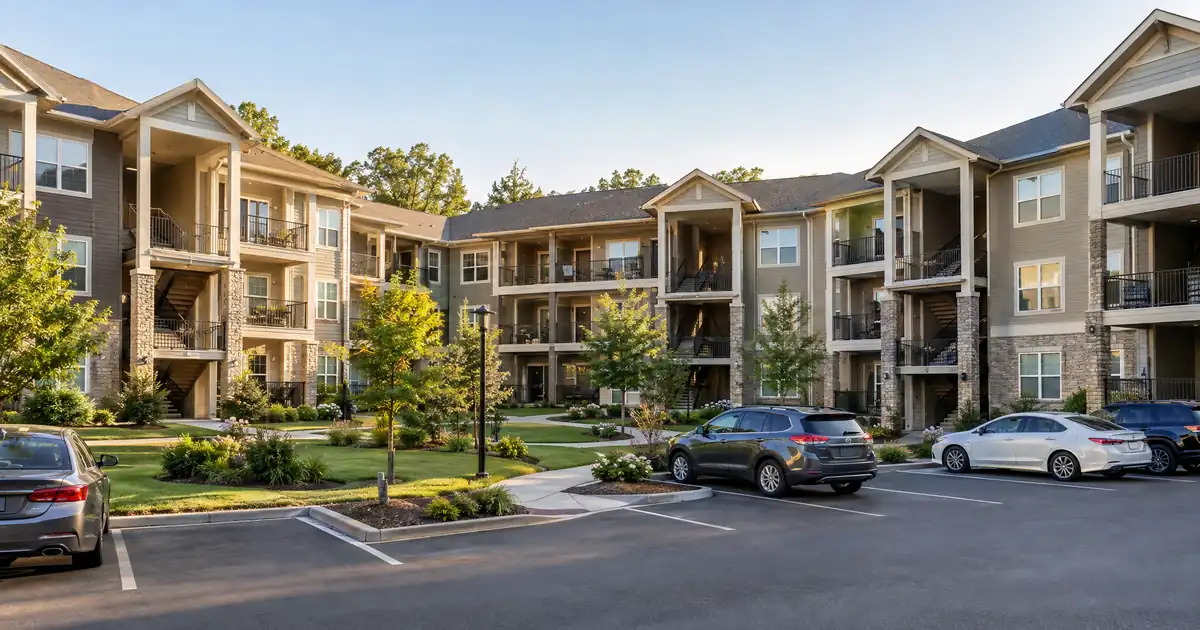
The Quick Read: Apartment refinancing splits into two lanes. The split happens the moment you count units. A 1-4 unit building refinances through residential-style DSCR underwriting. That means the lender compares rent to payment — simple math. A 5+ unit building moves into commercial territory. There, net operating income, past financial records, and a different appraisal process take over. Knowing which lane your building sits in tells you which lenders, forms, and documents apply to your file.
Most investors searching this topic own something between a duplex and a mid-size complex. They’ve hit the same wall. Bank refinance pages assume a single-family rental. Commercial-finance pages assume a 50-unit deal backed by a syndication. Neither one answers the question for a sixplex or a twelve-unit walk-up. This guide fills that gap.
DSCR Calculator
Run the numbers in your market
Rate is an editable market assumption — the live benchmark loads when available.
Prefilled with starting assumptions — enter your own rent or nightly figures, taxes, insurance, and HOA for a more accurate picture.
Program parameters update from Lendmire’s centralized guideline source. Taxes and insurance are editable estimates.
Fallback assumption · General Freddie Mac market benchmark, not a Lendmire loan offer. Rent, nightly rate, occupancy, taxes, and insurance are editable estimates. Short-term rental figures are estimates only and vary significantly by season, property type, management approach, and local short-term-rental rules — confirm local regulations before relying on them. Qualifying income for short-term rentals varies by program — some use appraisal market rent, others use documented STR history or projections — and is confirmed in underwriting. Not a Loan Estimate, approval, or commitment to lend. Program availability and eligibility are subject to lender guidelines, credit approval, property review, and underwriting.
Key Terms Defined
DSCR (debt-service coverage ratio): Divide the property’s rent (or, on larger buildings, its net operating income) by its full monthly payment. That payment includes principal, interest, taxes, insurance, and any HOA dues. The result is your DSCR. A ratio of 1.00 means the income exactly covers the payment.
PITIA: This is shorthand for your full monthly loan payment. It covers principal, interest, taxes, insurance, and association dues if they apply. This number is the denominator in your DSCR calculation.
NOI (net operating income): On a commercial-scale multifamily property, this is rental income minus real operating costs. Those costs include management fees, utilities the tenant doesn’t pay, maintenance, and similar items. NOI is calculated before debt payments come out. Once a building crosses into commercial underwriting, NOI replaces gross rent as the top number in the DSCR formula.
Cash-out refinance: With this refinance, you replace your existing loan with a new, bigger one. You pocket the difference in cash. The new loan amount is based on the property’s current appraised value, not what you originally paid.
Business-purpose loan: This is a loan on a property you hold for investment or rental income — not a home you live in. Since it isn’t a consumer mortgage, lenders underwrite and document it differently than a loan on your primary residence.
Seasoning: This is the minimum time a lender wants you to own a property before refinancing it. Seasoning rules matter most for cash-out refinances.
Where the Line Actually Falls: 1-4 Units vs. 5+ Units
The unit count on your deed decides almost everything that happens next. It determines which appraisal form gets used, what income statement the underwriter wants, and which lenders will even look at your file. This split isn’t random. It matches lines drawn independently across federal housing policy and standard appraisal practice.
On the government side, HUD’s own multifamily insurance programs — Section 207 and Section 207/223(f) — are built around a 5-or-more-unit threshold (HUD.gov). On the appraisal side, most residential DSCR files rely on a standardized form: the Small Residential Income Property Appraisal Report (Fannie Mae Form 1025). This form covers two-to-four-unit properties specifically (Stewart Valuation; Fannie Mae). DSCR loans don’t get sold to Fannie Mae. But non-QM appraisers and underwriters still use that form’s language and scope, because it’s the industry standard for valuing small multi-unit buildings.
Here’s the practical rule. A fourplex or smaller refinances much like a residential rental. A building with five units or more gets treated as commercial multifamily. That means different appraisal methods, different income analysis, and often a different lender — even within the same non-QM market.
How Underwriting Treats a 1-4 Unit Refinance
On a small multi-unit refinance, the math is simple. Divide gross rent by PITIA. There’s no expense-by-expense deduction and no operating statement required. The underwriter just compares what the units rent for against what the new loan will cost each month.
Across the DSCR programs Lendmire places files with, coverage floors typically start around 1.00x on select programs. Don’t treat that as a universal minimum — plenty of lenders in the network want a bigger cushion. And stronger ratios consistently open the door to better leverage and terms. On the refinance side, cash-out LTV generally tops out around 75% across most of the network. Roughly six months of ownership is the common seasoning expectation before a lender takes a cash-out file seriously. Credit requirements vary too. A 620 floor exists in parts of the network. Most programs want something closer to 660. And 700-plus is where the strongest leverage tiers open up.
One thing worth saying plainly: clearing 1.00 DSCR is not the same as making money. The ratio only measures rent against PITIA. It says nothing about vacancy, repairs, property management, capital expenses, or utilities you cover yourself. A file that clears 1.05x on paper can still lose money in a bad year if those other costs run high. Don’t confuse “the loan qualifies” with “the deal is profitable.”
Reserve requirements shift based on loan size and leverage — there’s no single fixed number. Most files need around six months of PITIA in reserve. Conservative rate-and-term refinances at lower leverage under $1,500,000 sometimes skip reserves entirely. Loans above that size typically need around nine months. None of this is guaranteed for any individual file. It depends on the lender, the property, and the borrower’s full financial picture, subject to lender guidelines and underwriting review.
How Underwriting Treats a 5+ Unit Refinance
Once a property crosses five units, the whole document package changes. Instead of a simple rent-versus-payment comparison, the underwriter wants past operating statements and year-to-date income and expense details. The building’s actual track record becomes the key evidence — not just a snapshot of current rents.
The ratio itself changes too. As JPMorgan’s commercial lending desk explains it, DSCR on a commercial-scale property comes from dividing annual net operating income by annual debt service. This is a much more document-heavy process than the gross-rent math used on smaller buildings, since operating expenses must be verified and subtracted first. Appraisal follows the same split. Below five units, the appraiser typically uses the small-residential-income form mentioned above. At five units and up, valuation runs through commercial income-approach methods instead — the same threshold HUD and the GSEs use for their own eligibility rules.
Loan structure looks different here too. Non-QM, business-purpose loans in this space commonly run on 30-year fixed or 30-year amortizing terms. They often include interest-only periods in the first five to ten years to boost cash flow. Prepayment penalties that step down on a 5-4-3-2-1 schedule are standard, not the exception (Baseline). None of these features — interest-only stretches, step-down prepay schedules, adjustable structures — would show up the same way on a consumer-purpose mortgage. They don’t follow the same rules.
Across Lendmire’s wholesale network, loan sizes on standard programs generally go up to about $3,000,000. Above roughly $2,500,000, the network mostly sticks with 30-year fixed structures rather than shorter or unusual terms. Smaller-balance apartment deals route through select lenders built specifically for that segment, rather than the standard program tier.
The 5-8 Unit Gray Zone
Almost nobody serves this segment well, and it’s worth calling out directly. Buildings in the 5-8 unit range are often too small for institutional commercial lenders, who prefer larger loans for efficiency. But they’re also too big for standard 1-4 unit residential DSCR programs. This isn’t a paperwork quirk. HUD, Fannie Mae, and Freddie Mac each set their own eligibility lines at five units, independently. That leaves a real gap between the two systems.
The fix is a small-balance commercial lender or a non-QM program built specifically to bridge that range. Lendmire’s team works these files through select lenders in the network built for exactly this size. It’s worth a direct conversation rather than assuming your six-unit building automatically fits into either bucket. Reach Lendmire at 828-256-2183 or request a quote to see which lane fits a specific gray-zone property.
What a Refinance Scenario Looks Like in Practice
Say an investor owns a ten-unit building bought a few years back. It’s now stable, with steady occupancy and rents that have grown since purchase. Because the property sits above the four-unit line, the refinance runs through commercial-style underwriting. That means past operating statements instead of a rent roll, NOI-based debt coverage instead of gross-rent math, and a commercial income-approach appraisal.
Say the building’s NOI clears its projected debt service comfortably — call it a healthy coverage ratio in the 1.2x-plus range. In that case, the file has room to negotiate cash-out proceeds at a leverage level the lender is comfortable with. That’s generally capped around 75% LTV on the refinance side. If coverage comes in tighter — closer to 1.0x, or a touch below — the deal doesn’t automatically die. Instead, it shifts to lower leverage, adjusted terms, or a different structure through select lenders in the network built for that scenario. Coverage below 1.00 can still be workable on the residential-scale side of this business too. It’s never automatic, though. When a lender considers it, the maximum LTV drops and other terms adjust to match the added risk. All of this stays subject to underwriting review and the program guidelines in place at the time.
Working files like this across a wholesale network, rather than one lender’s book, shows a clear pattern. Apartment refinances with clean trailing twelve-month financials and rent rolls that match market comps close smoother than files built on projected numbers. Underwriters and appraisers trust a building’s own track record far more than a hopeful future estimate — especially now, when in-place rents get checked hard against genuinely comparable data before anyone signs off.
Market conditions matter here too. Multifamily asset values nationally have dropped meaningfully below their 2022 peak, according to one market outlook report (MMCG Invest). That directly limits how much cash-out sizing is available for anyone who bought at the top of that cycle. On the fundamentals side, national multifamily vacancy tightened in the first quarter of 2026, as demand outpaced new supply. Average rents rose modestly year-over-year, even as overall investment volume softened slightly (CBRE). Better occupancy paired with softer values is a mixed bag for refinance sizing. You get better income support, but less equity cushion than two or three years ago.
Rate-and-Term vs. Cash-Out: Which Fits Your Refinance
A rate-and-term refinance replaces your existing loan without pulling equity out. It’s useful when you want to convert an adjustable structure to fixed, extend or shorten the loan term, or simply restructure the loan around a stronger DSCR now that rents have risen. A cash-out refinance does the same thing, but it sizes the new loan against current appraised value and hands you the difference in cash. That’s generally capped around 75% LTV across most of the network, with roughly six months of seasoning expected first.
The right choice usually comes down to what problem you’re solving. If the building’s cash flow has strengthened and you just want better structure or a lower monthly obligation, rate-and-term is the cleaner path with fewer strings attached. If you need capital for the next acquisition, a renovation, or paying down higher-cost debt elsewhere in your portfolio, cash-out is the tool. Just expect the appraisal and seasoning requirements to get scrutinized more closely than on a same-loan-amount refinance. Lendmire’s DSCR cash-out refinance resources walk through this in more depth, and the complete DSCR loans guide covers the full qualification picture.
What’s Never on the Table
A few property types simply fall outside DSCR programs in the network entirely, no matter the unit count or coverage ratio. Manufactured homes — both single- and double-wide — log homes, and barndominiums are not offered. This isn’t a “harder to finance” situation. It’s a flat exclusion, and it’s worth knowing before you spend time building a file around one.
Investment-property HELOC lines are a separate product from a refinance. They cap out at $500,000 total across the network — there’s no higher tier for this line type. So larger equity-pull needs on bigger buildings need to run through a cash-out refinance instead. A handful of states — Connecticut, Florida, Illinois, and New Jersey among them — carry overlays too. These generally cap purchase leverage near 75% LTV and tend to hold overlay-state deal sizes around $2,000,000. So a file that would clear at 80% elsewhere may need a different structure in those states.
DSCR loans are built for non-owner-occupied investment properties. Because they’re business-purpose investor loans, lenders review them differently than a standard owner-occupied mortgage. That’s part of why the structures above exist at all — interest-only periods, step-down prepayment schedules, and coverage paths below 1.00 with reduced leverage and adjusted terms, subject to underwriting.
Frequently Asked Questions
Does a five-unit building automatically disqualify me from DSCR loans?
No. It moves you from residential-style DSCR underwriting into commercial multifamily underwriting — it doesn’t push you out of the non-QM space entirely. The math shifts from gross rent versus PITIA to net operating income versus debt service. The appraisal shifts to a commercial income approach. But select lenders in the network still finance these deals.
How much seasoning do I need before a cash-out refinance on an apartment building?
Around six months of ownership is the common expectation across most of the network before a cash-out file gets serious traction. This can shift depending on the lender, the loan size, and how much the property’s value or income has changed since purchase.
Can I refinance a sixplex if it’s too small for commercial lenders and too big for residential DSCR programs?
This gray-zone segment is real. Buildings in the five-to-eight unit range often need a small-balance commercial or specialty non-QM lender built specifically for that size. It’s worth a direct conversation about the specific property rather than assuming standard programs on either side will fit.
Is a DSCR of 1.00 enough to qualify for a refinance?
It can be, on select programs where 1.00 works as a floor rather than a target. But it’s never guaranteed. Coverage below that level may still work through select lenders. When it does, expect reduced maximum LTV and adjusted terms, all subject to underwriting review and program guidelines. Stronger coverage ratios generally open better leverage across the network.
Does the type of income documentation change based on building size?
Yes. Small multi-unit refinances typically rely on rent rolls and lease documentation. Larger apartment refinances lean on past operating statements and year-to-date financials as the main proof of the building’s income performance.
About Lendmire
Lendmire is a mortgage broker, NMLS# 2371349. It arranges non-QM DSCR investor loans through select lenders across a wholesale network spanning 41 markets, including Washington, D.C. Lendmire doesn’t fund or underwrite loans directly. Instead, it structures files and places them with lenders whose guidelines fit the property and the borrower’s goals. For a deeper look at how these deals typically get financed, Lendmire’s guides to mortgage lending and to choosing lenders for apartment investment property refinances both go further into lender-side structuring. The investment property refinance playbook covers the bigger-picture strategy. Scotsman Guide named Lendmire a Top Mortgage Workplace in both 2025 and 2026.
Tax treatment can depend on how you use refinance proceeds and how you hold the property. Keep clear records, and talk to a qualified tax professional before relying on any deduction.
Loan approval is never guaranteed, and nothing here is a commitment to lend. Every scenario described here is illustrative. Actual outcomes depend on lender approval, underwriting review, and the specific borrower, property, and program guidelines in place at the time of application. This article is general information only. It is not financial, legal, or tax advice.
Get Started
Ready to find the right loan for you?
In about 30 seconds you can review financing options available for your investment property. No commitment required.
Informational only. Not a Loan Estimate, approval, or commitment to lend. Program availability and eligibility are subject to lender guidelines, credit approval, property review, and underwriting.
References
1. HUD.gov Multifamily Programs
2. Stewart Valuation — Small Residential Income Property Appraisal Report
3. Fannie Mae Single Family Form Publication
4. Baseline — A Brief History of DSCR Loans
5. MMCG Invest — U.S. Multi-Family Market Outlook
6. CBRE — Q1 2026 U.S. Multifamily Figures
This article is part of Lendmire’s DSCR loan program — full qualification details, guidelines, and scenarios live on the program page.
Related reading: Apartment Investment Property Refinance Mortgage Loans · Apartment Investment Property Refinance Mortgage Loan · Apartment Investment Property Refinance Mortgages
Brandon Miller
Founder & CEO, Mortgage Loan Originator, Lendmire LLC
- Mortgage Loan Originator · NMLS# 1129696 · Verify on NMLS Consumer Access
- North Carolina Real Estate Broker · License# 343312 · Verify on NCREC
- North Carolina Insurance Producer · License# 19053198 · Property, Casualty, Life, Health · Verify on NAIC SBS
- Lendmire LLC · Firm NMLS# 2371349 · Verify firm licensure
Compliance and disclosures. Lendmire (NMLS# 2371349) is a licensed mortgage broker and is not a direct lender, depository institution, financial advisor, or tax professional. Content in this article is general market analysis and educational information — not financial, legal, or tax advice for any specific situation. Lendmire does not guarantee loan approval; every transaction is subject to underwriting by the funding lender. Mortgage pricing and loan program guidelines are subject to change at any time without notice and vary by borrower characteristics, property type, and state regulations. Lendmire complies with Equal Housing Opportunity. Licensure verification: NMLS Consumer Access.