
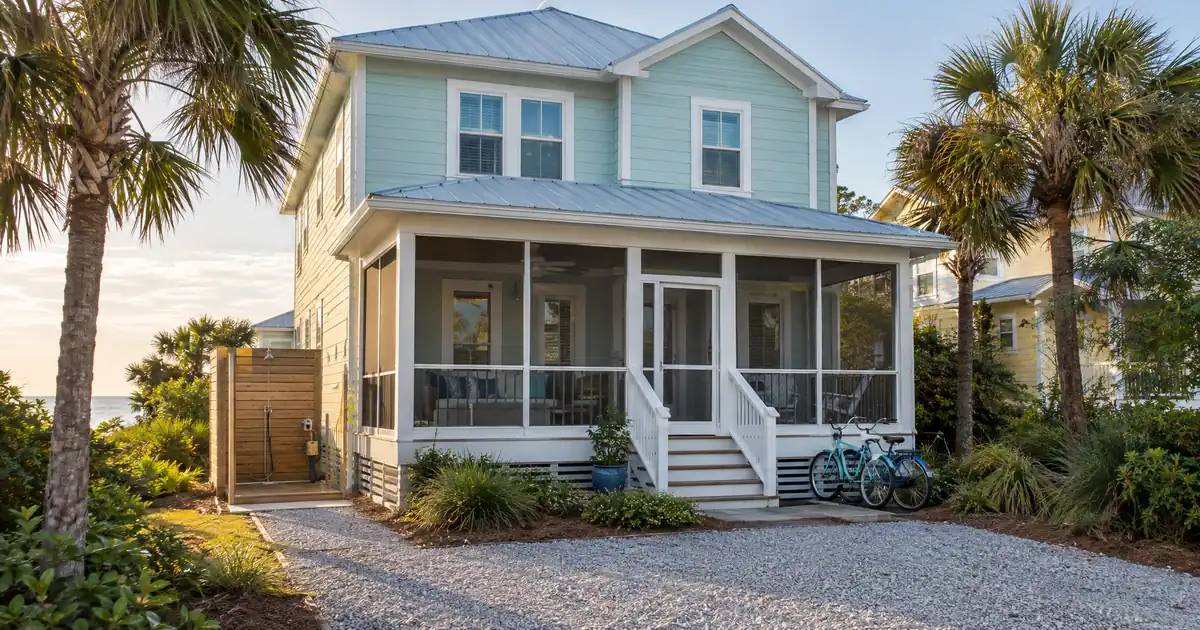
The Quick Read: Use a cash-out refinance on a rental you already own to pull equity out as cash, then use that cash for the down payment, closing costs, and reserves on a separate loan for the new short-term rental. Each property qualifies as its own file, on its own value, rental coverage, and leverage limits.
- Two loans, two files. The cash-out loan on the property you keep never looks at where you plan to buy.
- Leverage differs by property type. Cash-out tops out around 70% LTV when the collateral is a short-term rental, versus about 75% on a standard long-term rental. Short-term rental purchases reach up to 75% LTV on the strongest files.
- Coverage gets tested twice. The larger balance lowers the first property’s coverage ratio, and the new Airbnb needs its own.
- Income method matters. Whether a lender counts hosting history, a market projection, or long-term rent can move the loan size more than the property does.
- Local rules come first. Short-term rental rules can vary by city, county, HOA, and property type, so investors should confirm local rules before relying on projected rental income. Exact terms depend on the lender’s guidelines, property type, leverage, and a full review of the borrower’s file.
Key Terms Defined
These terms come up in every file, so here they are once.
- Cash-out refinance: a new, larger loan that pays off the old one and hands you the difference as cash.
- DSCR (debt service coverage ratio): monthly rent divided by the monthly housing payment. The lender checks whether the property’s income covers its own payment. Rent of twice the payment gives a 2.00 ratio.
- PITIA: principal, interest, taxes, insurance, and any HOA dues. It is the payment figure in the DSCR formula.
- LTV (loan-to-value): the loan balance as a percentage of the property’s appraised value.
- Seasoning: the waiting period between buying a property and refinancing it.
- Reserves: liquid money you hold after closing, usually counted in months of PITIA.
- Business-purpose loan: a loan for an investment property, not a home you live in. It is reviewed differently from a standard owner-occupied mortgage.
DSCR Cash-Out Calculator
Run the cash-out numbers in your market
Rate source: Freddie Mac 30-yr average via FRED® — Federal Reserve Bank of St. Louis · effective Oct 8, 2026
Prefilled with starting assumptions — enter your property’s value, balance, taxes, and insurance for a more accurate picture.
Program parameters update from Lendmire’s centralized guideline source. Taxes and insurance are editable estimates.
As of Oct 8, 2026 · General Freddie Mac market benchmark, not a Lendmire loan offer. Property value, balance, taxes, and insurance are editable estimates. Maximum loan-to-value varies by lender, program, property type, and seasoning. Not a Loan Estimate, approval, or commitment to lend. Program availability and eligibility are subject to lender guidelines, credit approval, property review, and underwriting.
What Does the Strategy Look Like Start to Finish?
The sequence has seven steps. Nothing about the target market touches the first loan. The second loan cares about the target market a great deal.
1. Size the source loan. The lender starts with the appraised value of the rental you own. It applies the cash-out LTV cap, subtracts your existing payoff and closing costs, and what remains is your net cash. Across most of the wholesale network Lendmire places files with, cash-out on a standard rental tops out near 75% LTV. When the collateral is itself a short-term rental, the ceiling drops to about 70%.
2. Test the new payment. The larger balance raises the payment, so the property’s coverage ratio falls after the cash-out. Model the post-refinance number before you apply, not after.
3. Appraise. The appraisal confirms value. On a rental it also produces a market rent estimate, which matters if the lender falls back on long-term rent.
4. Check seasoning. Most programs want some ownership time before a cash-out, commonly around six months.
5. Fund the source loan. The old loan pays off and you receive the remainder.
6. Underwrite the Airbnb separately. It has its own LTV, income evidence, credit review, and reserves.
7. Close the purchase. The cash from step five covers the down payment, closing costs, and reserves. Furnishing and setup costs sit outside the loan, so keep cash for them too.
A purchase loan on a short-term rental typically allows up to 75% LTV on the strongest files, which means at least 25% down. Cash-out proceeds are what make that down payment possible without selling anything.
Typical documents include platform payout exports or bank deposits for the property you own, a rent projection or appraisal rent schedule for the target, and proof the short-term rental use is allowed. You also provide insurance and, if an LLC holds title, entity documents (subject to lender program eligibility). Lendmire’s complete DSCR loans guide walks through the base program rules if you are new to the structure.
How Much Cash Can You Pull?
You get the smallest number produced by three tests: the LTV cap, the coverage floor, and reserves. Equity alone does not set your cash. A property with plenty of equity can still yield little if the bigger payment pushes coverage below the floor.
| Test | What it asks | When it binds |
|---|---|---|
| LTV cap | Is the new balance under the ceiling? | Low equity, modest value |
| Coverage floor | Does rent still cover PITIA? | High equity, modest rent |
| Reserves | Do you hold enough cash after closing? | Larger loans, thin liquidity |
Run a modeled example. Assume a short-term rental covers its payment at 1.45x today, and a cash-out raises the balance enough to bring it to roughly 1.15x. That clears a 1.00 floor with cushion. Pull more, and the ratio slides toward 1.00, where a slow season can erase the margin.
Select programs start at 1.00 coverage on short-term rentals, on the purchase side and on the refinance side. A separate select-lender path takes coverage below 1.00, with leverage and terms adjusted. A stronger ratio usually opens better pricing and leverage. It never lifts the LTV cap itself.
One more point on the math. A ratio above 1.00 is not positive cash flow. DSCR compares rent to PITIA only. Repairs, vacancy, management fees, utilities, and capital expenses sit outside the calculation, and short-term rentals tend to carry heavier operating costs than long-term ones. Judge the deal on both measures.
How Does Underwriting Treat Airbnb Income in a New Market?
The lender picks one of three income methods, and your file lives or dies on which one it accepts. Ask before you commit. The same property can produce meaningfully different qualifying income under each method, which can change the loan size more than the property’s performance does.
| Income method | Evidence used | Typical fit |
|---|---|---|
| Hosting history | 12 months of platform or deposit records | Properties you already operate |
| Market projection | Data-service report for the area | New purchases with no history |
| Long-term rent | Appraiser’s rent schedule | Fallback, often the lowest income |
History is the cleanest evidence, and it is what your existing rental supplies for the source loan. Projections are the usual route for the new Airbnb, since it has no track record yet. Only some lenders accept them, and those that do often apply a discount. Take a modeled case: if a lender counts 80% of projected income, a file that shows 1.25x on the full projection lands at 1.00x. Discounts vary by lender and program.
Long-term rent comes from an appraisal rent schedule. Because it measures what a tenant would pay for a year, it usually undercounts a strong short-term rental.
Short-term rental programs also expect hosting experience, usually about 12 months. Many files use the history from the property you already own to meet that expectation, though lenders differ on how they count it. The usual credit floor for these loans sits around 640, subject to lender guidelines.
What Does It Cost to Close on the New Property?
Plan for more than the down payment. The loan covers the purchase, and several costs sit outside it. A file that runs out of cash on setup costs stalls just as surely as one that runs out of equity.
| Item | Paid from | Inside the loan? |
|---|---|---|
| Down payment | Cash-out proceeds | No |
| Closing costs | Cash-out proceeds | No |
| Reserves for the new property | Liquid funds | No |
| Reserves for the source property | Liquid funds | No |
| Furnishing and setup | Cash on hand | No |
| Cushion for a slow start | Cash on hand | No |
Reserves deserve a second look. They vary by lender, leverage, loan size, and transaction type, commonly landing near six months of PITIA. Some conservative, low-leverage refinance files under a certain loan size can see them waived. Larger loans typically step up. The lender may ask for reserves on both properties, since the source loan just got bigger.
Where Does the General Rule Break?
Most of the exceptions come down to what the collateral is, who holds title, and what the local market allows.
The source property is itself a short-term rental. Cash-out on short-term rental collateral reaches about 70% LTV, while a standard long-term rental reaches about 75%. If your equity sits in an Airbnb, you pull less than you would from a similar long-term rental. Every figure here varies by lender and program — guidelines, property type, leverage, and credit profile all apply.
Smaller cash needs. For a modest amount of cash on a rental held in your own name, a home-equity line can fit better than a full cash-out. Investment-property lines cap at $500,000 total. A DSCR cash-out usually suits larger pulls and rentals held in an LLC, subject to program terms.
Coverage below 1.00. If the larger balance drops the source property under the floor, you have two moves. You can pull less, or you can ask about select lenders in the network that take coverage below 1.00, with leverage and terms adjusted. Neither is automatic, and both depend on credit, property review, and lender guidelines.
Ineligible property types. Manufactured homes (single- and double-wide), log homes, and barndominiums are not offered through the network’s DSCR programs. This applies to the target and the source.
Loan size. Standard programs run up to $3,000,000. Above $2,500,000 the network generally holds to 30-year fixed structures, so extended terms and interest-only periods are mostly a smaller-loan conversation.
Local legality. Short-term rental rules can vary by city, county, HOA, and property type. They sit outside the lending rules, but they decide whether the income assumption survives. A permit you cannot obtain or transfer can strand the whole projection. Experienced investors tend to favor markets with clear, established rules over markets with no policy at all, since rules can arrive later. Read the HOA or condo documents too.
Tax. Tax treatment can depend on how the funds are used and how the property is held; investors should keep clear records and speak with a qualified tax professional before relying on any deduction, and IRS Publication 535 is the starting reference.
How Does Cash-Out Compare With the Alternatives?
Cash-out wins when you want a large sum, the source rental has real equity, and you do not want to sell. Other tools win in other cases. The table shows the tradeoffs side by side.
| Option | Best for | Main catch |
|---|---|---|
| Cash-out refinance | Large pulls, no sale | New debt, lower coverage |
| Investment-property HELOC | Smaller amounts | $500,000 total cap |
| Sell the source rental | Exiting that market | Gives up the asset |
| Partner with an investor | Thin capital | Shared ownership |
An investor holding a paid-off rental sits in an especially clean spot for cash-out, since there is no existing payoff to subtract. Lendmire’s piece How to Use a Paid-Off Rental Cash-Out Refinance to Clear Another Loan covers that setup. The same logic of treating each loan as its own file carries through DSCR cash-out income requirements to buy another Airbnb.
What Does the Decision Look Like in Practice?
Start with the new market, not the loan. A lender can size the cash-out in either order, but the property must be legal and workable before the loan matters. Confirm the local rules, test demand, and line up a local manager, because the evidence for your income now sits with other people: a manager, a platform, and a county office.
Then size conservatively. In files with an out-of-market purchase, the weak point is rarely the cash-out itself. It is a projection that sounds strong, a lender that discounts it, and a source property whose coverage is thin after the pull. A cushion on the source property matters, because a slow season there now carries a bigger payment. Stress-test both properties against a weak stretch before you sign.
Weigh the tradeoff plainly. Cash-out turns idle equity into purchasing power without a sale. It also swaps your existing loan for a larger new one and uses leverage on two properties at once. The investor who does this well keeps coverage comfortable on both, holds cash for setup, and pulls only what the plan needs.
Ask the right questions up front:
- Which income method will the lender use on the new Airbnb, and will it discount the projection?
- What does coverage look like on the source property after the cash-out?
- Does the combined cash covering down payment, closing costs, setup, and reserves hold up with a cushion?
- Is the short-term rental use allowed where I am buying?
Frequently Asked Questions
Can I use equity from one rental to buy another in a different state?
Yes, because the two loans are separate files. The cash-out lender reviews the property you keep, and the purchase lender reviews the new one. The target location matters for the purchase and for local short-term rental rules, not for the source loan.
Do the reviews and bookings transfer when I buy an existing Airbnb?
Generally no. You buy the real estate, not the host account or its review history. That is why many purchases are underwritten on a projection or on long-term rent instead of on the seller’s results.
Does the cash-out lender care where I plan to spend the money?
Not in the way the purchase lender does. The cash-out file turns on the source property’s value, coverage, credit, and reserves. Expect the purchase file to carry the review of the target property.
What if the new market restricts short-term rentals after I buy?
Then the income assumption may not hold, and a long-term rental fallback may produce a lower number. Check the rules before you contract, and treat any projection as dependent on legal use. Qualification stays subject to lender guidelines and property review.
Can a higher coverage ratio get me more cash?
It can improve pricing and terms, but it does not raise the LTV ceiling. The strongest files clear both tests: enough equity and enough rental coverage.
Next Step
If you are buying or refinancing a rental property and want to see how the numbers work, Lendmire can help you compare DSCR loan options based on the property income, credit profile, leverage, and investor goals. Lendmire is a broker that arranges these loans through select lenders in its wholesale network, across 41 markets including Washington, D.C., and no loan is a commitment to lend. The editable calculator on this page gives an illustrative estimate, not a quote.
A slow first season in a market you do not live in is the stress test that matters most, so size the cash-out around that season and not the best month.
A deeper walk-through of investment-property equity extraction lives in Lendmire’s guide to cash-out refinance on an investment property.
About Lendmire
Lendmire — NMLS# 2371349 — is a mortgage brokerage specializing in DSCR investor loans, helping arrange financing across 41 markets, including Washington, D.C., through wholesale and investor-lending channels. The model centers on property-level rental income reviewed by the lender rather than W-2 documentation, subject to lender guidelines, suiting entity-owned and multi-property investors. Lendmire holds Scotsman Guide Top Mortgage Workplace recognition for 2025 and 2026.
Get Started
Ready to find the right loan for you?
In about 30 seconds you can review financing options available for your investment property. No commitment required.
Informational only. Not a Loan Estimate, approval, or commitment to lend. Program availability and eligibility are subject to lender guidelines, credit approval, property review, and underwriting.
References
This article is part of Lendmire’s investment property cash-out refinance program — full qualification details, guidelines, and scenarios live on the program page.
Related reading: How to Fund a Luxury Airbnb Purchase With a Super Jumbo DSCR Cash-Out · Cash-out DSCR Loans For Short-term Rental Investors: Accessing Equity · Pulling Equity Out Of A Short-term Rental To Buy The Next One: The STR Cash-out Playbook
Brandon Miller
Founder & CEO, Mortgage Loan Originator, Lendmire LLC
- Mortgage Loan Originator · NMLS# 1129696 · Verify on NMLS Consumer Access
- North Carolina Real Estate Broker · License# 343312 · Verify on NCREC
- North Carolina Insurance Producer · License# 19053198 · Property, Casualty, Life, Health · Verify on NAIC SBS
- Lendmire LLC · Firm NMLS# 2371349 · Verify firm licensure
Required disclosures. Lendmire (NMLS# 2371349) operates as a licensed mortgage broker, not a direct lender or depository. The discussion in this article is general in nature and should not be relied upon as financial, legal, or tax advice — every investment scenario is unique and should be reviewed by a qualified professional. Any loan inquiry is subject to lender underwriting, and this article is not a commitment to lend or a guarantee of approval. Mortgage rates, loan terms, and program guidelines vary by borrower, property, and state, and may change without notice. Equal Housing Opportunity. Verify licensure at NMLS Consumer Access.