
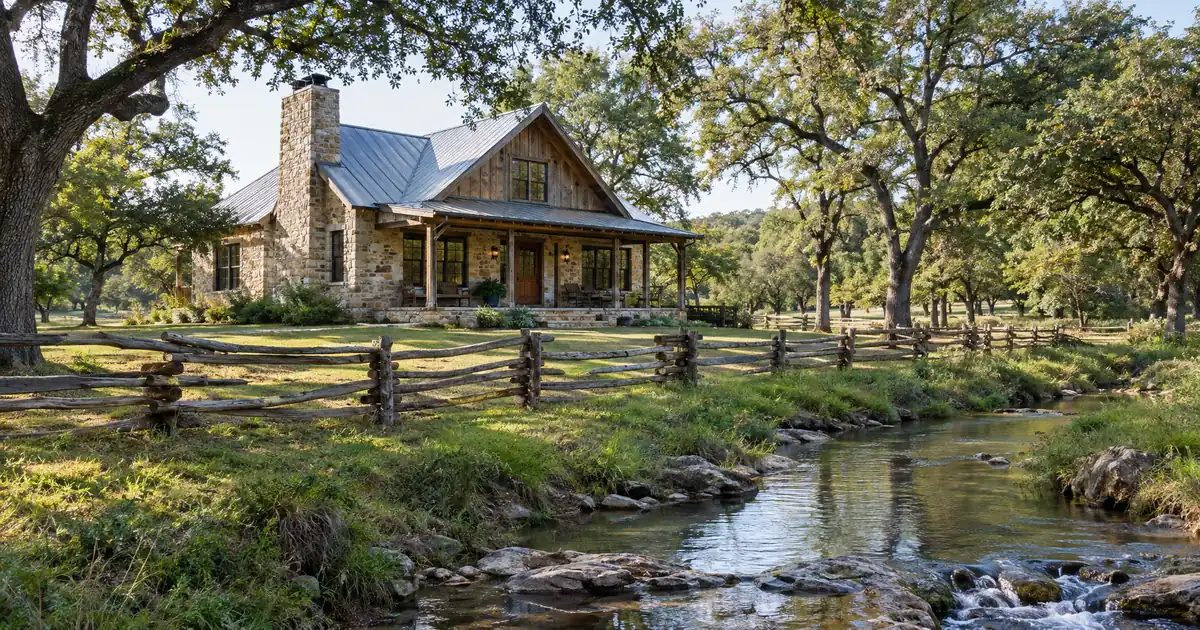
The Quick Read: A Texas homestead on acreage can carry a HELOC, but only if the home is your primary residence, the pledged land fits the state’s acreage limits, and total debt stays at or under 80% of the home’s value. Across Lendmire’s wholesale network, Texas properties are also limited to 10 acres, so larger tracts need a smaller, separately surveyed parcel or a different loan.
- A Texas homestead HELOC is a consumer loan on your primary residence. It cannot be placed on a rental or investment property under the state’s homestead rules.
- State law caps a homestead by acres, not by dollar value: up to 10 urban acres, or up to 200 rural acres for a family and 100 for a single adult.
- Combined liens on a Texas primary residence cap at 80% CLTV (combined loan-to-value), subject to lender guidelines and full file review.
- Only one such loan can be made in a 12-month period, and a mandatory 12-day waiting period applies.
- Equity from the homestead can fund rental purchases. The rentals themselves are financed under investor rules, such as DSCR.
What a Texas HELOC on a Homestead Actually Is
A HELOC is a revolving line of credit secured by your home. In Texas it is not an ordinary HELOC, because the state treats every equity loan on a homestead as a special category with its own rulebook.
How large a line the equity supports in Texas.
An equity line is sized by combined loan-to-value, occupancy, and credit — not by rental coverage. Switch the occupancy or the credit band and the ceiling moves with it.
Investment-property lines require a 700 minimum credit score; second-home lines start at a 640 minimum and primary-residence lines at 600, and the combined-LTV ceiling steps down as the credit band drops on primary-residence and second-home lines and holds on investment-property lines; the line cap steps down on primary-residence lines and holds at every tier on investment-property and second-home lines.
A debt-to-income ratio above 45% requires 680+ credit. Profiles under 640 are limited to single-family homes. At least 75% of the approved line is drawn at closing. Ceilings, floors, and caps update from Lendmire’s centralized guideline source.
Line estimate
Illustrative estimate only — not a quote, Loan Estimate, approval, or commitment to lend. The rate is an editable assumption; equity-line pricing is variable through both the draw and repayment periods and never converts to fixed. Occupancy and credit drive the ceiling together: an investment property tops out at 70% combined LTV (minimum credit 700, line cap $500,000); a second home tops out at 90% combined LTV (minimum credit 640, line cap $500,000), with the ceiling stepping down as the credit band drops (the cap holds at every tier); a primary residence tops out at 80% combined LTV (minimum credit 600), and its $750,000 maximum line is available only at 75% combined LTV or below with a 700-or-better credit profile (720 on the longer-runway program) and a full appraisal. Lines above $500,000 require a full appraisal. Credit, debt-to-income, property type, and full underwriting review all affect the final line.
The Texas A&M Real Estate Research Center explains that these homestead equity loans cannot be taken on a secondary residence, rental, or investment property. Only the homestead can secure them, and only one can be made in any 12-month period, even if the earlier loan was repaid.
The practical result is that two different rulebooks sit on one balance sheet. Your primary residence follows the homestead rules. Your rentals follow investor-program rules.
Key Terms Defined
Homestead: the home you live in as your primary residence, which Texas protects from most forced sales.
CLTV (combined loan-to-value): all liens on the property added together, divided by its value.
Urban homestead: a homestead that passes the statutory test for city-style location and services, with a smaller acreage cap.
Rural homestead: any homestead that fails the urban test, with a larger acreage cap.
Pledged acreage: the land that actually secures the line, which is not necessarily all the land you own.
DSCR (debt service coverage ratio): monthly rent divided by the full monthly obligation on an investment property, used to qualify rental loans.
Is Your Property Urban or Rural?
Classification comes first, because it sets the acreage cap. Texas allows up to 10 acres for an urban homestead. A rural homestead can reach 200 acres for a family or 100 acres for a single adult, in one or more parcels with improvements, per the Texas Property Code acreage definitions.
| Homestead type | Family | Single adult |
|---|---|---|
| Urban | Up to 10 acres | Up to 10 acres |
| Rural | Up to 200 acres | Up to 100 acres |
| Accepted in Texas by Lendmire’s network | Up to 10 acres | Up to 10 acres |
The statute defines urban with a two-part test. The property must sit inside a municipality, its extraterritorial jurisdiction, or a platted subdivision. It must also have police protection, fire protection, and at least three of five services: electric, natural gas, sewer, storm sewer, and water.
Rural is simply what is left over. A rural address outside city limits does not settle it, and neither does a mailing address. The Texas Bankers Association’s application checklist warns lenders not to rely on the urban, rural, or suburban box on an appraisal.
Two other points matter on acreage. Rural land does not have to be one parcel, and separate tracts can count if they are used with the home for the family’s comfort, convenience, or support. A family also cannot hold both an urban and a rural homestead.
The Requirements Checklist
Property requirements
- The home must be your primary residence and a true homestead, which takes both intent to live there and an overt act such as occupancy.
- It must be held by you personally or by a revocable living trust. LLCs, corporations, partnerships, and irrevocable, blind, or land trusts cannot hold title on the equity lines Lendmire arranges.
- Eligible types include single-family, 2-4 units, PUDs, townhomes, and condominiums. Manufactured homes, log homes, commercial, mixed-use, and agricultural-zoned properties are not eligible.
- A property listed for sale, or listed within the past 60 days, is ineligible in Texas.
Borrower requirements
- The minimum credit score is 600 across the network. A Texas primary residence caps at 80% CLTV, and on the network’s primary-residence matrix a 640 or better profile reaches that 80% level.
- DTI (debt-to-income) tops out at 50%, drops to 45% for scores from 600 to 679, and is calculated on the interest-only payment at the maximum draw.
- A bankruptcy needs 4 years of seasoning from discharge or dismissal.
- Borrowers are limited to three lines, and anyone with more than 15 financed properties is not eligible.
Texas process requirements
- A 12-day waiting period applies before closing, per the Texas Bankers Association’s document checklist.
- Owners and spouses sign the required documents, including a sworn homestead affidavit.
- Only one lien of this type at a time is allowed, and 12-month seasoning applies to primary residences.
- Fees are capped at 2%, with appraisal, survey, title insurance, and title examination excluded, as the Texas Bankers Association’s amendment overview describes.
- The line is non-recourse absent actual fraud, and foreclosure requires a court order.
How Underwriting Treats Acreage, Step by Step
1. Establish homestead. The file must show you live there. Title held by an entity defeats homestead status.
2. Classify urban or rural. The lender applies the statutory test to the facts, not to the appraiser’s label.
3. Check the pledged acreage. On Lendmire’s network the pledged tract cannot exceed 10 acres in Texas, whatever the state allows.
4. Separate the parcel. If you own adjoining land, lenders commonly want a survey showing the homestead tract stands alone.
5. Value the property. Lines at or below $500,000 ordinarily use an automated valuation. A full appraisal is required above $500,000, and you can request one on any line.
6. Size the line. Combined liens are held to the 80% ceiling, and your credit tier and DTI set the final limit.
7. Close after the waiting period. The 12-day notice must run first, and the 12-month spacing rule must be met.
Automated valuations can be thin on rural parcels with few nearby comparable sales. A borrower on a large or unusual tract may be better served by requesting the full appraisal up front.
Where the General Rule Breaks
Agricultural land. Before a later constitutional amendment, property designated for agricultural use under the tax laws could not secure a home equity loan, except where it was primarily used for milk production. That bar was repealed, according to the Texas Bankers Association overview. Older articles that still repeat it are outdated.
State law and program eligibility are separate questions, though. The network’s equity lines exclude agricultural-zoned property, so a tax valuation for agricultural use is a different issue from agricultural zoning, and the lender must confirm which one applies.
Occasional use. Weekend or holiday use does not establish a rural homestead. Farming the land without living on it does not either.
Owned versus pledged acreage. You might own 60 acres but pledge only a 9-acre homestead tract. The survey is what proves the pledged piece is its own parcel.
An urban tract that is too big. An urban tract over 10 acres cannot be pledged in full under the urban limit. If it fails the urban test, it is rural, and the rural cap applies instead.
Existing equity lien. A homestead equity loan generally blocks a second one. A no-cash-out refinance exit exists once the loan has seasoned for at least one year.
Barndominiums and manufactured homes. Acreage often comes with these structures. Manufactured homes and log homes are not eligible on these lines, so the structure can disqualify a property even when the acreage is fine.
Former homestead now a rental. A prior homestead equity lien can still affect later refinances, so title counsel should review it.
Structures and Limits Behind the Line
Two wholesale programs sit behind these lines. One uses a 3-year interest-only draw followed by a 17-year repayment period. The other, called the longer-runway program here, uses a 5-year draw and a 25-year repayment period.
At least 75% of the line is drawn at closing on both. Pricing floats across the draw and repayment periods and never converts to fixed. The minimum draw after closing is $4,000 in Texas on the longer-runway program, while the 3-year program does not state subsequent-draw minimums.
Line sizes run from $25,000 to $750,000. A line above $500,000 is for primary residences only and requires a credit profile of 700 or better (720 on the longer-runway program). It also caps at 75% CLTV and requires a full appraisal.
Texas also keeps its own ceiling on top of the matrix. A Texas primary residence caps at 80% CLTV no matter how high the credit tier, and every figure here is subject to lender guidelines and full file review.
The Investor Decision in Practice
The homestead HELOC answers one question: how do you pull equity from the house you live in? It is underwritten on you, using credit, DTI, and equity. A DSCR loan answers a different question about a different property, because DSCR loans are designed for non-owner-occupied investment properties and are reviewed differently from a standard owner-occupied mortgage.
Using homestead equity to buy a rental is a legitimate move, since the rules attach to the collateral and not to how the funds are spent. The tradeoffs are timing and structure. The mandatory waiting period and one-lien-per-12-months limit mean a homestead line cannot be pulled together at the last minute for an offer.
Picture a buyer who wants to live on 8 acres and also own a duplex. The homestead line taps the residence, and the duplex is financed on its own rent. Most DSCR purchases land at 75%-80% LTV, and a DSCR cash-out refinance tops out around 75% LTV with about 6 months of seasoning as the common expectation. Select programs start at 1.00 coverage, while a separate select-lender path goes below 1.00 with leverage and terms adjusted. Stronger ratios open better terms. Final terms depend on the lender’s guidelines, the property type, and the borrower’s complete credit picture.
Clearing 1.00 does not mean positive cash flow, because repairs, vacancy, and management sit outside the calculation. Rental loans qualify primarily on property-level rental income covering the payment, subject to lender guidelines. The complete DSCR loans guide walks through the full picture.
If you run an investment property through an LLC, a homestead line cannot be placed on it, and a property already deeded to an LLC needs a vesting change or a DSCR cash-out instead. Investment-property HELOC lines run at 70% CLTV with a 700 minimum credit score and cap at $500,000 total.
Tax treatment can depend on how the funds are used and how the property is held; investors should keep clear records and speak with a qualified tax professional before relying on any deduction.
Frequently Asked Questions
Does a large rural homestead disqualify me from a HELOC?
Not automatically. State law allows up to 200 rural acres for a family, but the network’s programs accept up to 10 acres in Texas. If you own more, the pledged tract must be a separate, surveyed parcel at or under that limit. Eligibility is subject to lender guidelines and file review.
Can I use a HELOC on my homestead to buy a rental?
Yes, because the rules attach to the collateral and not to how you spend the funds. The line is underwritten on your credit and equity, and the rental is financed separately. Plan for the mandatory waiting period and the one-per-12-months limit.
Does paying off a prior equity loan reset the 12-month clock?
No. The Texas A&M center states that only one such loan may be made in 12 months, even if the previous loan was repaid. A seasoned loan can sometimes be refinanced without cash out after one year.
What is the maximum CLTV on a Texas primary residence?
It is 80% CLTV across the network, even for borrowers whose credit tier would otherwise allow more. Texas primary residences never reach the higher tiers shown on the network’s general matrix.
Can a second home or rental on acreage get an equity line in Texas?
Yes, but as a separate, non-homestead transaction, not under the homestead HELOC rules above. The 12-day waiting period and 12-month spacing bind primary residences only. Second homes floor at a 640 score, and investment properties need 700 and cap at 70% CLTV.
Next Step
If you are considering a home equity line and want to see how the numbers work, Lendmire can help you compare HELOC options based on the property, the equity available, credit profile, combined leverage, and your goals. Lendmire is a broker arranging financing through select lenders in its wholesale network and is not a commitment to lend. Call 828-256-2183 or use the illustrative calculator on the page for an estimate.
About Lendmire
Lendmire (NMLS# 2371349) is a mortgage broker. Home equity lines of credit — on a primary residence, a second home or an investment property — are arranged through wholesale lenders in Lendmire’s 16 full-service states, and every line is underwritten by the lender under its program guidelines. Scotsman Guide named Lendmire a Top Mortgage Workplace in both 2025 and 2026.
Get Started
Ready to find the right loan for you?
In about 30 seconds you can review financing options available for your home or investment property. No commitment required.
Informational only. Not a Loan Estimate, approval, or commitment to lend. Program availability and eligibility are subject to lender guidelines, credit approval, property review, and underwriting.
References
1. Texas A&M Real Estate Research Center, What to Know About Home Equity Loans in Texas
2. Texas Property Code §41.002
3. Texas Bankers Association, home equity application checklist
4. Texas Bankers Association, home equity document checklist
5. Texas Bankers Association, overview of the amendment
This article is part of Lendmire’s home equity line of credit program — full qualification details, guidelines, and scenarios live on the program page.
Related reading: HELOC Tiers for a First-Time Equity Borrower on a Primary Home · How a HELOC Funds Four Years of Tuition for a Parent Borrower · How Much Home a First-Lien HELOC Down Payment Supports After DTI
Brandon Miller
Founder & CEO, Mortgage Loan Originator, Lendmire LLC
- Mortgage Loan Originator · NMLS# 1129696 · Verify on NMLS Consumer Access
- North Carolina Real Estate Broker · License# 343312 · Verify on NCREC
- North Carolina Insurance Producer · License# 19053198 · Property, Casualty, Life, Health · Verify on NAIC SBS
- Lendmire LLC · Firm NMLS# 2371349 · Verify firm licensure
Important disclosures. Lendmire (NMLS# 2371349) is a licensed mortgage brokerage. Lendmire is not a direct lender, depository institution, or financial advisor. All loan inquiries are subject to lender underwriting; this article does not constitute a commitment to lend. Rates, terms, and program guidelines are subject to change without notice and vary by borrower profile, property type, and state. Information in this article is general in nature and is not financial, legal, or tax advice. Equal Housing Opportunity. NMLS Consumer Access: nmlsconsumeraccess.org.