
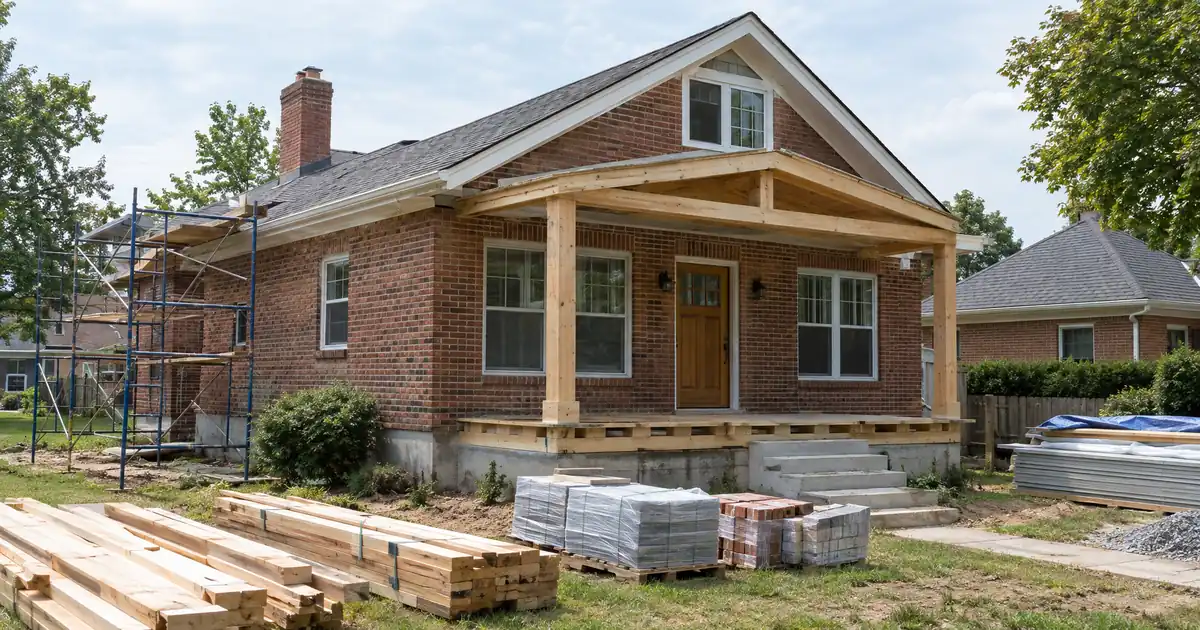
The Quick Read: The biggest risk of funding a flip or BRRRR with a HELOC is that your own home secures the debt, so a stalled rehab, a low appraisal, or a frozen credit line becomes a problem for the house you live in, not just for the project. A home equity line of credit (HELOC) is a revolving loan secured by your house. BRRRR means buy, rehab, rent, refinance, repeat.
- Your residence is the collateral, so the project’s worst case lands on your home.
- The lender can freeze or reduce an undrawn line, so unused credit is not committed money.
- Payments float with the market and never convert to a fixed amount on the network’s lines.
- The draw period and the end-of-plan balance create hard deadlines that a late rehab can miss.
- A HELOC adds to your personal debts, while a DSCR exit loan is sized on the property’s rent.
How a HELOC-Funded Flip or BRRRR Actually Works
A HELOC-funded project borrows against the equity in your own home, spends it on the purchase, down payment, or rehab, then repays the line from a sale or a refinance. The lender underwrites you and your house, not the project.
How large a line the equity supports.
An equity line is sized by combined loan-to-value, occupancy, and credit — not by rental coverage. Switch the occupancy or the credit band and the ceiling moves with it.
Investment-property lines require a 700 minimum credit score; second-home lines start at a 640 minimum and primary-residence lines at 600, and the combined-LTV ceiling steps down as the credit band drops on primary-residence and second-home lines and holds on investment-property lines; the line cap steps down on primary-residence lines and holds at every tier on investment-property and second-home lines.
A debt-to-income ratio above 45% requires 680+ credit. Profiles under 640 are limited to single-family homes. At least 75% of the approved line is drawn at closing. Ceilings, floors, and caps update from Lendmire’s centralized guideline source.
Line estimate
Illustrative estimate only — not a quote, Loan Estimate, approval, or commitment to lend. The rate is an editable assumption; equity-line pricing is variable through both the draw and repayment periods and never converts to fixed. Occupancy and credit drive the ceiling together: an investment property tops out at 70% combined LTV (minimum credit 700, line cap $500,000); a second home tops out at 90% combined LTV (minimum credit 640, line cap $500,000), with the ceiling stepping down as the credit band drops (the cap holds at every tier); a primary residence tops out at 90% combined LTV (minimum credit 600), and its $750,000 maximum line is available only at 75% combined LTV or below with a 700-or-better credit profile (720 on the longer-runway program) and a full appraisal. Lines above $500,000 require a full appraisal. Credit, debt-to-income, property type, and full underwriting review all affect the final line.
Here is the usual sequence:
1. Borrow against your home. You open a line secured by your primary residence. Interest accrues on what you draw.
2. Buy and rehab. Draws follow the purchase and the contractor invoices.
3. Stabilize or sell. A flip gets sold. A BRRRR gets rented.
4. Exit. On a flip, the settlement agent pays off the line from sale proceeds. On a BRRRR, a refinance on the project property is supposed to return enough cash to pay the line down.
5. Keep or close the line. A paid-down line can stay open for the next deal until the draw period ends.
Four things decide whether this works. The rehab has to stay on budget. The after-repair value has to hold up. The exit has to happen before the draw period ends. The line has to stay open the whole time.
A DSCR loan works the other way around. DSCR stands for debt service coverage ratio, which compares a property’s rent to its full monthly payment. Lendmire’s complete DSCR loans guide covers that side in depth.
What Does a Home Equity Line Look Like Across the Network?
Across the wholesale network Lendmire works with, a standalone home equity line comes with firm limits on leverage, credit, size, and structure. Lendmire is a broker, so every figure here is a guideline subject to lender review, not a commitment to lend. These lines are available only in Lendmire’s 16 full-service states, which is narrower than its 41-market DSCR footprint, including Washington, D.C.
- Leverage on a primary residence. CLTV is combined loan-to-value, meaning all loans against the home divided by its value. Ceilings step with your credit score, from 60% CLTV at a 600 score up to 90% CLTV at 720 or better on lines up to $500,000.
- Line size. Lines run from $25,000 up to $750,000 on a primary residence. A line above $500,000 is for a primary residence only, needs a 700 score or better (720 on the 5-year-draw structure), and requires a full appraisal.
- Debt-to-income. Maximum DTI is 50%, and the lender reviews your file on the interest-only payment calculated as if you had drawn the full line.
- Valuation. Lines at or below $500,000 ordinarily use an automated valuation instead of a traditional appraisal.
- Title. An individual or a revocable living trust must hold title. An LLC cannot.
Two draw structures exist. One has a 3-year interest-only draw followed by a 17-year repayment. At least 75% of the line is drawn at closing, so you owe interest on most of the line from day one, whether you need the money yet or not. Pricing floats through both periods and never converts to fixed.
Risk One: Your Home Is the Collateral
Foreclosure on your residence is the worst case, and it is the risk that sets a HELOC apart from every other flip funding source. A hard money loan puts the project property at risk. A HELOC puts the roof over your head at risk.
A BiggerPockets podcast transcript makes the same point. A HELOC fits a flip or BRRRR only if you could still pay it back if the project fails. That is a sound test. Could you repay the line from savings and income without selling the project at a loss?
The failure that hurts most is the slow one. A rehab runs over, the sale drags, and you carry both your home and the project at once. Many flips do not fail outright. They run late and cost more, and the house you live in pays for the delay.
Risk Two: The Lender Can Freeze or Cut the Line
An undrawn HELOC is permission to borrow, not money in the bank. The CFPB’s HELOC brochure explains that a lender can freeze or reduce a credit line when the home’s value declines significantly or the lender reasonably believes you cannot make payments because of a material change in your finances.
That matters for staged rehab draws. A softening market can shrink your home’s value just as you need the last tranche for finishes and permits. Plan the project so the cash you have already drawn can carry it to the exit. Treat anything undrawn as a bonus.
Risk Three: Payment Shock and the 75% Draw at Closing
Variable pricing means your carrying cost can rise mid-project. Because at least 75% of the line is drawn at closing on the network’s programs, that exposure starts at full size on day one. Interest-only payments feel light, but they do not reduce the balance.
Slow sales raise the cost of carrying a line. News coverage of ATTOM data reports flip return on investment fell to 23.1% in a recent quarter, with slower sales pushing flippers to hold longer. Each extra month on a floating line is another month of interest you did not budget for.
Stress-test the line before you sign. Ask what happens if the project takes twice as long as planned and payments are higher than today. If the answer is that you would have to sell your home or drain your emergency fund, the plan is too tight.
Risk Four: Draw Periods, Balloons, and the Clock
Every line has a draw period and then a repayment period, and the end of the draw period is a deadline. After a 3-year draw, the balance begins amortizing over 17 years. After a 5-year draw, it amortizes over 25 years. Investment-property lines run the 5-year structure only.
With interest-only payments, the CFPB’s HELOC booklet warns, you may have to pay the entire balance at once when some plans end. It adds that if you cannot make that balloon payment, you could lose your home. The network’s lines amortize after the draw, so payments step up instead of one lump coming due. The step-up can still strain a household that planned around interest-only payments.
For a BRRRR, the clock has another layer. The refinance usually needs the property to be rented and seasoned first. On a DSCR cash-out refinance across most of the network, about six months of seasoning is the common expectation. If the rehab runs late, the HELOC keeps running while the refinance waits.
Risk Five: Appraisal and ARV Misses
The after-repair value (ARV) is your estimate of what the property is worth when the work is done. Every exit depends on it. If a flip sells below your ARV, the shortfall comes out of your profit. If a BRRRR appraises low, the refinance returns less cash than you planned, and you owe the difference on the HELOC out of pocket.
Cash-out refinances on standard rentals top out around 75% LTV across most of the network, and the figure is lower on short-term rental collateral. A low appraisal does not just trim profit. It shrinks the check that was supposed to repay your line. Terms vary by lender guidelines, property type, leverage, credit profile, and full file review.
Risk Six: Added Debt and Stacked Liens
A HELOC counts toward your personal debts, and the lender reviews your file on the full-line interest-only payment. That can crowd out personal-income-based loans later. Lendmire’s piece How a HELOC Changes DTI When Buying a Rental or Funding a BRRRR walks through that effect. A DSCR exit loan looks at the property’s rent against its payment, so it is less affected by your personal debt load.
Stacking is the riskiest version. Some investors use HELOC funds as the down payment on a hard money loan. That produces two liens and two payments with one home behind the first. If the flip stalls, both payments keep coming.
The Risks at a Glance
| Risk | Flip | BRRRR | Mitigation |
|---|---|---|---|
| Home as collateral | Sale delay hits the house | Refi delay hits the house | Keep repayment capacity outside the deal |
| Freeze or cut | Rehab funding stops | Rehab funding stops | Draw early, budget from drawn cash |
| Payment shock | Longer hold costs more | Longer hold costs more | Stress-test a long timeline |
| Draw period end | Sale after the deadline | Refi after the deadline | Time the exit well inside the draw |
| Appraisal miss | Lower sale price | Smaller refi check | Underwrite ARV conservatively |
| Added debt | Fewer future loans | Fewer repeat deals | Plan the DSCR exit first |
Where the General Rule Breaks
Who holds title. The line must be in the name of an individual or a revocable living trust. If your home is deeded to an LLC, it needs a vesting change first, or a DSCR cash-out may be the better fit.
HELOC on the project property. A line on a rental you already own is a different product. On an investment property, lines cap at 70% CLTV and $500,000 total, with a 700 minimum score. There is no tier above that.
Lien position at the exit. A HELOC is a recorded lien. A sale pays it off. A refinance of the project property does not touch your home’s line, but a refinance of the home would require paying off or subordinating it, and the line holder has no duty to subordinate.
Business-purpose label. DSCR loans are designed for non-owner-occupied investment properties. Because they are business-purpose investor loans, they are reviewed differently from a standard owner-occupied mortgage. A HELOC on your own home is generally written as consumer credit, so do not expect investor-style treatment.
Tax. Tax treatment can depend on how the funds are used and how the property is held; investors should keep clear records and speak with a qualified tax professional before relying on any deduction.
Three Ways a HELOC-Funded Project Can End
| Outcome | What happens to the line | Pressure on you |
|---|---|---|
| Sells on plan | Paid off at settlement | Low |
| Sells late | Interest keeps accruing | Moderate to high |
| BRRRR refi comes up short | Balance stays partly open | High |
The third row is the one to model before you start. If the refinance falls short, you have a rental that works and a line against your home that does not go away.
The DSCR Exit, and What 1.00 Does Not Mean
A DSCR cash-out refinance is the common take-out after a rehab. It qualifies primarily on property-level rental income covering the payment, subject to lender guidelines. Across most of the network, cash-out tops out around 75% LTV on standard rentals. Most programs want a score around 660, and 700 or better unlocks the strongest leverage. Reserves commonly run around six months of PITIA (principal, interest, taxes, insurance, and HOA dues), though they vary by lender, leverage, and loan size.
On coverage, 1.00 is where many select programs start, and a separate select-lender path takes coverage below 1.00 with leverage and terms adjusted. Stronger ratios open better pricing and leverage.
Clearing 1.00 does not mean the property cash flows. The ratio compares rent to the payment only. Repairs, vacancy, management, utilities, and capital costs sit outside it. A DSCR loan can be held in an LLC, subject to program terms, which is a real structural difference from a HELOC.
Reasonable Fit, or Reconsider?
A HELOC can be a reasonable fit if you have flipped before, hold meaningful cash reserves outside the project, keep conservative ARV numbers, and have a tested exit lined up before you draw.
Reconsider if this is your first flip, if you would need rent from the project to keep your own mortgage current, or if a late exit would force you to sell your home. In those cases, a hard money loan or a DSCR purchase puts the project property at risk instead of your residence.
If you are considering a home equity line and want to see how the numbers work, Lendmire can help you compare HELOC options based on the property, the equity available, credit profile, combined leverage, and your goals. Reach the team at 828-256-2183.
Key Terms Defined
- Draw period: the stretch of years when you can borrow from the line and pay interest only.
- Repayment period: the years after the draw ends, when the balance amortizes.
- After-repair value (ARV): the projected market value of the property once the rehab is done.
- Balloon payment: a lump sum due at the end of a plan when payments did not fully pay off the balance.
- Seasoning: the waiting period a lender wants between buying a property and refinancing it.
- PITIA: principal, interest, taxes, insurance, and HOA dues, the full monthly housing obligation.
Frequently Asked Questions
Can the lender cancel my HELOC in the middle of a rehab?
The lender can freeze or reduce the line if your home’s value drops significantly or your finances change materially. Only the cash you have already drawn is certain, so budget the rehab around drawn funds.
Can I use my HELOC for a flip if my home is in an LLC?
No. An individual or a revocable living trust must hold title. A home already deeded to an LLC needs a vesting change before it can secure the line, or a DSCR cash-out may fit better.
What happens if my BRRRR appraisal comes in low?
The refinance returns less cash than planned. You cover the gap on the line out of pocket, and the line stays open against your home until you do. Underwriting ARV conservatively is the best protection.
How much can I borrow against my home?
On a primary residence, the ceiling steps with your credit score, from 60% CLTV at a 600 score to 90% CLTV at 720 or better on lines up to $500,000. Lines run up to $750,000. All of this is subject to lender guidelines and full file review.
Does a DSCR exit loan replace the HELOC?
A DSCR cash-out refinance on the project property can generate proceeds to pay the line down. It does not replace the line automatically, and the proceeds have to cover the payoff.
About Lendmire
Lendmire (NMLS# 2371349) is a mortgage brokerage serving homeowners and real estate investors in its 16 full-service states. Home equity lines of credit are arranged through wholesale lending channels; Lendmire brokers the line and the lender underwrites each application under its occupancy-based guidelines. Scotsman Guide named Lendmire a Top Mortgage Workplace in both 2025 and 2026.
Get Started
Ready to find the right loan for you?
In about 30 seconds you can review financing options available for your home or investment property. No commitment required.
Informational only. Not a Loan Estimate, approval, or commitment to lend. Program availability and eligibility are subject to lender guidelines, credit approval, property review, and underwriting.
References
1. BiggerPockets podcast transcript
This article is part of Lendmire’s home equity line of credit program — full qualification details, guidelines, and scenarios live on the program page.
Related reading: HELOC Tiers for a First-Time Equity Borrower on a Primary Home · How a HELOC Funds Four Years of Tuition for a Parent Borrower · How Much Home a First-Lien HELOC Down Payment Supports After DTI
Brandon Miller
Founder & CEO, Mortgage Loan Originator, Lendmire LLC
- Mortgage Loan Originator · NMLS# 1129696 · Verify on NMLS Consumer Access
- North Carolina Real Estate Broker · License# 343312 · Verify on NCREC
- North Carolina Insurance Producer · License# 19053198 · Property, Casualty, Life, Health · Verify on NAIC SBS
- Lendmire LLC · Firm NMLS# 2371349 · Verify firm licensure
Compliance and disclosures. Lendmire (NMLS# 2371349) is a licensed mortgage broker and is not a direct lender, depository institution, financial advisor, or tax professional. Content in this article is general market analysis and educational information — not financial, legal, or tax advice for any specific situation. Lendmire does not guarantee loan approval; every transaction is subject to underwriting by the funding lender. Mortgage pricing and loan program guidelines are subject to change at any time without notice and vary by borrower characteristics, property type, and state regulations. Lendmire complies with Equal Housing Opportunity. Licensure verification: NMLS Consumer Access.