
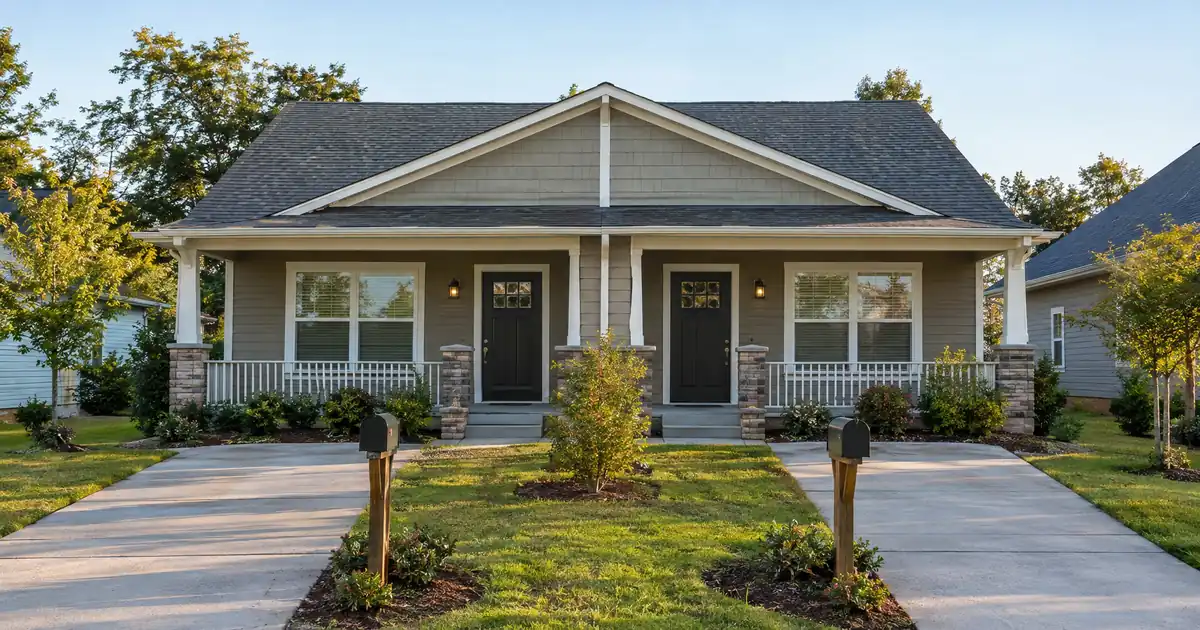
The Quick Read: A duplex you plan to rent short-term in both units is financed as an investment property, and a DSCR loan, which tests the property’s rent against its payment, is the usual route because the lender totals both units’ Airbnb income and tests it against one payment.
- Two Airbnbs with you living elsewhere is an investment-property file, not an owner-occupant file.
- On short-term-rental purchases, leverage typically tops out at 75% LTV, subject to lender guidelines.
- Expect about 12 months of hosting history and a credit score of roughly 640 or higher.
- Lenders haircut gross Airbnb revenue before dividing by the payment, so strong bookings can still miss the ratio.
- Clearing the ratio does not mean the duplex cash flows.
Which Loan Category Does Your Plan Put You In?
Your occupancy plan decides the loan category, and the loan category decides almost everything else. Live in one unit and you are shopping owner-occupant loans. Rent both units to guests and you are shopping investment-property loans.
DSCR Calculator
Run the numbers in your market
Rate source: Freddie Mac 30-yr average via FRED® — Federal Reserve Bank of St. Louis · effective Oct 15, 2026
Prefilled with starting assumptions — enter your own rent or nightly figures, taxes, insurance, and HOA for a more accurate picture.
Program parameters update from Lendmire’s centralized guideline source. Taxes and insurance are editable estimates.
As of Oct 15, 2026 · General Freddie Mac market benchmark, not a Lendmire loan offer. Rent, nightly rate, occupancy, taxes, and insurance are editable estimates. Short-term rental figures are estimates only and vary significantly by season, property type, management approach, and local short-term-rental rules — confirm local regulations before relying on them. Qualifying income for short-term rentals varies by program — some use appraisal market rent, others use documented STR history or projections — and is confirmed in underwriting. Not a Loan Estimate, approval, or commitment to lend. Program availability and eligibility are subject to lender guidelines, credit approval, property review, and underwriting.
| Your plan | Loan category | Occupancy strings | Income the lender leans on |
|---|---|---|---|
| Live in one unit, rent the other | Owner-occupant | Yes, you must live there | Your personal income |
| Both units as Airbnbs, you live elsewhere | Investment property | None | Property rental income |
| Live there a while, then move out | Owner-occupant first | Yes, for a set period | Your personal income |
| One Airbnb, one long-term lease | Investment property | None | Mix of STR and lease income |
Owner-occupant loans, including government-backed ones, need less down and carry a living-there requirement. That requirement collides with running both units as short-term rentals from day one. Not a loophole-friendly area.
DSCR loans are designed for non-owner-occupied investment properties. Because they are business-purpose investor loans, they are reviewed differently from a standard owner-occupied mortgage. The loan is reviewed primarily on property-level rental income covering the payment, subject to lender guidelines.
Second-home loans are not a workaround either. They limit how much you can rent the property out, which defeats a two-Airbnb plan.
Key Terms Defined
DSCR (debt service coverage ratio): Monthly rent used for lender review divided by the monthly housing payment. A result of 1.00x means income equals the payment.
PITIA: Principal, interest, taxes, insurance, and any HOA dues. It is the payment the ratio is tested against.
Haircut: The reduction a program applies to gross Airbnb revenue to account for vacancy and costs that gross bookings hide.
Hosting history: The record of past bookings, usually platform earnings or manager statements covering the prior year.
Form 1025: The appraisal report for two- to four-unit properties. It includes a rent analysis for each unit.
LTV (loan-to-value): The loan amount as a percentage of the property’s value.
How Underwriting Treats Two Airbnbs, Step by Step
Underwriting boils down to one comparison: your counted income against one payment. Two units mean two streams of nightly income feeding one note and one PITIA. Here is how a file moves.
1. The haircut gets applied. Across the network, programs trim gross short-term revenue by different amounts. A few look only at long-term rent.
2. The result is divided by PITIA. The two units’ income is combined and compared with the single payment. Whether a program allows unit-by-unit evidence paths is an underwriting question for the lender.
3. One appraisal is ordered. It returns value and a rent schedule. On a two-unit property it is the Form 1025.
4. The binding limit gets tested. Either the LTV cap on value or the coverage test on income binds first. On short-term rentals, coverage is often the one that bites.
Typical documents include platform earnings or a manager statement, bank statements as a cross-check, and insurance that names short-term use. Documentation grows with unit count. Lendmire’s complete DSCR loans guide walks through the broader file.
What the Appraisal Does and Does Not Do
The appraiser values the building. The lender decides how much Airbnb income counts. Many investors assume the appraisal will count their bookings, and it will not.
Fannie Mae’s appraiser guidance describes Form 1007 as the comparable rent schedule for single-family investment properties. A duplex falls under Form 1025 instead. The same guidance says an appraiser should not take nightly comps and multiply by 30 to estimate monthly rent. That shortcut ignores furnishings, services, vacancy, and business expenses.
McKissock, an appraisal education provider, adds that appraisers consider only the real property, not personal property or business income. The lender makes the final call on income, including short-term income.
Some appraisers add a separate short-term projected income analysis as a narrative addendum, as Class Valuation describes. HousingWire notes that forcing Airbnb income through a long-term rent form can produce artificially low coverage ratios. Appraisal form names may change over time, so focus on what the document does rather than its label.
The Structures and Variations That Exist
Most duplex-Airbnb files land in one of a few structures, and the wholesale network handles them differently.
| Structure | Typical leverage | What drives the file |
|---|---|---|
| Standard rental purchase | 75%–80% LTV | Long-term rent coverage |
| Short-term-rental purchase | Up to 75% LTV | Hosting history or projection |
| Short-term-rental refinance | Around 70% LTV | Trailing 12-month income |
| Short-term-rental cash-out | 70% LTV | Trailing 12-month income |
| Standard rental cash-out | Up to 75% LTV | Seasoning of about 6 months |
On short-term-rental collateral, programs typically want a score around 640 or higher and roughly 12 months of hosting history. Coverage floors of 1.00 apply on purchases and, separately, on refinances. Select programs reach 85% LTV on purchases with a 700-plus score, though those tiers are aimed at standard rentals.
Term structures start from a 30-year fixed. Extended terms and interest-only periods are available through select lenders in the network. Adjustable structures exist for investors who want them. Loan sizes run up to $3,000,000 on standard programs, and reserves commonly sit around 6 months of PITIA, stepping up to about 9 months above $1,500,000. Reserves vary by lender, leverage, loan size, and transaction type.
A bigger down payment lowers the payment and can lift the ratio. It never erases leverage caps, credit floors, or reserve rules. The strongest files clear both tests: enough equity and enough rental coverage.
A Worked Example: Two Units, Modeled Coverage
Run the numbers on a modeled duplex. These inputs are assumptions, not market data.
Say a duplex is bought at 75% LTV on a short-term-rental purchase. Both units have similar bookings. Before any haircut, gross Airbnb revenue across both units covers PITIA at roughly 1.45x. A typical haircut trims that to the neighborhood of 1.15x. That clears a 1.00x floor with some room. These specifics are subject to lender guidelines and a full review of property, leverage, and credit.
Now stress it. Say one unit’s bookings fall by about 40% while the other holds. Gross coverage slips to roughly 1.16x, and after the haircut it lands near 0.93x. That is below 1.00x on short-term income alone.
Options a lender may review at that point include the appraiser’s long-term rent schedule, a lower loan amount, or more cash down. Coverage below 1.00x is also available through select lenders in the network, with leverage and terms adjusted. Eligibility depends on lender guidelines, credit approval, and property review.
Here is the honest part. Even the 1.15x version is not a cash-flow number. DSCR compares rent to PITIA only. Cleaning, turnover, furnishing both units, platform fees, utilities, management, vacancy, and repairs all sit outside the ratio. Budget for them separately.
Where the General Rule Breaks
One unit has history, the other is new. This is the common messy file. The seasoned unit may use trailing statements while the new unit needs a projection or a long-term rent figure. Whether a program mixes evidence paths is up to the lender.
No history at all. Some programs accept a market-data projection. Some do not. A thin history is a common reason a file gets sent back.
A weak Airbnb market. When bookings are modest, the long-term rent schedule can be the number that clears. Run both before you commit.
Seasonality. Lenders use a full trailing year, not your peak months. A beach or ski duplex needs the slow season to carry its weight.
One unit leased long-term. That works as an investment file, with lease income and short-term income blended according to program rules. Documentation covers both.
Local rules. Short-term rental rules can vary by city, county, HOA, and property type, so investors should confirm local rules before relying on projected rental income. Also confirm the property is a true duplex under one title rather than a split twin home, because that affects eligibility and insurance.
Funding the down payment. Programs differ on borrowed funds. Ask before you draw on a line of credit. Lendmire’s piece who will do a HELOC on an investment duplex? covers that side. Investment-property lines cap at $500,000 total.
Prepayment periods. Some DSCR programs carry them. Refinancing out early can cost you, so ask what applies before you sign.
What the Decision Looks Like in Practice
The real decision is occupancy versus scale. Living in one unit for a period may get you cheaper owner-occupant financing. Buying as a pure investment gets you both units on Airbnb from day one and lets you keep buying. Many investors weigh the lower cost of the first against the faster stacking of the second. It is a genuine tradeoff, and neither path is wrong.
If you go the investment route, work this checklist in order:
1. Collect 12 months of statements per unit, each tied to its address. 2. Confirm short-term rental permitting for both units. 3. Run the ratio on the haircut figure, not gross bookings. 4. Confirm your score clears roughly 640 and your reserves cover about 6 months of PITIA. 5. Get an insurance quote that names short-term use before the file goes to the lender. 6. Check whether the loan terms would still work if you needed to switch units to long-term leases.
Lendmire’s article How to Finance a Resort Condo You Will Rent Short-Term as a Business Owner shows how a similar file reads for a condo.
Across a wholesale network, the pattern is steady. Duplex files with two Airbnbs usually fail on coverage, not equity. Investors who stress-test one weak unit before applying tend to land cleaner files than those who underwrite on their best month.
Tax treatment can depend on how the funds are used and how the property is held; investors should keep clear records and speak with a qualified tax professional before relying on any deduction.
Frequently Asked Questions
Can I use an FHA loan and run both units as Airbnbs?
Not from day one. Government-backed duplex loans require you to live in one unit. If both units go to guests with you elsewhere, the property is an investment file and moves to an investment-property loan such as a DSCR loan.
Do I need Airbnb experience?
Not always, but history helps. Programs typically look for about 12 months of hosting history on short-term collateral. Without it, select programs may accept a market projection, usually on purchases, and others fall back to long-term rent.
Can I hold the duplex in an LLC?
Often yes, subject to lender program eligibility. Entity documents are added to the file, and personal guarantees are common.
What if one unit is empty at closing?
The lender may use a projection or the appraiser’s long-term rent schedule for that unit. A vacant unit is workable on some programs and a sticking point on others, so raise it early.
Can I convert to long-term rentals later?
Yes, though the loan terms stay the same. If short-term income drops, the long-term rent schedule becomes your coverage story. Ask about any prepayment period before refinancing.
Next Step
If you are buying or refinancing a rental property and want to see how the numbers work, Lendmire, a mortgage broker arranging DSCR financing through select lenders across 41 markets including Washington, D.C., can help you compare DSCR loan options based on the property income, credit profile, leverage, and investor goals. Programs change, and every file is underwritten individually. This is not a commitment to lend.
About Lendmire
As a DSCR and non-QM mortgage broker, Lendmire — NMLS# 2371349 — connects investors with wholesale lending channels across 41 markets, including Washington, D.C. The property’s rental income, not the borrower’s tax returns, is central to lender review, which works for self-employed operators and portfolios beyond four financed properties. Scotsman Guide named Lendmire a Top Mortgage Workplace in both 2025 and 2026.
Get Started
Ready to find the right loan for you?
In about 30 seconds you can review financing options available for your investment property. No commitment required.
Informational only. Not a Loan Estimate, approval, or commitment to lend. Program availability and eligibility are subject to lender guidelines, credit approval, property review, and underwriting.
References
1. Fannie Mae appraiser guidance on Form 1007 and short-term rentals
2. McKissock on Form 1007 and short-term rental appraisals
3. Class Valuation on why Form 1007 cannot be used for short-term rentals
4. HousingWire on short-term rentals and the appraisal playbook
This article is part of Lendmire’s short-term rental loan program — full qualification details, guidelines, and scenarios live on the program page.
Related reading: How W-2 Investors Keep DSCR Loans From Compounding Into a Home DTI · How a 760 Score Helps a First-Time Landlord Get More DSCR Leverage · How to Refinance an Existing DSCR Loan Without Losing the Savings
Brandon Miller
Founder & CEO, Mortgage Loan Originator, Lendmire LLC
- Mortgage Loan Originator · NMLS# 1129696 · Verify on NMLS Consumer Access
- North Carolina Real Estate Broker · License# 343312 · Verify on NCREC
- North Carolina Insurance Producer · License# 19053198 · Property, Casualty, Life, Health · Verify on NAIC SBS
- Lendmire LLC · Firm NMLS# 2371349 · Verify firm licensure
Compliance and disclosures. Lendmire (NMLS# 2371349) is a licensed mortgage broker and is not a direct lender, depository institution, financial advisor, or tax professional. Content in this article is general market analysis and educational information — not financial, legal, or tax advice for any specific situation. Lendmire does not guarantee loan approval; every transaction is subject to underwriting by the funding lender. Mortgage pricing and loan program guidelines are subject to change at any time without notice and vary by borrower characteristics, property type, and state regulations. Lendmire complies with Equal Housing Opportunity. Licensure verification: NMLS Consumer Access.