
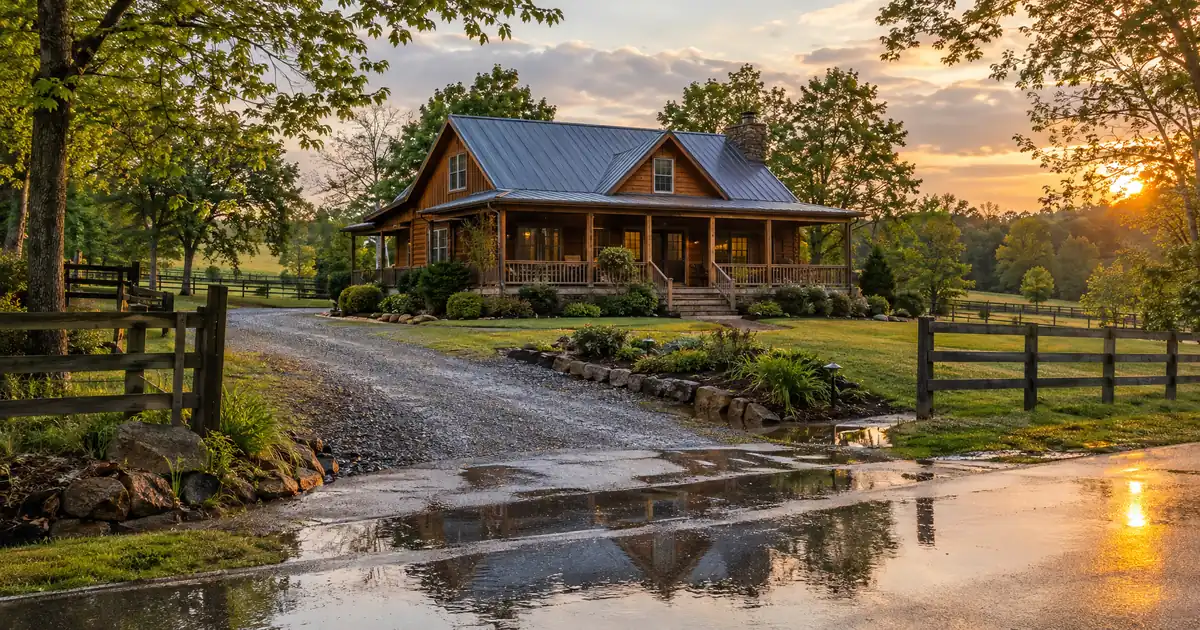
The Quick Read: Underwriting a rural cabin short-term rental (STR) market for a DSCR loan means proving that one cabin’s income, backed by real comparable cabins, covers the full monthly payment with room to spare. DSCR stands for debt service coverage ratio, and it compares rental income to the monthly payment. Rural markets make the proof harder because the data is thin, demand is seasonal, and one attraction often drives the bookings.
- Pick the income basis first: a market-data projection, hosting history, or an STR appraisal analysis.
- Build a tight comp set of cabins that match on bedrooms, amenities, and drive time.
- Stress the slow months, not just the peak season.
- Confirm legality, septic capacity, road access, and insurance before you trust any number.
- Run the ratio, then run a separate operating-cost check, because the two answer different questions.
Short-term rental rules can vary by city, county, HOA, and property type, so investors should confirm local rules before relying on projected rental income.
Short-Term Rental Calculator
Run the STR numbers in your market
Rate source: Freddie Mac 30-yr average via FRED® — Federal Reserve Bank of St. Louis · effective Oct 15, 2026
Prefilled with starting assumptions — enter your nightly rate, occupancy, taxes, and insurance for a more accurate picture.
Short-term rental income is documented with a 12-month history or a market data report. Program parameters update from Lendmire’s centralized guideline source.
As of Oct 15, 2026 · General Freddie Mac market benchmark, not a Lendmire loan offer. Nightly rate, occupancy, taxes, and insurance are editable estimates. Qualifying income for short-term rentals varies by program — some use appraisal market rent, others use documented STR history or projections — and is confirmed in underwriting. Not a Loan Estimate, approval, or commitment to lend. Program availability and eligibility are subject to lender guidelines, credit approval, property review, and underwriting.
Key Terms Defined
DSCR (debt service coverage ratio): Monthly rental income divided by the monthly housing payment. A result of 1.00 means income equals the payment.
PITIA: Principal, interest, taxes, insurance, and any association dues. It is the full payment the income is measured against.
ADR (average daily rate): The average nightly price a guest pays.
Occupancy: The share of available nights that are booked.
RevPAR: Revenue per available night. It blends ADR and occupancy into one figure.
Comp set: The group of comparable properties used to estimate what your property will earn.
Seasoning: The waiting period or track record a lender wants. For STRs, this usually means hosting history.
Why Do Rural Cabin Markets Underwrite Differently?
Rural cabin markets underwrite differently because the evidence is thinner. A suburb has hundreds of comparable rentals. A mountain or lake town might have a dozen cabins that look like yours, and most of them draw guests for the same reason.
That creates three problems. First, small samples swing wildly on a few listings. Second, demand is often tied to one park, lake, ski hill, or event. Third, rural supply is growing. AirDNA’s midyear outlook, published through PRNewswire, says the strongest supply growth is expected in affordable small-city, rural, and mid-size markets. A projection built on a thin, fast-changing comp set is fragile.
DSCR loans are designed for non-owner-occupied investment properties. Because they are business-purpose investor loans, they are reviewed differently from a standard owner-occupied mortgage. The file qualifies primarily on property-level rental income covering the payment, subject to lender guidelines. For a cabin, that makes the income figure the whole game.
Step 1: Confirm the Property Can Be Financed and Rented
Start with eligibility, because no income figure matters if the cabin is off the menu. Across the wholesale network Lendmire works with, manufactured homes (single- and double-wide), log homes, and barndominiums are not offered in DSCR programs. Plenty of rural “cabins” are log construction. Check the construction type before you fall in love with the listing.
Then check the physical and legal limits that can cap income:
- Zoning, permits, and HOA or CC&R rules. Confirm the rental is allowed and whether a permit transfers at sale.
- Septic and well. Septic capacity can limit the legal bedroom count or occupancy, which limits the nightly rate you can charge.
- Road access. Year-round access and private-road maintenance affect winter bookings and guest reviews.
- Insurance. Standard homeowner policies often limit or exclude STR activity. Get rental-specific quotes early, since the premium flows into the payment and moves the ratio.
Local practitioners in cabin country stress these same points, including a Fannin County buyer guide on septic limits and a Sevier County guide on road access and early insurance quotes. Treat them as practical reminders, not program rules.
Step 2: Choose the Income Basis
The income basis decides the outcome. For an STR, the lender typically looks at one of three things: a third-party market-data projection, trailing platform history from Airbnb or VRBO statements, or the income analysis inside an STR appraisal. Annual income gets divided by 12 and compared to the monthly PITIA.
| Income basis | Best fit | Main weakness |
|---|---|---|
| Market-data projection | Purchase, no history | Thin rural data |
| Trailing platform history | Refinance, existing host | Needs a full year |
| STR appraisal analysis | Either, when lender allows | Quality varies by appraiser |
Here is the part many borrowers miss: the standard agency rent form cannot do this job. Fannie Mae’s forms page lists Form 1004 (the standard appraisal), Form 1007 (the comparable rent schedule), and Form 1025 (the small income property appraisal). The Nevada Real Estate Division’s reproduction of Fannie Mae guidance says the 1007 was not designed for STRs, and that an appraiser should not convert nightly comps into a monthly rent figure. DSCR loans are not agency products. This is contrast only. It explains why STR appraisals use a narrative income analysis instead, and why that analysis is not standardized.
On STR files, the network expects about 12 months of hosting experience and a credit score of 640 or higher. Hosting history works in your favor on a refinance. On a purchase with no history, the projection or appraisal analysis carries the weight. Exact terms depend on the lender’s guidelines, property type, leverage, and a full review of the borrower’s file.
Step 3: Test Whether the Market Has Enough Data
Ask a blunt question: are there enough true comparables to trust any number? If you can find only three or four cabins within a reasonable drive, the average is noise.
When data is thin, work through this order:
1. Widen the radius, but keep the demand driver. A cabin 40 minutes from the same lake is a better comp than one 10 minutes away in a different type of market.
2. Weigh relevance, not just count. Two cabins that match yours closely beat ten that do not.
3. Cross-check sources. Compare the data-tool projection against property-manager figures and the appraisal analysis. Large gaps are a warning, not a rounding error.
4. Check demand concentration. If one event or one attraction drives most bookings, the income is only as stable as that draw.
5. Walk away if it stays thin. Sometimes the honest answer is that the market cannot support a confident number.
Step 4: Build the Comp Set
Build the comp set around how guests actually choose a cabin. Match on bedroom count, sleeping capacity, amenity tier (hot tub, theater room, view), pet policy, and drive time to the main attraction. A forum commenter on BiggerPockets suggests pulling trailing-12-month revenue for 8 to 10 truly comparable cabins and underwriting to the 25th percentile rather than the average. That is one investor’s opinion, not a standard, but the logic is sound: the average includes your neighbor’s best-in-class listing.
Beware averages that hide tradeoffs. High nightly rates can pair with low occupancy, and a BiggerPockets markets article shows an example of a $413 ADR sitting beside 36% occupancy. Revenue is what counts, not the prevailing pricing.
The practitioner formula is simple: occupancy times days in the month times ADR gives estimated monthly income, as BiggerPockets’ STR analysis guide lays out. Add seasonality on top for vacation destinations, which is the next step.
Step 5: Model Seasonality Month by Month
Annual averages hide the months that hurt. Mountain cabins can hold demand through the year, but winter weather can suppress or boost bookings depending on geography. Lay out twelve months of expected income against twelve months of payments and find the trough.
Some resort-area owners argue their real earning window is only a few weeks long. One BiggerPockets thread on a ski-area cabin shows how gross revenue claims can look inflated next to comparable listings. The lesson is to test the claim before you rely on it.
Lenders feel the same way about short track records. A BiggerPockets answer on seasoning says lenders rarely annualize six months of STR income, because six months can capture only the peak. That matches what the network expects: roughly a full year of history.
The practical use of the trough test is reserves. If three slow months run below the payment, you need cash to carry them. Reserves vary by lender, leverage, loan size, and transaction type. They commonly run around 6 months of PITIA, with some conservative files seeing them waived and larger loans stepping up.
Demand trends matter too. AirDNA’s midyear outlook forecasts U.S. occupancy averaging 57.4%, and AirDNA’s 2026 outlook names Mountain/Lake markets as an exception to the broader demand slowdown. Good news for cabins, but a national forecast is not your cabin’s calendar.
Step 6: Run the Ratio, Then Run a Real Cash-Flow Check
Divide the monthly income figure by the full PITIA, including insurance and any association dues. That is your coverage number.
Across the network, a 1.00 coverage floor applies to STR purchases and to STR refinances. Stronger ratios open better pricing and leverage. Some select lenders in the network will look below 1.00, with leverage and terms adjusted, but that is a separate path, not a softer version of the same program.
Now the part that trips up new investors: clearing 1.00 is not positive cash flow. The ratio compares income to PITIA only. Repairs, vacancy, cleaning, management, utilities, supplies, and capital expenses all sit outside it. Rural cabins carry extra layers: well and septic upkeep, snow removal, long cleaner drive times, and internet service in places with weak coverage.
Picture a cabin whose underwritten income clears the payment at roughly 1.15x. On paper that works. Once you subtract cleaning, utilities, and a management cut, the true cushion can vanish. Run both tests: ratio for the lender, net cash flow for yourself.
A broker’s pattern note: on files like this, the income basis often swings the result more than the price does. The same cabin can pass on a well-matched projection and miss on a conservative appraisal analysis, so it pays to compare both before choosing a program. A larger down payment can lift the ratio by lowering the payment, but it never erases credit floors, reserve rules, or property eligibility.
DSCR vs. conventional financing
There are two common ways to finance an investment property, and they qualify you differently — here’s how investors weigh them.
Why investors choose it
- Qualifies on the property’s rental income — no personal tax returns, W-2s, or pay stubs needed to document income.
- No personal debt-to-income ceiling to clear, so existing mortgages and obligations don’t cap your borrowing the same way.
- Can be closed in an LLC, keeping the property inside a business entity.
- Built for scaling — not held to the limit on number of financed properties that conventional financing applies.
- Underwriting centers on the deal: generally qualifies when the rent covers the payment, a 1.00x coverage ratio being a common baseline (confirmed in underwriting).
- Designed specifically for investment property, including long-term and, where the program allows, short-term rentals.
Where it’s strong
- Often the lowest ongoing financing cost for a buyer who fully qualifies on personal income — a fit for a first property or a cost-first purchase.
Trade-offs for investors
- Requires full personal income documentation and must fit within a debt-to-income limit — salary, existing debts, and other mortgages all count.
- Typically held in your personal name rather than a business entity.
- Caps how many financed properties you can carry, which can become a ceiling as a portfolio grows.
- Evaluates you as a borrower as much as the property, which usually means more paperwork.
How investors usually choose: a first or single property often optimizes for the lowest financing cost; portfolio builders often optimize for leverage, vesting in an LLC, and scaling past conventional caps. The right answer depends on your goals, the property, and current guidelines — both paths run through select lenders in Lendmire’s wholesale network, with eligibility and terms confirmed in underwriting.
Where the General Rule Breaks
Several situations bend the process:
- Storm-reset markets. A regional realtor guide on western North Carolina says a hurricane reset many income benchmarks there and warns against trusting pre-storm numbers. After a major weather event, old comps may describe a market that no longer exists.
- Fast-growing rural supply. Small-city and rural supply grew 9.3% in the most recent full year, per AirDNA. New cabins can dilute a projection quickly built on last year’s listings.
- STR income treated as business income. Under agency guidance reproduced in the Nevada document above, a conventional lender could treat STR income as business income. That is not how DSCR works, and it is one reason investors turn to DSCR for these properties.
- Appraisal friction. An STR appraisal gives two opinions: market value and rental income. appraisal requirements for short term rental properties explains why the income analysis varies by appraiser and why the 1007 cannot turn a nightly rate times 30 into monthly rent.
Purchase Versus Refinance, History Versus No History
On a purchase, STR leverage tops out at 75% LTV on the strongest files, and income typically comes from a projection or appraisal analysis. On a refinance, leverage runs up to 70% on STR collateral, and trailing history carries more weight. A cash-out on STR collateral also sits at 70%. Standard long-term rentals reach higher, so do not assume STR numbers match them.
Loan amounts run up to $3,000,000 on standard programs. Term structures start with the 30-year fixed, and extended terms or interest-only periods are available through select lenders in the network. Everything is subject to lender guidelines, and every file is underwritten individually.
If you already host the cabin, a refinance is where your history earns its keep. Lendmire’s piece How to Refinance a Rural Cabin Airbnb Into a DSCR Cash-Out Loan covers that path. For the full program picture, see the complete DSCR loans guide.
What Pre-Empts a Denial?
Files tend to stall on a short list of problems: no usable hosting history, a comp set that does not match the property, an unconfirmed permit, a septic limit below the advertised bedroom count, or insurance that excludes rental use. Fix each before submission.
A quick go/no-go scorecard:
| Check | Go | Walk or restructure |
|---|---|---|
| Property type | Standard construction | Log, manufactured, barndominium |
| Comp set | 8+ close matches | Only a handful, loose fit |
| Trough month | Reserves cover it | Deep, long shortfall |
| Legal status | Permit confirmed | Unclear or non-transferable |
| Real cash flow | Positive after costs | Only works on the ratio |
When the numbers say no, the fixes are usually lower leverage, a better-documented market, or a different property. Tax treatment can depend on how the funds are used and how the property is held; investors should keep clear records and speak with a qualified tax professional before relying on any deduction.
Frequently Asked Questions
Can a rural cabin with no rental history qualify for a DSCR loan?
Sometimes. On a purchase, the income usually comes from a market-data projection or an STR appraisal analysis rather than history. Select programs in the network may review it, subject to lender guidelines, credit approval, and property review. Expect the comp set to get close scrutiny.
Does a strong AirDNA number guarantee the income figure?
No. A data-tool projection is one input. The lender may rely on its own approach, and an appraisal analysis can land lower. Thin rural comps make the gap more likely, so compare several sources.
Is 1.00 coverage enough on a cabin?
On STR purchases and refinances, 1.00 is the floor in the network’s programs, not a target. Stronger coverage can open better pricing and leverage. Remember that 1.00 does not mean positive cash flow, since operating costs sit outside the ratio.
What credit score do I need for an STR cabin loan?
Expect a minimum around 640 on STR files, with stronger scores supporting better terms. Requirements vary by lender and loan scenario.
Can I finance a log cabin?
No. Log homes, manufactured homes, and barndominiums are not offered in the network’s DSCR programs. Framed or stick-built cabins are the typical fit.
If you are buying or refinancing a rental property and want to see how the numbers work, Lendmire can help you compare DSCR loan options based on the property income, credit profile, leverage, and investor goals. Call 828-256-2183 or request a quote. The illustrative calculator can give you a rough estimate, not a quote. Program details change, and nothing here is a commitment to lend.
About Lendmire
Lendmire (NMLS# 2371349) is a mortgage brokerage built around DSCR investor lending, with programs available in 41 markets, including Washington, D.C. DSCR lenders commonly evaluate rental-income coverage instead of personal income paperwork — a practical fit for LLC-owned and multi-property investors. Terms vary by lender, property, leverage, and program. Scotsman Guide named Lendmire a Top Mortgage Workplace in both 2025 and 2026.
Get Started
Ready to find the right loan for you?
In about 30 seconds you can review financing options available for your investment property. No commitment required.
Informational only. Not a Loan Estimate, approval, or commitment to lend. Program availability and eligibility are subject to lender guidelines, credit approval, property review, and underwriting.
References
1. AirDNA Midyear Outlook release (Yahoo Finance/PRNewswire)
2. Local realtor and agent guides (septic, insurance, access)
5. Nevada Real Estate Division (reproducing Fannie Mae STR guidance)
7. BiggerPockets markets article
8. BiggerPockets: How to Analyze a Short-Term Rental
9. BiggerPockets thread on a ski-area cabin
10. BiggerPockets answer on seasoning
11. 2026 outlook
12. Brandi Rininger WNC investor guide
13. AirDNA STR Data Lab, Episode 162
This article is part of Lendmire’s short-term rental loan program — full qualification details, guidelines, and scenarios live on the program page.
Related reading: How to Qualify for a DSCR Loan in Mississippi · How to Qualify for a DSCR Loan in Oklahoma · STR Loan 30-Year Fixed vs Interest-Only for a Seasonal Market
Brandon Miller
Founder & CEO, Mortgage Loan Originator, Lendmire LLC
- Mortgage Loan Originator · NMLS# 1129696 · Verify on NMLS Consumer Access
- North Carolina Real Estate Broker · License# 343312 · Verify on NCREC
- North Carolina Insurance Producer · License# 19053198 · Property, Casualty, Life, Health · Verify on NAIC SBS
- Lendmire LLC · Firm NMLS# 2371349 · Verify firm licensure
Disclosures. The information presented in this article is general market commentary, not financial, legal, or tax advice. Lendmire is a mortgage brokerage (NMLS# 2371349) — not a direct lender or depository institution — and loan placement is subject to lender underwriting. Nothing in this content represents a commitment to lend. Loan terms, pricing, and program availability vary based on borrower qualifications, property characteristics, and state of subject property, and are subject to change at any time. Lendmire complies with Equal Housing Opportunity requirements. Consumer access: nmlsconsumeraccess.org.