
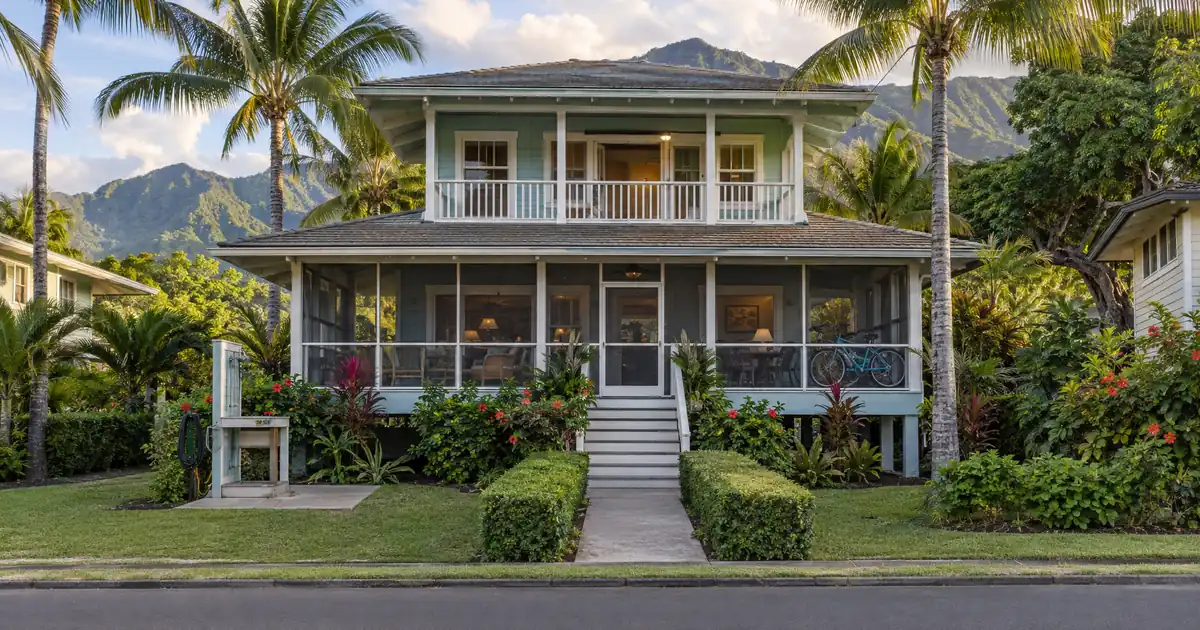
The Quick Read: Yes, a DSCR loan can finance an Airbnb in Hawaii, as long as the property is legally allowed to run as a short-term rental, the rental income can be documented in a way the lender accepts, and the property type is eligible, with short-term-rental purchase leverage up to 75% LTV on the strongest files. A DSCR loan is reviewed primarily on property-level rental income covering the payment, subject to lender guidelines.
- Legal status of the exact property comes first. Hawaii rules differ by county, and a profitable but non-compliant rental is a problem for any lender.
- Short-term-rental programs typically expect a 640+ credit score and about 12 months of hosting experience from the borrower.
- Purchases start at a 1.00 coverage floor, and refinances carry their own 1.00 floor.
- Resort condos and condotels are where Hawaii files most often get complicated.
- Passing the coverage test is not the same as positive cash flow.
LTV, or loan-to-value, is the loan balance divided by the property’s appraised value. A 75% LTV means the investor puts down about 25%. The rest of this piece covers how the file actually works, where Hawaii breaks the pattern, and what to do before you write an offer. These specifics are subject to lender guidelines and a full review of property, leverage, and credit.
Short-Term Rental Calculator
Run the STR numbers in Hawaii
Rate source: Freddie Mac 30-yr average via FRED® — Federal Reserve Bank of St. Louis · effective Oct 15, 2026
Prefilled with starting assumptions — enter your nightly rate, occupancy, taxes, and insurance for a more accurate picture.
Short-term rental income is documented with a 12-month history or a market data report. Program parameters update from Lendmire’s centralized guideline source.
As of Oct 15, 2026 · General Freddie Mac market benchmark, not a Lendmire loan offer. Nightly rate, occupancy, taxes, and insurance are editable estimates. Qualifying income for short-term rentals varies by program — some use appraisal market rent, others use documented STR history or projections — and is confirmed in underwriting. Not a Loan Estimate, approval, or commitment to lend. Program availability and eligibility are subject to lender guidelines, credit approval, property review, and underwriting.
How a DSCR Loan Works on an Airbnb
A DSCR loan compares the property’s income to its full monthly obligation. Divide the income by PITIA (principal, interest, taxes, insurance, and any HOA dues). The result is the coverage number. Lenders read it as a measure of whether the property can carry its own debt.
DSCR loans are designed for non-owner-occupied investment properties. Because they are business-purpose investor loans, they are reviewed differently from a standard owner-occupied mortgage. You are not handing over pay stubs. The lender looks at the property.
With an Airbnb, the income side is where the work happens. A long-term rental has a lease or a market rent figure. A short-term rental has nightly revenue that swings by season, so lenders reduce that income before they divide. The exact reduction depends on the lender and the income method. If you want the fundamentals first, the what-is-a-DSCR-loan explainer covers the formula in more depth. Lendmire’s complete DSCR loans guide covers the full program picture.
Can Hawaii Airbnbs Qualify? Two Gates Come First
Hawaii does not ban DSCR financing, and it does not ban Airbnb statewide. Two gates decide whether a specific property works: whether short-term use is legal for that address, and whether the income can be documented.
The first gate is a yes-or-no question. Short-term rental rules can vary by city, county, HOA, and property type, so investors should confirm local rules before relying on projected rental income. Hawaii makes this point sharply because the four counties handle vacation rentals differently. A permit, registration, or grandfathered status that exists for one house may not exist for the one next door.
The stakes are visible on Maui. County lawmakers passed a law that phases out thousands of vacation rentals in apartment-zoned districts, with deadlines that arrive over the next several years, per Hawaii Public Radio. Honolulu Civil Beat describes the affected inventory as thousands of condos and other apartment-zoned units. Hotel-zoned areas are treated differently, according to a market source’s coverage.
That matters to a lender and to you. A rental that is legal today but faces a sunset date raises questions about future income and exit value. Plan for a long-term-rental fallback on any file like that, because the long-term rent then becomes the number that matters.
The second gate is documentation, and it is where the loan structure takes over.
How Lenders Count Short-Term Rental Income
Programs generally accept three routes to establish short-term income. Which one applies depends on whether you already operate the property and on the lender’s guidelines.
| Income route | What it uses | Typical fit |
|---|---|---|
| Actual history | Platform payouts, manager statements, deposits | Existing operators, refinances |
| Market projection | Third-party STR market report | Purchases without history |
| Appraiser rent schedule | Monthly market rent on the appraisal | Fallback or required baseline |
Across our wholesale network, the pattern is consistent. Actual history carries the most weight, because it shows what the property earned. Market projections help on purchases, but acceptance varies by lender. A few lenders welcome them, and others lean on the appraiser’s rent figure instead.
That last route deserves a warning. The appraisal’s rent schedule is a monthly long-term rent form. It usually lands well below what a good Hawaii vacation rental earns by the night. If a lender relies on it, your coverage can look much weaker than your real income. Before you commit to a lender, ask what happens if the appraiser’s rent comes in low and whether a projection can replace it.
Also expect a reduction to gross income. Lenders discount short-term revenue for vacancy, cleaning, and platform costs before dividing by PITIA. A property that looks like a comfortable pass on gross revenue can land much closer to the line after that reduction.
What the Short-Term Rental Program Looks Like
Here are the parameters that typically apply to short-term-rental files in a network like ours. They are guidelines, not promises, and every file is underwritten individually by the lender.
- Purchase leverage: up to 75% LTV on the strongest short-term-rental purchase files.
- Refinance and cash-out leverage: up to 70% LTV on short-term-rental collateral.
- Credit score: 640 is the usual minimum for short-term-rental files. Higher scores generally help with pricing and leverage.
- Coverage: a 1.00 floor on purchases, and a 1.00 floor on refinances.
- Experience: about 12 months of landlord or hosting experience from the borrower.
- Loan size: up to $3,000,000 on standard programs. Above $2,500,000, the network generally holds to 30-year fixed structures.
- Reserves: commonly around 6 months of PITIA, though this varies by lender, leverage, loan size, and transaction type. Larger loans typically step up.
Notice how the experience expectation interacts with income. The experience requirement is about you, the borrower. The income method is about the property. A first-time host buying a condo can still be reviewed, but the file leans harder on the projection or appraiser route and on credit and reserves. Select lenders in the network may handle thinner experience differently, so it is worth asking before you assume a no.
Hawaii prices also matter here. The coverage test works on rent against the payment, so a high purchase price with a standard-sized income often produces a thinner ratio. A larger down payment lowers the monthly payment and can lift the coverage number. It does not erase leverage caps, credit floors, reserve rules, or property eligibility. The strongest files clear both tests: enough equity and enough rental coverage.
A Modeled Hawaii Example
Consider a hypothetical resort-area condo, bought at 75% LTV on a short-term-rental purchase. These are modeled assumptions, not market data. Terms depend on the lender’s guidelines, the property type, the leverage, and a full review of the credit profile.
Run the numbers three ways:
- Gross nightly revenue: coverage looks comfortable, roughly 1.4x.
- After the lender’s reduction to short-term income: coverage tightens to around 1.1x. HOA dues in the PITIA are what pull it down.
- Appraiser’s long-term rent schedule: coverage drops under 0.80x.
Same property, same loan, three different answers. The income method decides which one the lender treats as the real number. Clearing the benchmark at 1.1x would typically satisfy a program with a 1.00 floor, but only if the lender accepts the method behind it.
Here is the part first-time investors miss. Clearing 1.00 does not mean the property produces positive cash flow. The coverage calculation compares rent to PITIA only. Repairs, vacancy, management fees, cleaning, utilities, and capital reserves all sit outside it. A condo at 1.10x can still lose money after a slow season and a roof assessment.
If a file lands below 1.00, there are two separate paths to know about. Many select programs start at 1.00. A different select-lender path takes coverage below 1.00, with leverage and terms adjusted, and qualification is subject to lender guidelines. A bigger down payment is the other lever.
Which Hawaii Property Types Fit
Property type often decides the file before the numbers do. Here is the practical read, island-agnostic.
| Property type | General fit | Main question |
|---|---|---|
| Single-family house | Strong | Is STR use legal at the address? |
| Duplex to fourplex | Strong | Zoning and rent schedule per unit |
| Warrantable condo | Workable | HOA rules on rentals |
| Resort or condotel unit | Complicated | Project eligibility and rental pool |
| Leasehold property | Varies | Lease term remaining |
| Manufactured, log, barndominium | Not offered | Outside these programs |
Single-family homes and small multifamily buildings are the cleanest. The legal question is about zoning and permits, and the appraisal is straightforward.
Condos are where Hawaii gets interesting. Practitioners on the Big Island note that many resort condos count as non-warrantable because of heavy vacation-rental activity, according to Penn Henderson’s buyers guide. A non-warrantable condo is one in a project that fails standard lending rules, often because of investor concentration or pending HOA litigation. Conventional financing is often unavailable for those units. Non-QM and DSCR programs are frequently the realistic alternative, but eligibility depends on the project and the program, so ask early.
Leasehold is another Hawaii-specific wrinkle. In a leasehold, you own the building but lease the land. Many older condos in Honolulu are structured that way. Some programs will review them and some will not, and the remaining lease term can matter. Confirm before you fall in love with a unit.
Manufactured homes, log homes, and barndominiums are not offered through the network’s DSCR programs. That rarely comes up on a Waikiki condo, but it can on rural parcels.
The Hawaii Costs That Squeeze Coverage
Coverage is income divided by the full obligation, so anything that raises PITIA pulls the ratio down. Hawaii has three pressure points.
First, purchase prices. Higher prices mean larger loan balances against income that does not scale the same way.
Second, HOA and resort fees. A condo’s association dues count in PITIA. A unit with strong nightly revenue can still look thin once dues are included.
Third, insurance. Standard homeowner policies often exclude short-term rental use, per STRCityRegs. Get an insurance quote written for short-term use before you run coverage, because the policy you need may cost more than the one you assumed.
Tax treatment can depend on how the funds are used and how the property is held; investors should keep clear records and speak with a qualified tax professional before relying on any deduction.
DSCR vs. conventional financing
There are two common ways to finance an investment property, and they qualify you differently — here’s how investors weigh them.
Why investors choose it
- Qualifies on the property’s rental income — no personal tax returns, W-2s, or pay stubs needed to document income.
- No personal debt-to-income ceiling to clear, so existing mortgages and obligations don’t cap your borrowing the same way.
- Can be closed in an LLC, keeping the property inside a business entity.
- Built for scaling — not held to the limit on number of financed properties that conventional financing applies.
- Underwriting centers on the deal: generally qualifies when the rent covers the payment, a 1.00x coverage ratio being a common baseline (confirmed in underwriting).
- Designed specifically for investment property, including long-term and, where the program allows, short-term rentals.
Where it’s strong
- Often the lowest ongoing financing cost for a buyer who fully qualifies on personal income — a fit for a first property or a cost-first purchase.
Trade-offs for investors
- Requires full personal income documentation and must fit within a debt-to-income limit — salary, existing debts, and other mortgages all count.
- Typically held in your personal name rather than a business entity.
- Caps how many financed properties you can carry, which can become a ceiling as a portfolio grows.
- Evaluates you as a borrower as much as the property, which usually means more paperwork.
How investors usually choose: a first or single property often optimizes for the lowest financing cost; portfolio builders often optimize for leverage, vesting in an LLC, and scaling past conventional caps. The right answer depends on your goals, the property, and current guidelines — both paths run through select lenders in Lendmire’s wholesale network, with eligibility and terms confirmed in underwriting.
Purchase, Refinance, and Cash-Out Paths
A purchase is the path most new Hawaii investors take, and it carries the 75% ceiling on short-term-rental collateral. A refinance of a property you already host is often the easier file to document. Your payout statements are the proof. Refinance leverage runs lower, up to 70% on short-term-rental collateral, and cash-out is also capped at 70% on short-term-rental collateral. For a standard long-term rental, a cash-out tops out around 75%. About 6 months of seasoning is the common expectation on cash-out, meaning you generally need to have owned the property that long first.
Existing operators have an advantage. Twelve months of platform history captures peaks and troughs, so the lender sees real seasonality. New-to-short-term-rental investors typically rely on a projection or the appraiser’s figure. Select lenders in the network may have different views on thin history, which is why a broker comparing several programs can matter more here than on a plain long-term rental.
For the Airbnb-specific mechanics across all markets, the DSCR loan for Airbnb page covers the structure without the Hawaii overlay.
Structure Options for Out-of-State Buyers
Many Hawaii vacation-rental buyers live elsewhere. The program is built around the property, so an out-of-state owner is not a barrier by itself. Vesting title in an LLC is common, subject to lender program eligibility, and the entity documents get added to the file.
Term structures matter too. The 30-year fixed is the spine of most programs. Extended terms such as 40-year and interest-only periods are available through select lenders in the network, and ARM structures exist for investors who want them. Interest-only periods lower the monthly obligation and can raise the coverage number. They do not change the credit, leverage, or property-eligibility rules.
One practitioner note: files on island properties tend to be won or lost on paperwork rather than on credit. The permit or registration proof, the insurance quote, and the HOA documents are the items that stall files when they show up late. Collect them before the appraisal gets ordered.
Readiness Checklist Before You Apply
- Written proof of short-term-rental legality from the county, plus any HOA or condo rules that apply.
- A reliable income source: payout statements, a manager’s 12-month statement, or a projection report.
- An insurance quote written for short-term use.
- Entity papers if you plan to hold title in an LLC.
- Reserves in liquid funds, commonly around 6 months of PITIA.
- A fallback plan, meaning what the property earns as a long-term rental if the short-term income disappears.
That last item is the one that separates cautious investors from the rest. Hawaii law is changing, and a rental that depends on one rule staying in place carries a risk that the coverage ratio will never show.
Key Terms Defined
DSCR (debt service coverage ratio): the property’s income divided by its full monthly obligation, used to judge whether the property can carry the loan.
PITIA: principal, interest, taxes, insurance, and association dues, the full monthly cost the income is measured against.
LTV (loan-to-value): the loan balance as a percentage of the property’s appraised value.
Non-warrantable condo: a condo project that fails standard lending rules, often because of investor concentration or litigation, and so needs a non-QM program.
Leasehold: a structure where you own the building but lease the land underneath it.
Rent schedule: the appraiser’s estimate of monthly market rent, used as a fallback for coverage.
Frequently Asked Questions
Do I need traditional personal-income documentation or W-2s for a Hawaii Airbnb loan?
A DSCR loan is reviewed primarily on property-level rental income covering the payment, subject to lender guidelines, so the file centers on the property rather than your personal income. You will still document credit, reserves, and the property itself. Expect a short-term-rental file to also include evidence of how the income is earned.
Can I buy a Hawaii Airbnb with no hosting history?
Often yes, but expect more scrutiny. Short-term-rental programs typically expect about 12 months of hosting experience from the borrower, and the income is usually established through a projection or the appraiser’s rent figure. Select lenders in the network may view thin experience differently, so it is worth comparing programs before assuming a decline.
What if the property fails the coverage test?
You have options. A larger down payment lowers the payment and can lift the ratio. Many select programs start at 1.00, and a separate select-lender path takes coverage below 1.00 with leverage and terms adjusted. An interest-only period, where available, may also help. Qualification is subject to lender guidelines, credit approval, and property review.
Are resort condos and condotels eligible?
It depends on the project and the program. Many resort condos are non-warrantable, which closes the door on conventional financing, and DSCR programs review them case by case. Ask about project eligibility before you write an offer, not after the appraisal.
Is a DSCR loan the right fit if I also want to use the home myself?
Usually not. DSCR loans are built for non-owner-occupied investment properties, so a home you plan to use as your own vacation residence belongs in a different loan category. A true investment rental with a business plan is the right match.
Where to Go From Here
If you are buying or refinancing a rental property and want to see how the numbers work, Lendmire can help you compare DSCR loan options based on the property income, credit profile, leverage, and investor goals. As a mortgage broker, it arranges financing through select lenders in its wholesale network across 41 markets, including Washington, D.C. This is not a commitment to lend. Hawaii files reward early homework, because the county rules and the income method matter as much as the ratio.
About Lendmire
Lendmire, NMLS# 2371349, is a mortgage brokerage focused on investor financing, arranging DSCR loans in 40 states plus Washington, D.C. — 41 markets total. Qualification is based on the property’s income rather than personal income documentation, subject to lender guidelines, making it a fit for LLC-held rentals and scaling portfolios. Scotsman Guide named Lendmire a Top Mortgage Workplace in both 2025 and 2026.
Get Started
Ready to find the right loan for you?
In about 30 seconds you can review financing options available for your investment property. No commitment required.
Informational only. Not a Loan Estimate, approval, or commitment to lend. Program availability and eligibility are subject to lender guidelines, credit approval, property review, and underwriting.
References
1. Hawaii Public Radio: Maui County passes law to phase out thousands of vacation rentals
2. Honolulu Civil Beat: Maui plan to phase out thousands of short-term rentals advances
3. Penn Henderson: Big Island buyers guide
4. STRCityRegs: Honolulu short-term rental overview
This article is part of Lendmire’s short-term rental loan program — full qualification details, guidelines, and scenarios live on the program page.
Related reading: How Much Reserve a Jumbo STR DSCR Loan Requires on a Fifth Airbnb · DSCR Loan vs Business Loan for an Airbnb: Collateral, Recourse and Terms · How to Stress-Test Your First Airbnb at Long-Term Rent for a DSCR Loan
Guides: Short-Term Rental Loans in Hawaii
Brandon Miller
Founder & CEO, Mortgage Loan Originator, Lendmire LLC
- Mortgage Loan Originator · NMLS# 1129696 · Verify on NMLS Consumer Access
- North Carolina Real Estate Broker · License# 343312 · Verify on NCREC
- North Carolina Insurance Producer · License# 19053198 · Property, Casualty, Life, Health · Verify on NAIC SBS
- Lendmire LLC · Firm NMLS# 2371349 · Verify firm licensure
Compliance and disclosures. Lendmire (NMLS# 2371349) is a licensed mortgage broker and is not a direct lender, depository institution, financial advisor, or tax professional. Content in this article is general market analysis and educational information — not financial, legal, or tax advice for any specific situation. Lendmire does not guarantee loan approval; every transaction is subject to underwriting by the funding lender. Mortgage pricing and loan program guidelines are subject to change at any time without notice and vary by borrower characteristics, property type, and state regulations. Lendmire complies with Equal Housing Opportunity. Licensure verification: NMLS Consumer Access.