
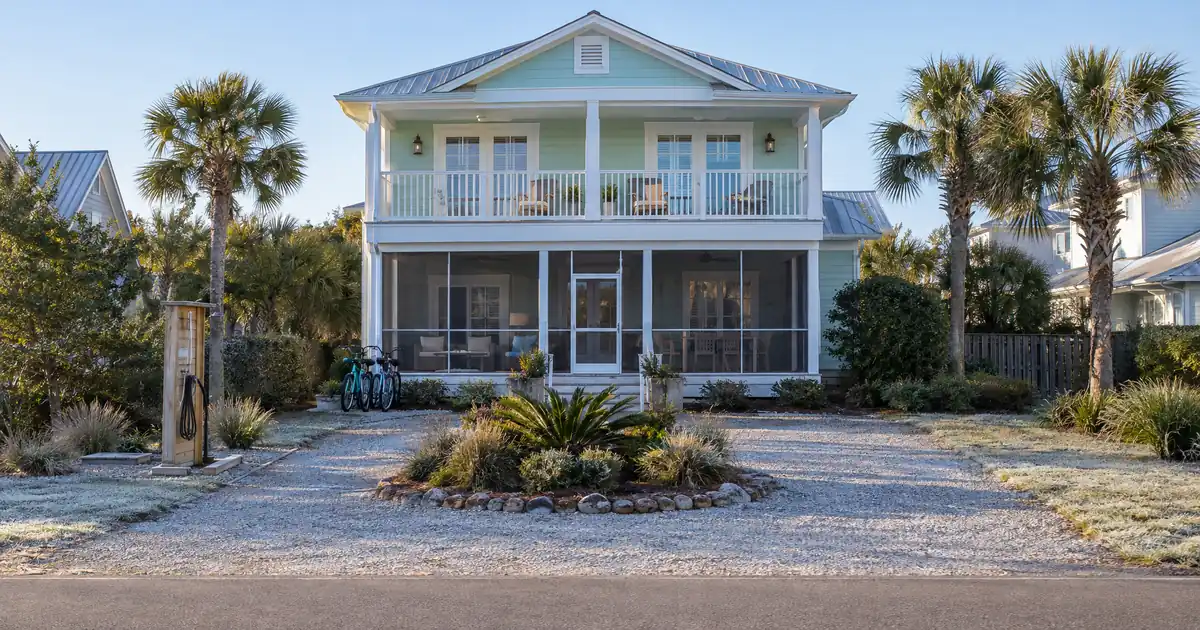
The Quick Read: It depends on how long you plan to hold, because a portfolio DSCR loan puts every rental under one note and tests rent against debt service across the whole pool, so it fits a steady long-hold set, while separate loans fit better when you may sell one or when the properties carry different risk. This size sits in a gray zone. Pooling cuts the number of closings, but each rental still needs its own appraisal, title work, insurance and rent evidence.
- Pooling fits when you plan to hold all of the rentals, each has documented income, and you want one pooled coverage test.
- Separate loans fit when you may sell one soon, want each rental to stand alone, or have uneven seasonal income.
- The pool is tested as a whole. Strong rentals can offset weak ones, which helps you qualify but can hide a weak property.
- Selling one rental is harder. Any sale follows the lender’s release terms, and the remaining rentals must still cover their debt.
- Clearing 1.00 is not profit. The ratio compares rent to the housing payment only.
This article explains the mechanics from how files actually move across Lendmire’s wholesale network of DSCR lenders. The complete DSCR loans guide covers the basics if you are new to the product.
Key Terms Defined
Portfolio DSCR loan. One note secured by several rentals, also called a blanket or cross-collateralized loan. These are three names for the same thing.
DSCR (debt service coverage ratio). Monthly rent divided by the monthly PITIA, which is principal, interest, taxes, insurance and any HOA dues.
Pooled coverage. One blended ratio, calculated from the rent and debt service of every property in the pool together.
Release provision. The loan-document terms that say how a property leaves the pool when you sell it.
TTM history. Trailing-twelve-month income statements from a booking platform or property manager, used to show what a rental has earned.
Seasonality. The swing between a rental’s weakest and strongest months of revenue.
How Does a Pooled DSCR Test Treat Short-Term Rentals?
The pooled test adds up the rent from every rental and compares it to the combined debt service. The result is one coverage number for the pool. Most programs we place files with start at a 1.00 floor on that pooled number.
A pool is not one big average of guesses. Every property still needs its own income evidence. For a short-term rental, that evidence usually comes in this order:
1. Trailing-twelve-month statements from the booking platform or manager, when the rental has history. 2. A market projection from a data provider, such as AirDNA, when the rental is new to you. 3. The appraiser’s long-term rent schedule, on Form 1007 for a single-family home or Form 1025 for a 2-4 unit property, as a fallback.
Underwriters often discount projected short-term income. The long-term rent schedule can also land well below what a good host earns. Both facts matter when you are mixing rentals with history and rentals without it.
On single-property short-term rental files, the network typically expects about 12 months of hosting experience and a credit score of at least 640. Those are single-property parameters. The pooled structures below carry their own credit notes. Short-term rental rules can vary by city, county, HOA, and property type, so investors should confirm local rules before relying on projected rental income.
DSCR loans are designed for non-owner-occupied investment properties. Because they are business-purpose investor loans, they are reviewed differently from a standard owner-occupied mortgage.
What Do the Two Portfolio Structures Look Like?
Two structures cover a set of four or five rentals. Both are subject to lender guidelines, and none of the figures below is a quote.
The 30-year portfolio DSCR loan takes two to 20 properties under one note. Loan sizes run from $300,000 to $5,000,000, with larger balances on review. Terms are 30 years on a 30-year schedule, with fixed or adjustable options and an interest-only period available. Pooled coverage is measured against a 1.00 floor. Eligible property types are single-family, 2-4 unit, condo and townhome.
The rental portfolio term loan takes five or more rental properties or units under one loan. Loan sizes run from $500,000 to $50,000,000, with larger balances on review. Leverage is up to 75% of value on an investment property. Terms are fixed at 3, 5, 7 or 10 years with a balloon at maturity, so the exit is a refinance or a sale. Prepayment is yield maintenance, which makes an early payoff costly. Reserves are held for taxes, insurance and capital expenditures. Properties in several markets or states can sit under one loan. Both recourse and non-recourse versions exist. A non-recourse loan looks to the real estate, with recourse limited to carve-outs such as fraud and bankruptcy. A recourse loan carries a personal guarantee.
Small multifamily of five or more units is eligible only inside the rental portfolio term loan. Manufactured and mobile homes are not reviewable on any of these programs.
On leverage, short-term rental collateral generally runs tighter than long-term rental collateral. Across the network, a short-term rental purchase tops out at 75% LTV on the strongest files. A short-term rental refinance or cash-out tops out at 70%. A cash-out on a pool of standard rentals never runs above 75% of the pooled value.
Seasoning applies to a recent purchase. Inside the first six months of ownership, the loan is also capped at 90% of total cost (purchase price plus documented improvements). From six to twelve months the cap is 100% of total cost. The leverage ceiling still applies, and the loan is the lower of the two. After twelve months the appraised value alone is the basis. A rate-and-term refinance is not subject to the cost-basis cap.
On credit, the portfolio programs start at a 640 score, and some portfolio structures want 680 or 720. Some structures require a special-purpose entity, typically an LLC, subject to lender program eligibility. Owner-occupied property, co-ops, mixed-use property and commercial property are ineligible in the pool. These structures are available inside Lendmire’s DSCR markets, and a few states sit outside the portfolio footprint.
For a deeper look at pool mechanics, see Lendmire’s piece Can Several Short-Term Rentals Sit on One Blanket DSCR Portfolio Loan?.
What Does a Pooled Test Look Like With Five Rentals?
Here is an illustration, not a market fact. Assume five short-term rentals with roughly equal debt service and the standalone coverage ratios below. With equal debt service, the pooled ratio is simply the average.
| Rental | Standalone coverage | Role in the pool |
|---|---|---|
| A | 1.45x | Strongest earner |
| B | 1.30x | Solid |
| C | 1.15x | Adequate |
| D | 1.05x | Thin |
| E | 0.90x | Weak |
| Pool | about 1.17x | Clears a 1.00 pooled floor |
Rental E would not clear 1.00 by itself. Remember that 1.00 is where many select programs start, while a separate select-lender path takes a single property below 1.00 with leverage and terms adjusted. Inside the pool, rental E rides along on the stronger properties. Underwriting tests the pooled coverage, the leverage and the terms.
That is the benefit. It is also the risk. The pooled 1.17x tells you nothing about which property is losing money. A loss-making rental can sit inside one note for years without anyone looking at it.
If the pool’s debt service is unequal, the math shifts. A large loan on a weak rental drags the pool down more than a small one. Run each rental’s numbers alone first, then run the pool.
Pooled Loans vs. Separate Loans for Four or Five Rentals
Pooling consolidates the loan, the closing and the servicer. It does not consolidate valuation, title, insurance or rent evidence. Here is how the two paths compare on the points that matter most.
| Factor | Portfolio loan | Separate loans |
|---|---|---|
| Coverage test | One pooled ratio | One ratio per rental |
| Weak property | Offset by strong ones | Must qualify alone |
| Selling one | Follows release terms | Sell freely |
| Default exposure | All collateral shared | Isolated per property |
| Closings and servicing | One of each | One per rental |
| Local-rule exposure | A problem can touch the pool | Stays with that rental |
The question is whether the pool’s gains outweigh the lost flexibility at this size. For long-hold, similar rentals, they often do. For a mixed set with an exit planned, they often do not.
Where Is Four or Five the Tipping Point?
At two or three rentals, pooling saves little, because you are only skipping a few closings. At eight or more, pooling can save real administrative work. Four or five is where the decision turns on your situation, not the count.
Pooling tends to fit when:
- You plan to hold every rental for years.
- The rentals are in similar markets with documented income.
- Each has about a year of host history.
- You want one servicer and one coverage test.
Separate loans tend to fit when:
- You may sell one rental in the near term.
- One rental has thin coverage you would rather not hide.
- The rentals sit in different jurisdictions with different rules.
- Some rentals are new and others are seasoned.
There is also a middle path. You can pool three seasoned rentals and keep the other one or two on their own loans. That keeps the rental you may sell free, and it keeps a weak one visible. It costs you some of the one-closing convenience.
Cost is a gray area too. Pooling can reduce closing work, but pricing and leverage on a pool may be less favorable than on a single clean file. Look at both paths before you decide.
What Happens When You Want to Sell One?
A sale is the moment a pooled loan shows its cost. Selling one rental out of a pool follows the loan documents and the lender’s release terms. The release price runs above the property’s allocated balance, so you pay down more than the property’s share of the debt to free it.
The remaining rentals must still cover their debt service after the property leaves. If the departing rental was a strong earner, the pool’s coverage can fall below the floor. In that case the lender may ask for more paydown or more collateral. Partial releases and substitutions are possible under the loan documents, but they are not automatic.
On the rental portfolio term loan, there is a second layer. Yield maintenance makes an early payoff costly, and the balloon at maturity means you eventually refinance or sell the whole pool. A one-time purchaser assumption exists on loans above $5,000,000, subject to underwriting and an assumption fee. That is not relevant to most four-or-five-rental pools, which fall below that size.
Read the release terms before you sign, and ask which rentals you are most likely to sell. If that answer is not none, price the cost of the release into your decision.
What Risks Are Specific to Short-Term Rentals in a Shared Loan?
Short-term income is more uneven than long-term rent. That matters more when the whole pool rides on it.
Seasonality. AirDNA defines seasonality as the gap between the lowest and highest monthly average revenue, and a lower score means sharper peaks and troughs. Pooling smooths swings only when the rentals peak in different months. Four or five rentals in the same resort town peak together, so the pool gets no smoothing.
Local rules. A permit change, zoning ruling or HOA ban can hit one rental. In a shared-collateral loan, one non-compliant property can complicate the whole pool.
Mixed histories. Some rentals have a full year of statements, and others rely on projections. Underwriters weigh those evidence types differently. A file that mixes them draws more questions than a file where every rental has history.
Market backdrop. AirDNA’s midyear outlook forecasts U.S. short-term rental occupancy averaging 57.4%, above the pre-pandemic 57.0%, with demand and listings each growing 2.7% and RevPAR up 2.9%. Short Term Rentalz reports that slower supply growth helps existing operators. These are national averages, not a forecast for any one property.
Does Clearing 1.00 Mean the Pool Makes Money?
No. DSCR compares rent to PITIA only. Repairs, vacancy, management fees, utilities, cleaning, platform fees and capital expenditures all sit outside the calculation.
That gap is wider for short-term rentals, which carry higher operating costs than a long-term lease. A pool that clears 1.00 can still lose money after expenses. Treat the coverage number as a qualifying test, and build your own operating budget for each rental.
Tax treatment varies; consult a qualified professional.
Are You Ready for the Fourth or Fifth Rental?
Lenders look at the guarantor as well as the properties. Before you add a rental to a pool, check the following:
1. Income evidence is ready for each rental. That means statements, manager reports or a market projection.
2. Reserves are documented. Requirements vary by lender, leverage, loan size and transaction type, and they commonly run around six months of PITIA. Loans above $1,500,000 typically step up to about nine months. Conservative rate-and-term files at modest leverage under $1,500,000 can see reserves waived.
3. Entity papers are in order. If an LLC holds title, have the operating agreement and good-standing records ready.
4. Insurance quotes are current and complete for every property, with coverage that matches short-term use.
5. Credit is in range. A 640 score is the floor on these programs, and a higher score opens stronger leverage.
6. You know your exit. Decide which rentals you intend to keep before you pick a structure.
A larger down payment can lift coverage by lowering the payment. It never erases leverage caps, credit floors, reserve rules or property eligibility. The strongest files clear both tests, enough equity and enough rental coverage.
For the mechanics of how rentals are counted as the portfolio grows, read Lendmire’s article How a DSCR Portfolio Loan Counts Short-Term Rentals at Scale.
Next Steps
If you are buying or refinancing a rental property and want to see how the numbers work, Lendmire can help you compare DSCR loan options based on the property income, credit profile, leverage, and investor goals. Qualification is subject to lender guidelines and credit approval. Nothing here is a commitment to lend.
Frequently Asked Questions
Is a portfolio DSCR loan the same as a blanket loan?
Yes. A portfolio DSCR loan, a blanket loan and a cross-collateralized loan all describe one note secured by several rentals. A bank’s portfolio loan, meaning a loan the bank keeps on its own books, is a different use of the word. A blanket describes the collateral structure, and DSCR describes how the loan is qualified.
Can I include a brand-new short-term rental in the pool?
Every property needs a lease or an appraiser-supported market rent, and a new short-term rental usually leans on a market projection instead of history. A file that mixes new and seasoned rentals gets more review, so expect more questions. Single-property short-term rental programs typically look for about 12 months of hosting experience.
Can an LLC hold the rentals?
Yes, subject to lender program eligibility. Some structures require a special-purpose entity, typically an LLC, and recourse loans carry a personal guarantee. Have the entity documents ready before the file goes in.
Is there a cap on how many properties I can own?
The portfolio programs set their own property counts. The 30-year portfolio DSCR loan takes two to 20 properties under one note, and the rental portfolio term loan starts at five rentals. Four or five fits inside the first structure and, at five, the second. Conventional loan-count and income limits are what push many investors toward DSCR at this size.
Does each property still get its own valuation?
Yes. Each rental is appraised and gets its own title work and insurance, even under one note. Pooling reduces the number of loans and closings, not the property-level work. That is why the savings at four or five rentals are modest.
Does four or five beat two or three for pooling?
Usually somewhat, but not by a wide margin. With two or three rentals the pool saves little. At four or five the savings grow, but so does the shared risk. The right call depends on your hold plan, not on the count alone.
About Lendmire
As a non-QM mortgage broker (NMLS# 2371349), Lendmire facilitates DSCR investor loans across 41 markets, including Washington, D.C. DSCR eligibility is generally reviewed around property-level rental income instead of personal income documentation, subject to lender guidelines, serving LLC-structured portfolios and self-employed borrowers who don’t fit conventional boxes. A two-time Scotsman Guide Top Mortgage Workplace (2025, 2026).
Get Started
Ready to find the right loan for you?
In about 30 seconds you can review financing options available for your investment property. No commitment required.
Informational only. Not a Loan Estimate, approval, or commitment to lend. Program availability and eligibility are subject to lender guidelines, credit approval, property review, and underwriting.
References
1. AirDNA seasonality data page
2. AirDNA midyear outlook via Yahoo Finance
3. Short Term Rentalz: AirDNA midyear outlook coverage
This article is part of Lendmire’s short-term rental loan program — full qualification details, guidelines, and scenarios live on the program page.
Related reading: Portfolio vs Individual DSCR Loan Reserves When Consolidating Rentals · Portfolio DSCR Loan vs Balloon Term Loan on Property Count and Leverage · How to Document Furnished Rentals in a Portfolio DSCR Loan
Brandon Miller
Founder & CEO, Mortgage Loan Originator, Lendmire LLC
- Mortgage Loan Originator · NMLS# 1129696 · Verify on NMLS Consumer Access
- North Carolina Real Estate Broker · License# 343312 · Verify on NCREC
- North Carolina Insurance Producer · License# 19053198 · Property, Casualty, Life, Health · Verify on NAIC SBS
- Lendmire LLC · Firm NMLS# 2371349 · Verify firm licensure
Compliance and disclosures. Lendmire (NMLS# 2371349) is a licensed mortgage broker and is not a direct lender, depository institution, financial advisor, or tax professional. Content in this article is general market analysis and educational information — not financial, legal, or tax advice for any specific situation. Lendmire does not guarantee loan approval; every transaction is subject to underwriting by the funding lender. Mortgage pricing and loan program guidelines are subject to change at any time without notice and vary by borrower characteristics, property type, and state regulations. Lendmire complies with Equal Housing Opportunity. Licensure verification: NMLS Consumer Access.