
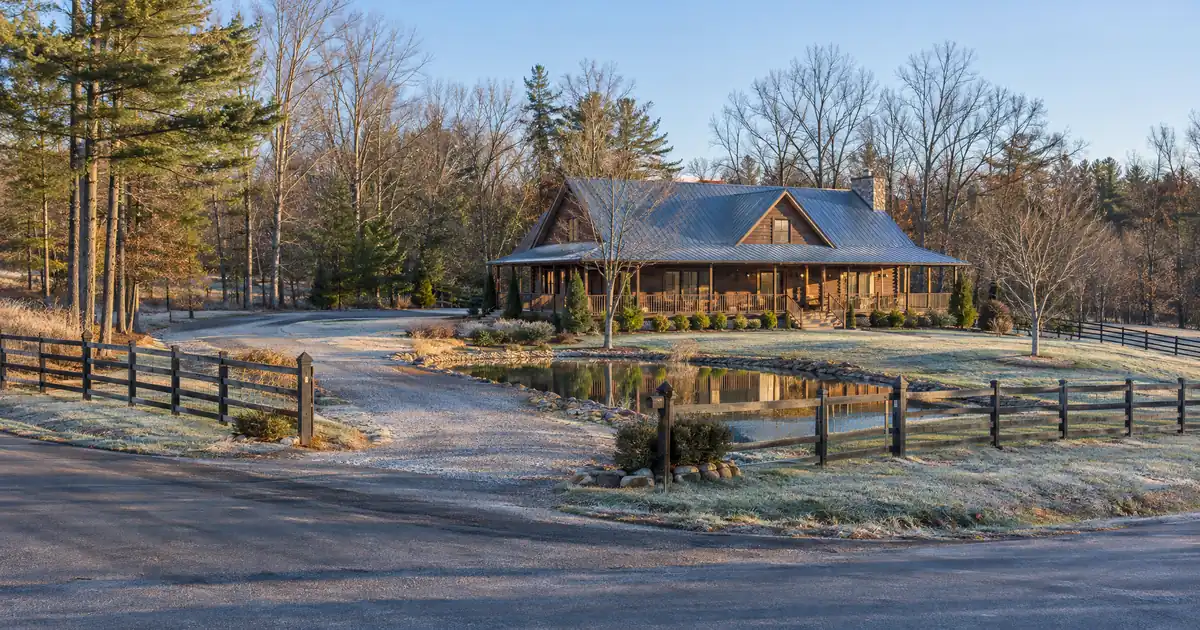
The Quick Read: Usually yes: no federal law changed how DSCR loans treat short-term rentals, so a cabin loan holds up as long as the cabin can legally host nightly guests, the income can be documented, and rent covers the full monthly payment, subject to lender guidelines. Local permits, county caps, and HOA rules are where files actually break.
- On a short-term-rental purchase, leverage tops out at 75% LTV on the strongest files. Refinance and cash-out on short-term-rental collateral run up to 70%.
- Expect a 640+ credit score and about 12 months of hosting history.
- Coverage starts at 1.00 on purchases and refinances. A separate select-lender path goes below 1.00, with leverage and terms adjusted.
- Log homes, barndominiums, and manufactured homes are not offered, even when they are called cabins.
- Permit status matters more than any headline. A cabin that loses its lawful short-term-rental use loses the income the loan was built on. Terms depend on the lender’s guidelines, the property type, the leverage, and a full review of the credit profile.
Key Terms Defined
- DSCR (debt service coverage ratio): monthly rental income divided by the full monthly housing payment. A result of 1.00 means rent equals the payment.
- PITIA: principal, interest, taxes, insurance, and assessments such as HOA dues. It is the payment that DSCR divides into.
- LTV (loan-to-value): the loan balance as a percentage of the property’s value.
- Hosting history: a documented record of running nightly rentals, either at this cabin or at other properties you own.
- Grandfathering: a rule that lets an existing permitted use continue after a new law would otherwise cap or ban it.
- Permit transferability: whether a short-term-rental permit stays with the cabin at sale or ends with the seller.
Does a Law Change Break the Loan or Just the Income?
A law change almost never attacks the loan product itself. It attacks the cabin’s right to earn nightly income. That distinction matters because a DSCR loan is built on rental income, so the real question is whether lawful income still exists at each stage.
Short-Term Rental Calculator
Run the STR numbers in your market
Rate source: Freddie Mac 30-yr average via FRED® — Federal Reserve Bank of St. Louis · effective Oct 15, 2026
Prefilled with starting assumptions — enter your nightly rate, occupancy, taxes, and insurance for a more accurate picture.
Short-term rental income is documented with a 12-month history or a market data report. Program parameters update from Lendmire’s centralized guideline source.
As of Oct 15, 2026 · General Freddie Mac market benchmark, not a Lendmire loan offer. Nightly rate, occupancy, taxes, and insurance are editable estimates. Qualifying income for short-term rentals varies by program — some use appraisal market rent, others use documented STR history or projections — and is confirmed in underwriting. Not a Loan Estimate, approval, or commitment to lend. Program availability and eligibility are subject to lender guidelines, credit approval, property review, and underwriting.
Think of three checkpoints.
Before you go under contract. This is where you have the most control. If the county caps permits, the permit does not convey, or the HOA bans nightly stays, you find out now, before you owe anything.
During underwriting. The lender wants the cabin to be lawfully allowed to operate as a short-term rental. If it is not, the lender may fall back on long-term market rent, or the file may not work. Qualification stays subject to lender guidelines, credit approval, and property review.
After closing. A new rule later does not by itself rewrite your loan. Loan documents typically expect you to operate legally, though, so a cabin running without a required permit creates its own problem. The bigger risk is at your next refinance, when the income you planned to document may no longer be lawful.
Where Do the Rules Actually Live?
They live in layers, and the layer closest to the cabin usually wins. There is no federal short-term rental law in the U.S.; Houfy’s state-by-state guide notes that states, counties, and cities set the rules. Some states, such as Arizona and Idaho, limit how far local governments can go. Others, including Colorado, Tennessee, and North Carolina, leave most decisions to local officials.
Here is the stack a cabin buyer should walk through.
| Layer | What to check | If it fails |
|---|---|---|
| State | Limits on local bans or caps | Local rules still apply |
| County or town | Permit, caps, waitlist, occupancy limits | No lawful nightly income |
| HOA or covenants | Minimum stays, outright STR bans | Association can block use |
| Tax and platform | Lodging-tax registration, license numbers | Listings can be pulled |
Caps are the piece that surprises cabin buyers most. Summit County, Colorado, publishes license caps by basin. Its Lower Blue Basin cap is 550, with 508 licenses issued as of the county’s January count, and two other basins were over their caps. That is one mountain county, but the pattern shows up in many resort-adjacent areas: permits are finite, and a cabin with a transferable permit can be worth more than one without.
Courts have also been backing strict local rules. A federal appeals court recently upheld a large city’s ordinance that allows one permit per block and requires platforms to verify permits before bookings. Treat that as an example of direction, not a national rule.
Short-term rental rules can vary by city, county, HOA, and property type, so investors should confirm local rules before relying on projected rental income. State preemption does not erase HOA covenants, either. Private rules still bind the owner.
What Changed This Year, and Does It Touch Your DSCR File?
The headline federal change is a tax change that helps owners, not a lending rule that restricts them. The IRS issued guidance on the permanent 100% additional first-year depreciation deduction for eligible property acquired after Jan. 19, 2025. Tax treatment varies; consult a qualified professional before relying on any deduction.
None of that enters the ratio. A DSCR file compares the property’s income to the property’s payment. It does not read your tax return, so depreciation never moves the number.
Conventional lenders also tightened how they document short-term-rental income on one-unit investment homes this year. Those rules govern a different product. DSCR programs in Lendmire’s wholesale network run on their own guidelines, which is why no single agency change rewrites a cabin DSCR file.
The market backdrop is steady. AirDNA’s midyear outlook forecasts average occupancy of 57.4%, with demand and listings both growing 2.7%. It expects the strongest supply growth in affordable small-city, rural, and mid-size markets, which is the cabin profile.
The tax tailwind may also bring more buyers into cabin markets. More competition for permitted cabins is a reason to do your permit homework before you make an offer.
What Does a Lender Count If the Permit Goes Away?
It counts only what is lawful. Across the network, most programs we place files with treat legal status as the gate. Here is how each situation usually plays out.
- Legal, and the permit transfers. Short-term-rental income counts, documented through hosting history or a market projection.
- Grandfathered. Income can count, but ask what ends the protection. A sale, a lapse, or a renewal can each reset the clock.
- Permit pending. You are underwriting on hope. Many files will not count nightly income until the permit exists, so plan for the fallback below.
- Capped or on a waitlist. No permit means no lawful nightly income. The file leans on the fallback, or it does not work.
- Banned. Short-term-rental income is out. You are buying a long-term rental, and the numbers have to work that way.
The fallback is long-term market rent from the appraisal. For a single-family cabin that is the rent schedule (Form 1007); for a two-to-four-unit property it is the operating income statement (Form 1025).
Here is the catch. If the long-term figure comes in lower, the same cabin can land below 1.00. Coverage of 1.00 is where many select programs start. A separate select-lender path goes below 1.00, with leverage and terms adjusted, but it is not the same program with a lower floor.
This is why we tell buyers to run the ratio both ways before they offer. A cabin that only works on nightly income is a bet on the permit.
How Is Cabin Income Documented?
Cabin income gets documented one of two ways: seasoned booking history, or a third-party market projection. Purchases with no history typically rely on a projection from a source such as AirDNA. Refinances lean on actual history. Programs usually expect about 12 months of hosting experience.
Two practical points come up on nearly every file. First, your own booking calendar is not accepted as proof. Second, lenders average income across the full year rather than underwriting to peak months. For the baseline mechanics, see Lendmire’s complete DSCR loans guide.
Projections generally get discounted more than seasoned history. A file built on a projection may carry lower leverage or more reserves. Reserves vary by lender, leverage, loan size, and transaction type, commonly around six months of PITIA.
The appraisal is a separate input. It values the collateral. The income analysis is a different piece of the file, and one does not replace the other.
What Does a Seasonal Cabin Look Like Through the Ratio?
A seasonal cabin can clear 1.00 on a full-year average while failing it in a third of the months. Run the numbers on a modeled cabin. These are assumptions for illustration, not market data.
Assume four peak months where rent covers the payment at about 1.60x. Assume four shoulder months at about 1.00x, and four off-season months at about 0.60x. The full-year average is roughly 1.07x.
That cabin clears the 1.00 line, but with little room. Anything that raises PITIA pulls the number down. Higher insurance, an HOA assessment increase, or a larger loan balance can all do it.
A bigger down payment helps. It lowers the payment and can lift the ratio. It does not erase the leverage cap, the credit floor, the reserve rules, or property eligibility. The strongest files clear both tests: enough equity and enough rental coverage.
One more correction. Clearing 1.00 is not the same as positive cash flow. DSCR compares rent to PITIA only. Repairs, vacancy, management, utilities, snow removal, and capital expenses all sit outside the calculation, and cabins carry plenty of them.
DSCR vs. conventional financing
There are two common ways to finance an investment property, and they qualify you differently — here’s how investors weigh them.
Why investors choose it
- Qualifies on the property’s rental income — no personal tax returns, W-2s, or pay stubs needed to document income.
- No personal debt-to-income ceiling to clear, so existing mortgages and obligations don’t cap your borrowing the same way.
- Can be closed in an LLC, keeping the property inside a business entity.
- Built for scaling — not held to the limit on number of financed properties that conventional financing applies.
- Underwriting centers on the deal: generally qualifies when the rent covers the payment, a 1.00x coverage ratio being a common baseline (confirmed in underwriting).
- Designed specifically for investment property, including long-term and, where the program allows, short-term rentals.
Where it’s strong
- Often the lowest ongoing financing cost for a buyer who fully qualifies on personal income — a fit for a first property or a cost-first purchase.
Trade-offs for investors
- Requires full personal income documentation and must fit within a debt-to-income limit — salary, existing debts, and other mortgages all count.
- Typically held in your personal name rather than a business entity.
- Caps how many financed properties you can carry, which can become a ceiling as a portfolio grows.
- Evaluates you as a borrower as much as the property, which usually means more paperwork.
How investors usually choose: a first or single property often optimizes for the lowest financing cost; portfolio builders often optimize for leverage, vesting in an LLC, and scaling past conventional caps. The right answer depends on your goals, the property, and current guidelines — both paths run through select lenders in Lendmire’s wholesale network, with eligibility and terms confirmed in underwriting.
Which Cabins Are Eligible, and What Trips Them Up?
Eligibility starts with construction. Log homes, barndominiums, and single- or double-wide manufactured homes are not offered through the network’s DSCR programs. A site-built cabin is a different story, and it is the common case.
Then comes the rural diligence. Thin comparable sales push appraisers to widen their search by distance and time, then explain and adjust. Documented well and septic records, clear road access, and permitted improvements most often protect value. Winter access and winterization matter too, because an inaccessible cabin is hard to rent and harder to appraise.
Insurance is the other late surprise. In wildfire-exposed areas, carriers have raised rates, tightened underwriting, and walked away from some properties. Cabins also need coverage that fits nightly rental use. Lendmire’s piece Ski Cabin Insurance Requirements for a Short-Term Rental Loan covers what to line up. Get the quote before you apply, because the full payment decides the ratio.
On loan size, standard programs run up to $3,000,000. Above $2,500,000 the network generally holds to 30-year fixed structures.
Pre-Offer Checklist for a Cabin Buyer
1. Get the permit status in writing, and confirm whether it transfers at sale.
2. Read the HOA or covenant rules for minimum stays and rental bans.
3. Ask the county about caps, waitlists, and occupancy limits.
4. Collect insurance quotes that include nightly-rental use.
5. Run the ratio on nightly income and on long-term rent.
6. Confirm the construction type is eligible.
7. Gather your hosting history, or plan around a projection.
Frequently Asked Questions
Can I get a cabin DSCR loan with no hosting history?
Sometimes, through a market projection. Programs usually expect about 12 months of hosting experience, so a first-time host may see lower leverage or more reserves. Projections get discounted more than seasoned history, and each file is reviewed individually.
Does bonus depreciation raise my DSCR?
No. The ratio compares rent to the full payment and never reads your tax return. Depreciation changes your tax bill, not your coverage number.
What if my county adds a cap after I close?
Your loan terms do not change by themselves. What changes is the income you can rely on. Whether your permit survives depends on grandfathering language and on what resets it, so ask that question before you buy.
Can I refinance or pull cash out of a cabin I already host?
Yes, subject to lender guidelines. A cash-out on short-term-rental collateral tops out at 70% LTV, versus 75% on standard rentals, and a refinance runs around 70%. Expect a 640+ score and about 12 months of hosting history. Lendmire’s piece How Short-Term Rental Loans Work for Equity-Rich Owners Refinancing in 2026 goes deeper.
Is a log cabin eligible?
No. Log homes are not offered through these programs, along with barndominiums and manufactured homes. A site-built cabin with standard construction is the usual fit.
Next Step: Run the Cabin Both Ways
If you are buying or refinancing a rental property and want to see how the numbers work, Lendmire can help you compare DSCR loan options based on the property income, credit profile, leverage, and investor goals. As a mortgage broker with DSCR financing across 41 markets, including Washington, D.C., Lendmire arranges loans through select lenders in its wholesale network; it is not a lender and makes no commitment to lend. You can reach the team at 828-256-2183.
In a cabin market, the permit is part of the asset, and a loan only survives as long as the permitted income does.
About Lendmire
As a DSCR and non-QM mortgage broker, Lendmire — NMLS# 2371349 — connects investors with wholesale lending channels across 41 markets, including Washington, D.C. The property’s rental income, not the borrower’s tax returns, is central to lender review, which works for self-employed operators and portfolios beyond four financed properties. Scotsman Guide named Lendmire a Top Mortgage Workplace in both 2025 and 2026.
Get Started
Ready to find the right loan for you?
In about 30 seconds you can review financing options available for your investment property. No commitment required.
Informational only. Not a Loan Estimate, approval, or commitment to lend. Program availability and eligibility are subject to lender guidelines, credit approval, property review, and underwriting.
References
1. Houfy: short-term rental laws by state
2. Summit County, CO: short-term rental regulations
3. Rentals United: U.S. short-term rental regulations
4. IRS Newsroom: guidance on the additional first-year depreciation deduction
5. AirDNA midyear outlook via Yahoo Finance
This article is part of Lendmire’s short-term rental loan program — full qualification details, guidelines, and scenarios live on the program page.
Related reading: Short-Term Rental DSCR Loan to Buy Out Siblings or a Partner · How to Cash Out a Coastal Rental After Hurricane Damage on a DSCR Loan · Ski Cabin Insurance Requirements for a Short-Term Rental Loan
Brandon Miller
Founder & CEO, Mortgage Loan Originator, Lendmire LLC
- Mortgage Loan Originator · NMLS# 1129696 · Verify on NMLS Consumer Access
- North Carolina Real Estate Broker · License# 343312 · Verify on NCREC
- North Carolina Insurance Producer · License# 19053198 · Property, Casualty, Life, Health · Verify on NAIC SBS
- Lendmire LLC · Firm NMLS# 2371349 · Verify firm licensure
Important disclosures. Lendmire (NMLS# 2371349) is a licensed mortgage brokerage. Lendmire is not a direct lender, depository institution, or financial advisor. All loan inquiries are subject to lender underwriting; this article does not constitute a commitment to lend. Rates, terms, and program guidelines are subject to change without notice and vary by borrower profile, property type, and state. Information in this article is general in nature and is not financial, legal, or tax advice. Equal Housing Opportunity. NMLS Consumer Access: nmlsconsumeraccess.org.